In July 2023, Al Jazeera's reporting shows China fined the American due-diligence firm Mintz Group about $1.5 million, days after raiding its Beijing office and detaining local staff, part of a wider crackdown that also hit the consultancies Bain and Capvision under Beijing's tightened counter-espionage and data-security rules. The reflexive read on episodes like this is well established by now: foreign firms are spooked, capital is fleeing China, and India is the default beneficiary of the "China plus one" shift. It is a clean story, and it is not hard to find someone repeating it.
It is worth checking that against the numbers rather than the narrative. The figure that undercuts it is 0.38. DPIIT's quarterly FDI fact sheet shows China accounts for just 0.38 percent of the cumulative foreign direct investment equity India has received since April 2000. A base that thin cannot register a large exodus, even if every rupee of remaining Chinese capital in India tripled overnight.
China's foreign investment really is collapsing
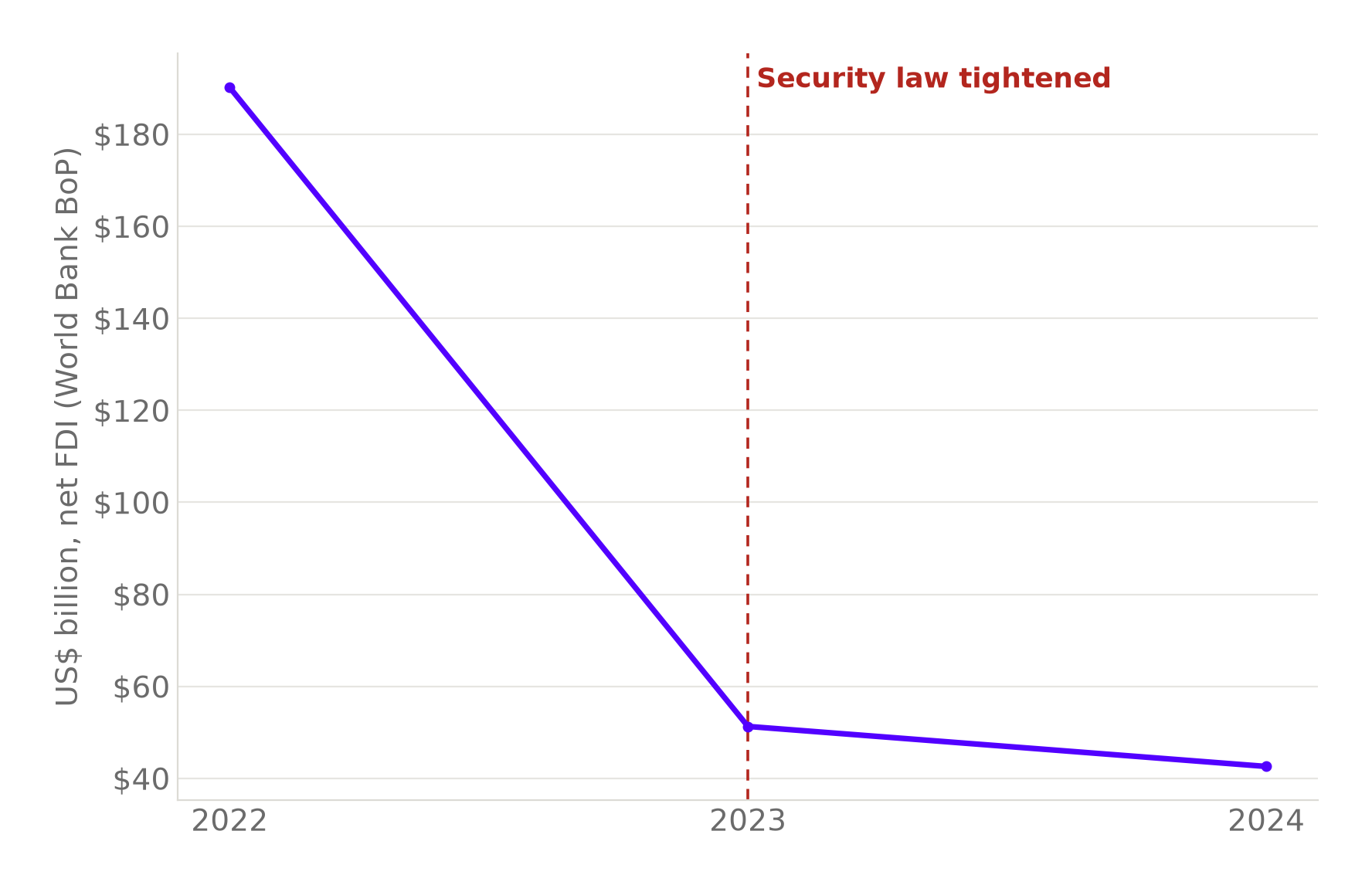
The premise that Chinese capital is under real pressure is not itself wrong. World Bank data show China's net FDI inflows, measured on a balance of payments basis, collapsed from $190.2 billion in 2022 to $51.3 billion in 2023 to just $42.6 billion in 2024.
The line breaks exactly where the tightened security rules took hold.
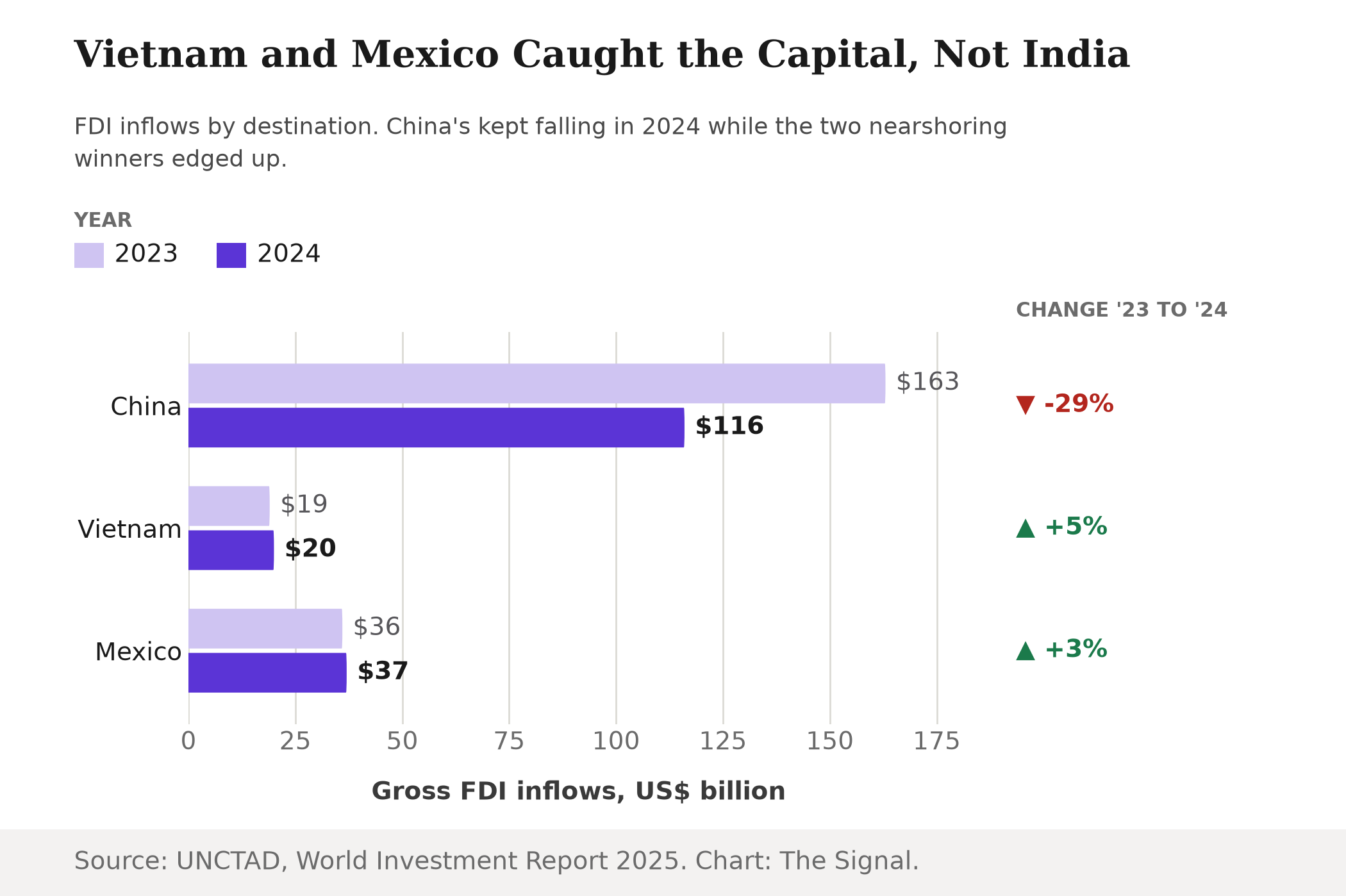
UNCTAD's World Investment Report 2025 shows the same slide on a different, gross-inflow basis: China's FDI inflows fell 29 percent to $116 billion in 2024, down from $163 billion in 2023. The two series measure different things, net financial-account flows against gross reported inflows, but they move together: whatever tightened in 2023, foreign capital pulled back.
India isn't catching what China is losing
If China's exodus were routing meaningfully to India, the more direct test is India's own aggregate inflow, and it fails the story. DPIIT's FDI fact sheet, updated to March 2025, shows India's total FDI equity inflows fell in dollar terms to $44,423 million in FY2023-24, down from $46,034 million in FY2022-23, the exact years foreign firms are supposed to have been rerouting capital toward it.
World Bank data show the same pattern on a wider lens: India's net FDI inflows on a balance of payments basis fell from $49.9 billion in 2022 to $27.1 billion in 2024, the same direction as China's decline rather than the reverse.
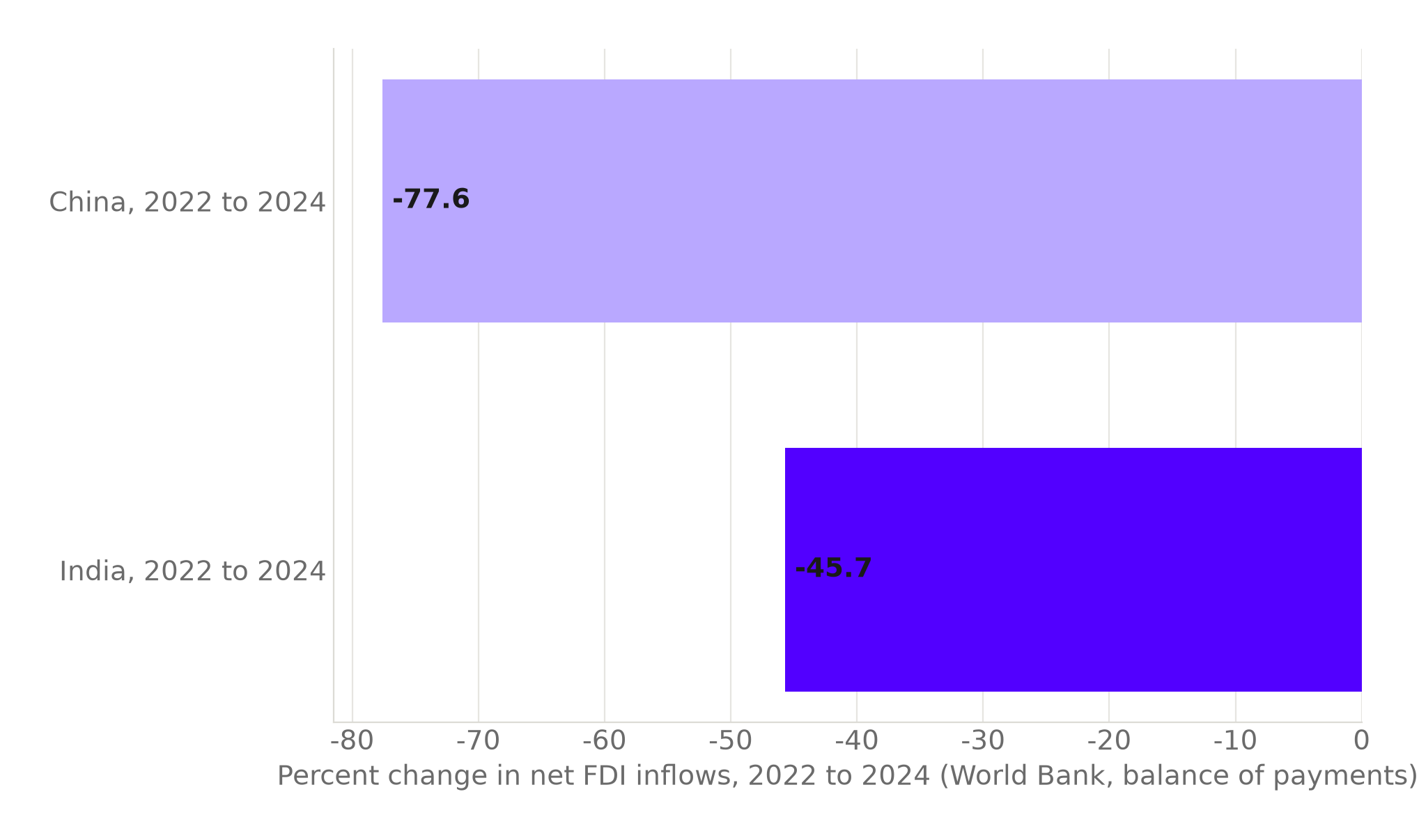
Both countries' investment intake fell by double digits over the same two years: China's by 77.6 percent and India's by 45.7 percent, our calculation from the two World Bank series. A reader looking for China's departing capital inside India's own numbers will not find it. The two countries' investment climates moved together.
The capital that moved went to Vietnam and Mexico
If the money did not land in India, the same UNCTAD report that documents China's fall also shows where a share of it actually went: Vietnam's FDI inflows rose to $20 billion in 2024 and Mexico's edged up to $37 billion, both up from 2023, in the same report that recorded China's decline to $116 billion.
The pattern shows up in trade too. US Census Bureau trade data show Mexico overtook China as the single largest source of US goods imports in 2023, $475.6 billion against $427.2 billion, a shift usually filed under the same nearshoring logic as the FDI numbers above. Vietnam and Mexico are where the concrete gains actually are.
The honest objection
The strongest case against this reading is that the security crackdown targeted a specific kind of firm, due-diligence and advisory shops like Mintz, Bain and Capvision, rather than manufacturers relocating a factory. Al Jazeera's reporting shows regulators went after firms whose business is scrutinizing Chinese companies, which could chill sensitive advisory work inside China without changing where the next factory gets built. On that view, aggregate FDI data is the wrong instrument to catch the shift at all.
That case holds for professional services specifically. It does not explain why India's own FDI equity inflows fell to $44,423 million in FY2023-24, down from $46,034 million in FY2022-23, in the very years the diversion was supposedly landing, or why India's net FDI inflows fell from $49.9 billion in 2022 to $27.1 billion in 2024 rather than rising. Nor does it explain why UNCTAD's tally of where investment actually grew names Vietnam and Mexico, not India. A chilling effect confined to consultancies would leave India's own inflows untouched at worst. Instead they fell alongside China's.
The Signal
The "China plus one" story is not wrong that China's investment climate has deteriorated: the collapse in China's own numbers is real and well documented. It is wrong about the beneficiary. On the data available through 2024, the capital did not detour to India, whose own inflows fell in step. It detoured to Vietnam and Mexico, whose inflows rose while China's kept falling. Should India's inflows eventually rise while China's stay down, the reflexive story will finally have evidence behind it. On the data through 2024, it does not. Watch the destination data, not the origin story: a security law can push capital out of Beijing without ever pulling it toward Delhi.
Reporting basis: the Mintz Group penalty and the wider crackdown on due-diligence firms are per Al Jazeera's reporting of a Beijing Bureau of Statistics ruling dated July 2023, the only source for that episode. China's cumulative share of India's foreign investment stock and India's FY2023-24 equity inflow figures are from two DPIIT quarterly FDI fact sheets. China's and India's net FDI inflows on a balance of payments basis for 2022 through 2024 are from the World Bank's World Development Indicators. China's, Vietnam's and Mexico's FDI inflows for 2023 and 2024, and China's 29 percent decline, are from UNCTAD's World Investment Report 2025. Mexico's overtaking of China as the top source of US goods imports is from US Census Bureau trade data. The percentage declines in China's and India's net FDI inflows are The Signal's calculations from the World Bank figures.