
On November 18, 2026, YouTube said that Samay Raina is the first creator anywhere to reach 1 million channel members. The coverage read it as a comedian's victory lap. Raina's channel has about 12.4 million subscribers as of November 2026, The Hollywood Reporter India reports, so he has roughly one paying member for every twelve subscribers.
It is worth slowing down on where this happened. India's internet is paid for by advertisers. The FICCI-EY media and entertainment report estimates that digital advertising rose 26% to ₹947 billion in 2025, nearly two-thirds of all ad revenue in the country. Digital subscription revenue rose 60% to ₹163 billion in 2025, per the same report, as carried by Open magazine. Ads out-earned subscriptions nearly six to one. This is not the market where anyone would have bet on the first million-member channel.
The number that explains the bet is not 1 million. It is 70. YouTube's Help Center states that creators get 70% of membership revenue after applicable taxes and fees. Its partner-earnings page puts the creator's share of net ad revenue at 55% on long-form watch pages, and 45% on Shorts. The two bases are not identical, since one is measured after taxes and fees and the other on net ad revenue. The direction is still plain: per rupee, a fan pays a creator better than an advertiser does.
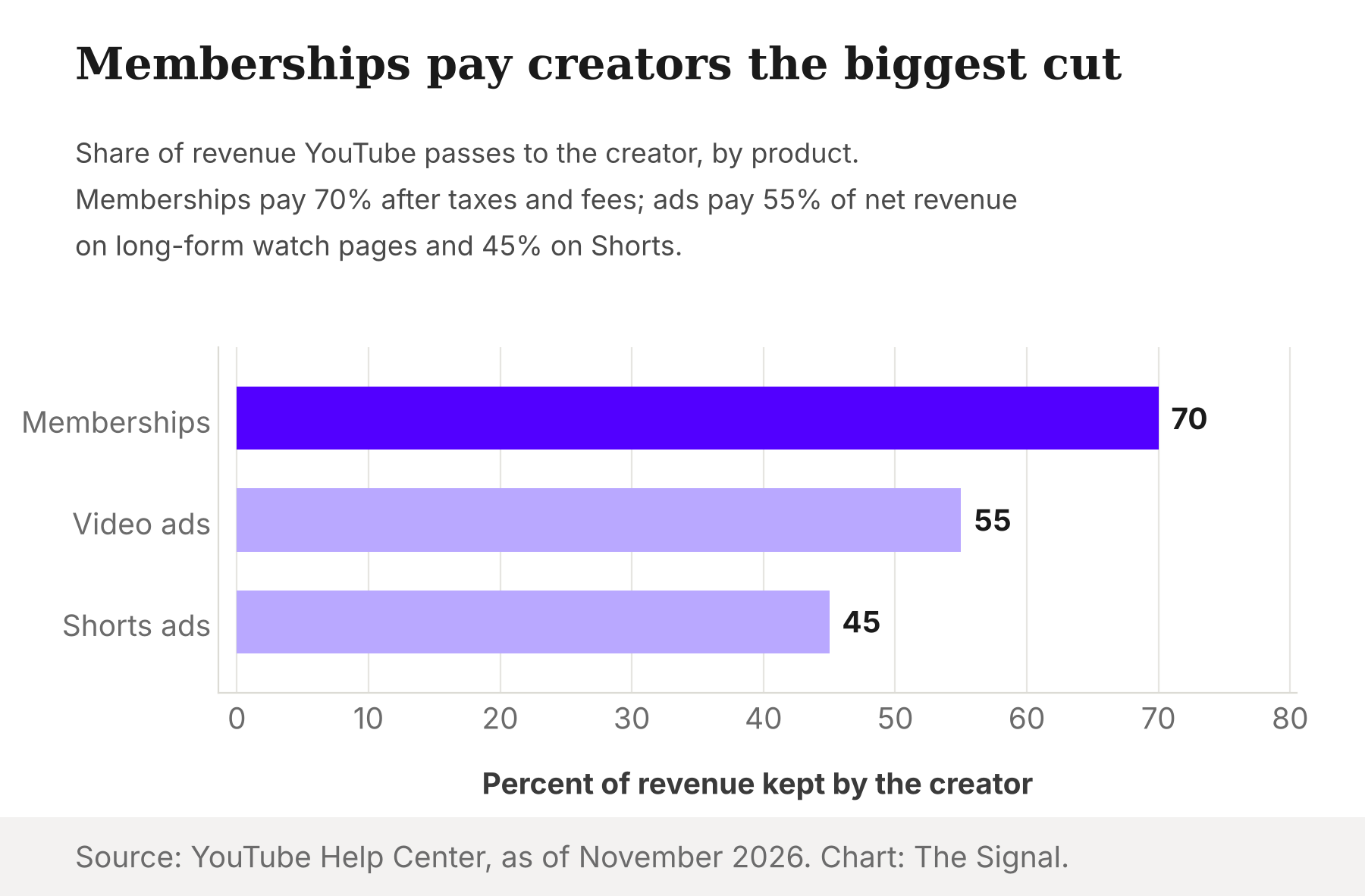
Source: YouTube Help Center, memberships; YouTube Help Center, partner earnings. Chart: The Signal.
Indian fans are already paying
Raina is the headline, but he is not the only buyer. YouTube's figure, as reported by Business Today, is that more than 1.2 million fans in India bought at least one channel membership in June 2026 alone. YouTube also says membership revenue for Indian creators rose more than 25% year on year in June 2026, as reported by Indian Television.
The supply side is far larger than the paying side. YouTube says over 100 million channels in India uploaded content in the year to May 2025, and more than 15,000 of them had passed 1 million subscribers. A May 2025 BCG report estimates India has 2 to 2.5 million monetized content creators. For many of them this is a living: YouTube's 2025 India Impact Report, researched by Oxford Economics, states that 73% of creators who earn money from YouTube call it their primary source of income.
The money flowing to them is large. YouTube CEO Neal Mohan said at WAVES 2025 that the platform paid more than ₹21,000 crore to creators, artists and media companies in India in the three years to May 2025. No public split of that sum between advertising and memberships was available for this piece. That split is the real gap in the story: it would show how much Indian creator income already comes straight from fans.
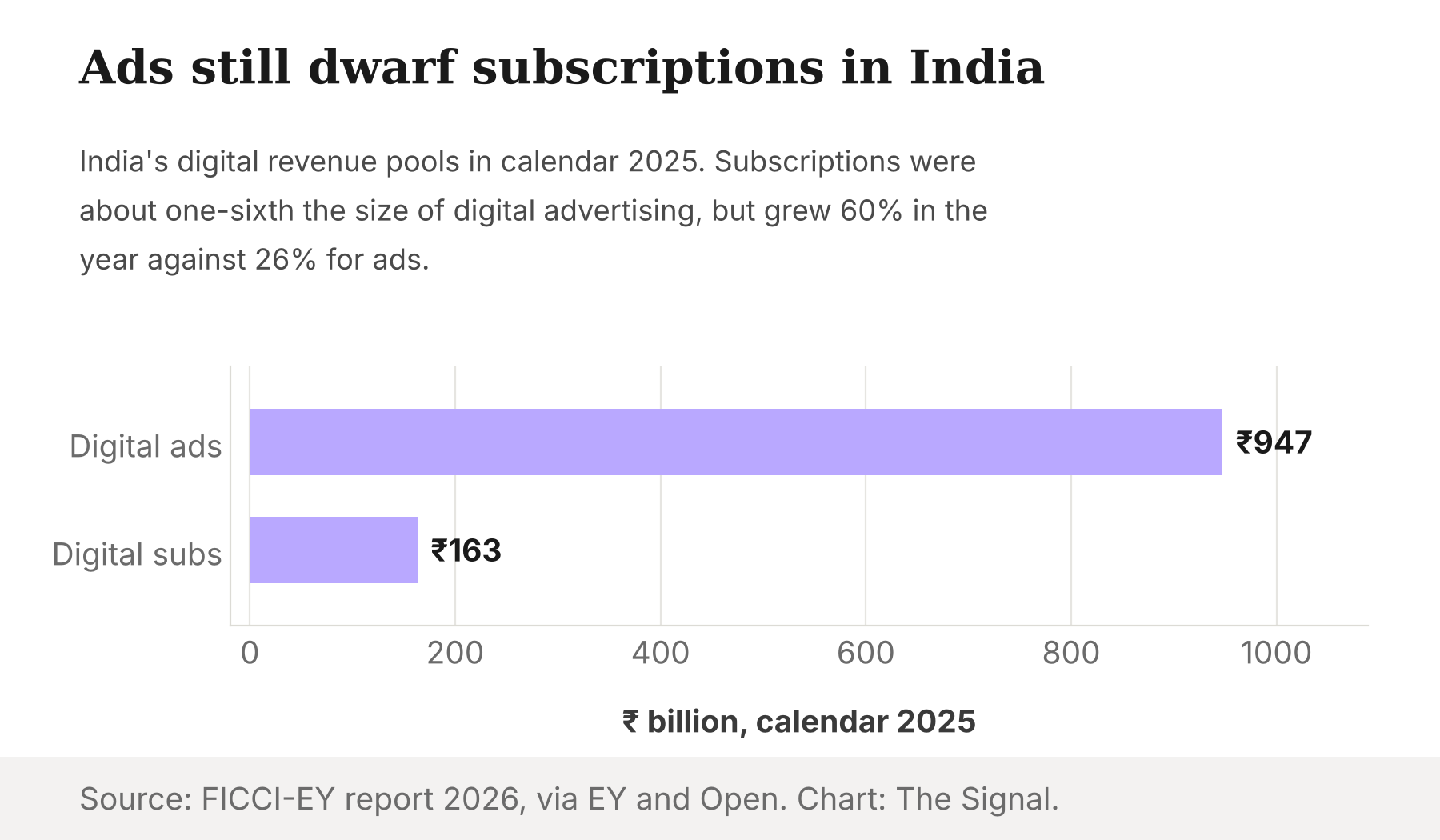
Source: FICCI-EY report, via EY and Open. Chart: The Signal.
What a million members is worth
Raina's price list is short. In November 2026, Gulf News reported three membership options on his channel: Samay Ke Dost at ₹59 a month, Samay Ke Khaas at ₹599 and Silent Supporter at ₹1,999.
Raina's entry tier costs a tenth of the middle one and a thirty-fourth of the top one.
| Tier | Listed price (₹) | Multiple of the ₹59 tier |
|---|---|---|
| Samay Ke Dost | 59 a month | 1x |
| Samay Ke Khaas | 599 | about 10x |
| Silent Supporter | 1,999 | about 34x |
Tier names and prices per Gulf News; multiples are The Signal's arithmetic.
Now put a floor under the income. Take the 1 million members YouTube reported and assume every one of them pays only the ₹59 entry tier. That is ₹5.9 crore a month in gross membership spending. At the 70% creator share, it is about ₹4.1 crore a month, or roughly ₹50 crore over a year (our calculation).
Two caveats bound that figure from opposite sides. It is a floor on spending, because some members pay ₹599 or ₹1,999, and no public figure says how many. It is also generous on the creator's cut, because YouTube applies its 70% only after taxes and fees are deducted, and the ₹4.1 crore ignores both. The real number sits above the floor on price and below it on deductions.
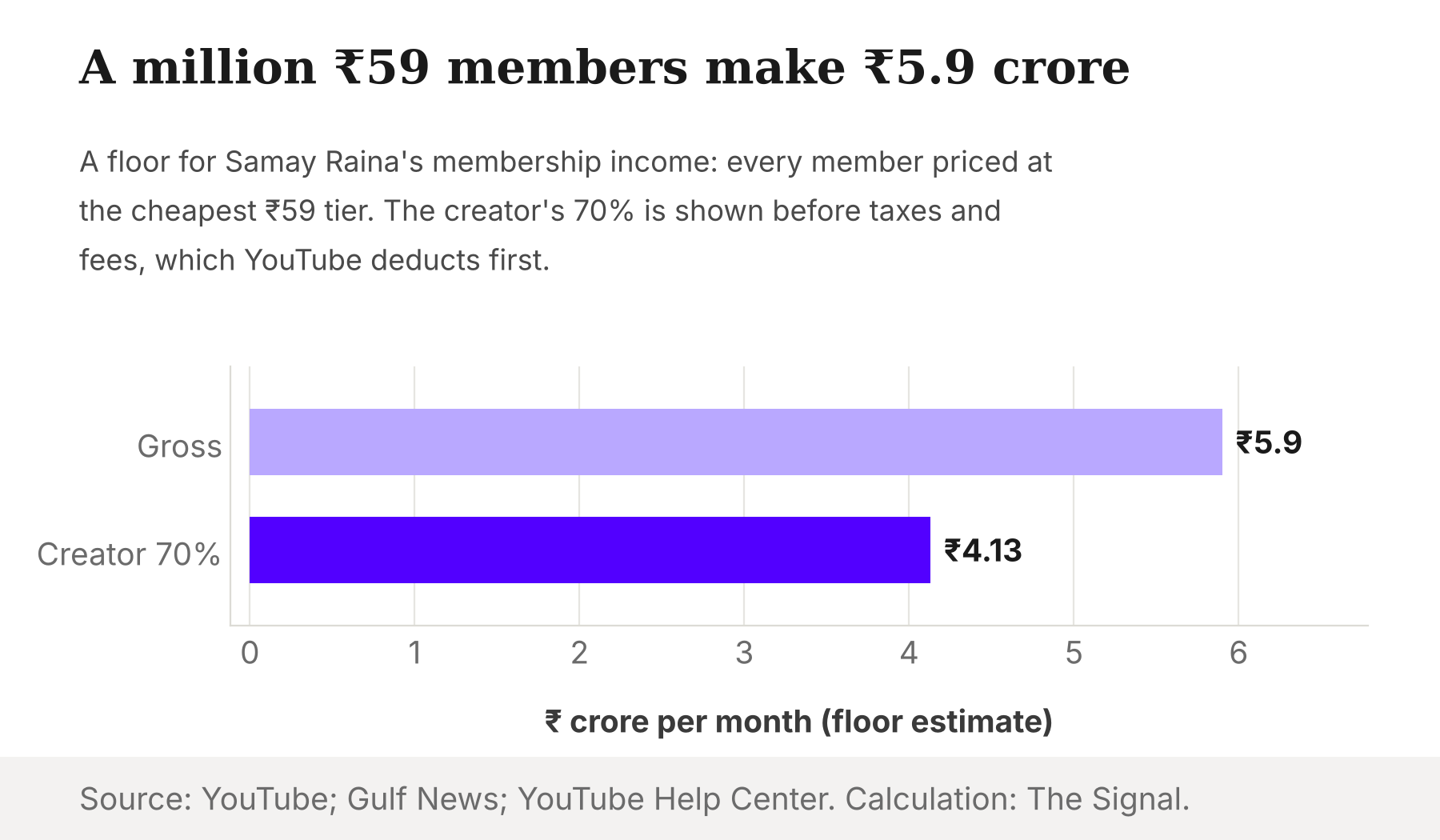
Source: YouTube for the member count, Gulf News for the ₹59 price, YouTube Help Center for the 70% share. Estimate is The Signal's calculation. Chart: The Signal.
The price itself is the quiet design choice. MoSPI's National Statistics Office puts India's per capita net national income at ₹2,08,090 in 2025-26, a provisional estimate at current prices. Twelve months at ₹59 is ₹708, about 0.34% of that average income. A membership priced there is a rounding error in a household budget, which is exactly what lets a million people say yes.
Why the smaller pool matters more
Advertising rewards reach. A creator is paid for the attention an advertiser buys, at whatever rate the market sets for Indian viewers. Memberships reward devotion. A creator with a smaller but loyal audience can earn from the fans themselves, at a higher share of each rupee, without waiting for ad rates to rise.
That shift has a slope behind it. Subscriptions grew 60% in 2025 while digital advertising grew 26%, per the FICCI-EY figures. The second-order effect is on what gets made: live streams, members-only episodes and recurring formats that give a fan a reason to keep paying, rather than one-off videos tuned for views.
The stakes are not small. Oxford Economics research commissioned by YouTube says its creative ecosystem contributed over ₹18,000 crore to India's GDP in 2025. If even a slice of that shifts from ad-funded to fan-funded, the creators who win will be those who own an audience, not those who rent one.
The honest objection
The strongest case against all of this is that one comedian is not a market. Raina's cult audience is not a model most creators can copy. The numbers support the worry. YouTube's June 2026 figure was 1.2 million Indian buyers across every channel, while Raina alone had 1 million members by November 2026. The two counts cover different dates, and his members need not all be in India. Even so, they are close enough to suggest that paying fans could be concentrated in a handful of channels. And in 2025 subscriptions were about one-sixth the size of digital advertising.
That case is real, and it rules out the big claim that India has become a subscription market. It does not touch the narrower one. YouTube says membership revenue for Indian creators rose more than 25% year on year in June 2026, which is growth across creators, not one channel's record. The base is also wider than one cult act: YouTube says over 45,000 channels in India earned money from its Fan Funding products in December 2024 alone, a count that covers Super Chat and Super Stickers as well as memberships. No public figure says how many of them have 10,000 or more paying members, so breadth of earning is not breadth of scale. Raina shows how high the ceiling goes. The June figures show the floor rising beneath him.
The Signal
India's creator economy was built on advertising, and with ₹947 billion in digital ads in 2025 it still is. What Raina proved is narrower and more useful: at ₹59 a month, an Indian audience will pay at scale, and YouTube hands the creator a bigger share of that rupee than of an ad rupee. Watch two things. First, whether YouTube publishes another India membership count, and whether it grows well past Raina's own. Second, the next FICCI-EY subscription figure, to see if a 60% growth rate holds. If both climb, Indian creators could come to be valued by members, not views. Advertisers rent India's attention; a million of Raina's fans chose to pay for it.
Reporting basis: the 1 million member milestone is YouTube's own announcement on Google's India blog. The June 2026 count of Indian membership buyers and the 25% revenue growth are also YouTube's figures, as reported by Business Today and Indian Television respectively, so they are one origin, not three. Revenue shares are from YouTube's Help Center pages, and the ₹21,000 crore payout, the channel counts and the December 2024 Fan Funding count are YouTube's own statements, which makes YouTube the single origin for every platform figure in this piece. The GDP contribution and the 73% primary-income figure come from Oxford Economics research commissioned by YouTube. Raina's tier prices rest on a single report, from Gulf News, and his subscriber count on a single report, from The Hollywood Reporter India. The creator count is a BCG estimate. India's digital advertising and subscription totals are from the FICCI-EY report, the advertising figure via EY and the subscription figure as reported by Open. Per capita income is MoSPI's provisional estimate, via PIB. The membership income floor, the annual cost of the ₹59 tier, its share of per capita income, the ad-to-subscription ratio and the tier multiples are The Signal's calculations from those figures.