Grand Theft Auto VI went on sale on 19 November 2026, and the number arrived a day later. Take-Two Interactive said in a filing with the US SEC that the game's day-one retail sales reached $3.79 billion worldwide, by company estimates through the end of launch day. It had already sold 32.5 million units before release. The publisher called it the biggest entertainment launch in history. For an Indian reader the obvious comparison writes itself, and it is a brutal one.
The Government of India puts the country's online gaming segment at ₹232 billion in 2024. At the World Bank's 2024 average rate of ₹83.67 to the dollar, that is about $2.77 billion. One game, in one day, sold roughly 1.4 times what India's entire online gaming industry earned in a year.
It is worth slowing down on that. The comparison is real, but the Indian half of it describes an industry that no longer exists in the form it was measured.
The figure that carries the comparison
The ₹232 billion is a 2024 number. It covers online gaming as a whole, in a year when online money games, where players stake cash on the outcome, were still operating. That changed in two steps. Parliament passed the Promotion and Regulation of Online Gaming Bill on 21 August 2025. Then the Online Gaming Rules, 2026 came into force on 1 May 2026, with a complete ban on online money games of chance, skill or both, and on their advertising and linked payments.
So the yardstick in the headline is a pre-ban yardstick. The official figures released in February 2026 give no post-ban size for the industry. A PIB backgrounder issued on 30 April 2026, the day before the rules took force, says 77 per cent of the ₹232 billion came from transaction-based games, but it does not say how much of that was money gaming. That gap is the real story, because the official forecast behaves as if the ban never happened.
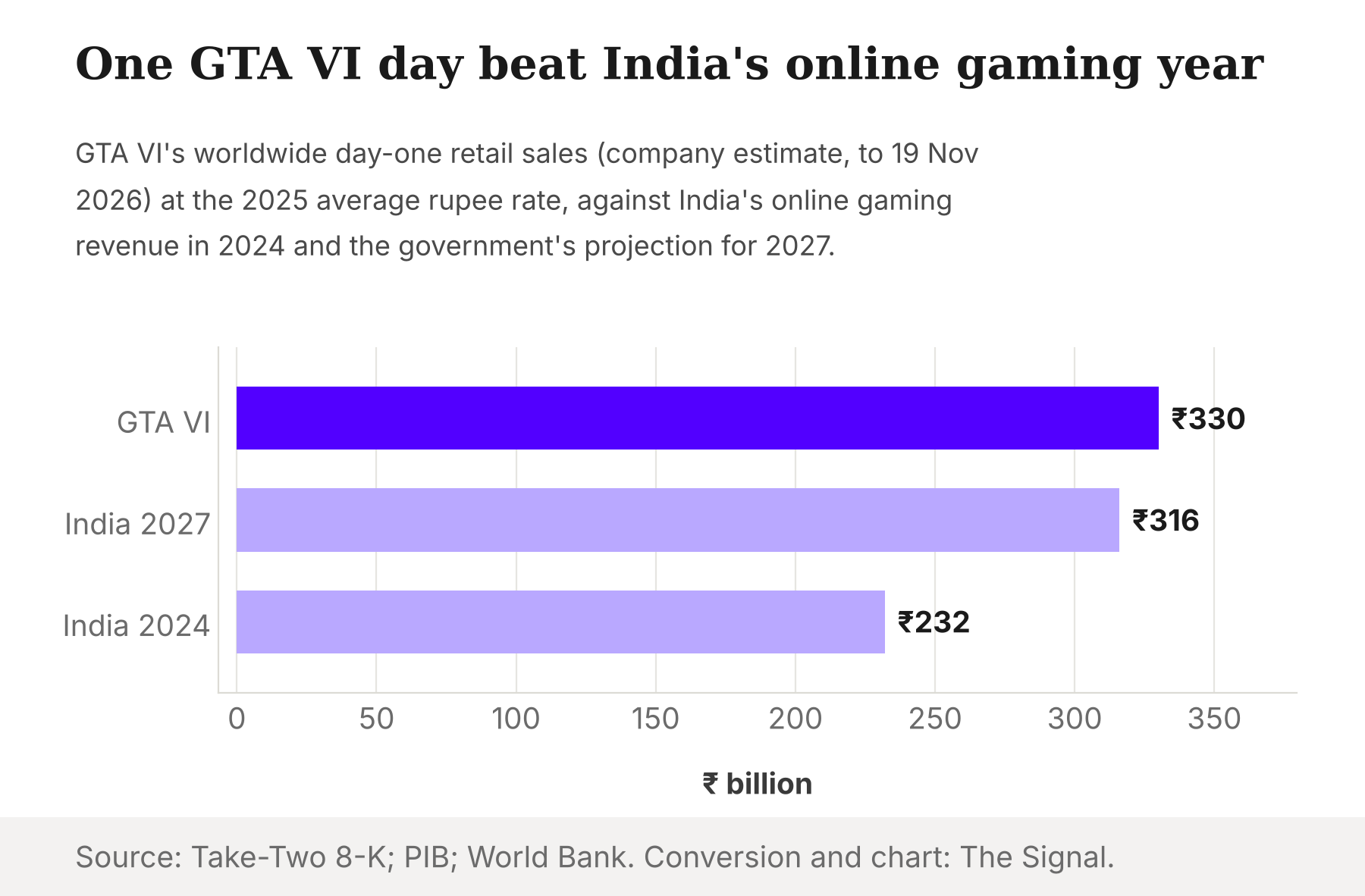
Converted at the World Bank's 2025 average of ₹87.16 to the dollar, GTA VI's $3.79 billion first day is about ₹330 billion, or roughly ₹33,000 crore. That beats not only India's 2024 total but also the ₹316 billion the government projects for Indian online gaming in 2027.
A forecast that did not bend
In a release dated 17 February 2026, the Ministry of Information and Broadcasting said online gaming generated ₹232 billion in 2024 and is projected to reach ₹316 billion by 2027. That release came six months after Parliament voted to ban money games. A PIB backgrounder published a day earlier lays out the full series: ₹232 billion, then ₹260 billion, ₹288 billion and ₹316 billion, a straight climb with no visible step down for the ban. The 30 April backgrounder repeated the path on the eve of the rules themselves: growth of 11 per cent a year, to ₹316 billion by 2027.
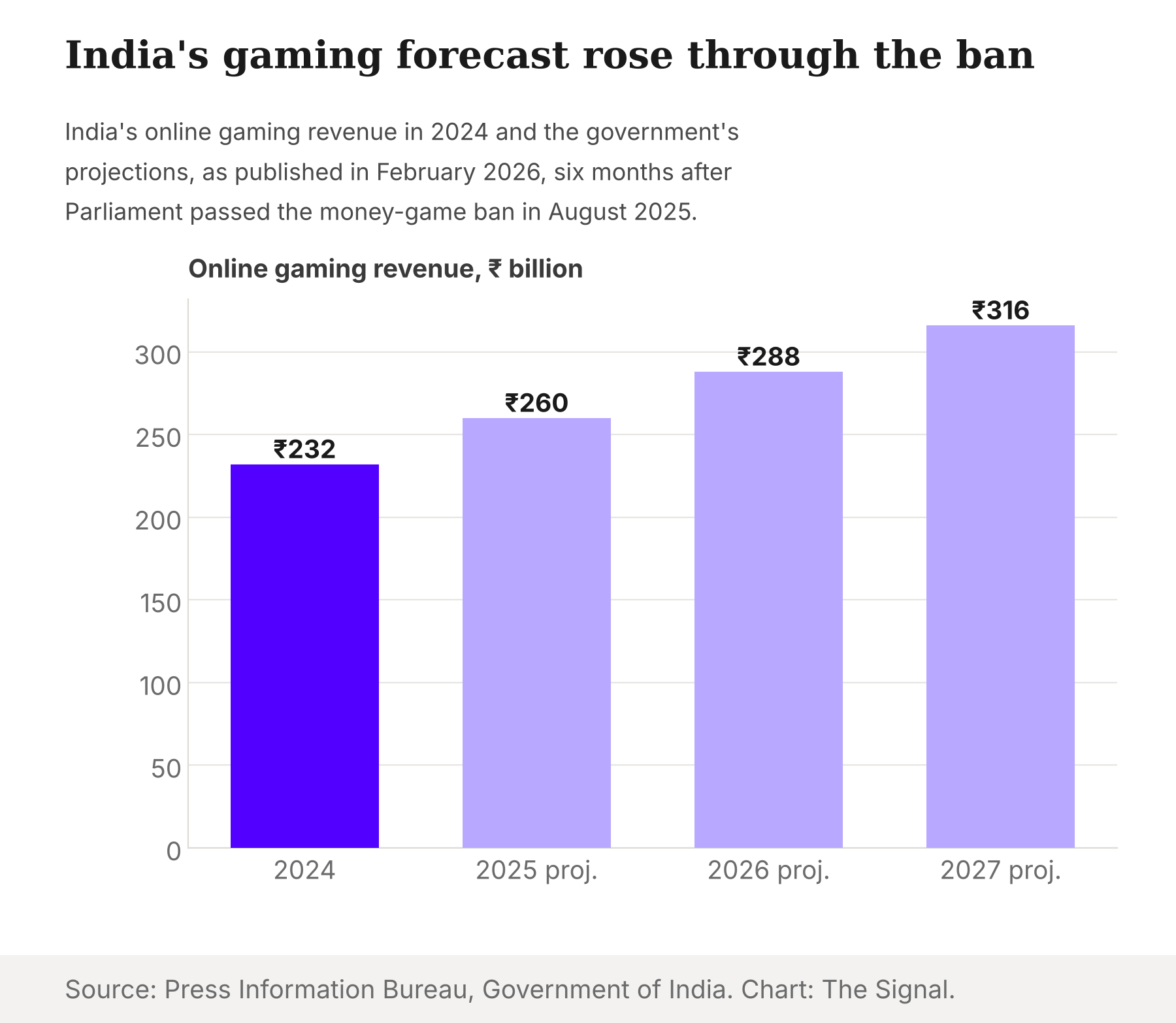
The series rises by ₹28 billion each year from 2024 to 2027, by the figures in the PIB backgrounder. Meanwhile the state was dismantling a large part of what that 2024 base contained. By March 2026 the government had blocked around 8,400 gambling and betting websites, nearly 4,900 of them after the Online Gaming Act passed, according to government sources cited by All India Radio.
Put the two official positions side by side and they pull in opposite directions.
The government's own numbers describe a ban and a growth path at the same time.
| Official position | What it says | Date |
|---|---|---|
| Size of online gaming | ₹232 billion | 2024 |
| Projected size | ₹316 billion | 2027 |
| Online Gaming Bill passed | Bans online money games | 21 August 2025 |
| Rules in force | Complete ban on money games, ads and payments | 1 May 2026 |
| Sites blocked | Around 8,400 gambling and betting sites | By March 2026 |
| People hit by money games | An estimated 45 crore, losing over ₹20,000 crore | Stated 21 August 2025 |
Sources: PIB, 16 February 2026; PIB, 17 February 2026; PIB, 21 August 2025; All India Radio, 1 May 2026; All India Radio, March 2026.
Why the government banned what it was counting
The case for the ban was made in human terms, not revenue terms. IT Minister Ashwini Vaishnaw told the Rajya Sabha that, by one estimate, 45 crore people were negatively affected by online money games and lost more than ₹20,000 crore. On that reading, money gaming was a harm being booked as output, and removing it is the point, whatever it does to a sector total.
The state was also earning from it. Minutes of the GST Council's 9 September 2024 meeting record that GST paid in cash on online gaming rose from ₹1,349 crore before the 1 October 2023 change to ₹6,909 crore in the six months after it, a figure the Council was told would come to about ₹14,000 crore over a full year. That change taxed online gaming at 28 per cent of the amount deposited, excluding bets placed out of winnings: money staked to play, the activity the 2025 Act went on to prohibit.
That argument is coherent. What does not follow from it is a forecast that keeps the old trajectory. If the ban works as its authors intend, the revenue that came from staking money should leave the series. If the forecast still holds, either the money-game share of the 2024 base was small, or the remaining segments are expected to fill the hole within three years. The published series does not say which.
The honest objection
The strongest case against this framing is that the comparison is unfair twice over. First, GTA VI's figure is worldwide retail sales, a company estimate of consumer spending across every market, not money that reaches Take-Two. The publisher's own measure of what it keeps is net bookings, and ten days before launch it reiterated an outlook of $8.0 billion to $8.2 billion for the whole company in the year to March 2027. Second, one global blockbuster against one country's domestic market says more about the blockbuster than about India.
Both points are right, and they shrink the headline's sting. They do not touch the forecast problem. Whatever GTA VI earned, India's official gaming forecast still has to explain how an industry measured with money games in it grows by more than a third after money games are banned. The ₹316 billion projection for 2027 may prove right. It has simply not been reconciled, in public, with the ban that took force on 1 May 2026.
The Signal
The GTA VI number is a spectacle. The useful number is the one India publishes about itself. The country now runs a gaming policy built on a pre-ban measurement and a forecast that carries that measurement forward untouched. Any plan sized off it, from investment pitches to state support for the sector, inherits the blind spot.
Watch for the first official estimate of India's online gaming revenue for a full year after the rules took force on 1 May 2026. If it comes in near the projected path, either money games were a small part of the base or the rest of the industry grew into the gap. If it comes in well below the ₹232 billion of 2024, the forecast was counting an industry Parliament had already voted to close. A forecast is not a market until someone measures it again.
Reporting basis: GTA VI's day-one retail sales and pre-release units are from Take-Two Interactive's press release furnished to the US SEC on Form 8-K, and rest on the company's own estimate; its net bookings outlook is from Take-Two's fiscal second-quarter 2027 earnings release filed with the SEC. India's 2024 online gaming revenue and the 2025 to 2027 projections are from the Ministry of Information and Broadcasting's figures, via two Press Information Bureau documents dated 16 and 17 February 2026, which are one government origin. The 77 per cent transaction-based share and the restated 11 per cent growth path are from a further PIB backgrounder dated 30 April 2026, which does not say how much of that share was money gaming. Online gaming GST collections are from the official minutes of the GST Council's 54th meeting, held on 9 September 2024. The bill's passage and the IT minister's estimate of people affected and money lost are from a PIB backgrounder of 21 August 2025, quoting the minister in the Rajya Sabha. The rules coming into force and the count of blocked sites are from All India Radio, the latter citing government sources. Exchange rates are World Bank World Development Indicators data. The dollar value of India's 2024 gaming revenue, the rupee value of GTA VI's first day, the 1.4 multiple, the annual increment in the forecast and its growth of more than a third to 2027 are The Signal's calculations from those figures.