
On 21 November 2026, European Council President António Costa tried to break the deadlock over the European Union's next seven-year budget by doing two things at once. He cut spending, and he reached for new money. Euronews reports that his plan trims the 2028-2034 budget to €1.78 trillion, a 10% reduction worth €204bn against the Commission's proposal. The new money includes a tax on the largest technology companies. Read as a Brussels story, this is budget haggling, and a levy on American platforms is one way to close the gap.
From India, it reads differently. The levy Costa proposed is a close cousin of one India had for nine years and switched off in April 2025.
The tax India dropped
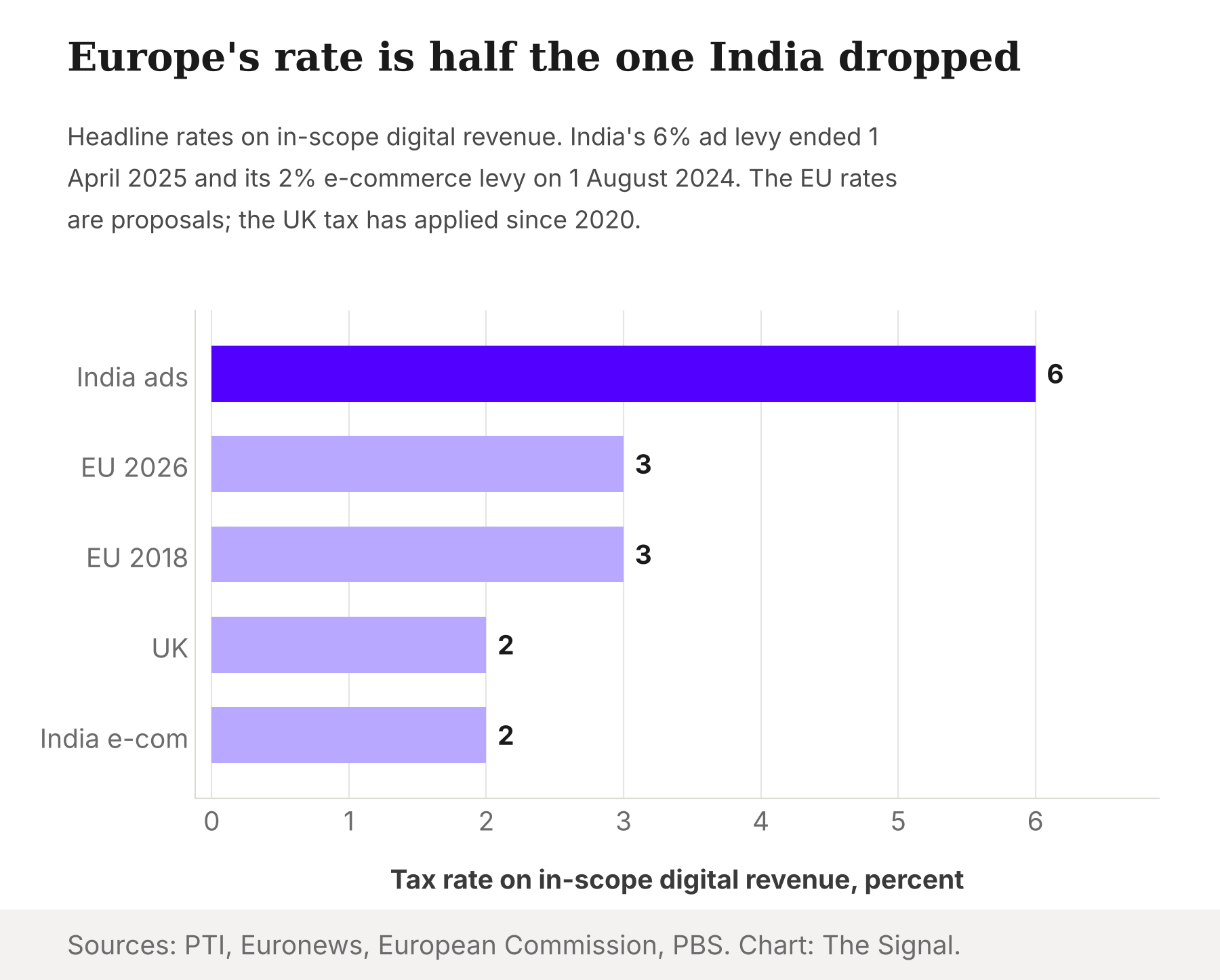
India got there first. A PTI report carried by ThePrint states that the Equalisation Levy on online advertisement services was imposed on 1 June 2016. It charged 6% on payments to foreign platforms for online ads. That was nearly two years before the European Commission's own draft of a digital services tax, published in March 2018.
India then took its digital taxes apart one by one. The same PTI report states that a separate 2% Equalisation Levy on e-commerce transactions was abolished on 1 August 2024. It adds that effective 1 April 2025, the 6% Equalisation Levy on online advertisements was abolished through amendments to the Finance Bill.
Nothing replaced it. Amit Agarwal of Nangia & Co, quoted by Business Today in August 2026, says India currently has no dedicated digital services tax applicable to foreign technology companies. Digital income is now handled under the older rules for royalties, technical fees and significant economic presence. Those rules were never built for advertising revenue earned without a local office.
Europe is reviving its own 2018 design
The Costa levy is not new thinking. It is the Commission's 2018 blueprint, taken out of a drawer. Euronews reports that the levy would be a 3% tax on annual net turnover, and that it would apply to companies with EU turnover above €50 million and global turnover above €750 million. Now compare that with the 2018 proposal. The Commission's draft directive stated that the DST rate should be set at 3%. Article 4(1) of that draft set thresholds of €750 million in worldwide revenue and €50 million in taxable revenue inside the Union.
The rate and both thresholds are identical, eight years apart. The 2018 draft never became law. The design has stayed put; what moved is Europe's willingness to carry it.
And the rate Europe is reaching for is half the 6% India gave up on 1 April 2025.
Washington's answer is already on record
India did not repeal its levy in a quiet room. The Office of the US Trade Representative found on 6 January 2021 that India's digital services tax discriminates against U.S. companies, which made it actionable under US trade law. India's government gave its own reasons for the 2025 repeal, and this piece does not presume to know which one carried the decision. But the US position on such taxes has only hardened since.
On 26 June 2026, PBS NewsHour reported, President Donald Trump posted that any country imposing such a tax "will immediately be met with a 100% TARIFF on any and all Goods", and said the tariff would supersede earlier trade deals. That threat lands on a Europe that, PBS NewsHour also reports, finalised a trade deal with the United States in May 2026 capping most tariffs on EU exports at 15%, and where the UK has charged its own 2% digital services tax since 2020.
So the choice in front of Brussels has the same shape as the one India faced. Europe is answering it the other way, five months after the sharpest threat yet.
Nobody knows what the levy is worth
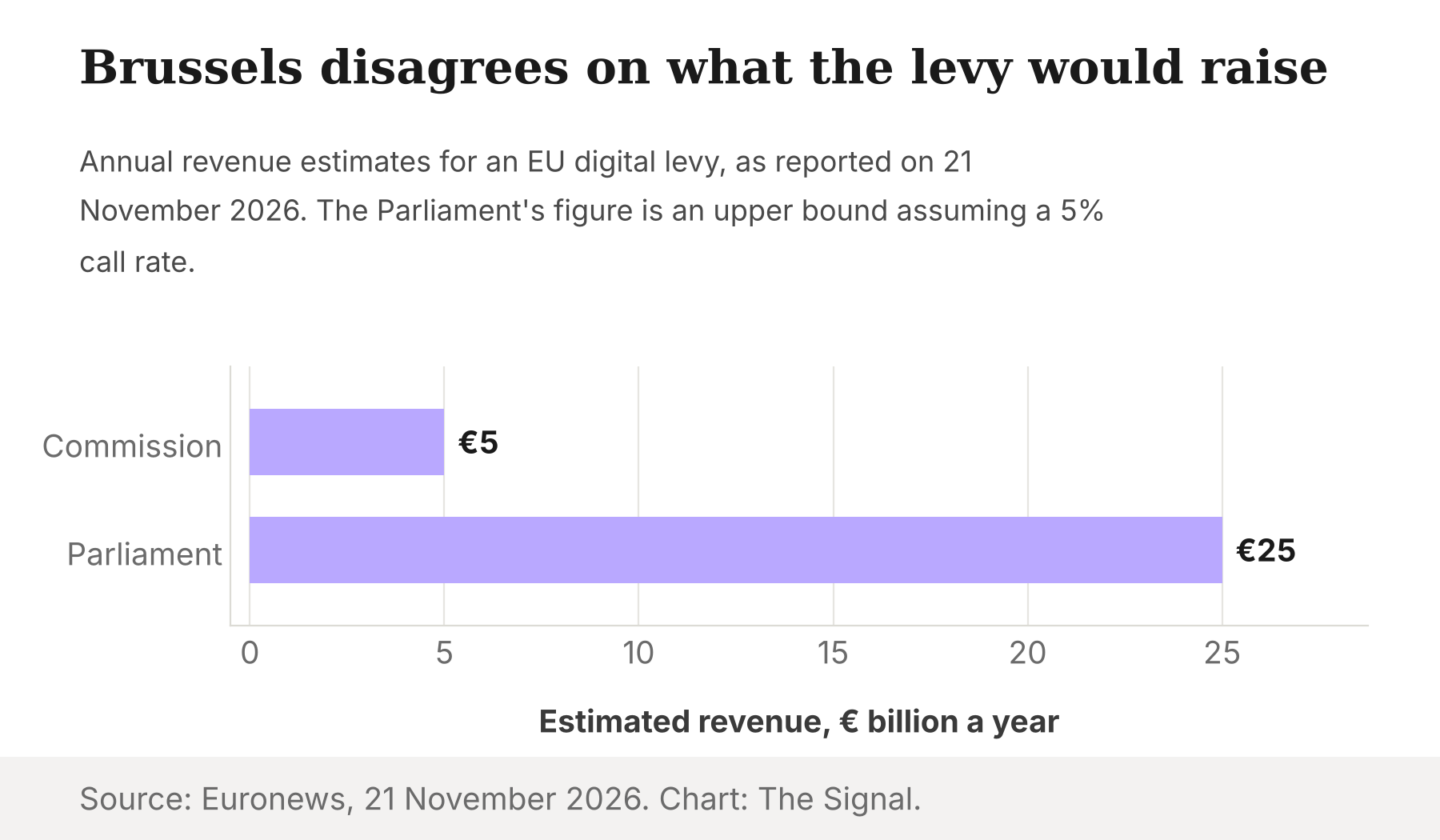
The case for the levy is fiscal, and the fiscal case is uncertain. The estimates differ fivefold. Euronews puts the European Parliament's figure at up to €25bn a year with a 5% call rate, against the Commission's estimate of €5bn a year.
India's own experience suggests the lower end is the safer guess for a levy of this kind. Tax adviser Ketan Dalal, quoted by Business Today, says that at its peak India's levy raised only around ₹3,900 crore, which he called minuscule in the overall scheme of things. Yet the base it was taxing keeps growing. A FICCI-EY projection cited by Business Today puts India's digital advertising revenue at close to ₹1.4 lakh crore in 2028. Only part of that is paid to foreign platforms, so the old levy's base would have been smaller. Even so, India gave up the tool just as the thing it measured was getting bigger.
The honest objection
The strongest case against this reading is that India and Europe were never playing the same game. India's levy was unilateral, and its money was small. Its biggest export market had already ruled it discriminatory in January 2021. Europe is a single bloc with a market large enough to make retaliation costly for the United States too, and it is building the levy into a common budget rather than one country's tax code. On this view India did not lose its nerve. It made a sensible trade, giving up a few thousand crore of revenue to keep a much larger trade relationship calm, while Europe has more leverage to spend.
That case is real, and it explains why the two answers differ. It does not show that India's answer was free. The repeal left India with no dedicated tool for foreign digital revenue at all, and no common rule has arrived to replace it. If Europe's levy survives, it shows that a large enough economy can hold this line.
Costa's levy is still a proposal. Politis reports that his plan cuts €204 billion from the Commission's original €2 trillion budget proposal for 2028-2034, and that he wants political agreement by the end of December. Every member state has to sign.
The Signal
India priced the US threat in 2025 and chose not to pay it. Europe is now pricing the same threat, at half India's old rate, with a design it has kept on file since 2018. Watch two things: whether EU leaders keep the levy in the deal, and whether Washington turns the June 2026 tariff threat into action against a bloc rather than a single country. If the levy survives both, New Delhi's 2025 calculation will look less like prudence and more like an early exit. India wrote this tax first. Europe may now prove it could have been kept.
Reporting basis: Costa's proposal, the levy's rate and thresholds, the budget total and cut, and the Commission and Parliament revenue estimates are per Euronews' report of 21 November 2026, with the €204 billion cut also reported by Politis from the same proposal, so they share one origin in the proposal itself. The 2018 rate and thresholds are from the European Commission's draft directive, COM(2018) 148, on EUR-Lex. The start and end dates of India's two equalisation levies are per a PTI report carried by ThePrint, describing the Finance Bill 2025 amendments. The 2021 discrimination finding is from the US Trade Representative's own release. The June 2026 tariff threat, the EU-US tariff cap and the UK tax are per PBS NewsHour. The ₹3,900 crore peak collection rests on a single source, tax adviser Ketan Dalal as quoted by Business Today, and is not an official figure; the absence of a dedicated Indian digital tax and the FICCI-EY advertising projection are also via Business Today. The halving of the rate, the identical thresholds across 2018 and 2026, and the fivefold spread in revenue estimates are The Signal's calculations from those figures.