
The scorecard looks clean. Commerce Department data, as reported by ANI, show India's gold imports fell 39.9 percent to $24.78 billion in April to October 2026, from $41.24 billion a year earlier. The Confederation of All India Traders calls that gap a $16.46 billion saving in foreign exchange and credits Prime Minister Narendra Modi's appeal to defer gold purchases for a year. On November 21, Modi said that when he asked people not to buy gold, "the people of the country bought less gold and its prices crashed."
Read the top line and the policy worked. Read the months and the gold, and two things get in the way.
The first is timing. The import bill rose in the three months right after the appeal, and the whole saving arrived later. The second is where the gold went. Much of what stopped showing up in the import data did not stop arriving. It came in without paying duty.
The bill went up before it came down
Reuters reported Modi's call to avoid gold for a year on May 11, 2026, as the Iran war pushed oil prices up and put pressure on India's balance of payments and the rupee. Two days later, the government raised the effective import duty on gold and silver to 15 percent from 6 percent, effective May 13.
The monthly Commerce data show what came next. May imports were $3.42 billion against $2.55 billion a year earlier. June was $1.97 billion against $1.84 billion. July was $4.16 billion against $3.97 billion. Add April, and the first four months of the financial year cost $15.18 billion, $3.72 billion more than the same months of 2025.
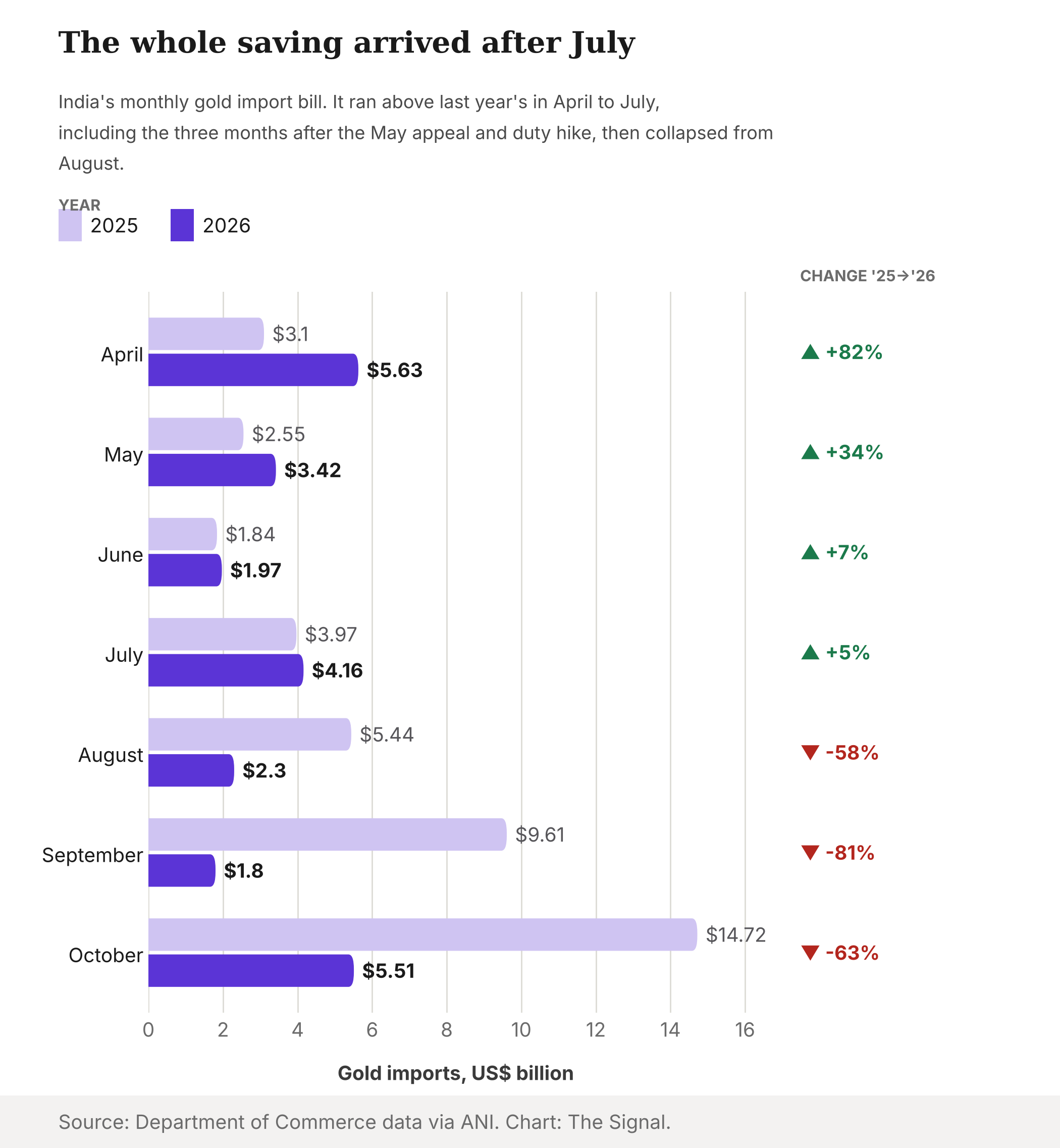
Then the floor gave way. August fell to $2.30 billion from $5.44 billion, September to $1.80 billion from $9.61 billion, and October to $5.51 billion from $14.72 billion, per the same Commerce figures. Those three months alone came in $20.16 billion below the year before. That is more than the entire seven-month saving. The saving is an August-to-October event, set against an unusually heavy autumn in 2025.
Price did not do the saving
A falling gold price is the obvious alternative explanation for a smaller bill. It does not fit the window. World Bank Pink Sheet data show gold averaged $4,512 an ounce in April to June 2026 and $4,268 in July to September. A year earlier, World Bank monthly data put April, May and June 2025 at $3,218, $3,309 and $3,353. Gold was about 37 percent dearer in the second quarter of 2026 than a year before, so the May-to-July import bills held up on price while the tonnes behind them shrank.
October is the cleanest test, because the price gap had closed. Gold averaged $4,105 that month, per the World Bank, against $4,058 in October 2025. The World Gold Council estimates gross import volume at about 70 tonnes, against 128 tonnes a year earlier. At nearly the same price, India brought in 45 percent fewer tonnes through official channels. The fall in the bill is a fall in volume.
What Modi credited on November 21 was the domestic price. IANS reported that 24-carat gold fell to Rs 12,523 a gram from Rs 15,250 on May 9, a drop of about 18 percent. The international price was also lower than its peak: ANI, citing the World Gold Council, put the January 2026 record at $5,405 an ounce.
Where the missing tonnes went
The duty hike changed the arithmetic of smuggling. The World Gold Council noted in May that moving the duty from 6 percent to 15 percent fully reversed the July 2024 cut. A 15 percent levy on a metal that small volumes can carry is a large prize for anyone who can avoid it.
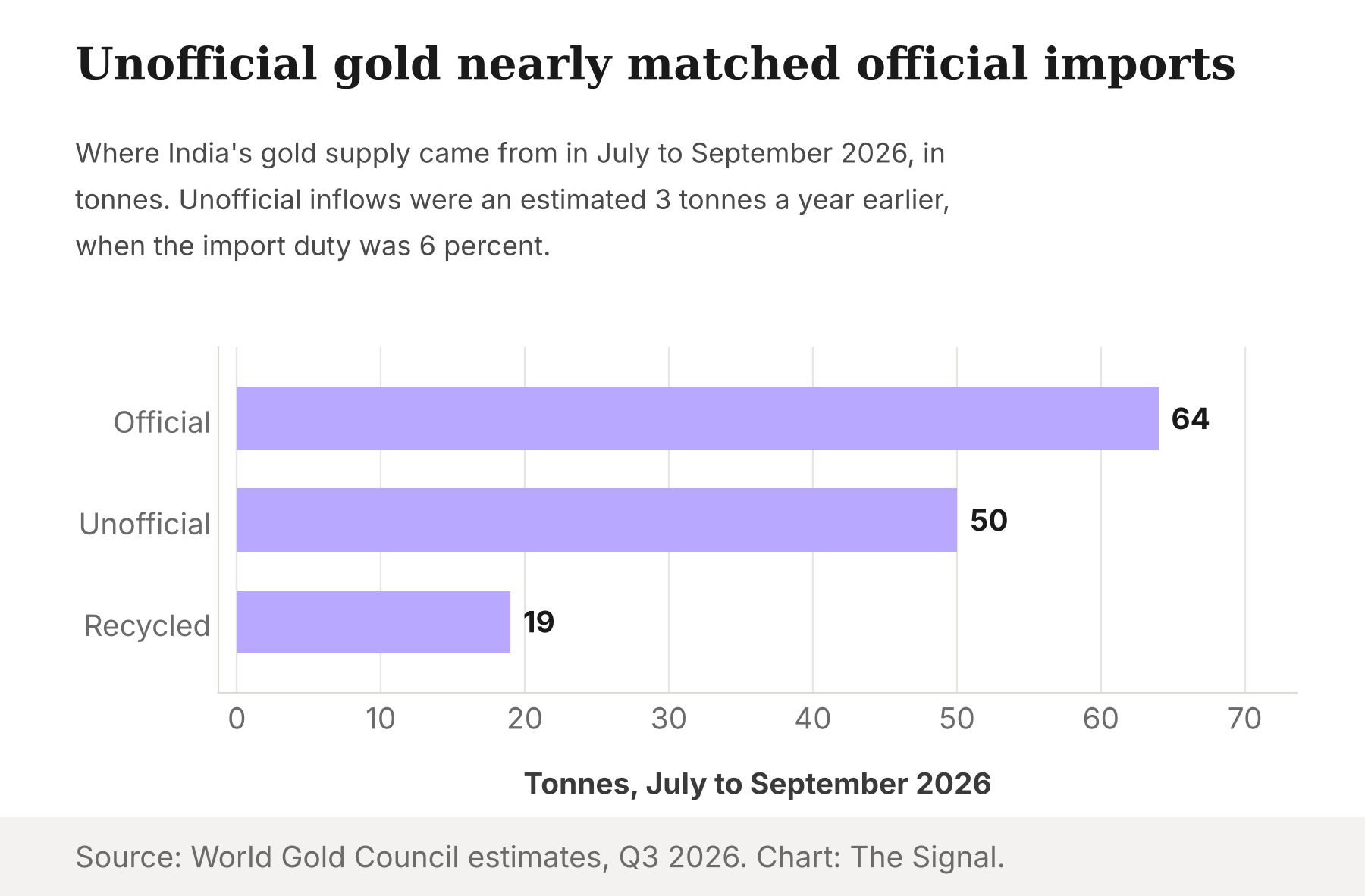
The council's quarterly numbers show the result. In July to September 2026, official bullion imports fell 70 percent year on year to 64 tonnes, while unofficial inflows are estimated to have risen to around 50 tonnes from just 3 tonnes a year earlier, when the duty was 6 percent. Of the roughly 114 tonnes that entered India from abroad that quarter, about 44 percent came in unofficially.
The council's monthly notes point the same way. September imports of $1.8 billion were the lowest since March 2024 and down 81 percent year on year, even with the festive season approaching. In November it wrote that market feedback and persistent price discounts point to more unofficial supply after the May duty hike, and that old-gold exchange made up 40 to 60 percent of sales at many retailers.
Two consequences follow. Smuggled gold is still bought abroad with foreign currency; it simply leaves the import line and the trade statistics. And the state collects nothing on it. At the third quarter's average price of $4,268 an ounce, the estimated 50 tonnes of unofficial gold is worth roughly $6.9 billion, and a 15 percent duty on that would have been about $1 billion in a single quarter.
The honest objection
The strongest case for the appeal is that the total still fell hard. Even counting the council's estimate of unofficial gold, India's demand in July to September was 162 tonnes, 29 percent lower than a year earlier, and recycled gold supplied 19 tonnes. Indians did buy less gold, and many paid with old jewellery instead of new imports. On that reading the appeal and the duty did what they were meant to do, and the lag to August may reflect orders already in the pipeline.
That case is real, and the drop in total demand is not in dispute. But it answers a different question. The claim on the table is a $16.46 billion foreign exchange saving. The official import line overstates that, because part of the gold kept coming without passing customs. Even the official saving was swamped elsewhere: India's merchandise trade deficit for April to October 2026 was $218.15 billion, against $199.46 billion a year earlier. That is $18.69 billion wider, despite the smaller gold bill.
The Signal
The appeal and the duty were two tools aimed at one number, and the number moved. India's reserve problem, though, is the dollars that leave the country, and a tonne of smuggled gold costs the same dollars as a tonne declared at the port. It costs the exchequer more, because it pays no duty. Watch the council's unofficial-inflow estimate for October to December and the size of the domestic discount. If unofficial supply stays near the third quarter's estimated 50 tonnes, the duty is collecting less and protecting less than the import data suggest. Gold that skips customs still costs dollars. It just stops being counted.
Reporting basis: monthly and April-to-October gold import values are the Department of Commerce's, as reported by ANI; the $16.46 billion saving claim is CAIT's own, as reported by Business League. The May appeal is per Reuters, carried by The Globe and Mail, and the duty change is per the Finance Ministry's customs notifications as reported by LiveLaw. Tonnage, unofficial-inflow, recycling and demand figures are World Gold Council estimates from four of its publications, which count as one origin. Gold prices are World Bank Pink Sheet data, the merchandise deficit is from the Commerce Ministry's release via PIB, and the Prime Minister's remarks and domestic gold prices are per IANS. The unofficial inflows rest on that single WGC estimate and should be read as an estimate. The four-month and three-month totals, the 37 percent price gap, the 45 percent October volume fall, the 44 percent unofficial share, the roughly $1 billion duty figure and the $18.69 billion deficit widening are The Signal's calculations from those figures.