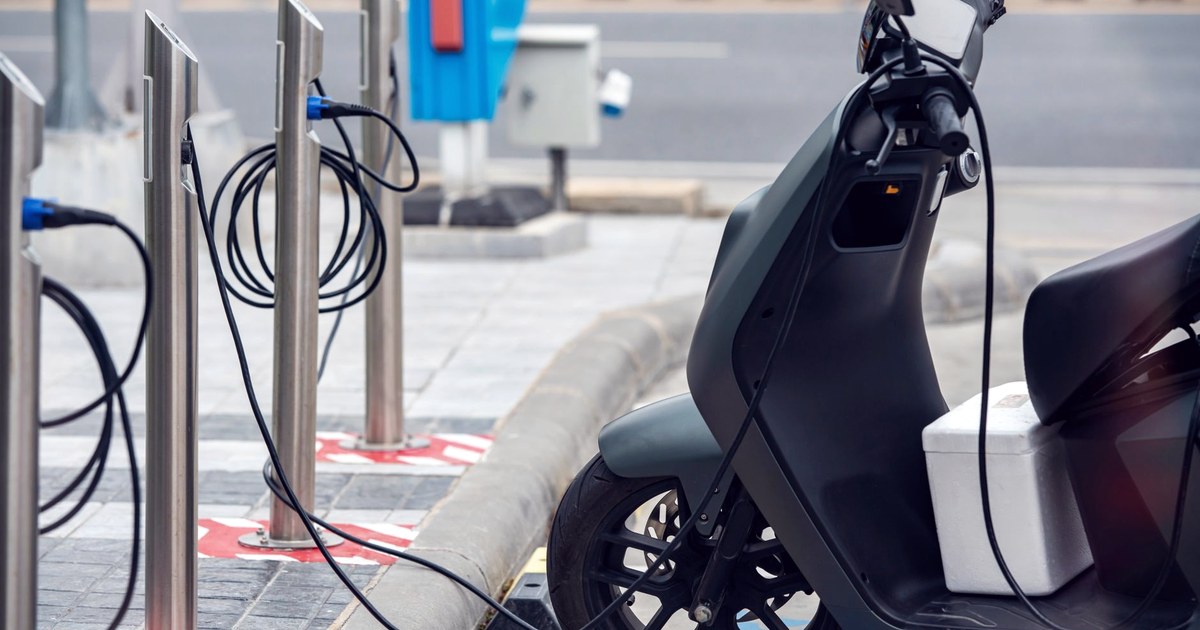
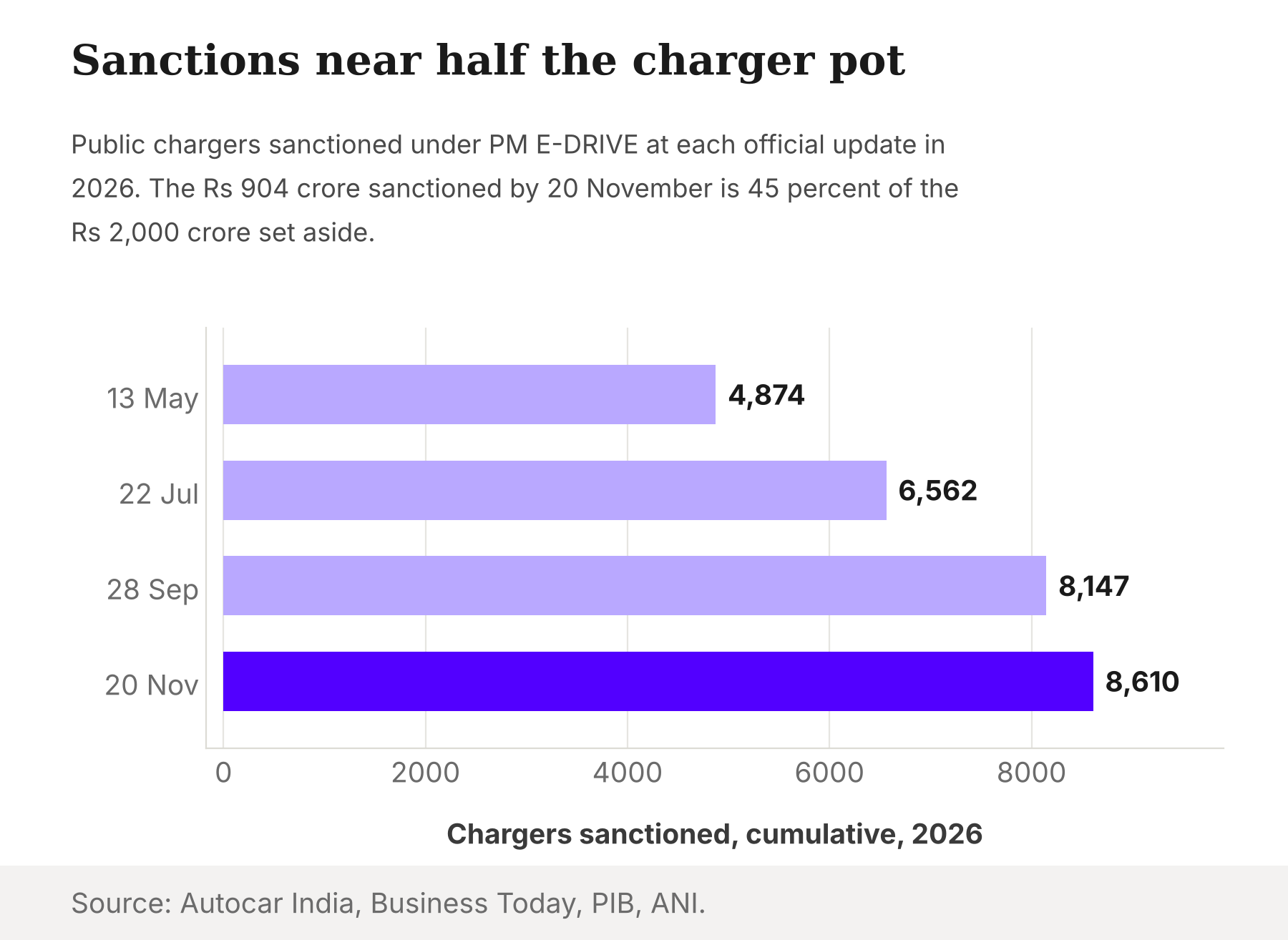
On Friday, 20 November, Heavy Industries Minister H D Kumaraswamy gave the charging side of India's electric-vehicle subsidy a new number. He said Rs 904 crore had been sanctioned to states and oil marketing companies to install 8,610 charging stations, out of the Rs 2,000 crore PM E-DRIVE sets aside for public charging. That is 45 percent of the pot. The vehicle side looks just as busy: the scheme had enabled 26.59 lakh EV sales as of June 2026, against an outlay of Rs 11,900 crore running to March 2028. Read the top line and the charging gap is closing on schedule.
It is worth slowing down on that word "sanctioned". A sanction is a promise to pay once a charger exists. Kumaraswamy said as much on the same stage, arguing that the count of chargers sanctioned or installed cannot be the only measure of progress. At the same conference, the Prime Minister's adviser named the reason a sanction stalls. Tarun Kapoor said electricity distribution companies are not sufficiently cooperative in setting up charging infrastructure. That is the bottleneck. India is not short of charger money. It is short of grid connections that make a charger pay.
The vehicle money moved first
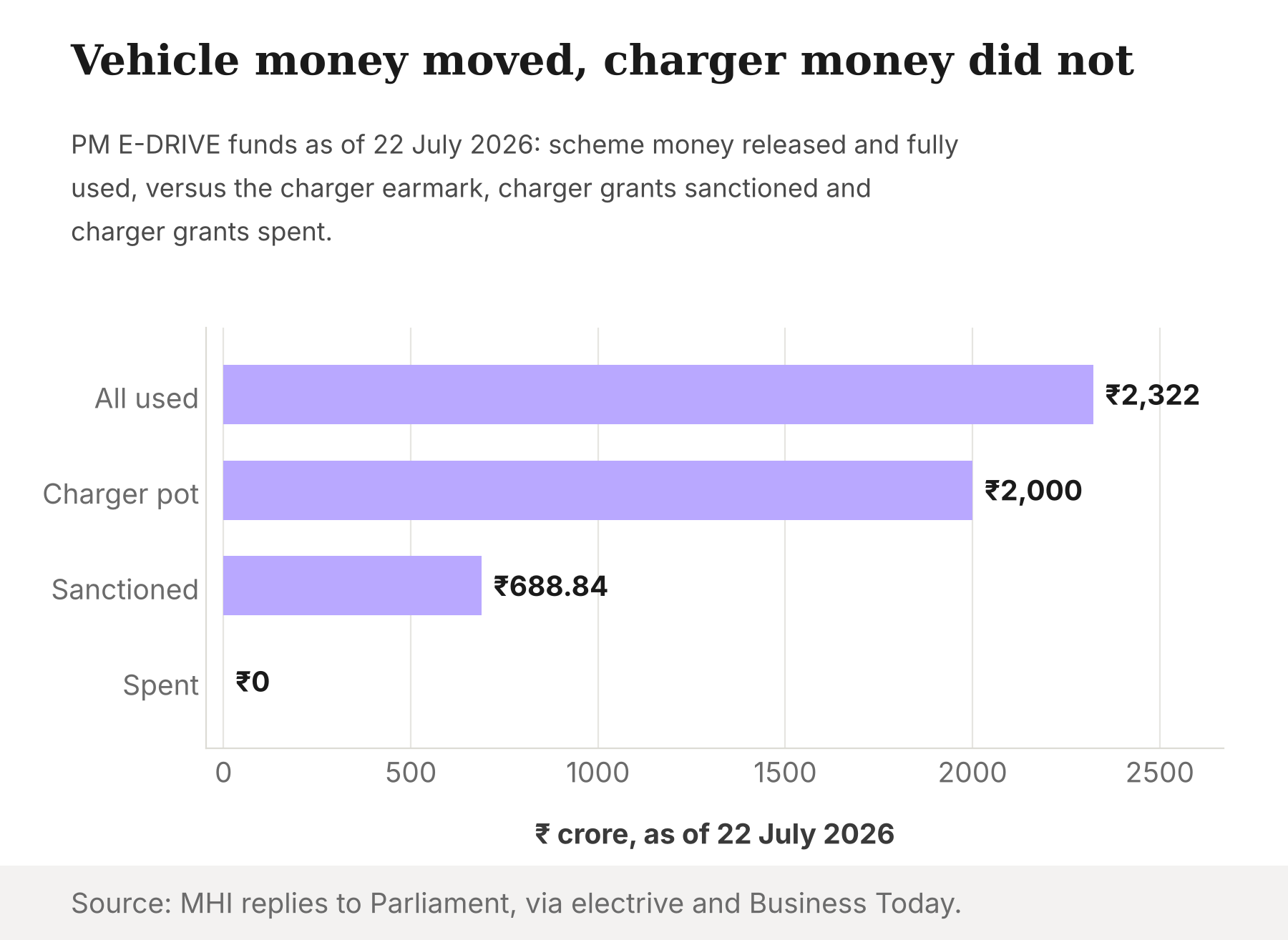
The two halves of PM E-DRIVE run on different clocks. A buyer gets the vehicle discount at the showroom, and the manufacturer claims it back. By 31 December 2025, Rs 1,703 crore had been reimbursed to makers of electric two- and three-wheelers. Three months later, the charger account had not started. As on 24 March 2026, no fund had been released for public charging stations under PM E-DRIVE, the ministry told the Rajya Sabha.
By July the gap was wider. Rs 2,322 crore of scheme money had been released and fully utilised by 22 July 2026, electrive reported from a ministry reply. On the same date, the Centre had approved Rs 688.84 crore for 6,562 public charging stations but had incurred no expenditure, according to a separate written reply reported by Business Today.
Sanctions have kept climbing since. In May the government approved Rs 503.86 crore for 4,874 chargers. By 28 September, Rs 851 crore had been approved for 8,147 chargers to 3 oil marketing companies and 10 states. The 20 November figure adds 463 chargers to that. Spread across 8,610 stations, Rs 904 crore works out to about Rs 10.5 lakh of grant per charger.
The last scheme shows what a sanction is worth
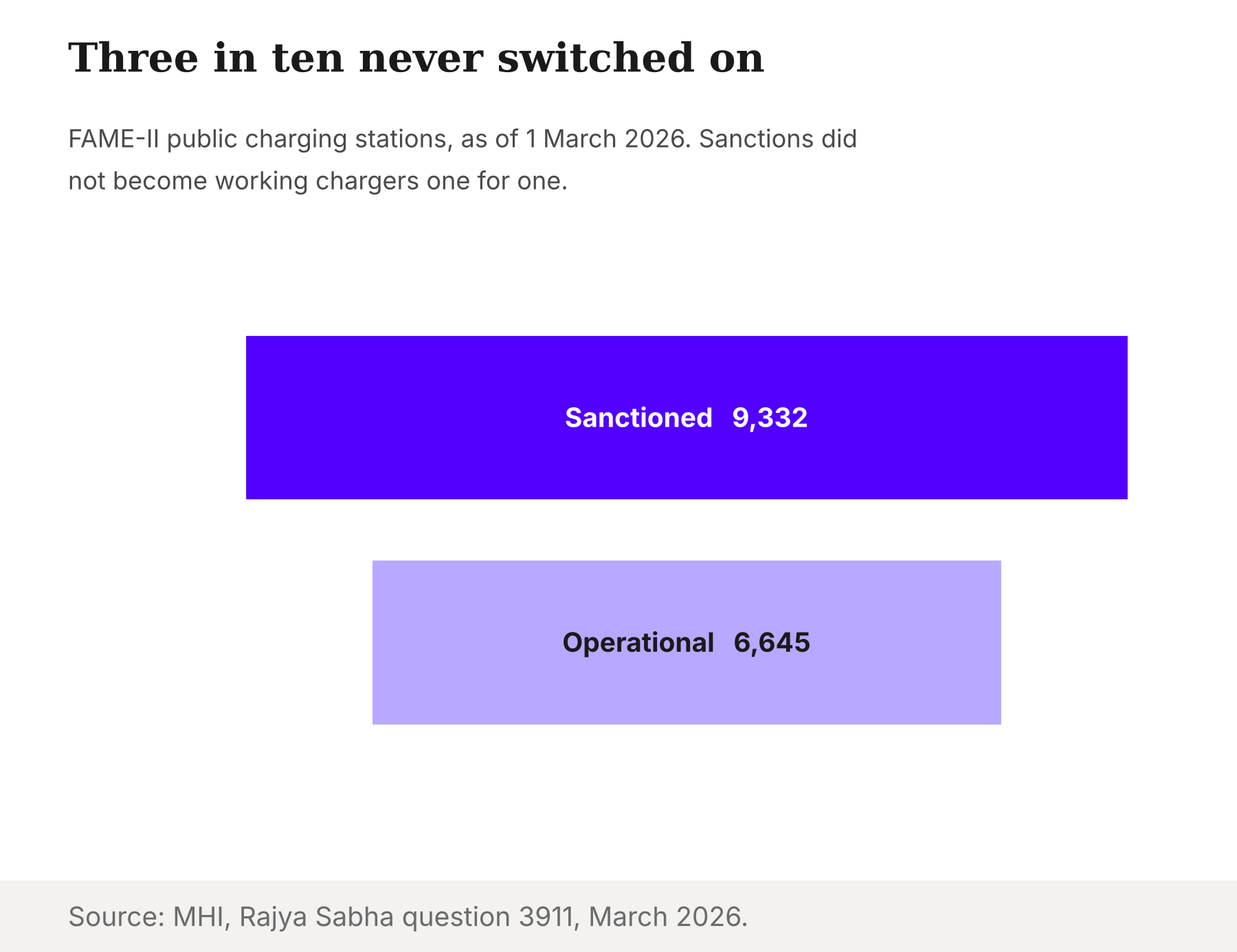
India has run this experiment before. FAME-II, the predecessor scheme, also paid for public chargers. As on 1 March 2026, 6,645 public charging stations were operational against 9,332 sanctioned under FAME-II. Nearly three in ten sanctioned chargers were not working, years after the money was committed.
The money tells the same story. Under FAME-II, Rs 912.50 crore was sanctioned for public charging, Rs 895.48 crore released and Rs 655.43 crore utilised as on 18 March 2026. Roughly 72 percent of the sanctioned sum had been used, close to the 71 percent of sanctioned chargers that were running.
If PM E-DRIVE's 8,610 sanctions convert at FAME-II's rate, about 6,100 would end up running. The ministry is not tracking whether even those get used. The ministry has not assessed the utilisation rates of installed EV chargers, it told Parliament in March.
The cost sits behind the meter
Kapoor was specific about where the money goes. "The higher share of the cost is behind the metre, where distribution companies sometimes require quite a substantial amount of money," he said, according to The Tribune. Business Standard reported that he singled out high-capacity stations of 200 kilowatts or more, and wanted a nodal officer in every discom to clear charging cases.
That cost lands on an asset that earns little. Kapoor said oil marketing companies had reported utilisation of less than 1 per cent at some locations. The averages are not much better. An SBI report estimates public charging capacity utilisation at just 1 to 3 percent, and an S&P Global report puts it at around 5 percent, Autocar India reported.
Put the two together and the mechanism is plain. An operator pays the discom up front for a high-power connection. It then sells electricity from a machine that is busy for a few minutes in every hour. The grant covers the hardware. It does not change that arithmetic.
The honest objection
The strongest case against all of this is that India does not need many more public chargers. Most of what PM E-DRIVE subsidises plugs in at home. Of the 22.12 lakh EVs sold under the scheme as on 27 January 2026, 19.19 lakh were electric two-wheelers and 2.93 lakh were three-wheelers. That is about 87 percent scooters and motorcycles, which can charge from a wall socket at home. Low utilisation then reads as proof of surplus, not shortage.
The network is already large. BHEL counted 52,718 public charging stations as of July 2026, of which 16,561 had fast charging. India had 10,023,396 registered EVs as of 26 July 2026, about 190 per public station. All 8,610 new sanctions would add about 16 percent to the station count.
That case is real, and it sharpens the point rather than sinking it. If the average charger is idle, more chargers of the same kind are not the answer. The gap is in the high-power stations that cars, buses and trucks need on highways and depots. Those are exactly the sites where Kapoor says discoms demand the most for a connection. A grant sized per charger cannot fix a cost set per connection.
The Signal
PM E-DRIVE has turned close to half its charger money into sanctions within a year. That part is moving. What it has not changed is who decides whether a sanction becomes a working station: a state-owned discom that bills for the connection, and a user base that charges at home. FAME-II's record of 6,645 working chargers out of 9,332 sanctioned is the baseline to beat. Watch two numbers. One is the first official count of PM E-DRIVE chargers actually operational, which the ministry has not yet published. The other is whether the unspent half of the Rs 2,000 crore is redirected toward connection costs, as Kapoor hinted. A sanctioned charger is a line in a ledger until the grid shows up.
Reporting basis: PM E-DRIVE's outlay, sales and 28 September charger approvals are from a Press Information Bureau factsheet; the January 2026 sales split and the December 2025 reimbursement figure are from a Ministry of Heavy Industries written reply in the Lok Sabha, released by PIB. The March 2026 position on charger funds, the FAME-II sanctioned, operational and utilised figures, and the ministry's statement that it has not assessed utilisation are from two Ministry of Heavy Industries replies in the Rajya Sabha, read in the original documents. The 22 July 2026 sanction and spending figures come from ministry replies to Parliament as reported by Business Today and by electrive. The May approval is per Autocar India, and the 20 November sanction is per ANI's report of the minister's remarks. Tarun Kapoor's remarks are per Business Standard and The Tribune, which reported the same speech and count as one origin. The station count is BHEL's, via a PIB backgrounder; the registered-EV count is from a Lok Sabha reply by the road transport minister, via Outlook Business; the SBI and S&P Global utilisation estimates are per Autocar India's summary of a Rubix Data Sciences report. The share of the charging pot sanctioned, the chargers added since 28 September, the grant per charger, the FAME-II conversion rates, the projected 6,100 working chargers, the two-wheeler share, the EVs per station and the addition to the network are The Signal's calculations from those figures.