The fight over the 8th Pay Commission has collapsed into two numbers. The staff side of the National Council (JCM) wants a fitment factor of 3.833, against the 2.57 adopted under the 7th Pay Commission, which would lift minimum basic pay from ₹18,000 to about ₹69,000. Read that way, 2.57 is the cautious anchor and 3.833 is the ambitious ask, and the commission will land somewhere in between.
That framing treats a multiplier as if it meant the same thing in 2026 as it did in 2016. It does not. A fitment factor is applied to basic pay, but it first has to swallow the dearness allowance that employees are already being paid. Only what is left over is a raise. And the dearness allowance a commission must swallow this time is half what it was last time.
The multiplier is mostly old money
When the 7th Pay Commission's pay took effect, dearness allowance stood at 125% of basic pay from January 1, 2016, per a finance ministry office memorandum. An employee on ₹7,000 basic was therefore drawing ₹15,750 in basic plus DA. A fitment factor of 2.25 would have done nothing but fold that DA into a new basic.
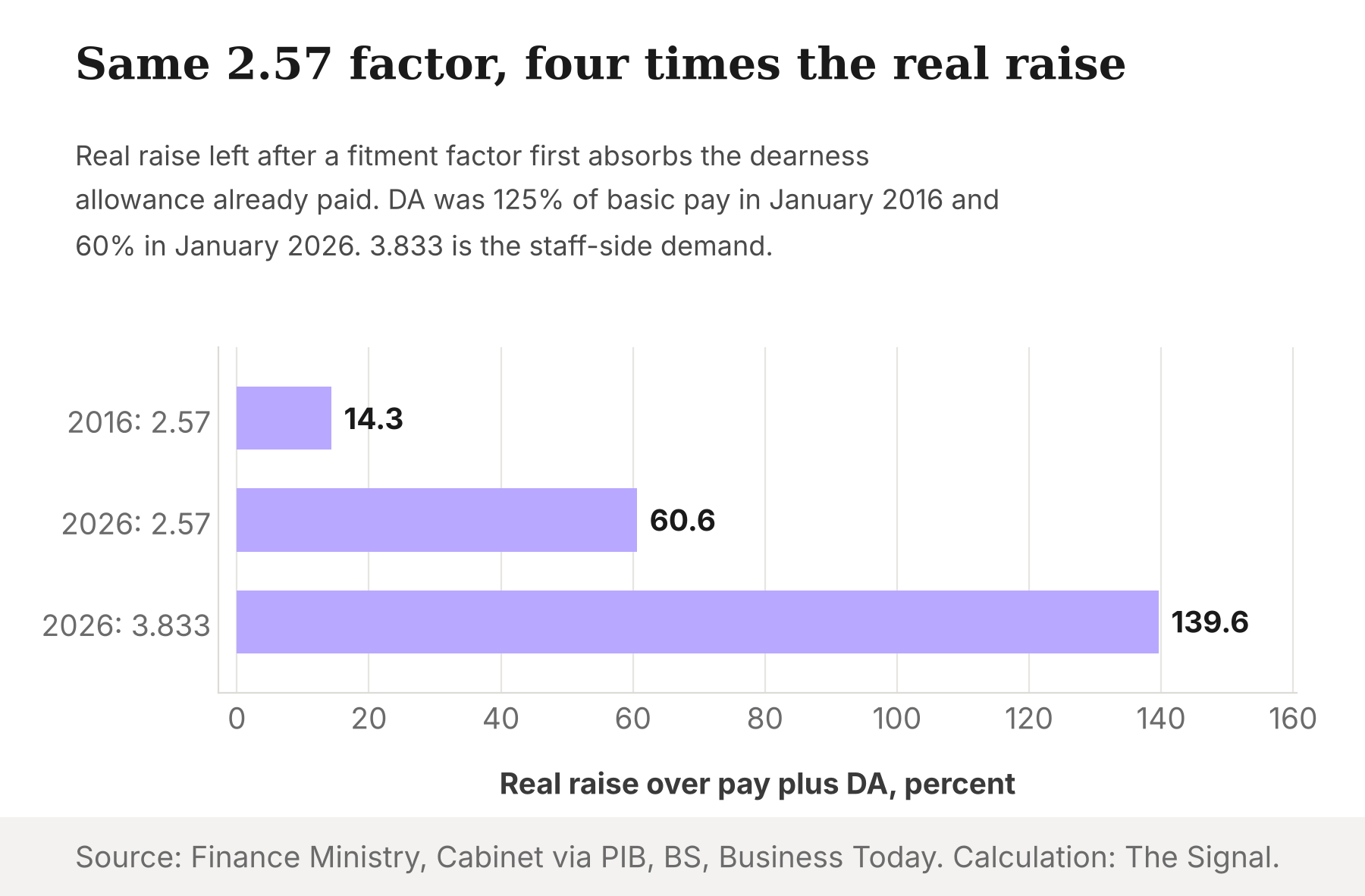
The Cabinet applied 2.57. That took minimum pay from ₹7,000 to ₹18,000 and raised the salary or pension of every employee and pensioner by at least 14.29% as on January 1, 2016. Divide 2.57 by 2.25 and you get roughly 1.14. Of a multiplier that sounded like a 157% increase, about 14 points were new money. That 14.27% hike in basic pay at junior levels was the lowest in 70 years, PTI reported in June 2016.
Half the DA, a far bigger raise
A decade later the starting point is very different. From January 1, 2026, the date the 8th Commission's award is normally expected to take effect, the Cabinet raised DA by 2 points over the existing rate of 58%, taking it to 60%. In October 2026 the Cabinet added 3 more points from July 1, 2026, over the existing rate of 60%, so DA now stands at 63%.
That changes what any multiplier buys. With DA at 60% from January 2026, the DA-neutral factor is 1.60, not 2.25. Apply the familiar 2.57 against it and the real raise is about 61%, more than four times the 14% the same number delivered in 2016. Apply the staff side's 3.833 and it is about 140%. The ₹69,000 minimum the memorandum seeks compares with ₹28,800 in basic plus DA that an employee on ₹18,000 drew at 60% DA in January 2026.
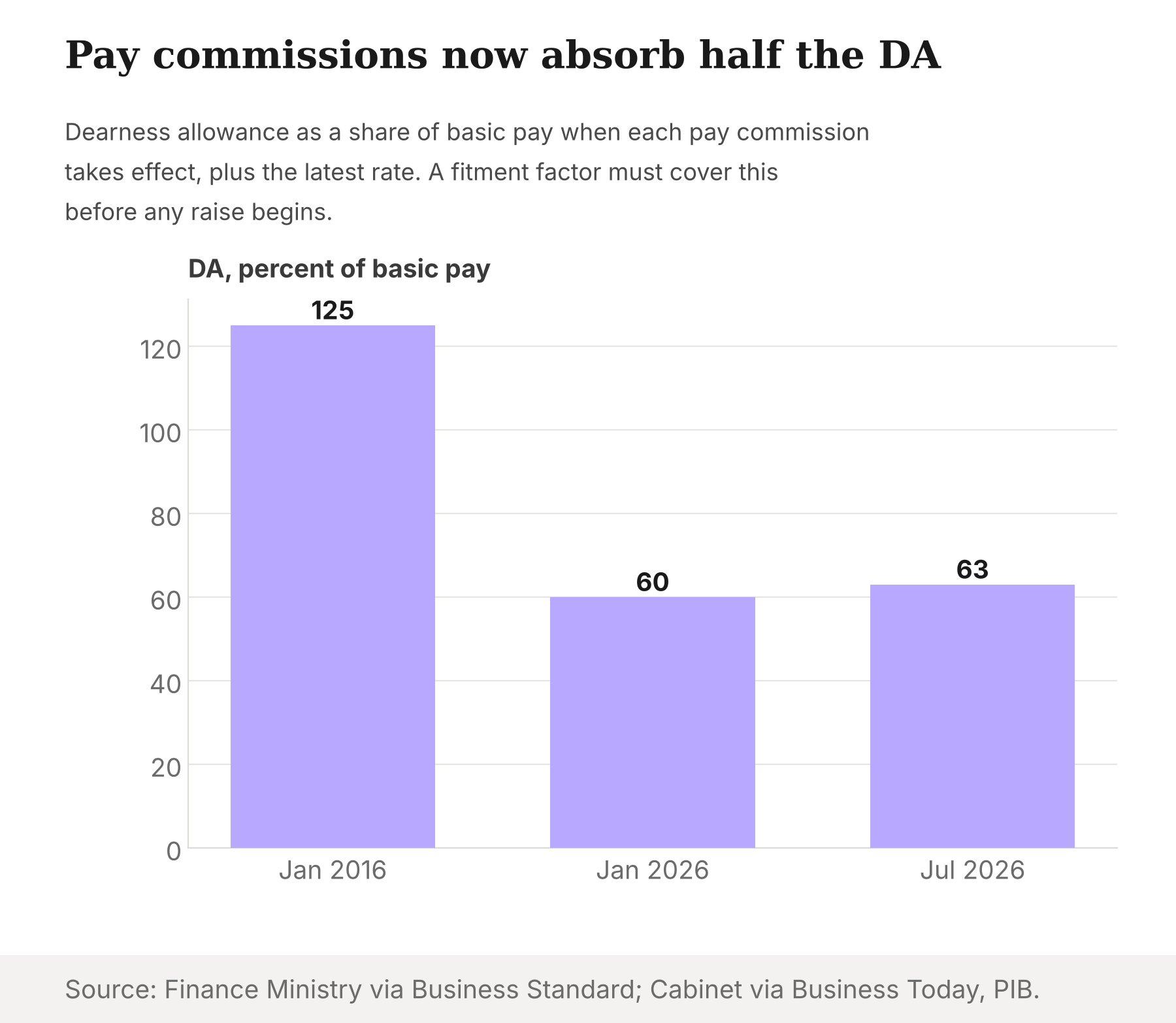
So the debate is mislabelled. A commission that "only" repeats 2.57 would not be repeating the 7th Commission's restraint, a junior-level hike that was the lowest in 70 years. It would be handing out the largest real increase of any pay round in the figures here, on the strength of a number that sounds conservative because it is familiar.
What it costs, before allowances
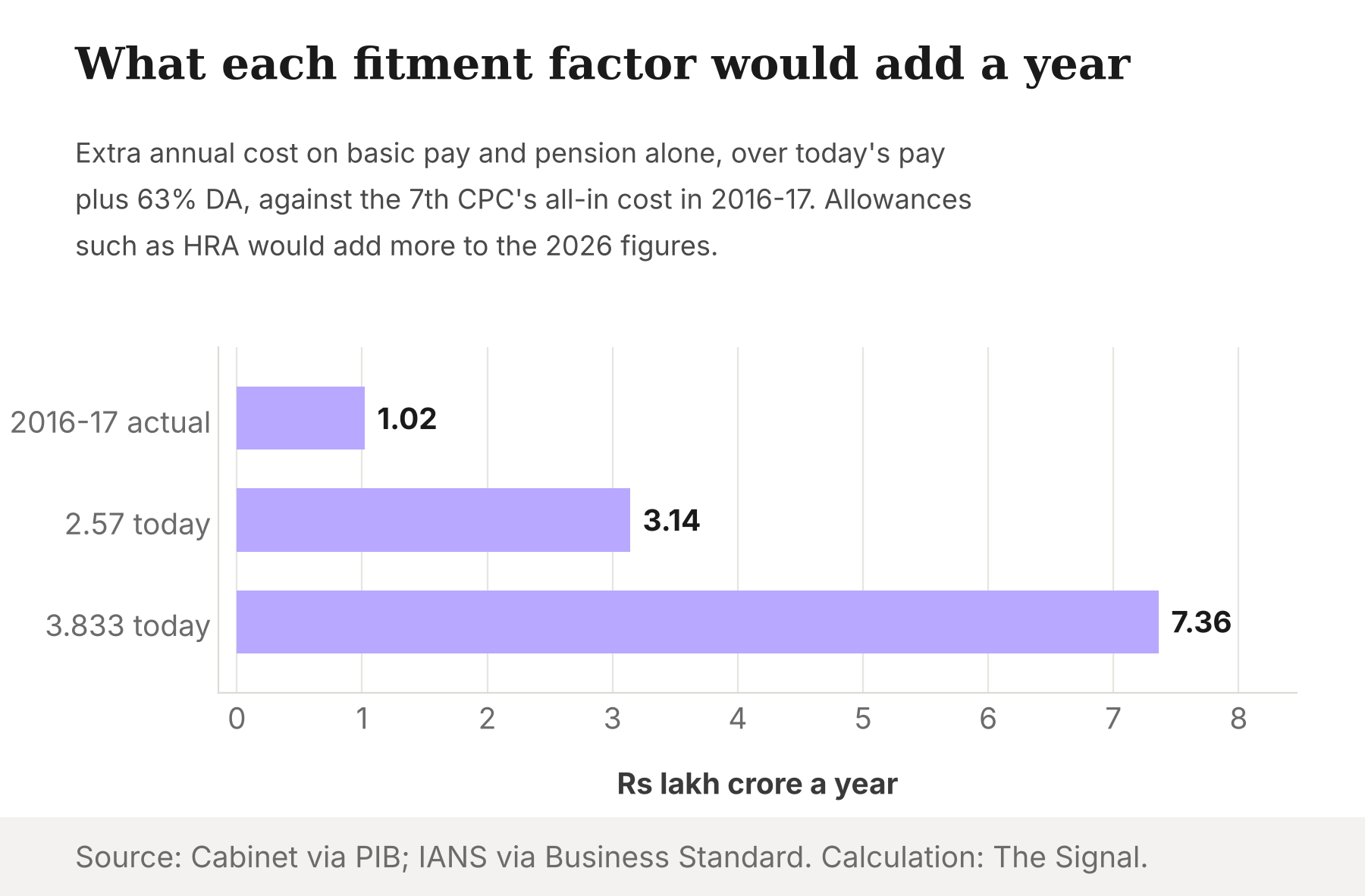
The Cabinet's own DA releases let one price this. The 3-point increase from July 2026 costs ₹10,016.10 crore a year and covers about 48.54 lakh employees and 68.71 lakh pensioners. One point of DA is therefore worth about ₹3,339 crore a year, which puts the annual basic pay and pension bill at roughly ₹3.34 lakh crore. In 2016 a 6-point DA increase cost ₹6,796.50 crore a year, or about ₹1,133 crore a point. The base each percentage point is multiplied against has nearly tripled.
| Fitment factor | Real raise over pay plus DA | Added annual cost on basic pay and pension |
|---|---|---|
| 2.57 in 2016 (7th CPC) | about 14% | ₹1.02 lakh crore all-in, 2016-17 |
| 2.57 now | about 61% | about ₹3.14 lakh crore |
| 3.833 now (staff demand) | about 140% | about ₹7.36 lakh crore |
Sources: PIB, Business Standard (IANS), Business Today. Real raises measured against January 2026 DA of 60%; added cost measured against today's 63% DA, before allowances. The Signal's calculations.
Against today's pay plus 63% DA, a 2.57 factor would add about ₹3.14 lakh crore a year on basic pay and pension alone, and 3.833 about ₹7.36 lakh crore. For scale, the additional impact of implementing all the 7th Commission's recommendations in 2016-17 was ₹1,02,100 crore, with a further ₹12,133 crore in arrears. The 2026 figures leave out house rent and other allowances, so they understate the full bill rather than overstate it.
The bill does not stop at the Centre
The government anticipated this. The terms of reference ask the commission to weigh fiscal prudence, the unfunded cost of non-contributory pension schemes and the likely impact on the finances of state governments, which usually adopt the recommendations with some modifications.
That last clause is the larger exposure. PRS Legislative Research finds that salary and pension payments were 39% of the combined revenue receipts of all states in 2023-24, and that other states may revise their pay scales once the 8th Commission is implemented. Add interest and the share was 53%, with Punjab above 100%. A single state's round is not small either: Karnataka's 7th State Pay Commission revision adds ₹20,208 crore a year. A central factor that looks moderate but carries a 61% real raise travels into every state budget that copies it.
The honest objection
The staff side's strongest case is that the 2016 round left employees behind. The 7th Commission's junior-level hike was the lowest in 70 years, and governments have gone further than commissions before: the 6th Pay Commission recommended a 20% hike, which the government doubled while implementing it in 2008. On that view a large real raise now is partly catch-up for a thin one then, and 3.833 is an opening position in a negotiation, not a forecast.
That case is real, and nothing here says what the right pay level is. But it argues about the size of the raise, not about how it is measured. Even the catch-up argument needs the real number on the table. A negotiation in which both sides quote multipliers, while the DA inside those multipliers has fallen from 125% in 2016 to 60%, is a negotiation in which neither side is saying what it is actually asking for.
The Signal
The fitment factor was a sensible shorthand when DA at the changeover was roughly the same each round. It no longer is. Because DA reset to zero in 2016 and has climbed only to 60% by 2026, the same 2.57 now carries four times the real increase it did. The commission has until roughly 18 months from its constitution to report, with its effect normally expected from January 1, 2026. Watch whether its report states the raise net of DA. If it does, the argument becomes honest. If it states only a multiplier, the headline will sound restrained and the bill will not be. The number that matters is not the factor. It is the factor divided by one plus DA.
Reporting basis: the July 2026 DA rate, its annual cost and the beneficiary counts are from the Union Cabinet's decision, via the Press Information Bureau; the January 2026 DA rate and cost are from the Cabinet's April 2026 decision, as reported by Business Today. The 8th Pay Commission's terms of reference are from the Cabinet's October 2025 decision, via PIB. The 3.833 demand and the ₹69,000 minimum are from the NC-JCM staff-side memorandum as reported by Business Today, which is the only source used for the demand. The 7th Pay Commission's minimum pay, 14.29% floor, 2016-17 cost and arrears are from the Cabinet's June 2016 decision as reported by IANS in Business Standard; the 14.27% junior-level hike and the 6th Commission comparison are per PTI in Business Standard; the 125% DA rate and 2016 DA cost are from a finance ministry office memorandum, as reported by IANS in Business Standard. State salary, pension and Karnataka figures are from PRS Legislative Research's compilation of state budget documents. The DA-neutral factors, real raises, per-point DA costs, implied pay and pension base, and added annual costs are The Signal's calculations from those figures.