EPFO's Central Board of Trustees meets today, 19 November 2026, and the item pensioners care about most is the floor. The Tribune reported that the board was expected to take up a long-pending proposal to raise the minimum pension under the Employees' Pension Scheme, which has stayed at ₹1,000 a month since September 2014, while unions want ₹7,500 plus dearness allowance. The usual framing is a fight over generosity: pensioners asking for more, and a fund weighing what it can afford.
It is worth slowing down on that. The pension scheme runs two separate bills through two separate wallets. One of them, the cost of pensions on higher wages ordered by the Supreme Court, is landing on the shared fund. The other, the ₹1,000 floor, never touched that fund at all.
The number that carries it
The figure that matters is ₹25 lakh. Onmanorama reported, citing EPFO trustee board documents, that a sample examination of 38,000 higher-pension applications showed granting them would create a ₹9,500 crore deficit in the pension fund. That is about ₹25 lakh for each case in the sample.
Set that against what an ordinary EPS pensioner draws. The Labour Ministry told the Lok Sabha in August 2026 that the scheme had 85,84,604 pensioners as on 31 March 2026, and that total pension disbursed up to that date was ₹15,819.28 crore. Read as the payout for the year to March 2026, that is roughly ₹18,400 per pensioner, or about ₹1,540 a month. The funding gap on one higher pension in EPFO's sample equals more than 130 years of that average.
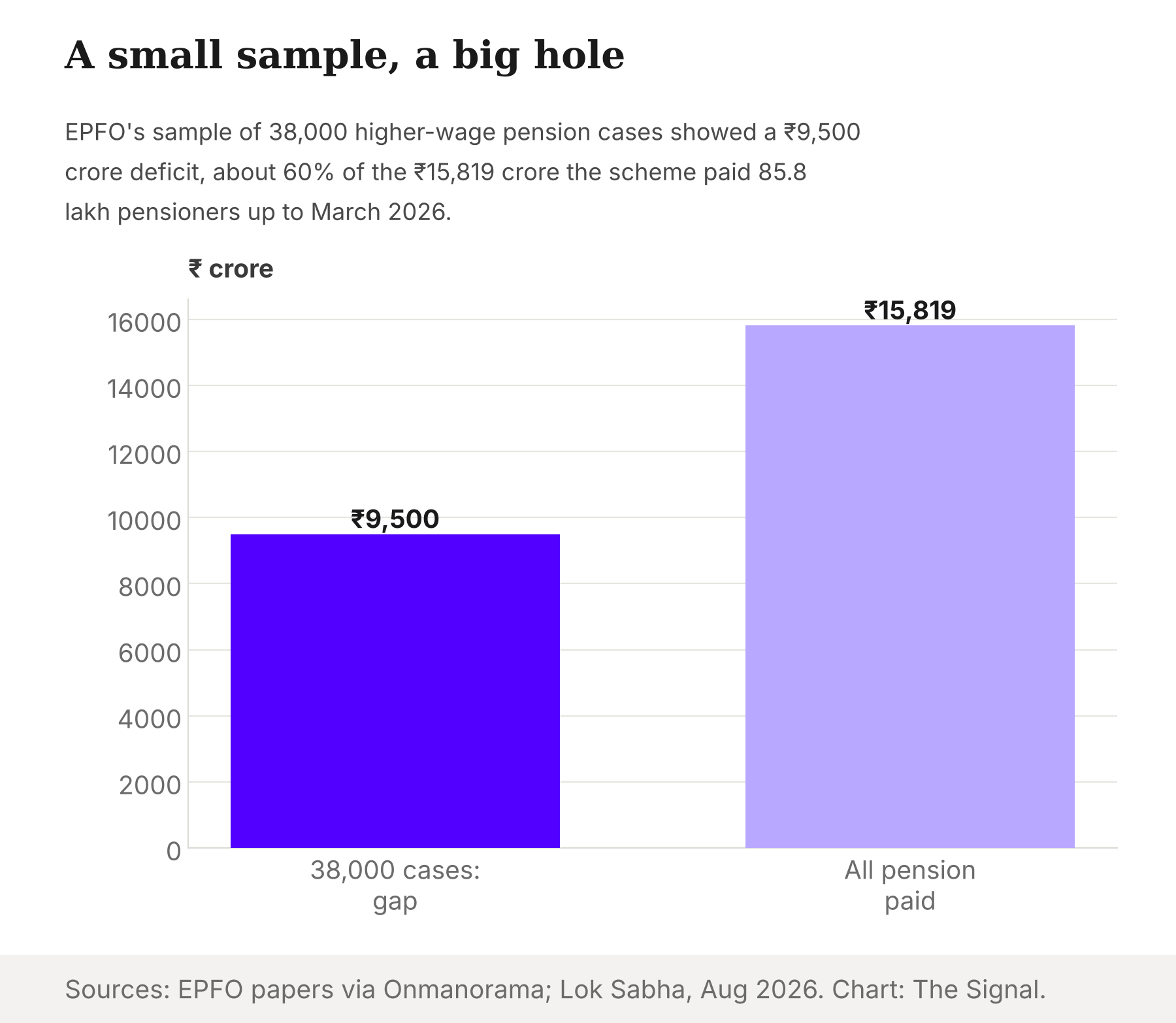
Put the two together and the ₹9,500 crore gap from 38,000 sampled cases equals about 60 percent of the ₹15,819 crore the whole scheme paid 85.8 lakh pensioners.
Two wallets, not one
It comes down to how the fund is built. The ministry has told Parliament that the pension corpus is built from an employer contribution of 8.33 percent of wages and a central government contribution of 1.16 percent of wages up to ₹15,000 a month, and that all benefits under the scheme are paid out of those accumulations. A higher pension is a benefit. Whatever the extra contributions deposited by those members do not cover is drawn from a pool built mostly on wages at or below the ceiling.
The floor works differently. In a March 2026 statement to the Lok Sabha, the ministry said the government provides the ₹1,000 minimum through budgetary support, in addition to its 1.16 percent contribution. The top-up comes from the Union Budget, not the corpus. That floor is where most of the scheme lives: Business Today reported, citing Labour Ministry data given to Parliament, that as of 31 March 2025 more than half of EPS pensioners, 4.915 million people, received less than ₹1,500 a month, and only 53,541 drew more than ₹6,000.
So the two decisions on the trustees' table are not trade-offs inside one pot. Raising the floor is a fiscal choice for the Finance Ministry. Paying higher pensions is a transfer inside the fund, from everyone whose employer pays into it to the few lakh retirees who won the right to a pension on their full salary. The fund was already short before the court ruled: the ministry has said its valuation as on 31 March 2019 showed an actuarial deficit.
How many will draw it
The pipeline has narrowed sharply, which limits the bill but does not remove it. The ministry's December 2025 reply said 17.49 lakh joint-option applications were filed by 11 July 2023, of which around 15.24 lakh were forwarded by employers. As of 24 November 2025, EPFO had issued 4,27,308 demand letters, and 34,060 of those were later found ineligible, mainly for not paying. Around 2,33,303 applicants had deposited the demand amount, 96,274 of them still in service and 1,37,029 retired.
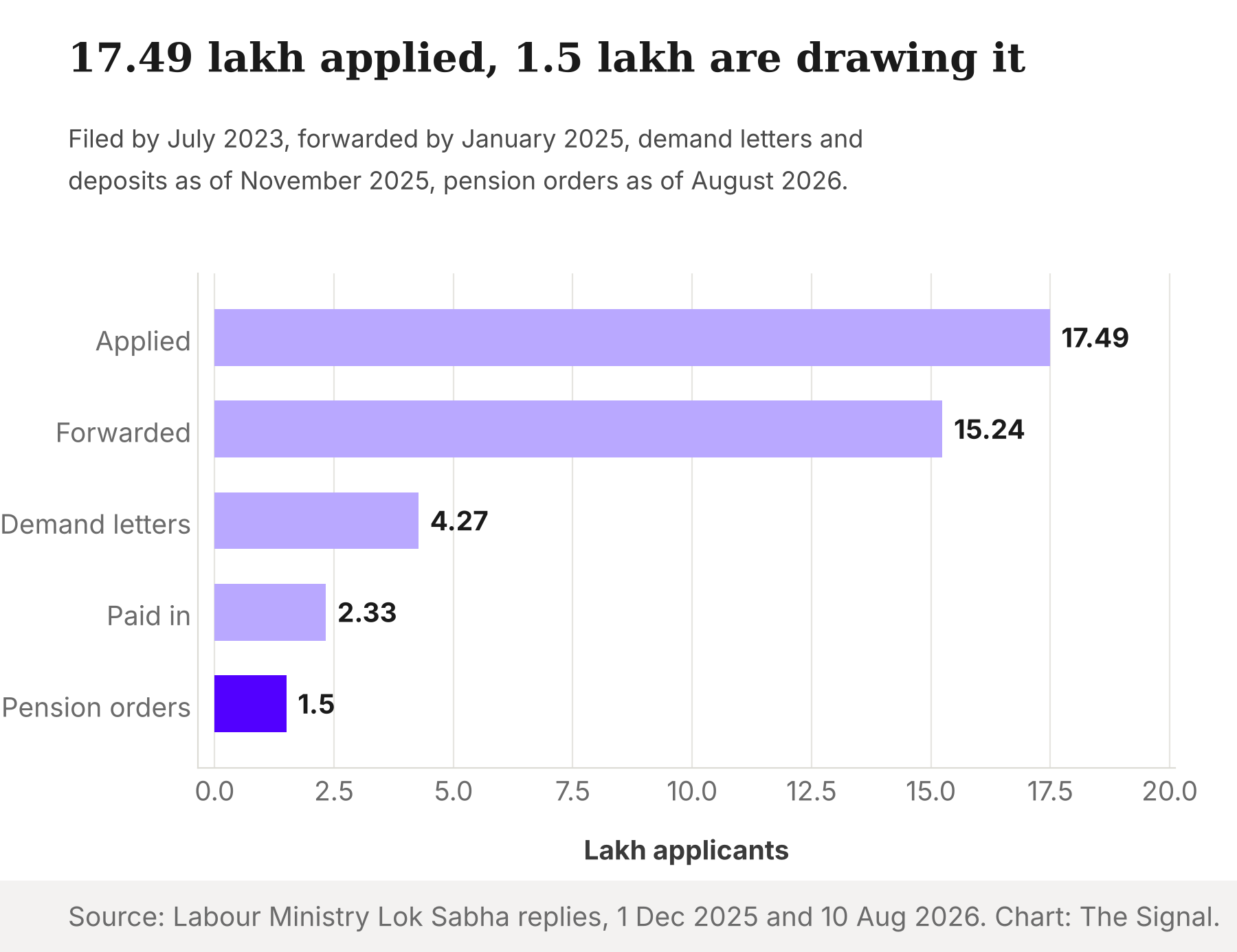
Money starts to flow only at the pension-order stage. The August 2026 reply put the count of higher-wage pension payment orders at 1,49,806. The processing is nearly done: a ministry annexure shows 15,24,365 applications received in field offices and 11,595 still pending as on 5 August 2026.
What the sample implies at scale
| Group | Count | Gap at ₹25 lakh each |
|---|---|---|
| EPFO's sample | 38,000 | ₹9,500 crore |
| Pension orders issued (Aug 2026) | 1,49,806 | about ₹37,500 crore |
| Paid the demand amount (Nov 2025) | 2,33,303 | about ₹58,300 crore |
Sources: EPFO board papers via Onmanorama; Lok Sabha, 10 Aug 2026; Lok Sabha, 1 Dec 2025. Larger rows assume the sample is representative.
Those scaled figures are illustrations, not EPFO estimates. EPFO's own early estimate, reported by Onmanorama from the same board papers, was that ₹1.86 lakh crore would be needed to approve at least half of the joint-option applications. Far fewer than half made it through, so the final bill should land well below that estimate.
The honest objection
The strongest case against this reading is that higher-pension members are not free riders. They earned more, they paid in on that higher salary, and those now drawing a higher pension had to deposit the arrears before getting one. The Supreme Court judgment of 4 November 2022 gave them the right, and EPFO, as the Labour Ministry said in a PIB release, is issuing demand notices to those found eligible under it. Calling a court-ordered entitlement a subsidy can sound like reopening the verdict.
That case is real, and nothing here questions the entitlement. The point is narrower. A defined-benefit formula pays a pension on salary and service, not on what an individual put in, so a member can be fully paid up and still be owed more than the contributions earned. EPFO's own sample says that gap is large. The sample is one sample, of 38,000 cases, reported in March 2025, and EPFO said it would use the collected data to calculate the additional liability. Until that number is published, ₹25 lakh a head is the best evidence anyone outside the board has.
The Signal
The minimum pension and the higher pension look like one argument about how generous EPS should be. They are two arguments about who pays. A higher floor needs a budget line. Higher pensions need the corpus that every ceiling-wage worker's employer funds, a corpus now governed by EPS 2026, which came into force on 29 June 2026. Watch for two things after today's board meeting: whether any floor increase is announced with a stated budget source, and whether EPFO publishes the full actuarial cost of the higher-pension cases its sample promised. The fund has already agreed to pay. It has not yet said how much.
Reporting basis: pensioner counts, total pension disbursed, the higher-pension application, demand-letter, deposit and pension-order counts, the funding structure of the pension fund, the budgetary source of the minimum pension, the 2019 actuarial deficit and the start date of EPS 2026 all come from the Ministry of Labour and Employment's written replies in the Lok Sabha, one origin, with the Supreme Court demand-notice process per the ministry's release via the Press Information Bureau. The 38,000-case sample, its ₹9,500 crore deficit and the ₹1.86 lakh crore half-of-applications estimate come from EPFO trustee board papers as reported by Onmanorama; we did not see the board papers themselves, and this is the only source for those figures. The distribution of pensions by size as of March 2025 also comes from the Labour Ministry, in data given to Parliament that we saw only as relayed by PTI and reported by Business Today. The agenda of the 19 November 2026 board meeting and the unions' ₹7,500 demand are per The Tribune. The ₹25 lakh per-case gap, the average annual pension, the 130-year comparison, the 60 percent share and the scaled gaps in the table are The Signal's calculations from those figures.