India's electronics exports had a striking first half. The Commerce Ministry says electronic goods exports grew 44 percent to US$31.97 billion in April to September of FY2026-27, up from US$22.20 billion a year earlier. The detail the ministry chose to lead with was not the iPhone. Non-smartphone exports expanded 56.5 percent, outpacing smartphone growth of 35.8 percent, and the backgrounder files the result under the heading "A Wider Range of Electronics Drives Growth."
That is the consensus read: India is no longer a one-product electronics exporter. It is worth slowing down on that.
Four lines did most of the work
The non-smartphone category rose to US$13.79 billion from US$8.81 billion, an increase of about US$4.98 billion. The ministry's own line-by-line figures show where that money came from.
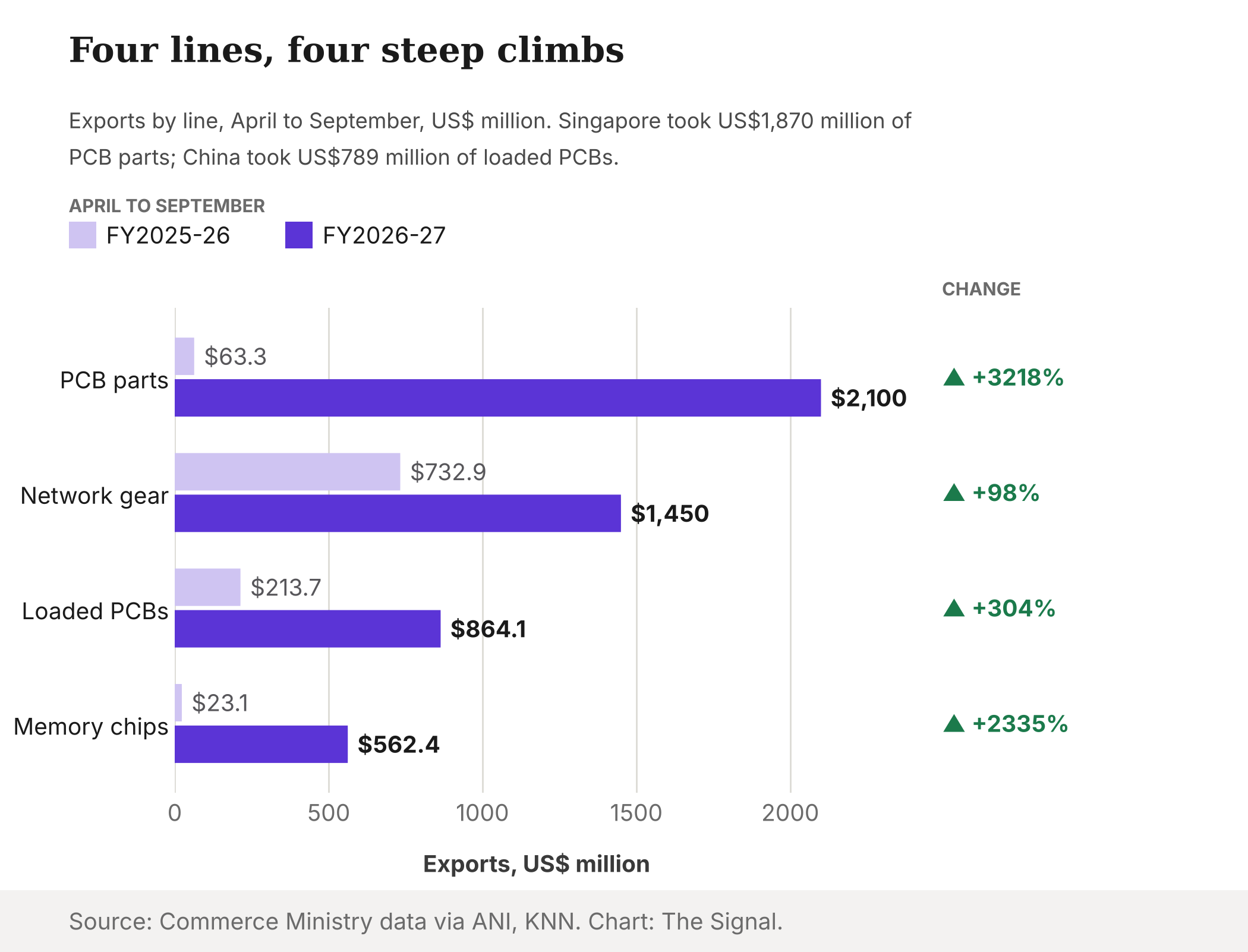
The biggest contributor is an obscure customs line. Per the ministry statement carried by ANI, exports of parts and accessories related to mounted printed circuit boards (HS 84733030) rose to US$2.10 billion from US$63.3 million. That one line added about US$2.04 billion, or roughly 41 percent of the entire non-smartphone gain.
Three more lines follow. The same statement reports that populated, loaded or stuffed printed circuit boards rose to US$864.1 million from US$213.7 million, and network transmission and routing equipment rose to US$1.45 billion from US$732.9 million. KNN, reporting the ministry data, adds that memory integrated circuit exports rose to US$562.4 million from US$23.1 million.
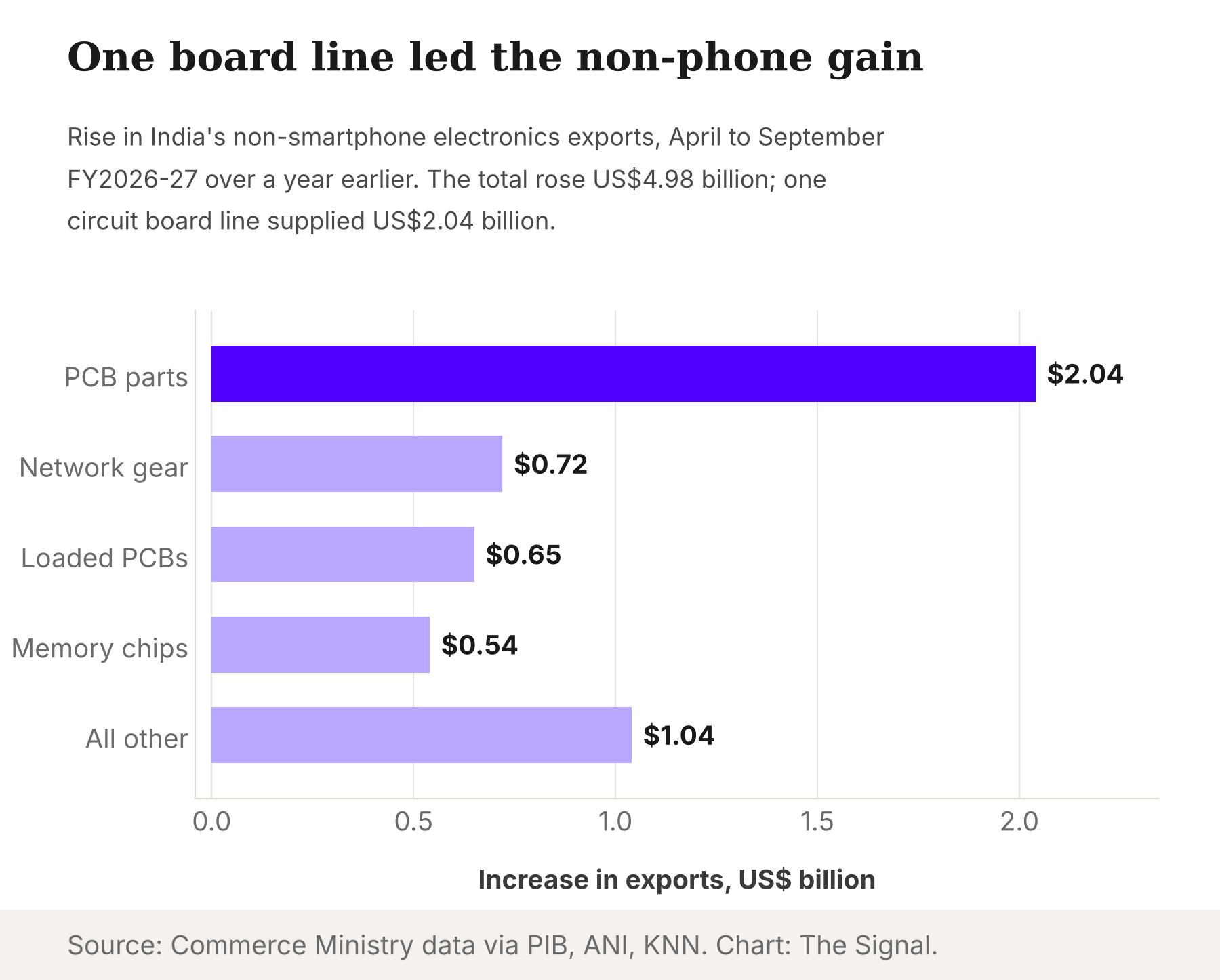
Together those four lines added about US$3.94 billion. That is close to 79 percent of the US$4.98 billion non-smartphone increase.
Take them out and the story flips
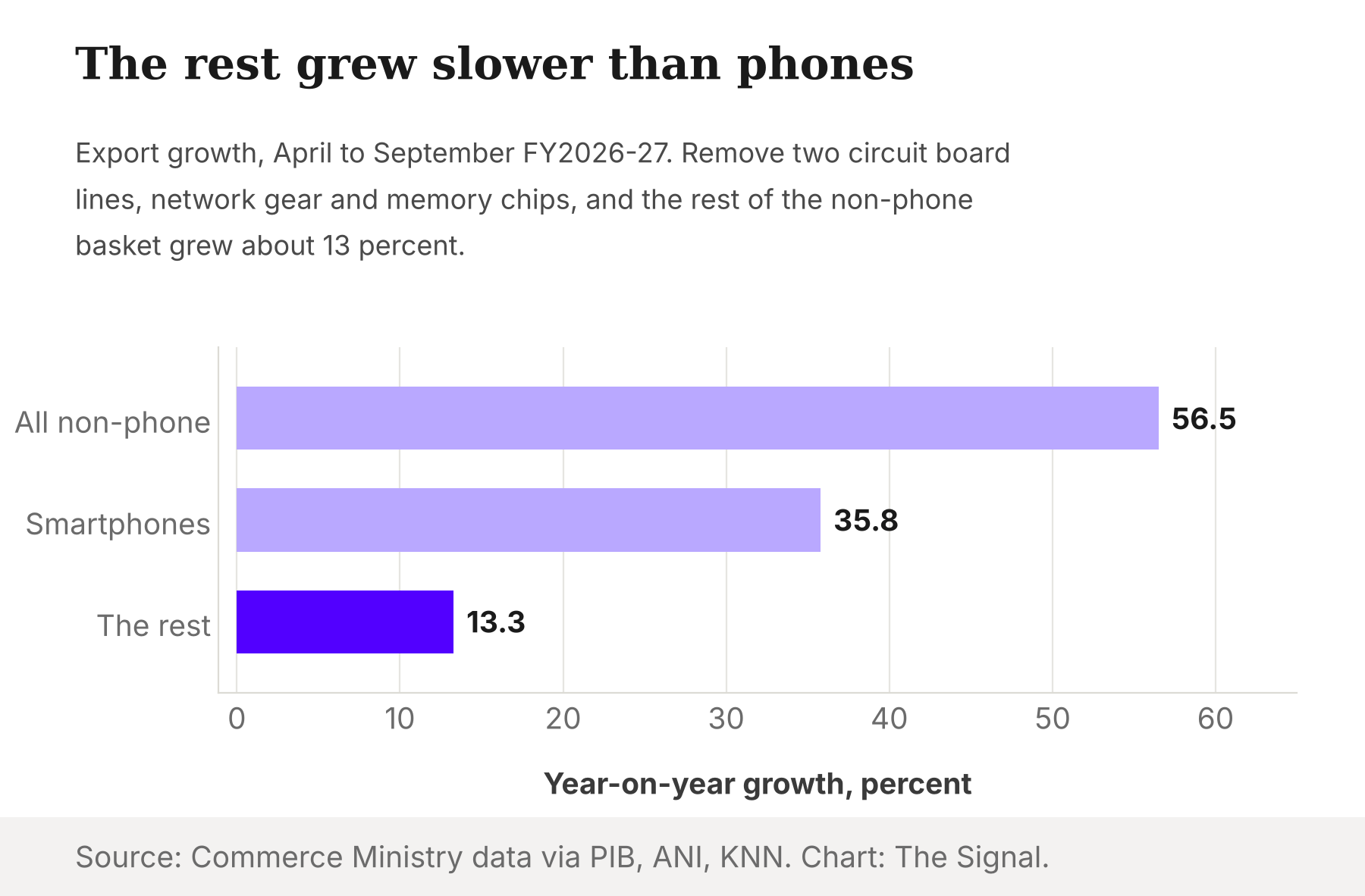
Subtract the four lines from both years of the ministry's non-smartphone total and the rest of the basket went from about US$7.78 billion to about US$8.81 billion. That is growth of roughly 13 percent, by our calculation.
Smartphones, the product the "wider range" story was meant to move beyond, grew far faster. Per the ministry, smartphone exports rose to US$18.17 billion from US$13.38 billion, the 35.8 percent rate. So the broad middle of India's electronics exports, everything that is neither a phone nor one of four component lines, grew at about a third of the phone rate.
The basket did widen, in the narrow sense that the share of non-smartphone electronics rose from 39.7 percent to 43.2 percent. But a share shift driven by four lines is concentration moving to a new address, not diversification.
The new lines have few buyers
The ministry's figures also show where these goods go. Of the US$2.10 billion in mounted circuit board parts, Singapore took US$1.87 billion and China US$111.5 million. That puts about 89 percent of the line on one destination. For the loaded boards, China took US$789.2 million of the US$864.1 million. In network equipment, Hong Kong climbed to US$857.7 million from US$264.7 million. For memory chips, Malaysia was the largest destination at US$390.8 million.
| Product line | Apr to Sep FY2025-26 (US$ million) | Apr to Sep FY2026-27 (US$ million) | Top destination (US$ million) |
|---|---|---|---|
| Mounted PCB parts (HS 84733030) | 63.3 | 2,100 | Singapore, 1,870 |
| Network transmission and routing equipment (HS 85176290) | 732.9 | 1,450 | Hong Kong, 857.7 |
| Populated PCBs (HS 85177910) | 213.7 | 864.1 | China, 789.2 |
| Memory integrated circuits | 23.1 | 562.4 | Malaysia, 390.8 |
Source: Ministry of Commerce and Industry data, via ANI and KNN.
Singapore and Hong Kong are better known as trading and transshipment hubs than as end markets. The pattern is consistent with India slotting into Asian supply chains as a component stage. That is real progress. It also looks very different from the older electronics export map, where the USA took 51.8 percent of India's electrical and electronic equipment exports in March 2026, according to the DGCI&S trade newsletter.
The country-level numbers echo the shift. The PIB backgrounder notes that exports to Singapore more than doubled at 103 percent, followed by Malaysia at 83 percent.
Why it matters beyond the trade table
Electronics now carries a large slice of India's export growth. Merchandise exports were US$259.89 billion in April to September 2026-27, against US$219.30 billion a year earlier. Electronics added about US$9.77 billion of that US$40.59 billion increase, or roughly 24 percent. Within electronics, the four lines added about 40 percent of the gain.
The timing matters too. The government's own PLI backgrounder says that the large-scale electronics manufacturing scheme's tenure is now completed, after cumulative incentive disbursement of Rs 19,090.98 crore. That is the phone-assembly subsidy behind the smartphone export boom. With it finished, the next leg of growth has to come from elsewhere. The first half of FY27 shows some of that happening, but in very few lines and for very few buyers.
The honest objection
The strongest case against this reading is that every supply chain starts narrow. Component exports begin with one anchor customer and one hub, then spread. There is evidence for that path. Micron opened its Sanand assembly and test plant in March 2026 and expects to assemble and test tens of millions of chips there in 2026, scaling to hundreds of millions in 2027. The PLI backgrounder reports that IT hardware exports grew 77.2 percent a year on average in 2021 to 2025. On this view, the four lines are the first wave of a deeper industry, not a statistical fluke.
That case is fair, and it may prove right. But it is an argument about the future, and the ministry framed the half-year as a result already achieved. A line that grew from US$63.3 million to US$2.10 billion, about 33-fold, with most of it going to one destination can fall just as quickly if a few buyers move their orders. Until the rest of the non-smartphone basket grows faster than 13 percent, "wider range" describes a hope more than a measurement.
The Signal
India's electronics export story has not moved beyond the smartphone. It has added a second, much narrower engine: circuit boards, network gear and memory chips flowing to Singapore, China, Hong Kong and Malaysia. The useful test over the next two quarters is simple. Watch whether the mounted circuit board line, US$2.10 billion in the latest half-year, holds that level with more than one major destination, and whether everything outside the four lines starts to grow faster than phones. If neither happens, the broadening was a few buyers' order books. A wider basket is measured by its middle, not its tallest item.
Reporting basis: the half-year electronics totals, the smartphone and non-smartphone split, and the growth rates by product line and destination country are Commerce Ministry figures, verified in the ministry's PIB backgrounder of 14 November 2026 and in the ministry statement carried by ANI (via The Tribune); these are one origin, not two. The memory chip values and their Malaysia figure are per KNN's report of the same ministry data and rest on that single relay. Merchandise export totals are from the ministry's September 2026 trade release on PIB. The completion of the LSEM scheme and the IT hardware export growth rate are from the government's PLI backgrounder on PIB. The March 2026 destination share is from the DGCI&S trade newsletter. Micron's Sanand output targets are per the company's press release, as reproduced by HPCwire. The four-line increase, its share of the non-smartphone gain, the 13.3 percent growth of the remaining non-smartphone basket, the destination concentration shares and electronics' share of merchandise export growth are The Signal's calculations from those figures.