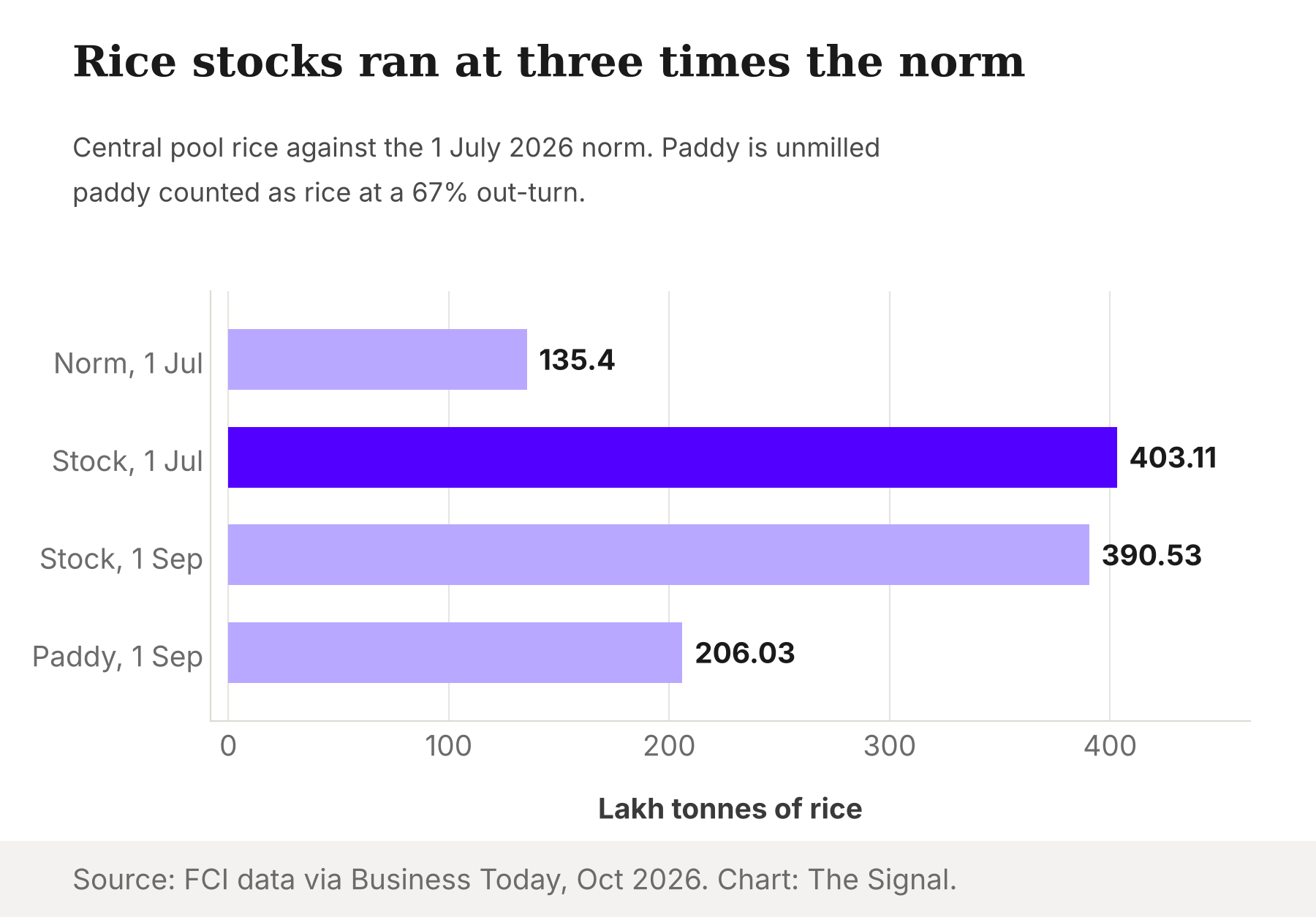
India has more rice than it knows what to do with, and the usual story about that surplus is about water and subsidies. The pile is real. On 1 July 2026 the central pool held 403.11 lakh tonnes of rice against a stocking norm of 135.40 lakh tonnes, almost exactly three times what the rules ask for. On top of that, FCI and state agencies held 307.51 lakh tonnes of unmilled paddy on 1 September, equal to 206.03 lakh tonnes of rice. The USDA's Foreign Agricultural Service expects India to export a record 25 million tonnes of rice in the 2026-27 marketing year.
Read that way, the surplus is a storage problem waiting for a buyer. The more useful question is which buyer the government has chosen, and at what price.
The price ladder
From 1 November 2026, FCI sells rice to ethanol distilleries at Rs 2,390 per quintal under the Open Market Sale Scheme policy for 2026-27. That is Rs 23.90 a kilo. Shoppers paid an all-India average of Rs 44.90 a kilo for rice on 29 July 2026, up 4.66 percent in a year, according to Department of Consumer Affairs data tabled in the Lok Sabha. A distillery pays a little more than half what a household does.
Now set the price against the government's own costs. The Food Ministry told the Rajya Sabha that FCI's average acquisition cost was Rs 3,889.46 per quintal in 2025-26, a revised estimate. The new distillery price is 39 percent below it. Go one step further back, to the farm gate. The MSP for common paddy is Rs 2,441 per quintal for the 2026-27 season, and a quintal of paddy yields about 67 kg of rice. That puts the paddy alone at about Rs 36.43 per kilo of rice, before milling, transport or storage. Distilleries are buying rice for a third less than the government pays farmers for the grain inside it.
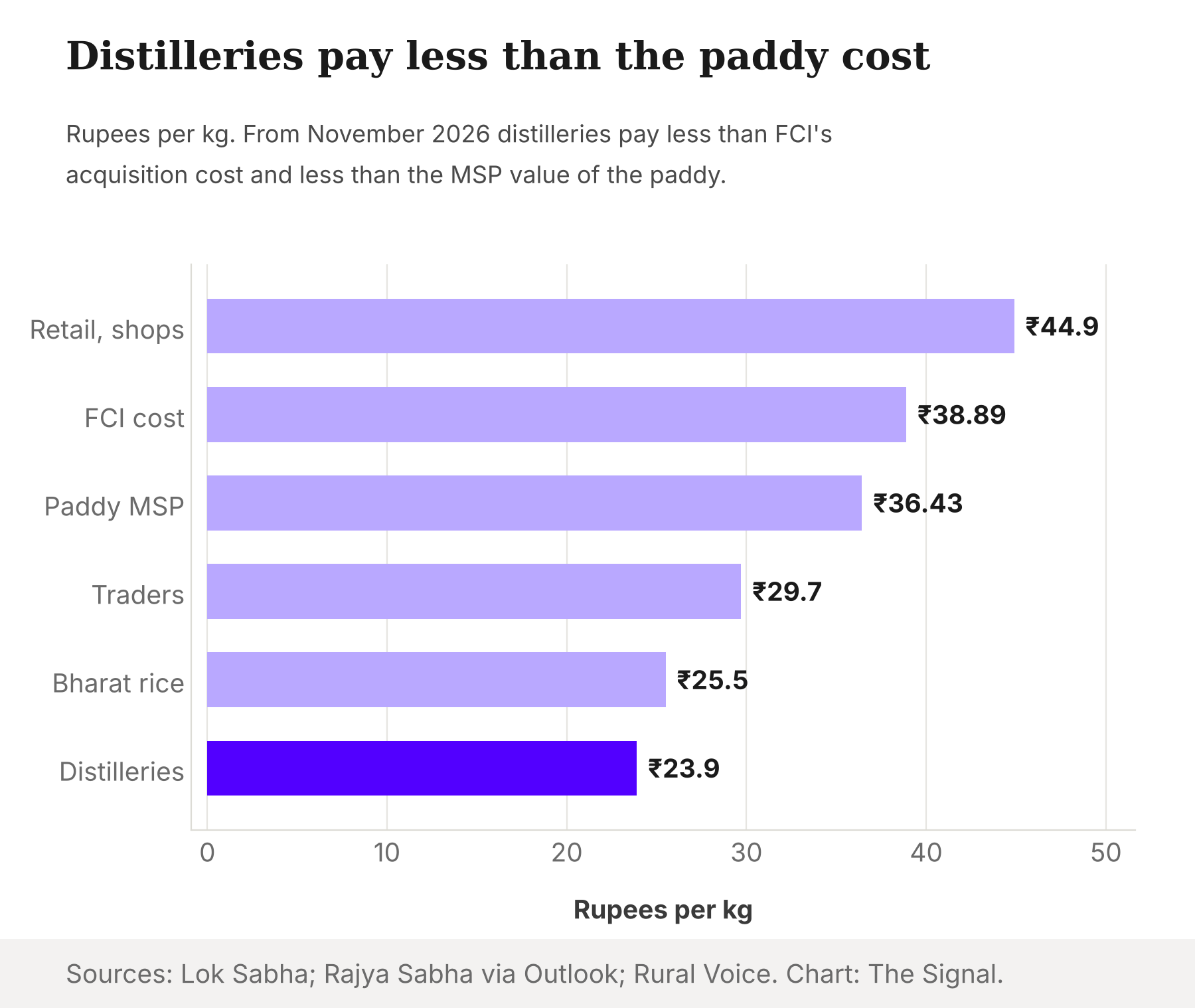
The same policy order sets Rs 2,970 per quintal for small private traders and Rs 2,550 for Bharat brand rice sold through cooperatives. A trader buying rice to sell into the food market pays Rs 580 a quintal more than a distillery buying it to make fuel, about 20 percent more.
How big the channel has become
This is no longer a disposal outlet at the margin. The Food Ministry's answer to Lok Sabha Question 1703 shows FCI's rice allocation for ethanol rising from 23 lakh tonnes in 2023-24 to 52 lakh tonnes in 2024-25 and 72 lakh tonnes in 2025-26, with the last figure running to 30 June 2026. Distilleries lifted nothing in the first year, 31.83 lakh tonnes in the second and 44.2 lakh tonnes in the third.
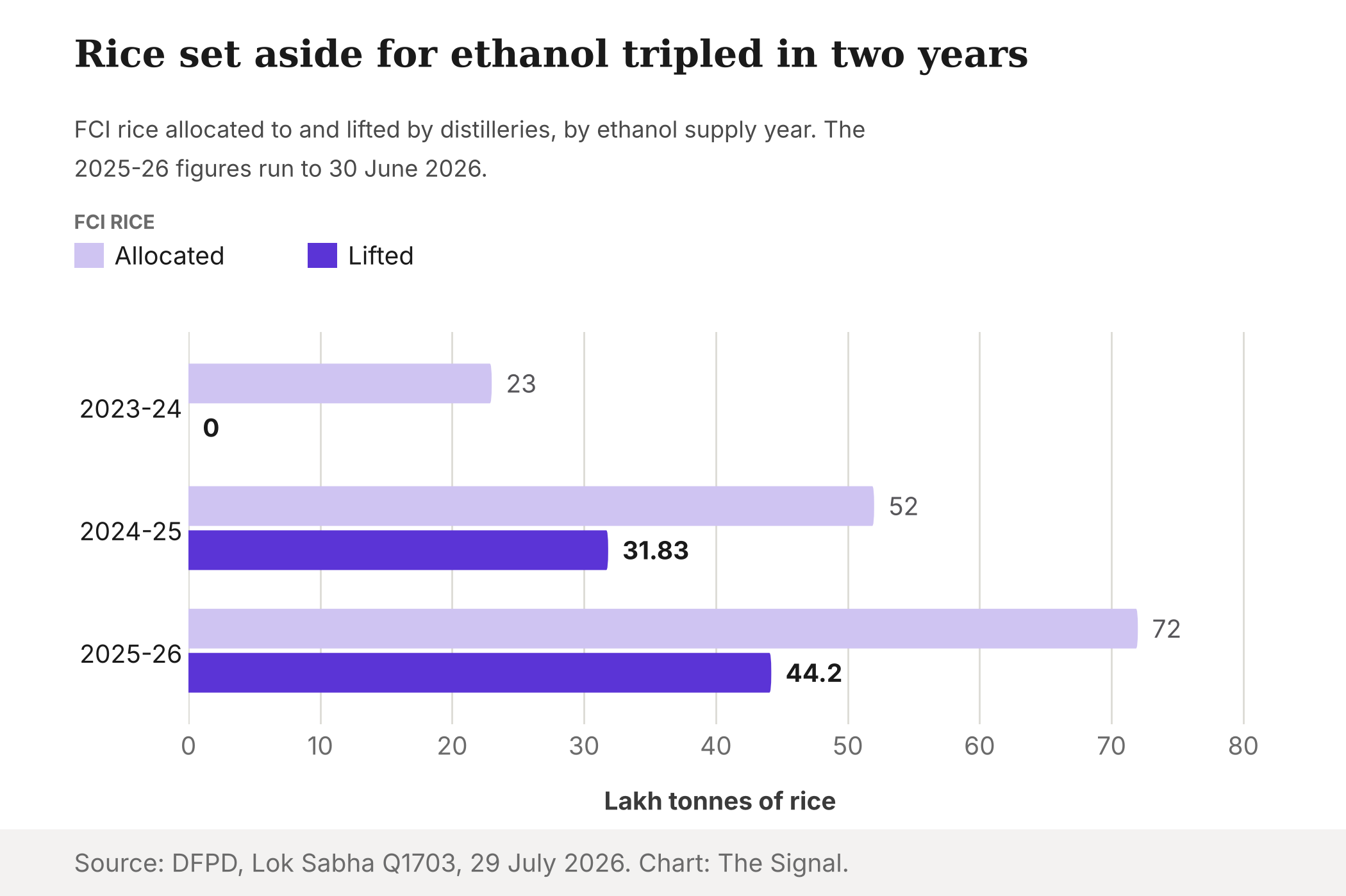
Agencies procured 562.21 lakh tonnes of rice in the 2025-26 kharif marketing season, up to 21 July 2026. The 44.2 lakh tonnes lifted for ethanol equals about 8 percent of that, roughly two-fifths of Punjab's entire 104.86 lakh tonne contribution. The periods do not line up exactly, so read the share as a scale marker, not an accounting identity.
In money terms, ChiniMandi, reporting the Rajya Sabha reply, says FCI dispatched 6.35 million tonnes of rice worth Rs 14,596.78 crore to ethanol plants between June 2025 and June 2026. That works out to about Rs 23 a kilo. Valued at the 2025-26 acquisition cost instead, the same rice was worth roughly Rs 24,700 crore. The gap is about Rs 10,000 crore for those twelve months.
The stockpile is meant for something else
The government's position is stated plainly in its Lok Sabha answer. It allows sale of excess rice under OMSS for ethanol only after maintaining buffer stocks and meeting the needs of the National Food Security Act and other welfare schemes. Outlook reports that the reply also says no subsidy is being provided to distilleries, because the rice moves at a notified price.
The food market has not behaved as if the surplus were truly surplus. In early November 2026, India doubled its OMSS rice sale target for 2026-27 to 5 million tonnes after selling 2.5 million tonnes by the end of October, against 1.1 million tonnes a year earlier, UkrAgroConsult reports, citing The Daily Star. The stated reason was price concerns, with the monsoon about 13 percent below its long-term average. A country holding three times its rice norm is now pushing extra grain into the market to cool retail prices, while its lowest commercial price goes to fuel.
The honest objection
The strongest defence of the policy is that holding rice is expensive and selling it at any price beats letting it age in a godown. Every quintal carried for another year adds interest, storage and loss. Seen that way, the acquisition cost is sunk. The real choice is between Rs 23.90 now and a smaller, later return on deteriorating grain. Ethanol demand also gives FCI a buyer large enough to move tens of lakh tonnes without crashing the domestic food market, which a flood of open-market rice could do. And the policy itself asks for old or broken rice to go to distilleries where feasible.
That case is serious, and it explains why the surplus is sold below cost. It does not explain the order of the price ladder. If the goal were only to clear stock, the food channel and the fuel channel would get the same rice at the same price. Instead, a trader feeding the retail market pays about 20 percent more than a distillery, in a year when retail rice rose 4.66 percent in the year to July 2026 and the government had to double its open-market target. The "no subsidy" line holds only in a narrow sense. The rice is not given away. But the roughly Rs 10,000 crore gap between what it cost and what it fetched does not disappear. It is a cost carried by the public food system, whatever the label on it.
The Signal
India's rice surplus is no longer only a food-security buffer. It is a feedstock pool for the ethanol programme, priced below the farm cost of the grain and below what food buyers pay. That is a defensible choice, but it is a choice, and it is being made through a price notification rather than a budget line. Watch two numbers: the ethanol allocation for the year that began in November 2026, and whether retail rice keeps rising while the central pool stays above its norm. If both move up together, the surplus is feeding petrol before it feeds prices. A food buffer that is cheapest for fuel is doing a second job, and someone is paying for it.
Reporting basis: ethanol allocations, distillery liftings and state-wise procurement are from the Department of Food and Public Distribution's written answer to Lok Sabha Unstarred Question 1703 of 29 July 2026, and retail rice prices are Department of Consumer Affairs data in its answer to Lok Sabha Question 3938 of 12 August 2026; both were read in the original documents. Central pool stock and unmilled paddy figures are FCI data as reported by Business Today, not checked against an FCI bulletin. The acquisition cost and the "no subsidy" position come from a Rajya Sabha written reply, as reported by Outlook; the 6.35 million tonne dispatch and its Rs 14,596.78 crore value come from the same reply as reported by ChiniMandi, so both rest on one origin. The 2026-27 OMSS prices and paddy MSP are per Rural Voice's report of the policy order. The export forecast is the USDA Foreign Agricultural Service's, via Rice News Today, and the doubled OMSS target is per UkrAgroConsult, citing The Daily Star. The per-kilo paddy cost, the percentage gaps, the 8 percent share and the roughly Rs 10,000 crore gap are The Signal's calculations from those figures.