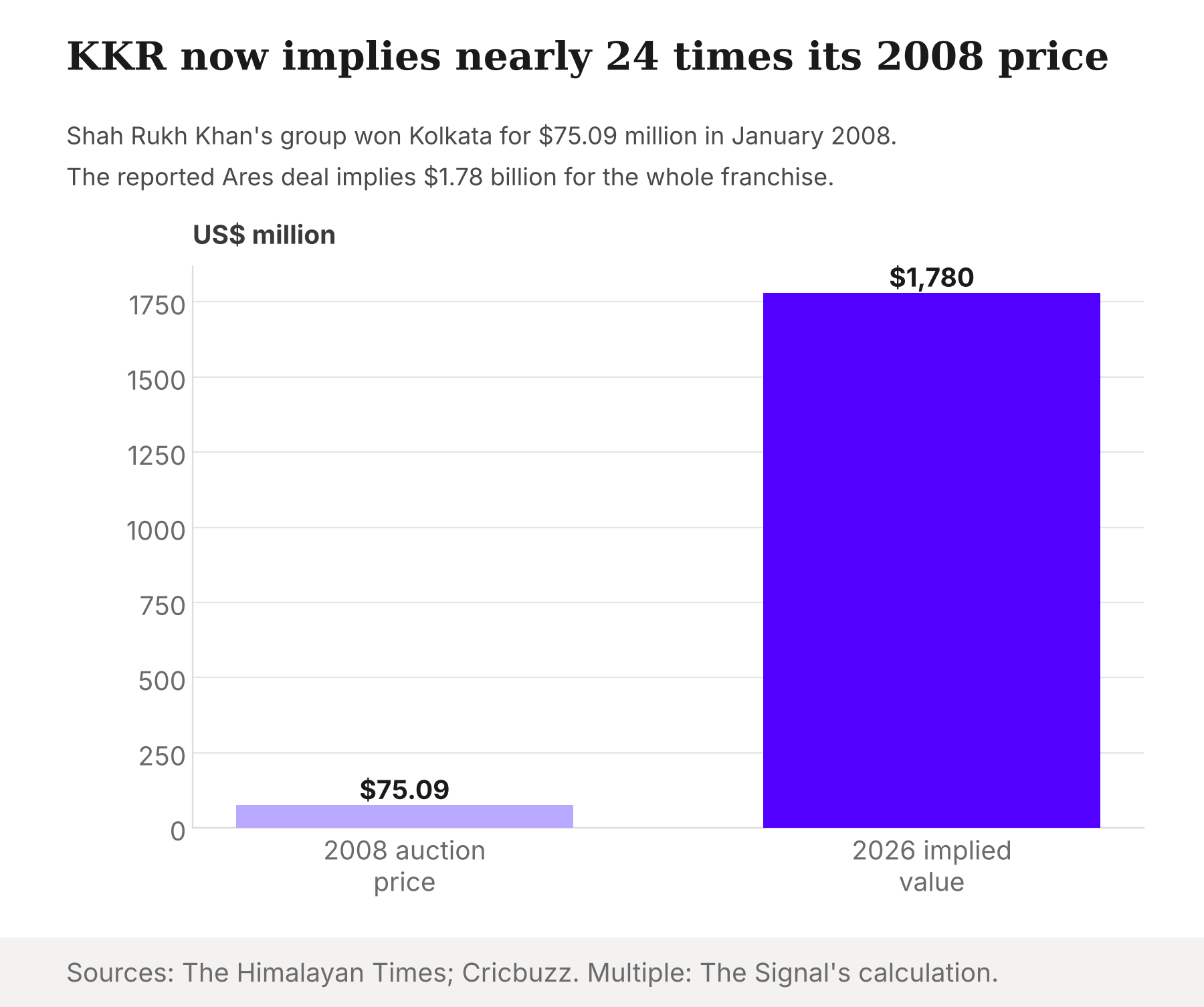
On 18 November 2026, Cricbuzz reported, citing sources, that Jay Mehta is transferring a 22.5 per cent stake in Kolkata Knight Riders to Ares Management for about $400 million, an overall valuation of $1.78 billion (Rs 16,634 crore). Cricbuzz describes the deal as close to completion but still needing BCCI approval. The easy read writes itself. A famous franchise has been marked up again by global money, and Shah Rukh Khan's group won Kolkata for $75.09 million at the January 2008 auction, so the reported price is nearly 24 times the original one.
It is worth slowing down on the price itself, because it is not new. In March 2026, United Spirits agreed to sell Royal Challengers Bengaluru at an enterprise valuation of Rs 16,660 crore ($1.78 billion), the highest ever for an IPL franchise. KKR's reported Rs 16,634 crore sits Rs 26 crore below it, a gap of under 0.2 per cent. RCB changed hands outright. Ares is reportedly buying a minority stake. Two franchises in different cities, sold eight months apart on different terms, land on the same number.
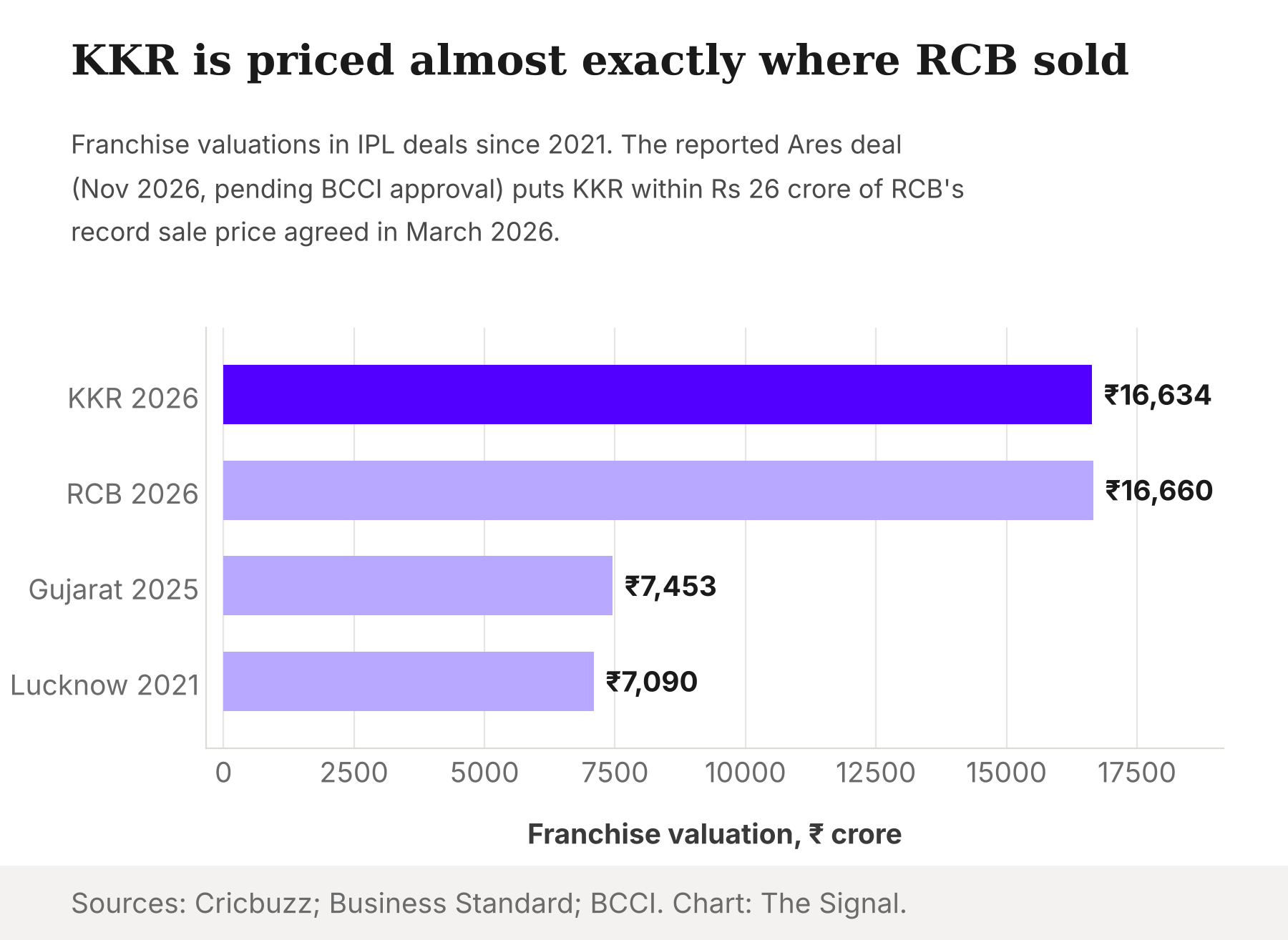
That convergence is the tell. If an IPL team's price were mainly a bet on its brand or its fan base, two different teams would not price within 0.2 per cent of each other, as the RCB and KKR figures do. They converge because the bulk of what any buyer acquires is the same asset for every team: a share of the BCCI's central pool.
Most of the money is the BCCI's to hand out
Sportico estimates that roughly three-fourths of IPL club revenue, on average, comes from a centralised pot distributed by the BCCI, which keeps half of media-rights income after production costs and splits most of the rest equally among the 10 clubs. That pot is fed above all by broadcasting. The BCCI sold IPL media rights for the 2023 to 2027 seasons for a cumulative Rs 48,390.32 crore in June 2022, about Rs 9,678 crore a season.
That changes what Ares is buying. A stake in KKR is, to a first approximation, a claim on one-tenth of a pool the franchise does not negotiate and cannot enlarge by winning matches. KKR sells its own sponsorships and tickets. Its single biggest income line is set by a BCCI auction.
The rights deal Ares is really pricing
The current contract ends with the 2027 season. Any multi-year case for a $1.78 billion valuation therefore leans mostly on a rights deal that has not been sold, and two things about that sale have changed since the last auction in June 2022.
The first is the bidder field. On 28 August 2024, the Competition Commission of India approved the combination of Reliance's Viacom18 and Disney's Star India businesses, subject to voluntary modifications. Those were the two winners of the last auction. In June 2022, Disney Star kept the IPL's Indian TV rights and Viacom18 won the digital rights, committing Rs 23,575 crore and Rs 23,758 crore respectively, per BCCI figures reported by Gulf News. Together that is nearly 98 per cent of the Rs 48,390.32 crore total. The two companies that bid against each other in 2022 now sit inside one joint venture. A thinner field of large Indian media buyers is rarely good for a seller's price, though who else will bid for the 2028 cycle is not yet known.
The second is the divisor. The BCCI is exploring an expansion to 12 teams from the 2028 season, Business Standard reported on 10 November 2026, citing Mint. That is the first season after the current rights deal runs out. If the central pool is still split equally, each team's share falls from one-tenth to one-twelfth, from 10 per cent to 8.3 per cent. That is a cut of one-sixth before a single rupee of the next deal is negotiated.
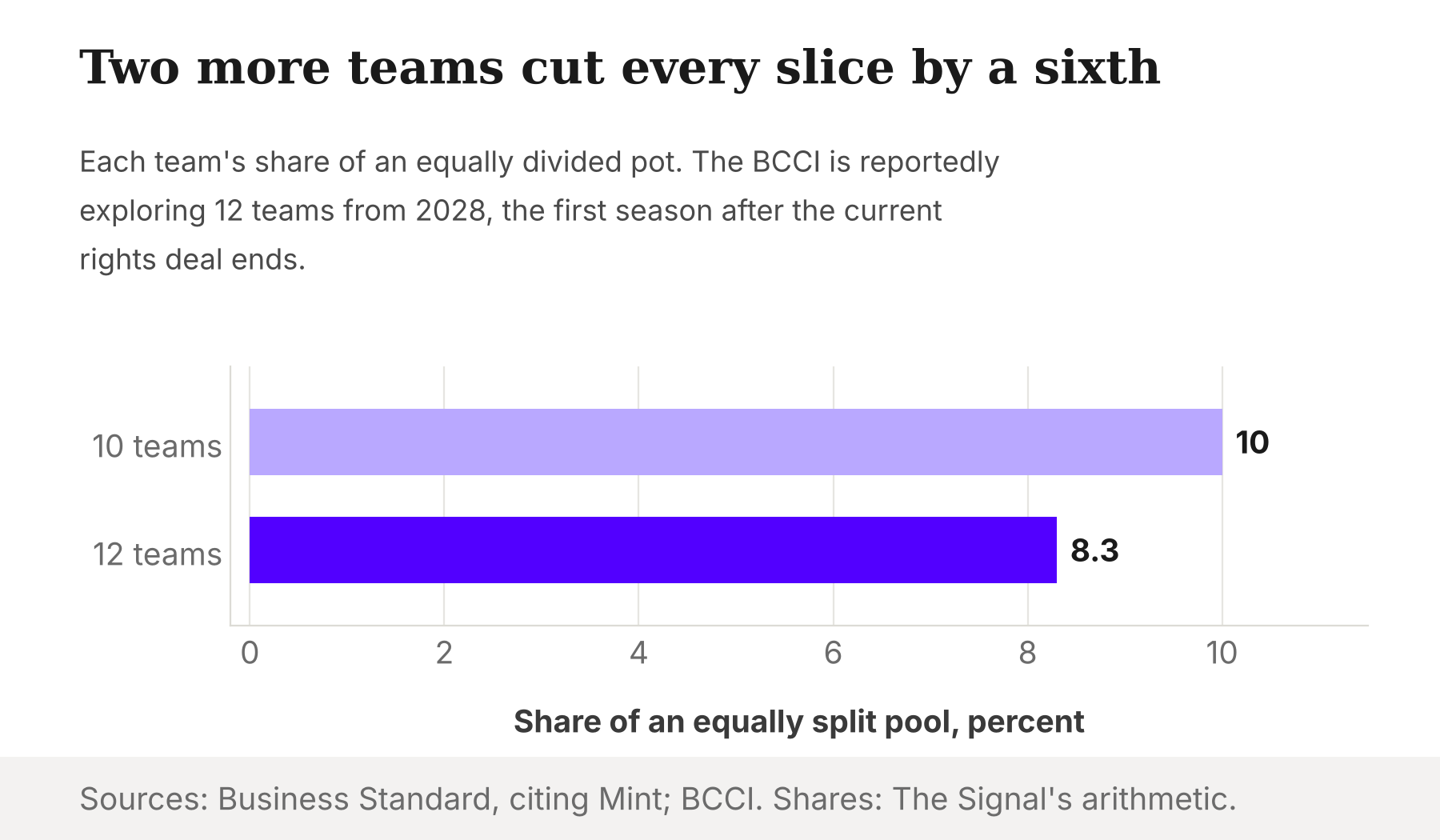
A 12-team league needs a rights deal about 20 per cent bigger just to keep each team's slice flat.
| Scenario | Teams sharing the pool | Each team's share (percent) | Five-season rights value that keeps today's per-team slice (₹ crore) |
|---|---|---|---|
| 2023-27 deal (actual) | 10 | 10.0 | 48,390 |
| Next deal, 10 teams | 10 | 10.0 | 48,390 |
| Next deal, 12 teams | 12 | 8.3 | 58,068 |
Source: BCCI, June 2022 for the 2023-27 value; Business Standard, citing Mint for the 12-team plan. Required values are The Signal's calculations in nominal rupees, assuming the BCCI's retention and equal split stay unchanged.
Put plainly, a buyer at RCB's price needs the next five-season deal to clear roughly Rs 58,068 crore in a 12-team league before KKR's central income merely stands still in nominal terms. Two more franchises raise that bar, and a merged broadcaster leaves one fewer big bidder to clear it, per the CCI approval and the reported expansion plan.
The one public forecast points the other way. Media Partners Asia projects the 2028-32 rights at around $5.4 billion, matching the current deal, with value per match falling about 13 per cent as the season grows to 94 matches, Outlook reported in March 2026. A flat deal in dollar terms is a long way from the 20 per cent rise a 12-team league would need to hold each team's slice steady.
How fast the price has moved
The deal record shows how quickly buyers have repriced that pool. In October 2021, the BCCI awarded Lucknow to RPSG Ventures for Rs 7,090 crore and Ahmedabad to CVC Capital Partners' Irelia for Rs 5,625 crore. In February 2025, Torrent Group agreed to buy 67 per cent of Gujarat Titans, the Ahmedabad franchise, from CVC at a valuation of Rs 7,453 crore, Business Standard reported, citing a source. KKR's reported Rs 16,634 crore is 2.2 times that Gujarat Titans valuation, 21 months later.
None of those deals changed the size of the central pool, which has been fixed at the June 2022 auction value throughout. What more than doubled between February 2025 and March 2026 was the market's view of what the next auction will fetch, and how long the league stays at 10 teams.
The honest objection
The strongest case against this reading is that IPL prices are set by scarcity, not by a rights forecast. There are only 10 franchises, global capital wants exposure to Indian cricket, and the estimates agree with each other. Sportico's own 2026 valuation put KKR at $1.738 billion, in line with the reported deal, per Cricbuzz. Moneycontrol reported in August 2026 a target KKR valuation of $1.8 billion, as relayed by Gulf News, though that was a target rather than an agreed price. And the buyer can afford patience: Ares had about $691 billion of assets under management on 30 September 2026, per its Q3 earnings release filed with the SEC, so $400 million is less than 0.06 per cent of that. A firm that size can hold through more than one rights cycle. The stake also comes with a global network: the Knight Riders group has owned Trinbago Knight Riders in the Caribbean Premier League since 2015 and bought the Abu Dhabi franchise in the UAE's new T20 league in 2022.
History is on the bulls' side too. Sony won 10 years of IPL TV rights in 2008 for Rs 8,200 crore, and Star India paid Rs 16,347.5 crore for the 2018-2022 rights, about Rs 820 crore and Rs 3,270 crore a season. The 2023-27 sale lifted that to about Rs 9,678 crore a season, roughly three times more. Every past auction has beaten the one before.
That case is real, and it explains why the numbers agree. It does not explain why they are safe. Sportico, Moneycontrol's sources and RCB's buyers were all pricing franchises whose revenue is mostly the same central pot. Their agreement is one assumption checked three times, not three independent checks. The past growth is real, but the only published forecast for the next cycle, from Media Partners Asia, expects it to stop. And scarcity is precisely the variable the BCCI is reportedly weighing changing for 2028. A 12-team league is, by construction, a less scarce one.
The Signal
If the deal closes on the reported terms and wins BCCI approval, Ares will own a slice of a franchise whose value turns on two decisions it has no vote in: the size of the next media-rights contract and the number of teams that share it. The 12-team plan reported in November 2026 and the next rights auction will tell investors whether $1.78 billion was a floor or a peak. That auction will be the first IPL sale since the Viacom18 and Star India combination was cleared in August 2024. Watch whether the BCCI confirms expansion before or after it tenders the 2028 rights. An IPL team's price is a forecast of someone else's auction.
Reporting basis: the Ares stake, its price and the implied KKR valuation rest on a single origin, Cricbuzz's 18 November 2026 report citing unnamed sources, which also relays Sportico's KKR valuation; the deal is unconfirmed and needs BCCI approval. The August 2026 target valuation is Moneycontrol's, as relayed by Gulf News. The central-pool revenue share is Sportico's 2026 estimate. The 2023-27 media-rights value and the 2021 franchise awards are from BCCI press releases. The Reliance and Disney combination approval is from the Competition Commission of India, via PIB. The RCB sale, the Gujarat Titans deal and the 12-team plan come from Business Standard, the last citing Mint, so Business Standard is one origin across three facts. The 2008 auction price is per The Himalayan Times, and Ares's assets under management are from its Q3 2026 earnings release filed with the US SEC. The 2008 and 2018-2022 rights deals, the 2022 package winners and the Knight Riders group's overseas teams are per Gulf News, the 2022 values citing BCCI figures. The 2028-32 forecast is Media Partners Asia's, as reported by Outlook. The per-season rights values, the Rs 26 crore and 0.2 per cent price gap, the 24-times, 2.2-times and three-times multiples, the 98 per cent combined share, the 8.3 per cent share and one-sixth cut, the 20 per cent required rise, the Rs 58,068 crore threshold and the 0.06 per cent stake size are The Signal's calculations from those figures.