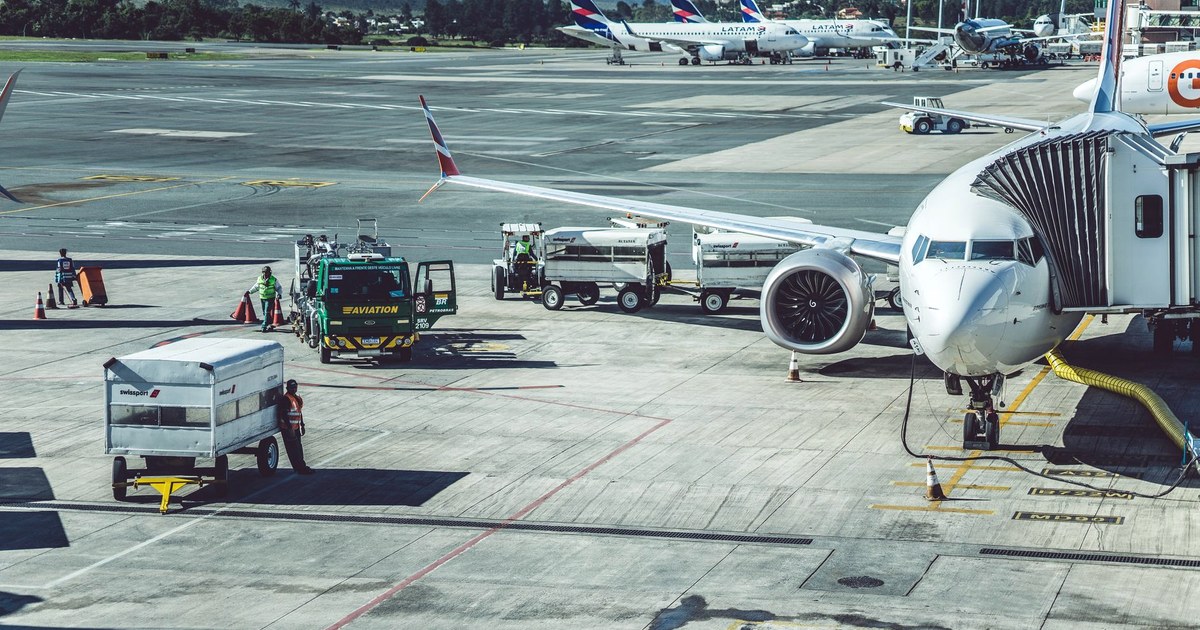
On Tuesday, 17 November 2026, Indian Oil Corporation said it had secured government approvals to commercially supply sustainable aviation fuel (SAF) from its Panipat refinery, PTI reported via ThePrint. Chairman A S Sahney said the facility can produce enough to meet India's 1% blending target for international flights in 2027. The coverage wrote itself: India has its first commercial green jet fuel, and the first year of the mandate looks handled.
Run the numbers at today's fuel demand and that claim nearly holds up. It is worth slowing down on the years that come after it, because the target does not stay at 1%.
The 2027 arithmetic nearly works
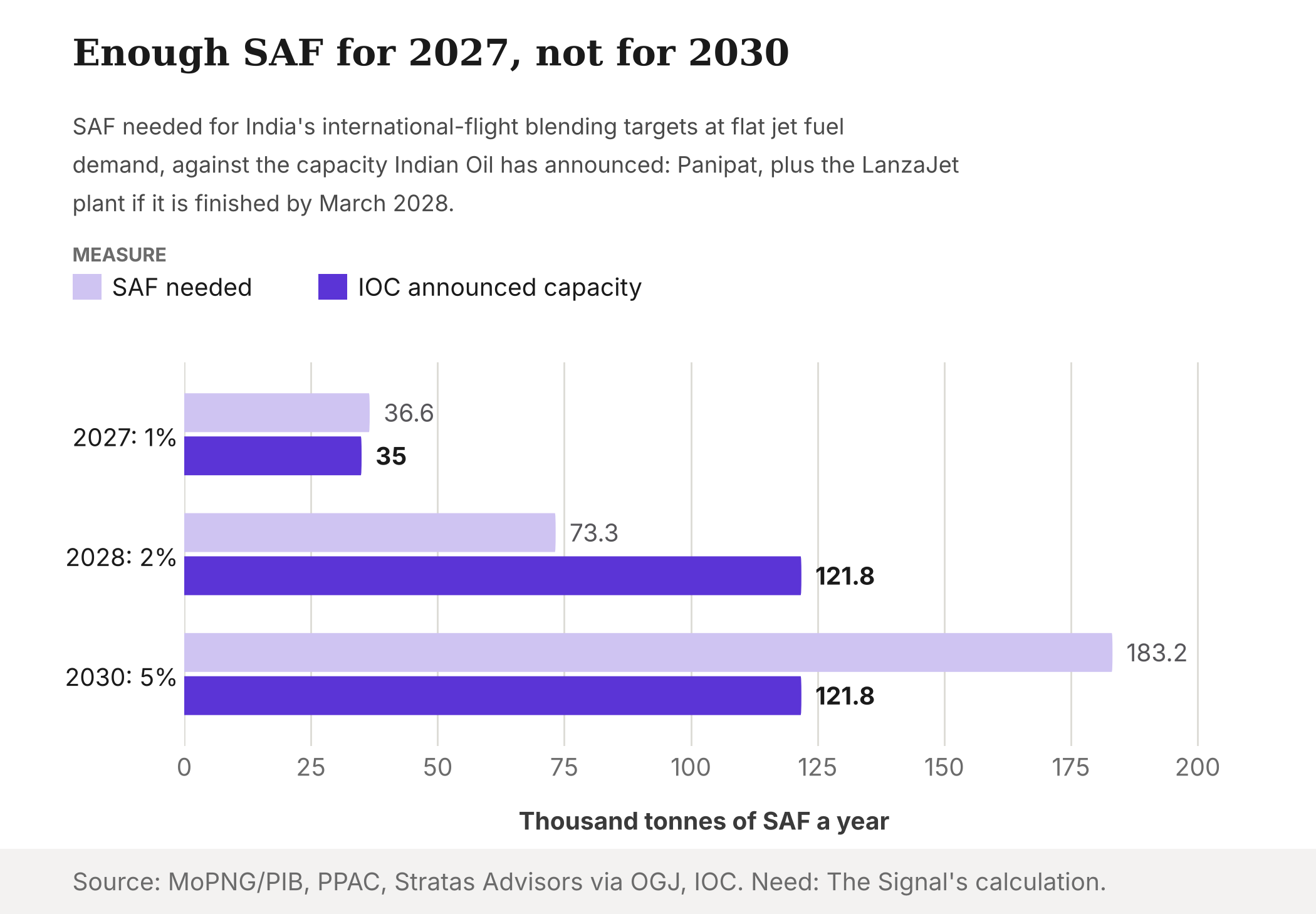
Start with what the mandate asks. The petroleum ministry has set indicative SAF blending targets for international flights of 1% in 2027, 2% in 2028 and 5% in 2030, according to a PIB release from April 2026. The same release notes that the ATF Control Order was amended, notified on 17 April 2026, to bring SAF-blended jet fuel under it, and that the mandatory phase of CORSIA, the global aviation carbon-offset scheme, begins in 2027.
Next, the fuel pool. PPAC data show India consumed about 9,161 thousand tonnes of aviation turbine fuel (ATF) in FY2025-26, the year to March 2026, on provisional monthly figures. The mandate applies only to international flights. A Stratas Advisors analysis published in Oil & Gas Journal estimates that international uplift was about 40% of India's jet fuel demand in 2024, with domestic flights taking the other 60%.
Put those together, 9,161 thousand tonnes times a 40% international share, and India's international jet fuel pool is roughly 3,664 thousand tonnes a year. A 1% blend of that is about 36,600 tonnes of SAF.
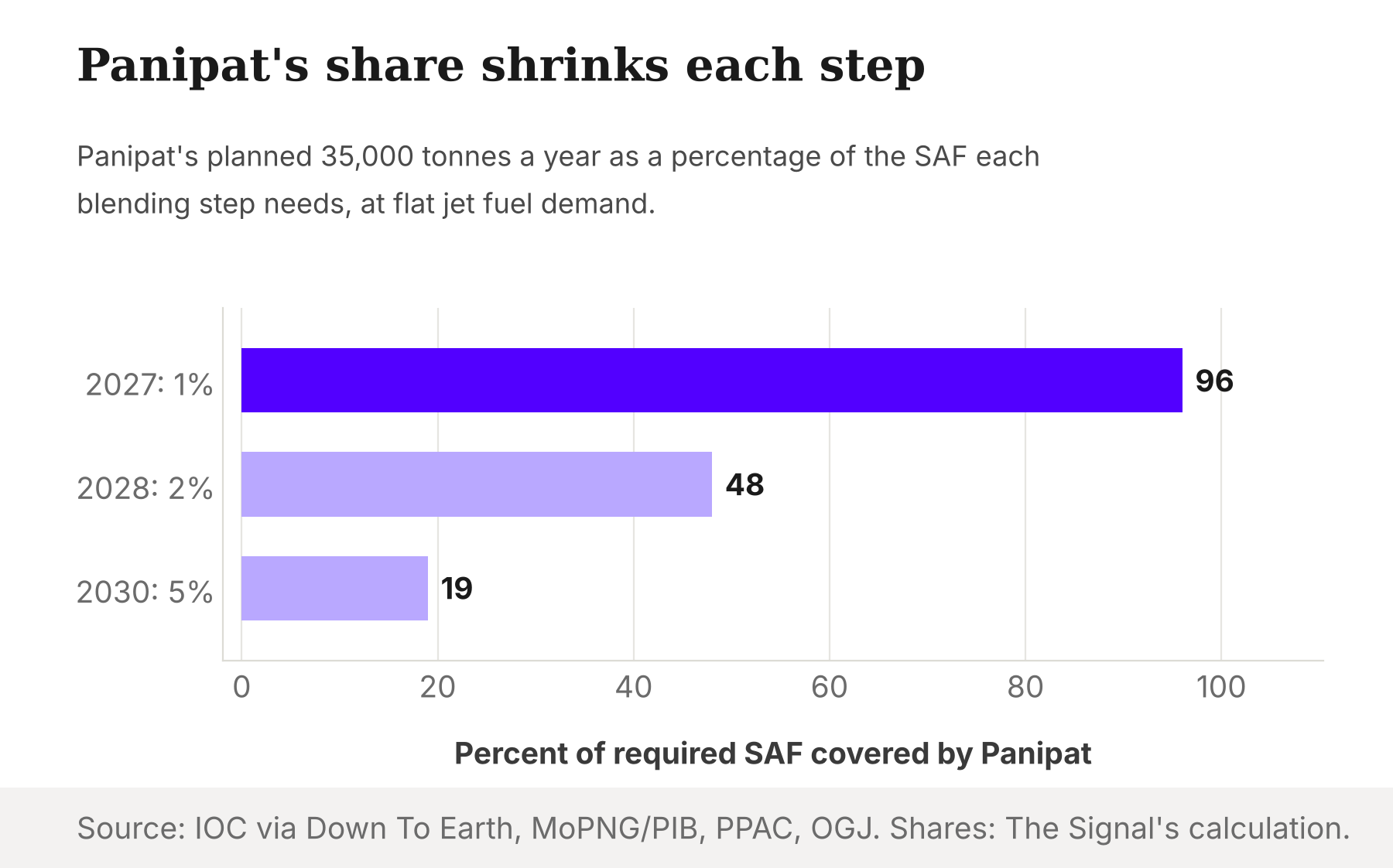
Now the supply. Down To Earth reports that IOC announced in August 2025 that its Panipat unit would produce 35,000 tonnes of SAF a year, using used cooking oil as feedstock. Against a 2027 need of about 36,600 tonnes, that is 96% coverage from one plant. Sahney's claim is close to the arithmetic.
Flat demand is the generous assumption
That 2027 figure assumes jet fuel use stays where it is, and for now it has. PPAC data show ATF consumption of 5,219 thousand tonnes in April to October 2026, against 5,191 thousand tonnes in the same months of 2025, a rise of about 0.5%. The year before was livelier: PPAC put FY2024-25 consumption at 8,985 thousand tonnes, so FY2025-26 grew about 2%.
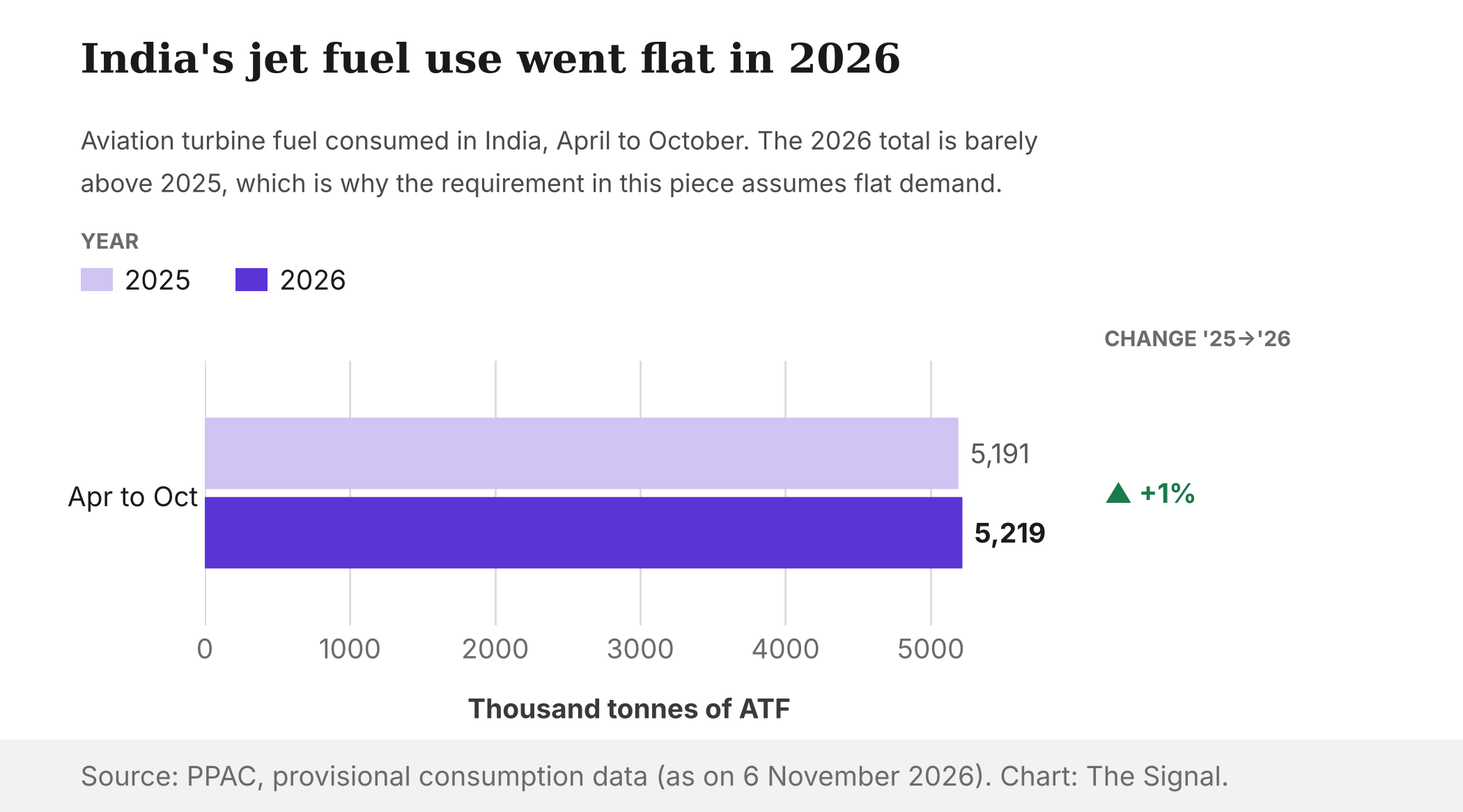
Flat demand flatters the supply side. Any return to the roughly 2% growth of FY2025-26 raises every requirement below, and the 2030 gap grows with it. The requirement figures here are therefore a floor, not a forecast.
Forecasters who build in growth get bigger numbers. A joint S&P Global Energy and SAF Association report, released on 28 September 2026 and reported by Platts, projects India's SAF demand at about 46,000 tonnes in 2027 and roughly 250,000 tonnes by 2030. On that 2027 figure, Panipat's 35,000 tonnes covers about three-quarters of the first year, not 96%.
The step that matters is 2030
The target doubles in 2028 and reaches five times its 2027 level by 2030. Each step uses the same fuel pool, so the requirement scales directly with the blend rate.
At flat demand, India's SAF need grows from about 37,000 tonnes in 2027 to about 183,000 tonnes in 2030.
| Year | Blend target (international flights) | SAF needed (thousand tonnes) | IOC announced capacity (thousand tonnes) | Gap (thousand tonnes) |
|---|---|---|---|---|
| 2027 | 1% | 36.6 | 35.0 (Panipat) | 1.6 short |
| 2028 | 2% | 73.3 | 121.8 (Panipat plus ATJ, if on time) | 48.5 spare |
| 2030 | 5% | 183.2 | 121.8 | 61.4 short |
Targets per the petroleum ministry via PIB; fuel pool from PPAC FY2025-26 consumption and the Stratas Advisors 40% international share; capacity per IOC via Down To Earth and PTI. Requirements and gaps are The Signal's calculations.
The 2028 row depends on IOC's second plant. PTI reports, via Millennium Post, that IOC is developing an alcohol-to-jet (ATJ) SAF facility with US-based LanzaJet, with planned annual capacity of 86,800 tonnes, using ethanol as feedstock and targeted for completion by March 2028. If it finishes on schedule, Panipat plus the ATJ plant total 121,800 tonnes, comfortably above the 2028 need. A plant finished in March 2028 still has to ramp up, so 2028 is covered on paper, not yet in tankers.
By 2030 the paper cover runs out. A 5% blend needs about 183,200 tonnes at flat demand, more than five times Panipat's planned 35,000 tonnes. Both announced IOC plants together fall about 61,400 tonnes short, roughly a third of the requirement.
The approval is narrower than it sounds
Two details in the 17 November report matter. PTI notes that Sahney did not specify the volume of fuel covered by the government approvals or when commercial supplies would begin. And the 35,000 tonnes is a capacity IOC announced, not an output it has reported. The 96% figure compares a planned plant with a derived requirement.
The groundwork is real, though. The petroleum ministry's Year End Review 2025 states that IOC became the first Indian company to receive ISCC CORSIA certification for SAF production, at Panipat, followed by an MoU with Air India for SAF supply. A certified plant with a named airline buyer is further along than most announcements. The same S&P Global and SAF Association report, though, lists Panipat's certified co-processing capacity at 30,000 tonnes, below the 35,000 tonnes IOC announced.
Who pays for the blend
Supply is one constraint; price is the other. IATA, the airline industry body, said in December 2025 that SAF prices exceed fossil jet fuel by a factor of two, and by up to five in mandated markets. On those multiples, a 1% blend lifts the cost of a tonne of blended fuel by 1% to 4%. At 5%, the same multiples lift it by 5% to 20%. These are global multiples, not Indian prices, and IOC has not published a SAF price. The nearest market benchmark is Asian: Platts assessed SAF at $2,440 a tonne, free on board in the Singapore Straits, on 25 September 2026.
At 1%, the premium IATA describes is a rounding error on an international fare. At 5%, it is a line item airlines will want someone else to carry. The mandate's real cost arrives in the same year as its real supply gap.
The honest objection
The strongest case against this reading is that it counts only Indian Oil. IOC is one refiner among several, the targets are indicative rather than binding, and four years is enough time to announce and build more capacity. On that view, a 61,400-tonne gap in 2030 is a planning item, not a shortfall.
That case is fair, and it has numbers behind it. The S&P Global and SAF Association report counts four certified refinery co-processing units in India with 106,500 tonnes of combined annual capacity: Bharat Petroleum's Mumbai refinery at 61,000 tonnes, Panipat at 30,000, Hindustan Petroleum's Visakh refinery at 10,000 and MRPL's Katipalla refinery at 5,500. BPCL says it is developing SAF units at its Mumbai, Kochi and Bina refineries, and plans to commission its first by the end of 2026.
Add the three non-IOC units, 76,500 tonnes, to IOC's two announced plants and India's announced total is about 198,300 tonnes. That clears the flat-demand 2030 need of 183,200 tonnes, narrowly. It does not clear the 250,000 tonnes the report projects for 2030, and the report itself says meeting that figure depends on greenfield plants coming online between 2028 and 2030.
So the claim is limited: the 61,400-tonne gap is between the 2030 target and IOC's announced plants, not between the target and everything India might build. The burden still sits on plants that are not running. The only commercial approval so far covers a plant that the chairman pitched at the 2027 target, and IOC's next plant does not finish until March 2028.
The 40% international share is the other soft spot. It comes from a single Stratas Advisors estimate for 2024. A higher share would widen every requirement; a lower one would narrow them. The 2030 gap closes only if the international share is about a third lower than that estimate.
The Signal
The Panipat approval answers the question the 2027 target asks, and almost no other. The blending schedule is built to be easy first and hard later: 1% of India's international fuel pool is about a single refinery's output, while 5% is more than five times that. Watch for three things: the volume IOC's approval actually covers, whether the LanzaJet plant hits March 2028, and whether any refiner announces capacity aimed at 2030 rather than 2027. On paper, India has nearly covered the first year of its green jet fuel mandate; the hard year is 2030.
Reporting basis: the Panipat approval and the chairman's 2027 claim are per PTI, as carried by ThePrint, and the LanzaJet ATJ plant's capacity and timeline are per the same PTI report, as carried by Millennium Post, so those count as one origin. Panipat's 35,000-tonne capacity and used-cooking-oil feedstock are per IOC's announcement, as reported by Down To Earth. The blending targets, the ATF Control Order amendment and IOC's CORSIA certification are from the Ministry of Petroleum and Natural Gas, via PIB releases. ATF consumption is from PPAC's provisional monthly data. The 40% international share is a single Stratas Advisors estimate, as published by Oil & Gas Journal, and is the only source for that split. The co-processing capacities, the 2027 and 2030 demand projections and the Platts SAF price are from a joint S&P Global Energy and SAF Association report, as reported by Platts and republished by Hellenic Shipping News. BPCL's SAF plans are per BPCL's own website. The SAF price multiples are IATA's global figures. The international fuel pool, the SAF requirements for 2027, 2028 and 2030, the coverage shares, the 2030 gap, India's combined announced capacity and the cost effect of the price multiples are The Signal's calculations from those figures.