The headline version of Thursday's EPFO decision is a straightforward win for retirees. The Labour Ministry says the Central Board of Trustees approved a Systematic Withdrawal Plan on 19 November 2026, so a retiring member can take provident fund savings monthly, quarterly or half-yearly instead of in one lump sum, while the rest of the corpus keeps earning. Until now, retirement meant a cheque and a decision about where to park it.
That reading is right. The interesting part is what the plan is being measured against, and what the fund gives up for the comparison to come out this well.
The number that sells it
EPFO has already run the sales pitch. Business Today, citing internal EPFO estimates, reports that a ₹50 lakh corpus could pay about ₹41,822 a month under the plan at an assumed 8% return, against ₹32,492 from a bank fixed deposit and ₹30,637 from a commercial annuity on post-tax assumptions. On those figures the EPF route pays about 36% more each month than the annuity and about 29% more than the deposit.
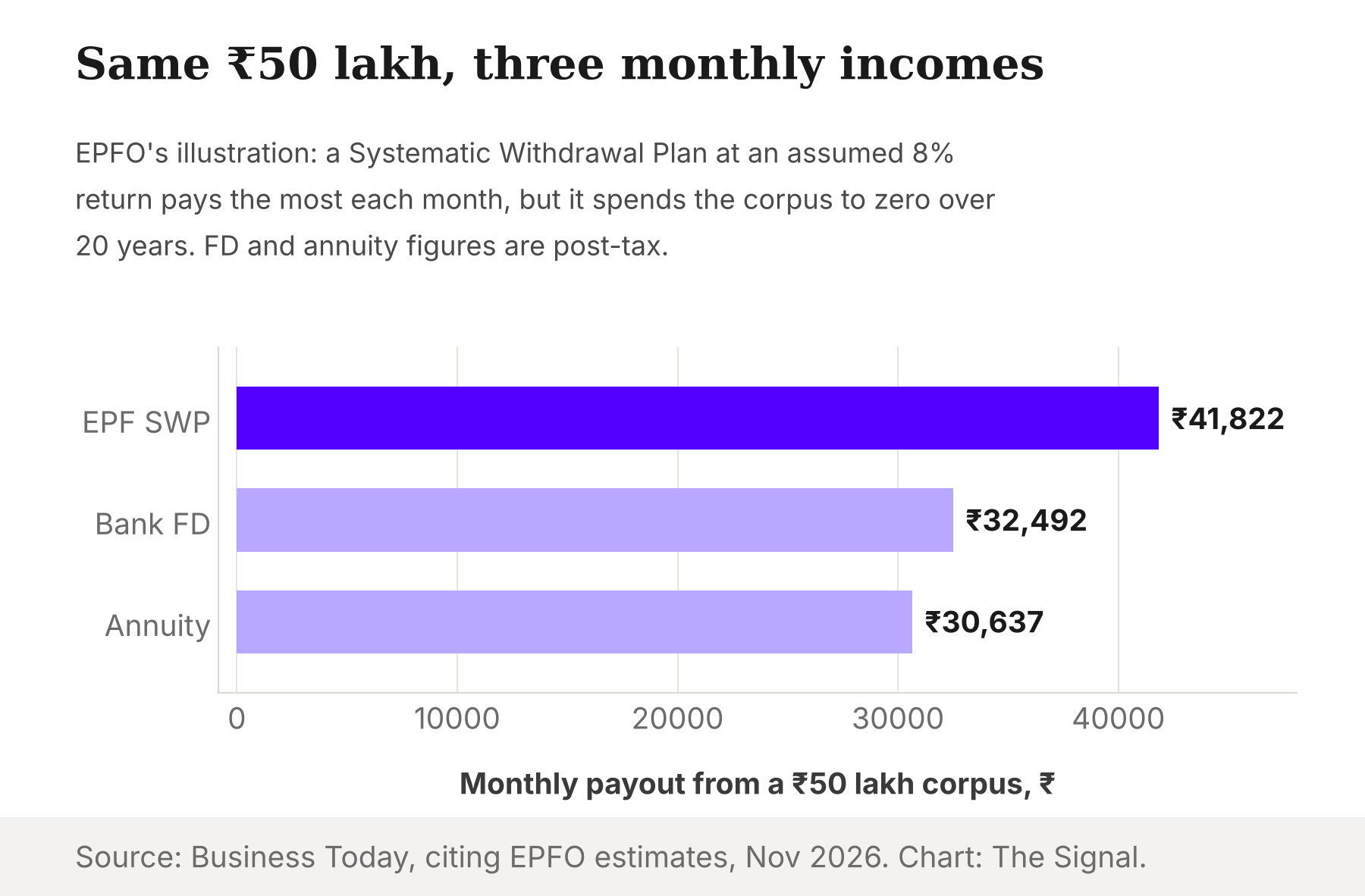
The same illustration contains the catch. Over 20 years, Business Today reports, cumulative withdrawals reach about ₹1 crore. That is 240 payments of ₹41,822, which is what it costs to spend a ₹50 lakh balance plus its interest down to nothing in two decades. An annuity is priced to keep paying for as long as the buyer lives. They are different products. The plan buys a higher income for a fixed term, while an annuity buys insurance against living too long.
Put plainly, EPF wins on monthly income and the annuity wins on the one risk a retiree cannot manage alone.
Who the plan is for
The first wave is large but specific. DT Next, relaying the Labour Ministry, reports that about 6.32 lakh EPF members aged above 55 with balances above ₹5 lakh are expected to be the primary beneficiaries in the initial phase. Even at that ₹5 lakh floor, the group holds at least ₹31,600 crore.
The same meeting loosened the exits for everyone else. The Tribune reports that the minimum balance a member must keep fell from 25% to 10%, and the wait for final withdrawal fell from 12 months to 2 months. EPFO is making it easier to leave before retirement and more attractive to stay after it. Both moves push in the same direction: the fund wants to be where Indians keep their retirement money, not just where it accumulates.
Why staying used to be a bad idea
Under the old rules, a retiree had a reason to take the money out. A Labour Ministry statement reproduced by Business Standard says that under the definition amended with effect from 11 November 2016, as the ministry described it in 2017, an account becomes inoperative after age 58, and inoperative accounts are not credited interest. Leave the money in and it eventually sits idle.
The withdrawal plan changes that. The remaining corpus "continues generating returns," in the ministry's words. That turns EPF from a savings account a retiree empties into a retirement income product a retiree keeps. It also turns the fund's annual interest declaration into something closer to a pension promise, because the people relying on it no longer have a salary to fall back on.
The rate doing the work
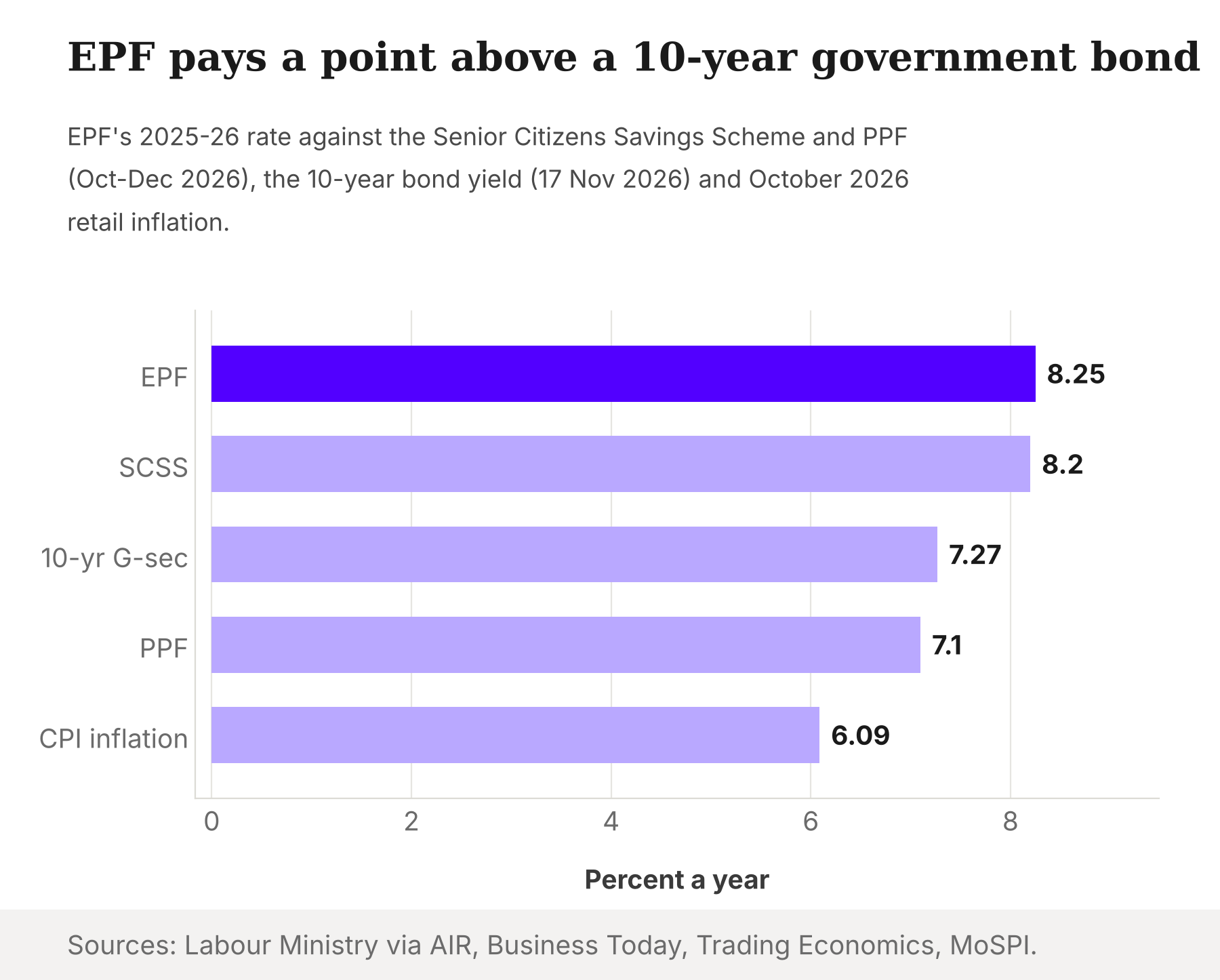
The plan's appeal rests on the EPF rate, and that rate is high by any comparison a retiree can make. All India Radio, relaying the Labour Ministry, reported that the board recommended 8.25% for 2025-26. Trading Economics reports that the 10-year government bond yield was around 7.27% on 17 November 2026, nearly a full point lower. Business Today reports that the Senior Citizens Savings Scheme pays 8.2% and PPF 7.1% for October to December 2026. MoSPI puts retail inflation at 6.09% in October 2026, so the EPF rate still clears prices by about 2.2 points.
The question is whether the fund earns that rate or merely declares it. In March 2026 the fund's own projections pointed to the second. People Matters reports, citing discussions at the meeting, that EPFO's investment sub-committee recommended cutting the rate to 8.10%, with Finance Ministry concurrence, and that keeping 8.25% implied a projected deficit of ₹944.06 crore against a ₹1,675.82 crore surplus at 8.10%.
Fifteen basis points decided whether EPFO ran a surplus or a deficit in 2025-26
| Rate for 2025-26 | Projected result | Who backed it |
|---|---|---|
| 8.10% | Surplus of ₹1,675.82 crore | Investment sub-committee, Finance Ministry |
| 8.25% | Deficit of ₹944.06 crore | Central Board of Trustees (adopted) |
Source: People Matters, citing discussions at the March 2026 CBT meeting.
That 15 basis point gap was worth about ₹2,620 crore in a single year, or roughly ₹175 crore for every basis point. The Pioneer reports that EPFO ran a surplus of nearly ₹5,500 crore in 2024-25 and that the trustees chose to absorb a 2025-26 shortfall of nearly ₹1,000 crore against it. A buffer of that size covers about five years of shortfalls at that pace, and fewer if the fund keeps more money for longer.
The honest objection
The strongest case for the plan is that this worry is overdone. The Pioneer reports the trustees absorbed the 2025-26 shortfall against the previous year's surplus. A deficit of under ₹1,000 crore is small for a fund of EPFO's size, and it was covered without touching members. The plan is voluntary. A retiree who prefers certainty can still take the lump sum and buy an annuity. And a fund that holds money for longer can, in principle, invest it for longer and earn more. On that view, EPFO is simply offering retirees a better deal than the insurance industry does.
All of that is true, and none of it removes the mechanism. The plan's 36% income edge over an annuity, on EPFO's own illustration, comes from two things: spending principal, and an interest rate set above what the fund's own investment panel recommended. The first is the retiree's choice and is fine if understood. The second is a policy choice that now carries a new kind of weight. A worker who sees a rate cut grumbles and keeps contributing. A 70-year-old drawing ₹41,822 a month sees a rate cut as a pension cut, and the pressure on trustees to hold the rate rises with every retiree who signs up.
The Signal
EPFO has moved from collecting retirement savings to paying out retirement income. The ₹41,822 headline is real, but it is a 20-year drawdown on an assumed 8% return, set beside an annuity that pays for life. The rate that makes the comparison work already cost the fund a projected ₹944 crore in 2025-26 against its own panel's advice. Watch three things: the scheme notification that will set the final terms, the rate declared for 2026-27, and how many of the 6.32 lakh eligible members choose to stay. The more of them stay, the less freedom the trustees will have to set that rate.
Reporting basis: the Systematic Withdrawal Plan and its terms are from the Labour Ministry's Press Information Bureau release of 19 November 2026; the 6.32 lakh beneficiary estimate is the ministry's, as relayed by DT Next, and the minimum-balance and waiting-period changes are the ministry's, as reported by The Tribune. The ₹50 lakh payout comparison and its ₹1 crore 20-year total rest on a single source, Business Today's report of internal EPFO estimates, which The Signal did not see directly. The 8.25% rate for 2025-26 is the Labour Ministry's statement as relayed by All India Radio. The investment panel's 8.10% recommendation and the projected deficit and surplus figures come from People Matters, citing discussions at the March 2026 board meeting, and the 2024-25 surplus and the decision to absorb the shortfall are as reported by The Pioneer; those two reports describe the same meeting and may share sources there. The inoperative-account rule is from a 2017 Labour Ministry statement reproduced by Business Standard. The bond yield is per Trading Economics, the small savings rates per Business Today, and inflation per MoSPI's October 2026 CPI release. The percentage income gaps, the ₹31,600 crore floor, the 15 basis point swing of about ₹2,620 crore, the per-basis-point cost, the real return over inflation and the buffer arithmetic are The Signal's calculations from those figures.