On 20 November 2026 the Supreme Court dismissed Karnataka's appeal against the High Court order that let bike taxis back on the state's roads. Deccan Herald reports that the court observed bike taxis already run in 25 states and offer an affordable, convenient option, particularly for women. Before the bench, the aggregators submitted that nearly 4.5 lakh passengers benefited from bike taxis in Karnataka, a figure that is the companies' own claim rather than an official count. The easy read writes itself: the platforms won, the state lost, and a fight that began with a High Court order in April 2025 is over.
It is worth slowing down on that. The court settled whether bike taxis may run in Karnataka. It did not settle on what terms, and the terms are where the money is. The Centre's own rulebook, the Motor Vehicle Aggregator Guidelines issued in 2025, already hands each state a dial for exactly this business. Karnataka lost the ban. It kept the dial.
The clause that replaces the ban
The dial is Clause 23. The Ministry of Road Transport and Highways' guidelines state that a state may impose fees on an aggregator for authorisations permitting non-transport motorcycles to carry passengers, on a daily, weekly or fortnightly basis, as the state determines. A non-transport motorcycle is a private, white-plate bike, the kind registered for personal use rather than for hire.
That one sentence moves the contest. Under a ban, the state's only choice is yes or no, and a court can overrule it. Clause 23 instead lets the state set a price per bike per day, at whatever amount it chooses. A low fee invites the platforms in. A high fee can make the arithmetic of a short, cheap ride stop working without anyone uttering the word "ban".
The Centre has also made clear it does not intend to settle the details itself. The guidelines say states may adopt them within three months of issue and may add provisions of their own. They are a model, not a mandate.
Maharashtra shows what a state does with that freedom. Its Bike-Taxi Rules, 2025, notified on 4 July 2025, require a licensee to have at least 50 electric bike-taxis, run as permitted contract carriages rather than private bikes. A year later the state put a number on the lever. In July 2026, Deccan Herald reports, transport minister Pratap Sarnaik told the assembly that under a proposed policy, bike-taxi operators would pay the government a daily fee of ₹5, with a further ₹2 from every ride going to a welfare fund for drivers. The fee is only a proposal and has not been notified. Still, it is the first state price on the record for the kind of per-day charge Clause 23 allows.
Why the private bike is the whole business
The registration data shows why Clause 23 matters. Bar and Bench reports the Road Transport Ministry's 18 March 2026 Rajya Sabha reply, which said the Centre keeps no bike-taxi data and relies instead on Vahan figures for two-wheelers registered as transport vehicles: 16,736 in 2023, 19,509 in 2024 and 20,111 in 2025, across all of India.
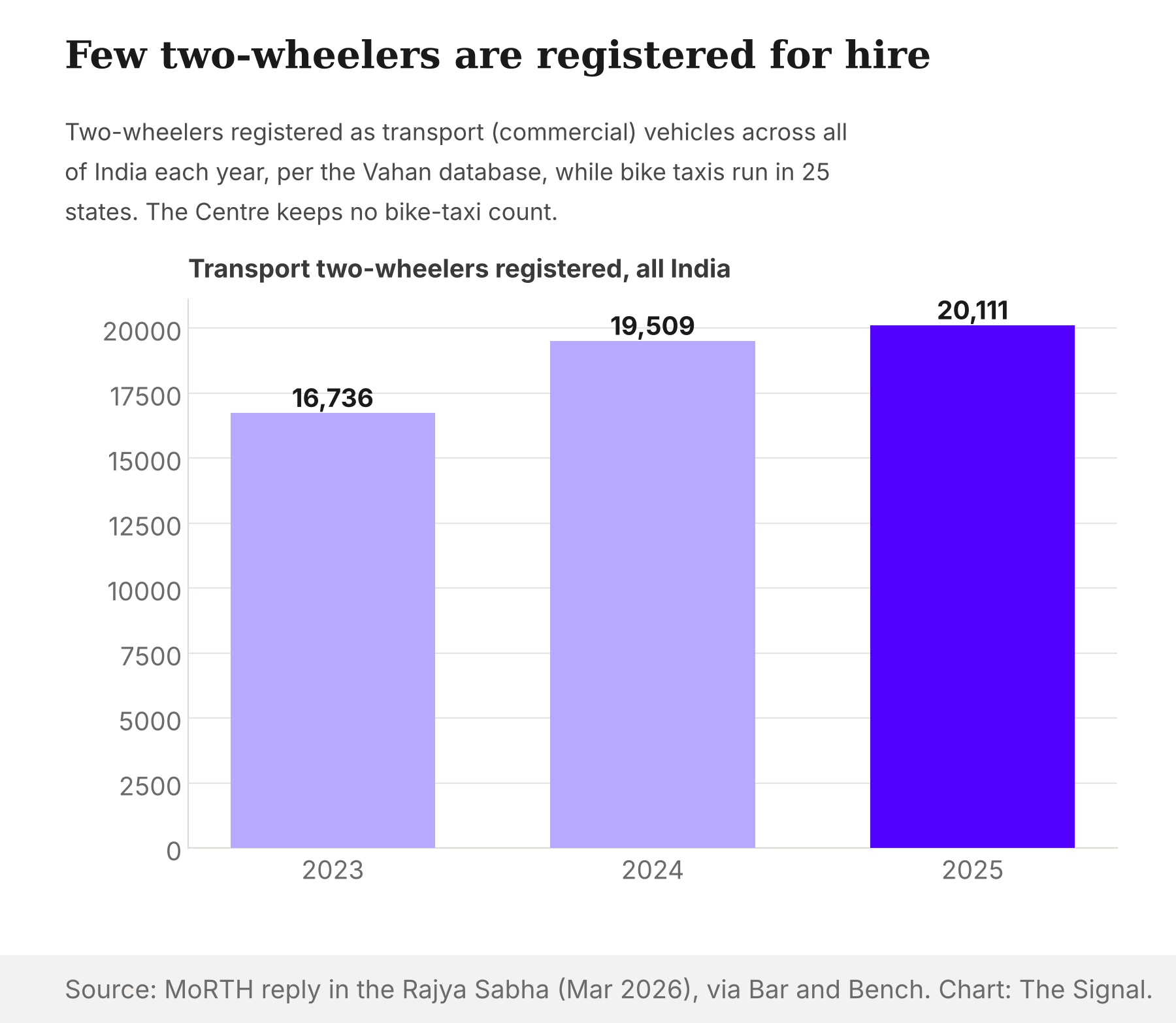
Source: Vahan figures from the Road Transport Ministry's 18 March 2026 Rajya Sabha reply, as reported by Bar and Bench. Chart: The Signal.
Set those Vahan registration figures beside a service that the Supreme Court noted runs in 25 states. About 20,000 commercial two-wheeler registrations a year, for the entire country, is a thin base for an industry of that reach. The data cannot say how many bike taxis run on private plates, and the ministry says it does not count them. But the gap points one way: the business has grown on white-plate bikes, which is precisely the category Clause 23 was written to license. Whoever sets the white-plate fee sets the industry's cost of operating.
What the rest of the rulebook costs
The fee is not the only lever. The 2025 guidelines also fix a fare band and a floor of insurance, and each moves the economics of a two-wheeler ride.
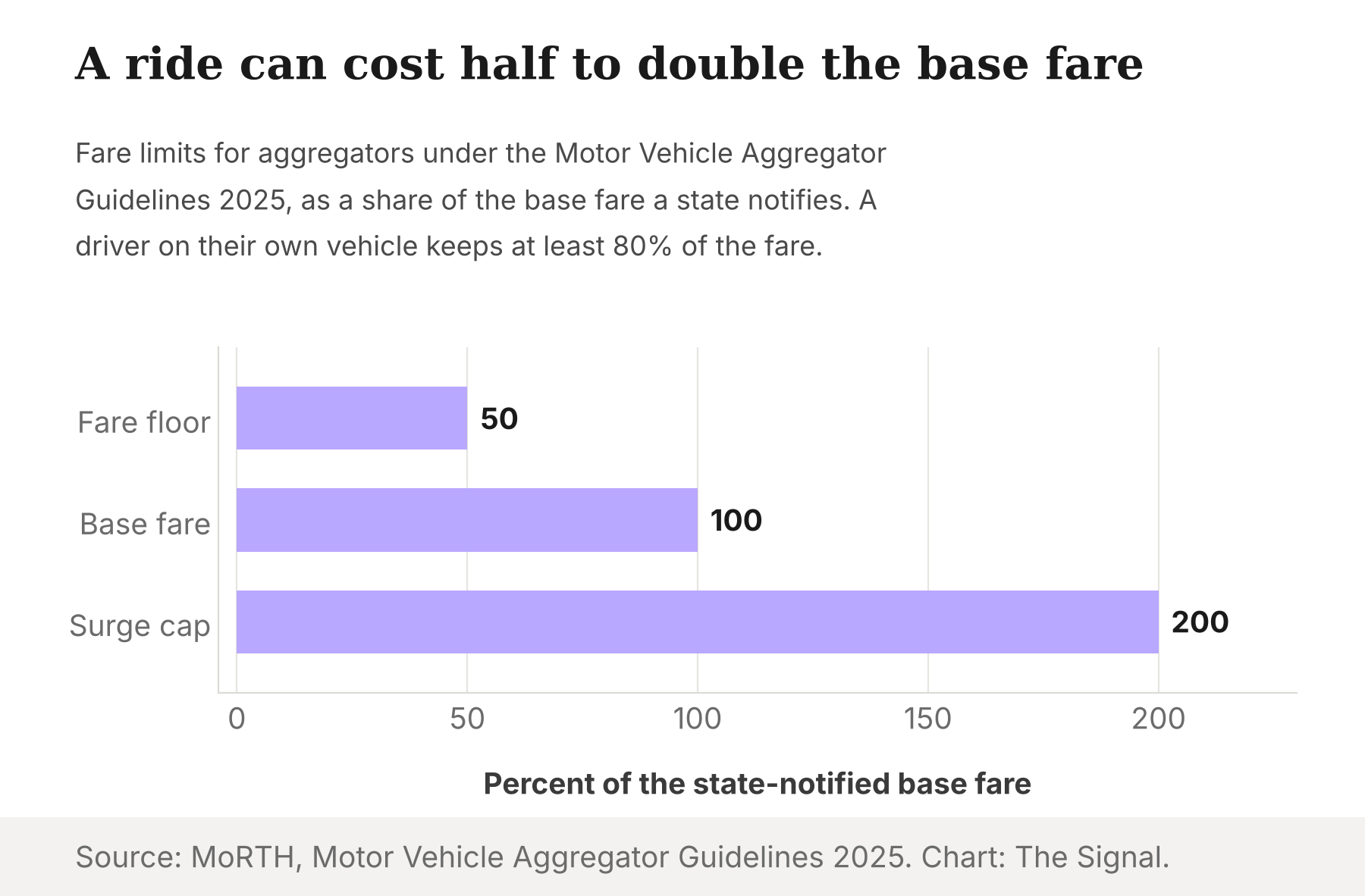
Source: Ministry of Road Transport and Highways, Motor Vehicle Aggregator Guidelines 2025. Chart: The Signal.
On price, the guidelines specify that an aggregator may charge as little as half the state-notified base fare and as much as twice it, and that a driver using their own vehicle must receive at least 80% of the fare. The base fare is itself set by the state, so the band moves wherever Karnataka anchors it.
The model rules put a fixed cost under every rider and every passenger.
| Requirement under the 2025 guidelines | Minimum amount | Paid or arranged by |
|---|---|---|
| Term insurance per driver on-boarded | ₹10 lakh | Aggregator |
| Health insurance per driver on-boarded | ₹5 lakh | Aggregator |
| Insurance per passenger | ₹5 lakh | Aggregator |
| Aggregator licence, grant (valid five years) | ₹5,00,000 | Aggregator |
| Aggregator licence, renewal | ₹25,000 | Aggregator |
Source: Ministry of Road Transport and Highways, Motor Vehicle Aggregator Guidelines 2025, clauses on driver insurance, passenger insurance and licence fees.
The guidelines require aggregators to provide each on-boarded driver term insurance of at least ₹10 lakh and health insurance of at least ₹5 lakh, and to ensure passenger insurance of at least ₹5 lakh. The model licence fee is ₹5,00,000 to grant and ₹25,000 to renew, for a five-year licence. The licence is a one-time cost an aggregator spreads across a whole state. The insurance scales with every rider it signs up, and the Clause 23 fee scales with every day each bike works.
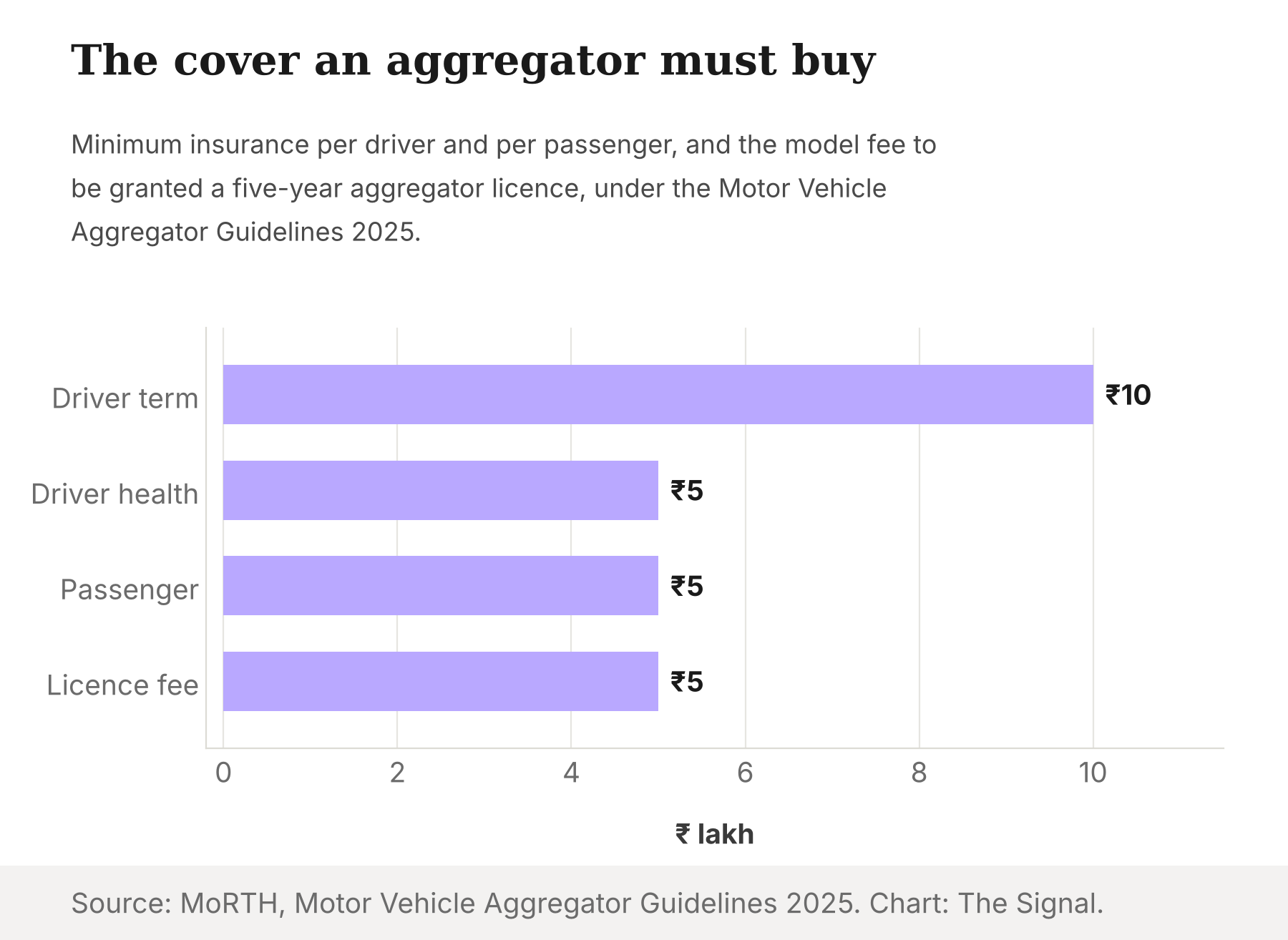
Source: Ministry of Road Transport and Highways, Motor Vehicle Aggregator Guidelines 2025, clauses on driver insurance, passenger insurance and licence fees. Chart: The Signal.
What the switch-off showed
Karnataka has already run the experiment of switching the service off and on. LiveLaw reports that a single judge of the High Court ordered in April 2025 that bike-taxi operations cease within six weeks, a deadline later extended to 15 June 2025, so services stopped from 16 June 2025.
When a High Court division bench lifted the ban on 23 January 2026, demand returned fast, at least by one company's account. Deccan Herald, quoting a Rapido spokesperson, reports that daily bike-taxi trips rose by about 10,000 after the ban was lifted, a 5% rise in the company's overall daily rides. That is a platform's claim, not audited data, but it is the only post-ban volume figure on the record.
The people on the bikes sit inside a much larger workforce. A NITI Aayog report, as released by PIB, estimates that 77 lakh workers were engaged in the gig economy in 2020-21 and projects that number to reach 2.35 crore by 2029-30, roughly three times the 2020-21 level. Clause 23 fees and the 80% driver share decide how much of each fare reaches that workforce.
The honest objection
The strongest case for Karnataka's original position is not about bikes at all. In June 2025, Deccan Herald reports, Karnataka's transport minister ruled out a bike-taxi policy, arguing that it would affect 1.75 lakh auto-rickshaws in Bengaluru that operate legally with the required permits. The same report estimated the ban would affect over one lakh workers. Auto drivers paid for permits, commercial plates and the obligations that come with them. A white-plate bike carrying the same passenger skips much of that. Allowing it, on this view, is not competition. It is a subsidy to the rider who did not pay.
That case is real, and the Supreme Court's observation that bike taxis run in 25 states does not answer it. Clause 23 does. If the grievance is that white-plate riders carry passengers without paying what permit holders pay, the guidelines give the state a daily, weekly or fortnightly fee to close that gap, set at whatever level the state judges fair. The auto drivers' argument does not lose with the ban. It moves to the fee schedule, where it can be priced instead of litigated.
The pricing is less obvious than it sounds. Deccan Herald reported in July 2024 that a Bengaluru auto-rickshaw permit costs ₹750 and runs for five years, though permits sometimes change hands on the black market for as much as ₹35,000. At the ₹5 a day Maharashtra has proposed, a bike working every day would pay about ₹1,825 in a year, more than twice the official five-year permit, by The Signal's arithmetic. What an auto driver really paid for is the scarce permit and the black-market price it carries, not the ₹750 fee.
The Signal
The ban was a blunt instrument, and the courts have now taken it away twice over. What remains is finer and more powerful: the per-bike authorisation fee, the base fare that anchors the 50% to 200% band, and the insurance floor the state chooses to enforce. Each can be set to welcome the platforms or to squeeze them. Watch Karnataka's first notification under the 2025 guidelines, and set it against Maharashtra's proposed ₹5 a day. A fee in that range is a licence charge. Pitch it many times higher and the state is rebuilding the ban out of arithmetic. The court decided that bikes may carry passengers. The fee schedule will decide how many do.
Reporting basis: the Supreme Court's 20 November 2026 order and its observation on 25 states are per Deccan Herald; the 4.5 lakh passenger figure is the aggregators' own submission, as reported by Bar and Bench, and is not an official count. The 2025 High Court timeline is per LiveLaw. The post-ban rise in trips is a Rapido spokesperson's claim, carried by Deccan Herald, and rests on that single company source. The transport minister's 1.75 lakh auto-rickshaw figure and the one-lakh worker estimate are per a separate Deccan Herald report. Fee, fare, insurance and licence terms are from the Ministry of Road Transport and Highways' Motor Vehicle Aggregator Guidelines 2025, read in the original document. Two-wheeler transport registrations are Vahan figures from the ministry's 18 March 2026 Rajya Sabha reply, as reported by Bar and Bench. The gig workforce estimate is NITI Aayog's, via PIB. Maharashtra's electric bike-taxi requirement is from the state's notified Bike-Taxi Rules, 2025, read in the original; its proposed ₹5 daily fee is the transport minister's statement to the assembly, as reported by Deccan Herald with PTI, and has not been notified. The Bengaluru auto permit cost is per a July 2024 Deccan Herald report. The court reporting rests on three outlets (Deccan Herald, LiveLaw, Bar and Bench); the official texts rest on three bodies (the Road Transport Ministry, NITI Aayog and the Maharashtra government); the company figures rest on the aggregators and Rapido themselves. The roughly threefold gig-workforce multiple and the ₹1,825 annual equivalent of Maharashtra's proposed fee are The Signal's calculations from those figures.