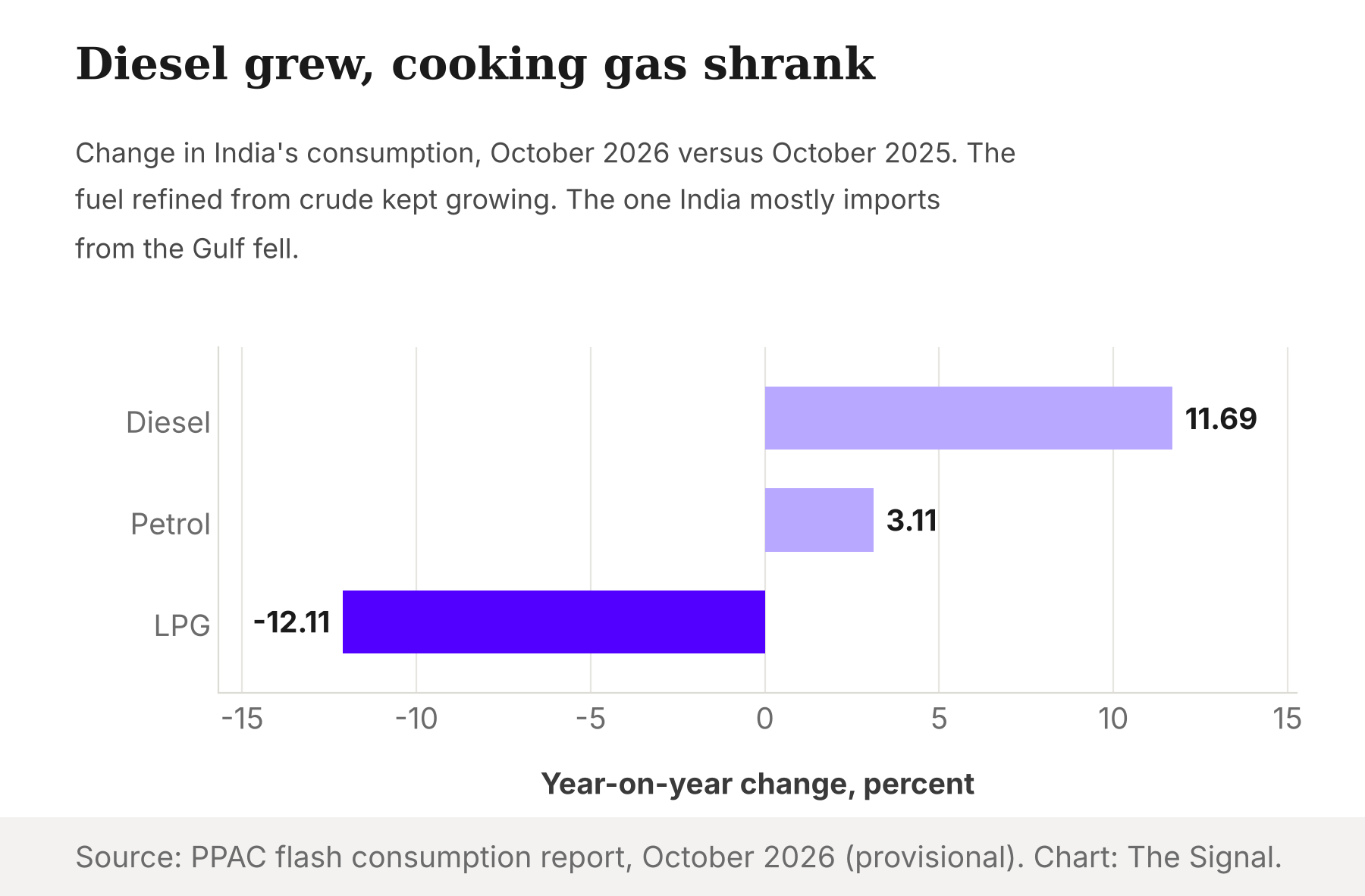
October's oil numbers have been read as a story about the import bill. A quieter line in the same data shows who is absorbing the West Asia shock. India's LPG consumption fell 12.11% in October 2026 to 2,614 thousand tonnes, from 2,974 thousand tonnes a year earlier, the Petroleum Planning & Analysis Cell's flash report shows.
That would be unremarkable if every fuel were shrinking under high prices. They are not. In the same month diesel consumption rose 11.69% to 8,511 thousand tonnes and petrol rose 3.11% to 3,779 thousand tonnes, per PPAC. The fuel that runs trucks grew at almost the same rate as the fuel that runs kitchens shrank.
Demand did not do this. Geography did. Over the past year India rebuilt where its crude comes from. It never rebuilt where its cooking gas comes from, and October is what that asymmetry looks like once the Gulf supply line breaks.
Crude learned to route around the Gulf
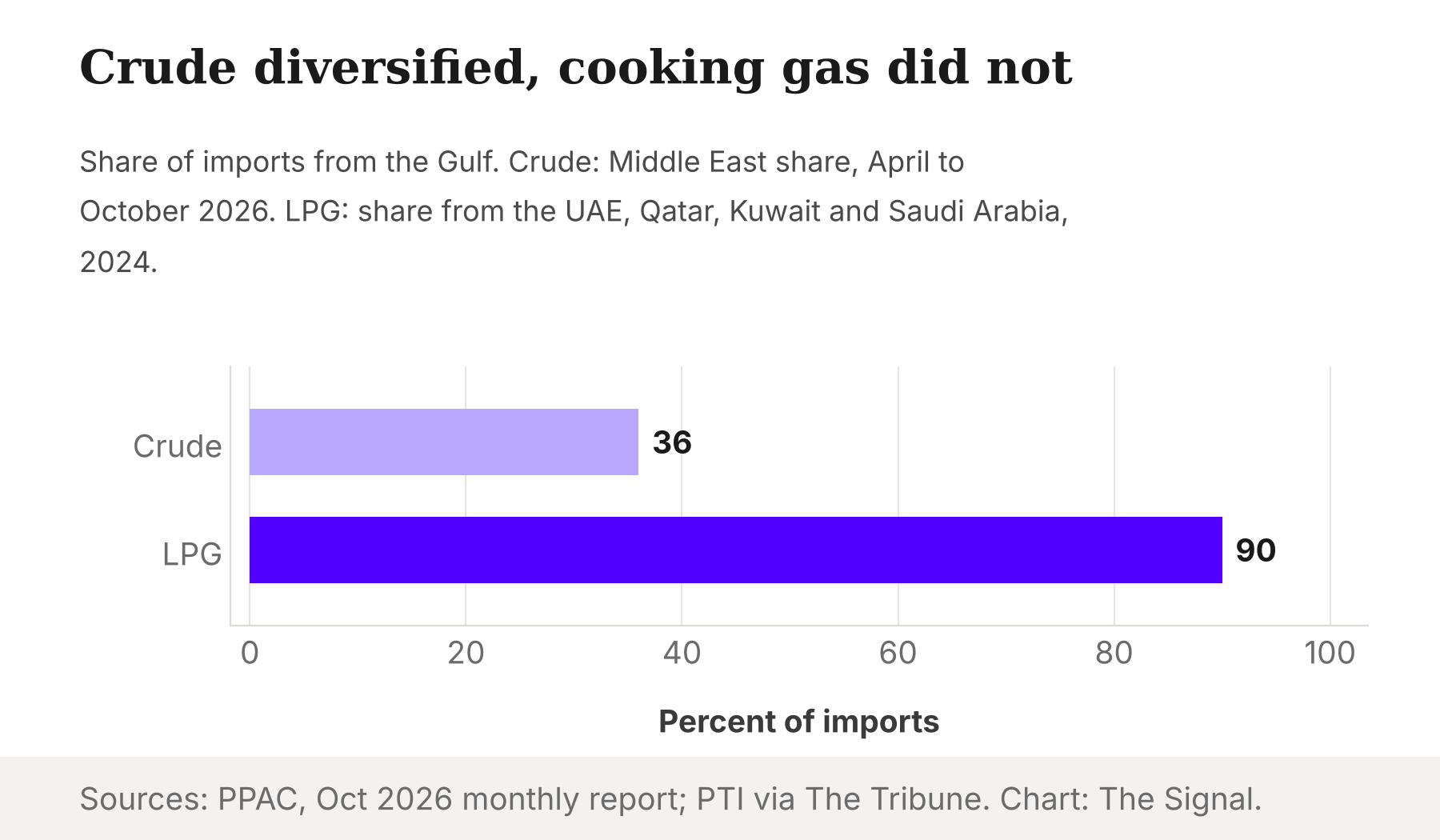
The crude side of the ledger has been reshaped. Imports from OPEC countries fell to 27.4% of India's crude imports in April to October 2026, from 38.5% a year earlier, PPAC's monthly report shows. By region, the Middle East supplied 36.0% of crude imports over April to October 2026, while Eurasia supplied 43.8%. Refiners kept running, so diesel and petrol kept flowing to the pump.
LPG never made that shift. India imports about 60% of its LPG consumption, and about 90% of those imports transit the Strait of Hormuz, Minister of State for Petroleum Suresh Gopi told the Rajya Sabha in March 2026. The supplier list is short. In 2024 India imported 20.4 million tonnes of LPG, about 90% of it from the UAE, Qatar, Kuwait and Saudi Arabia, PTI reported.
| Fuel | Gulf exposure | Period | October 2026 consumption change |
|---|---|---|---|
| Crude (feeds diesel and petrol) | Middle East share of imports: 36.0% | April to October 2026 | Diesel +11.69%, petrol +3.11% |
| LPG | Share of imports from four Gulf states: about 90% | 2024 | LPG -12.11% |
Sources: PPAC monthly report and flash report, October 2026; PTI via The Tribune.
The difference is what each fuel allows. Crude can be bought from many regions and run through the same Indian refinery, which is how Eurasia came to supply more of it than the Middle East. Imported LPG had no comparable second source lined up at scale.
When the strait closed, the cooking gas went with it
The scale of the break is in the shipping data. Gulf countries exported almost 1.5 million barrels a day of LPG through the Strait of Hormuz in 2025, and by April 2026 those flows had fallen to 270,000 barrels a day, according to the IEA citing Kpler data, as reported by Oil & Gas Journal. The same report found that India's LPG arrivals in April fell by more than 40% from January and February levels despite more US cargoes. The disruption affected about 30,000 tonnes a day of India's LPG supplies, Down To Earth reported.
India's response was to make more at home and import less. Refinery production of LPG was raised to 50,000 tonnes per day by May 2026, petroleum ministry joint secretary Sujata Sharma said at a briefing. By October, the supply mix had flipped. Refineries and fractionators produced 1,329 thousand tonnes of LPG in October 2026, while India imported 1,256 thousand tonnes of LPG that month, per PPAC. Imports covered about 48% of October's 2,614 thousand tonnes of consumption, against the pre-crisis share of about 60%.
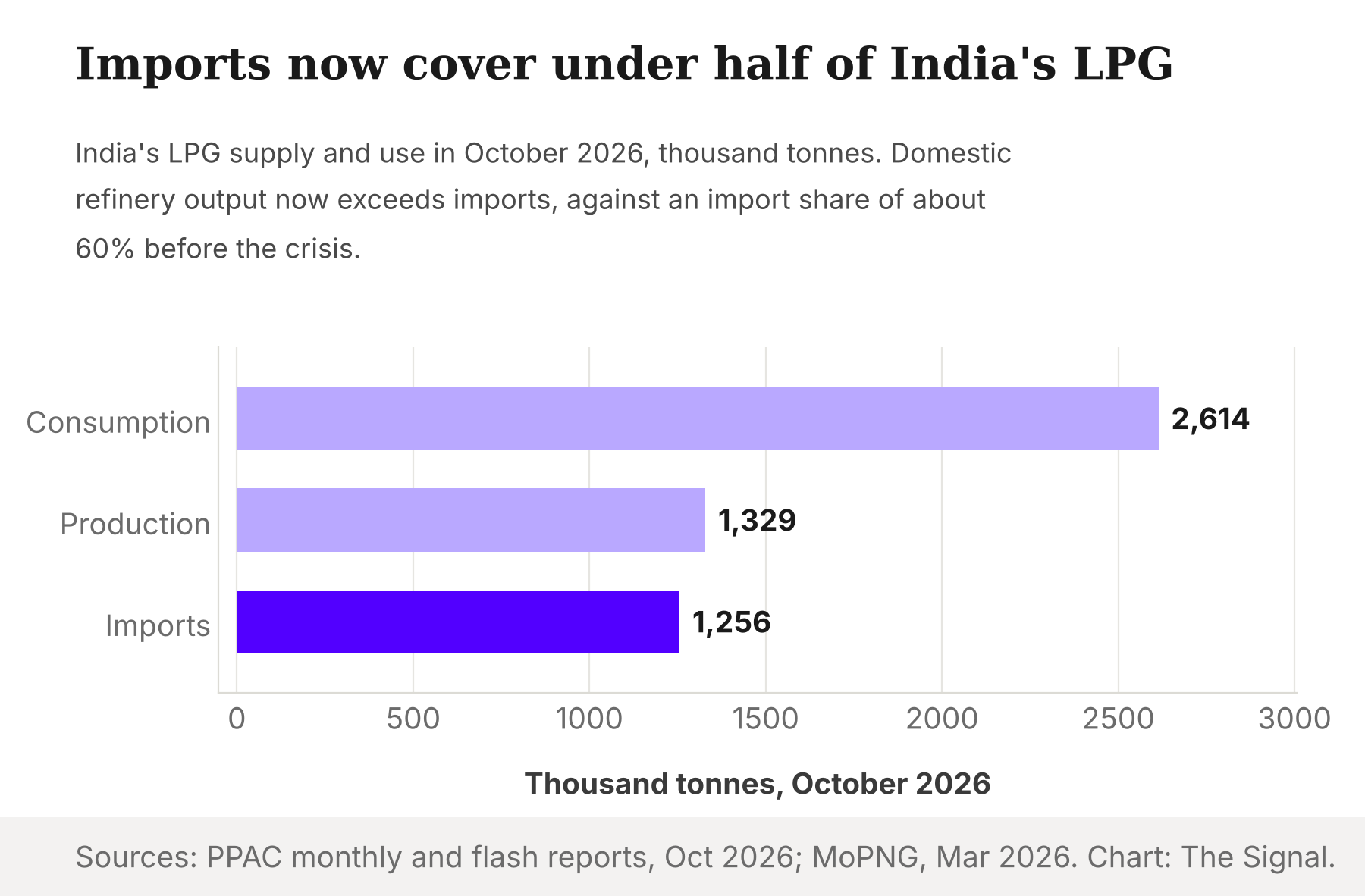
That looks like progress on self-reliance. It is mostly arithmetic. Domestic output rose, but not by enough to replace the missing cargoes, so the gap was closed by consuming less. Over April to October 2026, LPG consumption was 16,318 thousand tonnes against 19,090 thousand tonnes a year earlier, a shortfall of 2,772 thousand tonnes in seven months.
Households took the hit, not just restaurants
The first reflex is to assume the cut fell on hotels and eateries. The government did ration that segment: it raised commercial LPG allocation to states by 20% to 70% of the pre-crisis level, the ministry said in March.
But the domestic numbers fell almost as hard as the total. PSU oil companies' domestic LPG sales were 12.2 million tonnes in April to September 2026, down 13.5%, PPAC's LPG Profile shows, against a 14.6% fall in their total LPG sales over the same six months. The household cylinder carried nearly the whole decline.
The customer base is shrinking too. The same table shows active domestic LPG customers at 3,339 lakh on 1 April 2026 and 3,267 lakh on 1 October 2026, a drop of 72 lakh connections in six months. Growth stopped at the front door as well: issuance of new connections has been on hold since the West Asia crisis began, leaving about 5 lakh applicants waitlisted on 1 October 2026, per PPAC.
The honest objection
The strongest counter-reading is that much of this is administrative, not hardship. A drop in active connections can be paperwork. In March 2026 the government ordered households holding both piped natural gas and LPG connections to surrender the LPG one, so some of the 72 lakh lost connections are city homes that kept cooking on piped gas. A freeze on new connections also cuts the count without taking fuel from anyone already using it. On this view, the consumption fall is managed rationing of a scarce import, which is what a government is supposed to do in a supply shock.
That reading is fair about the connection count and wrong about the conclusion. Rationing is the symptom, not the alternative explanation. The government had to ration LPG and did not have to ration diesel, because one fuel's supply chain had already been diversified and the other's had not. The 2,772 thousand tonnes of missing consumption over April to October 2026 are real tonnes not burned in Indian kitchens, whether the cut arrived through a closed booking window or an empty delivery truck. The data cannot show what households cooked with instead, and this piece does not claim to know.
The Signal
India spent the past year making its crude supply resilient to the Gulf, and October's diesel numbers show that work paid off at the pump. The same data show it left the most politically sensitive fuel in the country exposed to one strait. The lever now is the same one that worked for crude: more non-Gulf supply contracts and more domestic output. Watch PPAC's import line each month. If imports recover toward their old share of consumption, the fall was a shock that passed. If production keeps rising while imports stay below half, India is quietly rebuilding its LPG chain around the kitchen it could not protect. Energy security that stops at the refinery gate is only half finished.
Reporting basis: consumption figures for LPG, diesel and petrol (from PPAC's October 2026 flash report), crude import shares by region and from OPEC, and LPG production and import volumes for October 2026 are from the Petroleum Planning & Analysis Cell's flash and monthly reports (provisional); domestic and total LPG sales, active domestic customers and the hold on new connections are from PPAC's LPG Profile for April to September 2026, compiled from the three public-sector oil marketing companies. The import-dependence and Hormuz-transit shares and the commercial LPG allocation are from the petroleum ministry's reply in the Rajya Sabha, the connection-surrender order is a ministry notification, and the 50,000 tonnes a day production figure is from a ministry briefing, all as reported by All India Radio. The 2024 import volume and supplier shares are per PTI, as carried by The Tribune. Hormuz LPG export volumes and India's April arrivals are the IEA's figures citing Kpler, as reported by Oil & Gas Journal, and the 30,000 tonnes a day disruption estimate is from a single Down To Earth report. Every PPAC and ministry figure ultimately traces to one government origin, so the piece rests on five independent origins in all: PPAC, the petroleum ministry, PTI, the IEA and Down To Earth. The import share of October consumption, the seven-month consumption shortfall and the fall in active connections are The Signal's calculations from those figures.