The easy story this week is a triumph. Ramayana opened on November 5 and, by the estimates of box-office tracker Sacnilk, collected Rs 511.10 crore net in India in its first seven days, and Rs 934.55 crore gross worldwide. For an industry that spent the years after the pandemic worrying about empty halls, that looks like proof the audience is back.
The second story got far less space. Filmmaker Vinod Kapri said in a social media post that his film Pyre, after expanding from 80 screens to 400 on audience response, lost 75% of its showtimes within two days and fell to under 100. Kapri did not name the film he blamed. Outlook India notes that the cut coincided with the November 5 release of Nitesh Tiwari's Ramayana.
These are usually told as two separate stories: a hit, and a complaint. They are one story. India has so few screens that a show given to one film is a show taken from another.
The number that carries it
Sacnilk's tracking shows Ramayana ran 24,239 shows in India on its seventh day, Wednesday November 11, and 1,66,476 shows across the week. According to the FICCI-EY 2026 report, as summarised by Bollywood Hungama, India had a total of 10,033 screens in 2025. Put those together and one film was running about 2.4 shows a day for every cinema screen in the country, on an ordinary weekday in its first week.
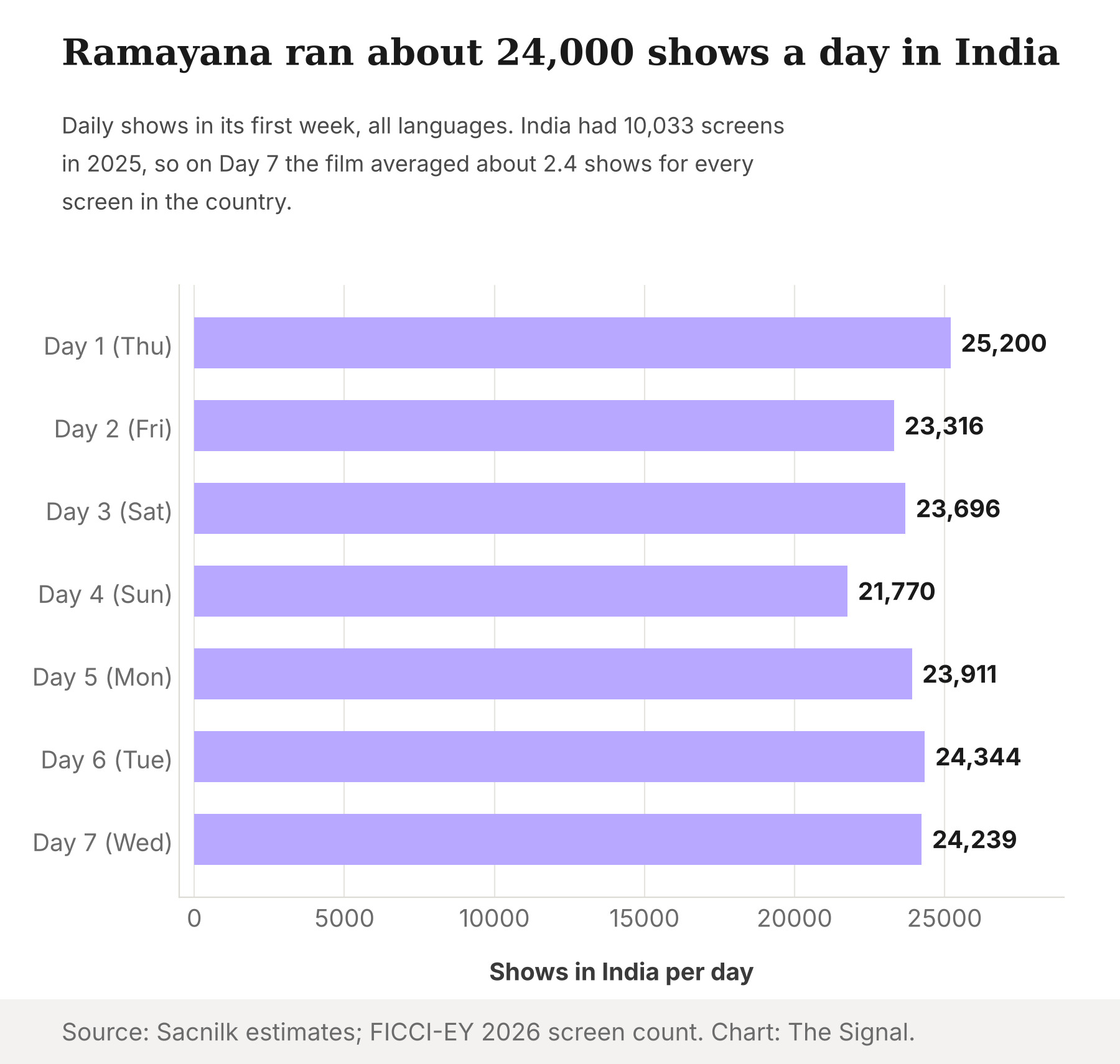
The plan was never modest. Before release, Business Today reported that the domestic footprint was slated for roughly 9,000 screens. Against 10,033 screens in the country, that is close to nine in every ten. Some of those screens would also have run other films at other hours. But every show Ramayana takes in a given hall is a slot that cannot go to Pyre, or to anything else.
A market of fixed slots
The squeeze is structural because the screen base barely moves. A Multiplex Association of India report prepared by EY found that screens rose only from 9,527 in 2019 to 9,927 in 2024, while screens per million people fell from 7.6 to 6.8. In 2025, per the FICCI-EY summary, 240 screens were added while 124, mainly single screens, shut down. That is a net gain of 116 screens in a year.
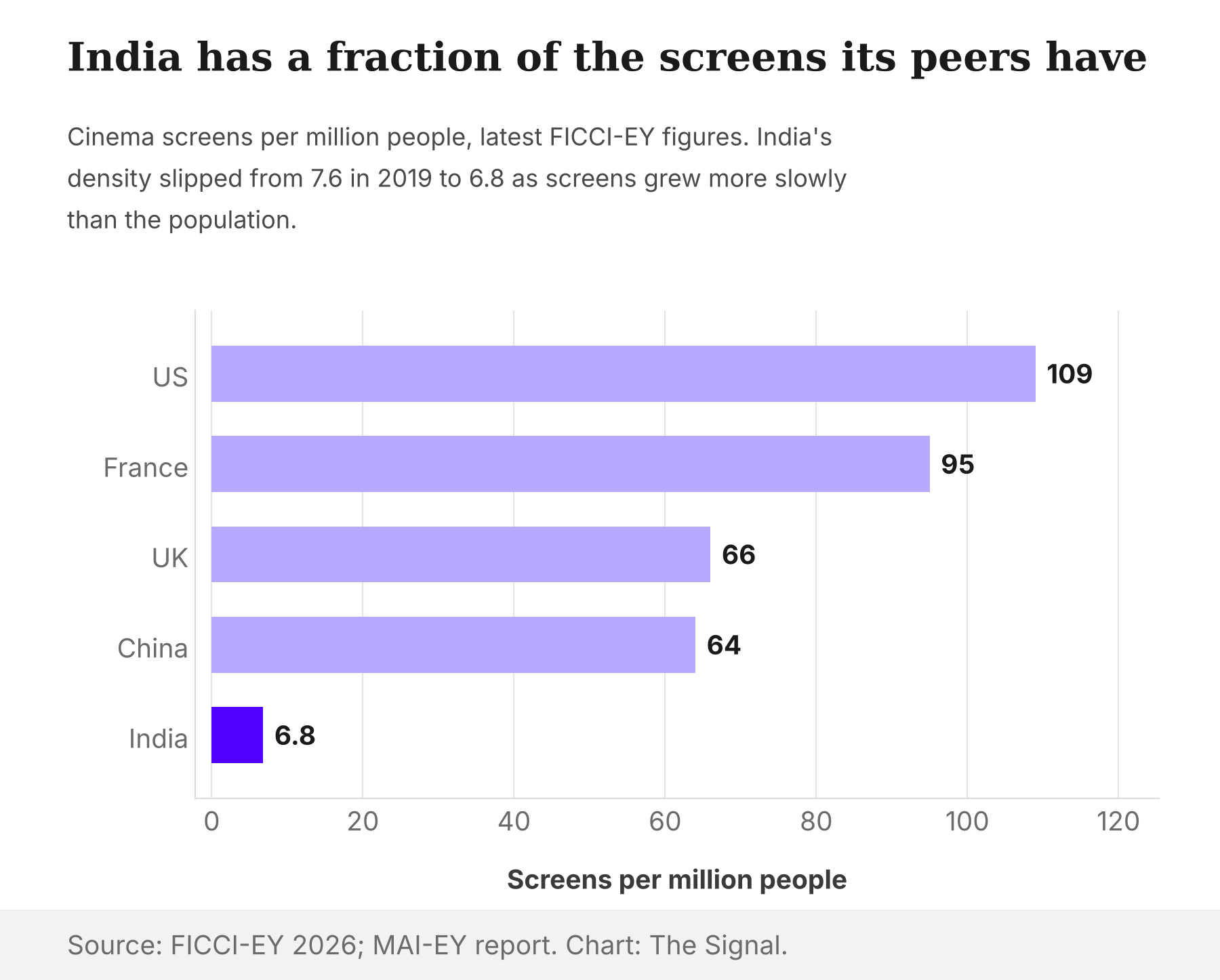
The same FICCI-EY summary puts India's density at 6.8 screens per million, against 109 in the US, 95 in France, 66 in the UK and 64 in China. China has roughly nine times India's density.
India's screen base grew 4% in five years while ticket sales fell 41%.
| Measure | 2019 | 2024 | 2025 |
|---|---|---|---|
| Cinema screens | 9,527 | 9,927 | 10,033 |
| Screens per million people | 7.6 | 6.8 | 6.8 |
| Cinema footfalls (tickets sold) | 1.46 billion | 0.86 billion | not reported |
Sources: MAI-EY report via Social Samosa for 2019 and 2024; FICCI-EY 2026 report via Bollywood Hungama for 2025.
When the number of slots is fixed, exhibitors are not choosing whether to show a smaller film. They are choosing which hours to take from it. On a typical weekday, Ramayana's extra shows came out of other films' hours.
Why exhibitors make this trade
The exhibitor's maths rewards concentration. The FICCI-EY report found that in 2025 over 1,900 films were released and theatrical revenues rose 16%, mainly from higher ticket prices. Nineteen hundred films competing for roughly 10,000 screens, in a business growing on price rather than on headcount, means each show has to earn as much as possible. A tentpole that fills a hall at a premium price wins that contest almost every time.
There is a cost on the other side of that bargain. Before release, Sacnilk reported that Ramayana's distributors sought a 60% first-week revenue share from single screens, against a usual 52.5%. Exhibitors keep a smaller cut of each ticket on the biggest film. The bet is that a smaller cut of a full house beats a larger cut of a half-empty one.
The audience pattern points the same way. The MAI-EY report found that cinema footfalls fell 41%, from 1.46 billion in 2019 to 0.86 billion in 2024, and footfalls per screen fell 44%. Fewer people go to the cinema, and they go for events. That is a market built for a Ramayana, and hostile to a Pyre.
Where the smaller films go
The squeeze also has a geography. The FICCI-EY summary found that, as of its 2026 edition, only 3,150 of India's 19,500 pin codes have a cinema hall, roughly one in six. Most Indians cannot see any film in a hall without travelling, so the screens that do exist go to whatever draws people across town.
The exit is streaming. The same FICCI-EY report found digital subscription revenues rose 60% in 2025 to INR 163 billion, with 216 million paid video subscriptions. A film that cannot hold its shows past a tentpole's opening has a ready alternative, and producers planning mid-size films are likely to weigh it before they book a release date.
The honest objection
The strongest case against calling this a squeeze is that it is simply the market working. Exhibitors give shows to the film audiences want. Pyre had 400 screens at its peak and lost them when demand moved, which is how a ticketing market should behave. Nobody forbade anyone from buying a Pyre ticket, and a hit that lifts total admissions helps every cinema that stays open.
That case is right about the mechanism and wrong about the scale. In a market with 109 screens per million, a tentpole and a small film both fit, so allocation by demand barely hurts the smaller one. At 6.8 per million, the same rule means the second-best film in a given week can lose three-quarters of its shows in two days. EY's own analysis estimates that growing India's screen count from 9,927 to about 20,000 could add INR 6,600 crore a year to theatrical revenue. That figure is an estimate for an industry whose filmed entertainment revenues fell 2% between 2019 and 2024, but it shows the shortage is a supply problem, not a sign of weak demand.
The Signal
Ramayana's week is a real record, and it should be read as one. It is also a picture of a market that struggles to hold two releases at once. With about 10,000 screens and a net gain of 116 in 2025, every blockbuster becomes a fight over a fixed number of hours, and the films that lose go to streaming. The thing to watch is the screen count in the next FICCI-EY report, not the next opening weekend. Until the screens grow, every Indian blockbuster comes out of other films' showtimes.
Reporting basis: Pyre's screen and show counts rest on a single source, filmmaker Vinod Kapri's own social media post as reported by Outlook India, and the link to Ramayana's release is Outlook's reading of the timing, not Kapri's claim. Ramayana's collections and daily show counts are tracker estimates from Sacnilk, which also reported the pre-release revenue-share dispute; the planned 9,000-screen domestic release is per Business Today's pre-release report. Screen counts for 2025, screen density, closures and pin-code coverage are from the FICCI-EY 2026 report as summarised by Bollywood Hungama; the 2019 and 2024 screen and footfall figures are from a Multiplex Association of India report prepared by EY, as reported by Social Samosa, a study commissioned by the exhibitors' own trade body. Theatrical and subscription revenue figures are from EY's press release on the FICCI-EY report, and the screen-expansion estimate from EY's own analysis, so the EY-related figures share one producing firm. The shows-per-screen ratio, the share of national screens, the net screen gain, the five-year screen growth and the China density multiple are The Signal's calculations from those figures.