The headline from this week's direct tax data is easy to read. Between April 1 and November 10, 2026, net direct tax collection grew 11.76 percent to about Rs 14.42 lakh crore, while refund issuances soared 26 percent to Rs 3.08 lakh crore, per Income Tax Department data reported by PTI. Gross collections rose 14 percent. Refunds growing nearly twice as fast as collections reads like the taxman suddenly handing back far more money.
It is worth slowing down on that. A year earlier, over the same April-to-November window, refunds dropped 18 percent to Rs 2.42 lakh crore from Rs 2.95 lakh crore, Business Today reported. Set the 2026 figure against 2024 rather than 2025, and refunds are up from Rs 2.95 lakh crore to Rs 3.08 lakh crore, about 4 percent in two years. The surge is mostly the slump running in reverse.
That matters because refunds sit between what taxpayers pay and what the government keeps. When they swing, the net numbers swing with them, and in 2025 and 2026 they swung in opposite directions for one group in particular.
The swing sits almost entirely with individuals
The tax department splits collections into corporate tax and non-corporate tax, the second paid by individuals, firms and Hindu Undivided Families. Subtracting net from gross in each category gives the refunds each side received.
On the corporate side, gross corporate tax was Rs 8.01 lakh crore and net corporate tax Rs 6.32 lakh crore by November 10, 2026, implying about Rs 1.69 lakh crore in refunds. A year earlier, gross corporate tax was Rs 6.91 lakh crore and net Rs 5.37 lakh crore, or about Rs 1.54 lakh crore refunded. Companies' refunds moved modestly in both years.
Individuals are a different story. On the same gross-minus-net arithmetic, non-corporate refunds were roughly Rs 1.42 lakh crore in the 2024 window and Rs 0.89 lakh crore in 2025, then climbed back to Rs 1.38 lakh crore in 2026.
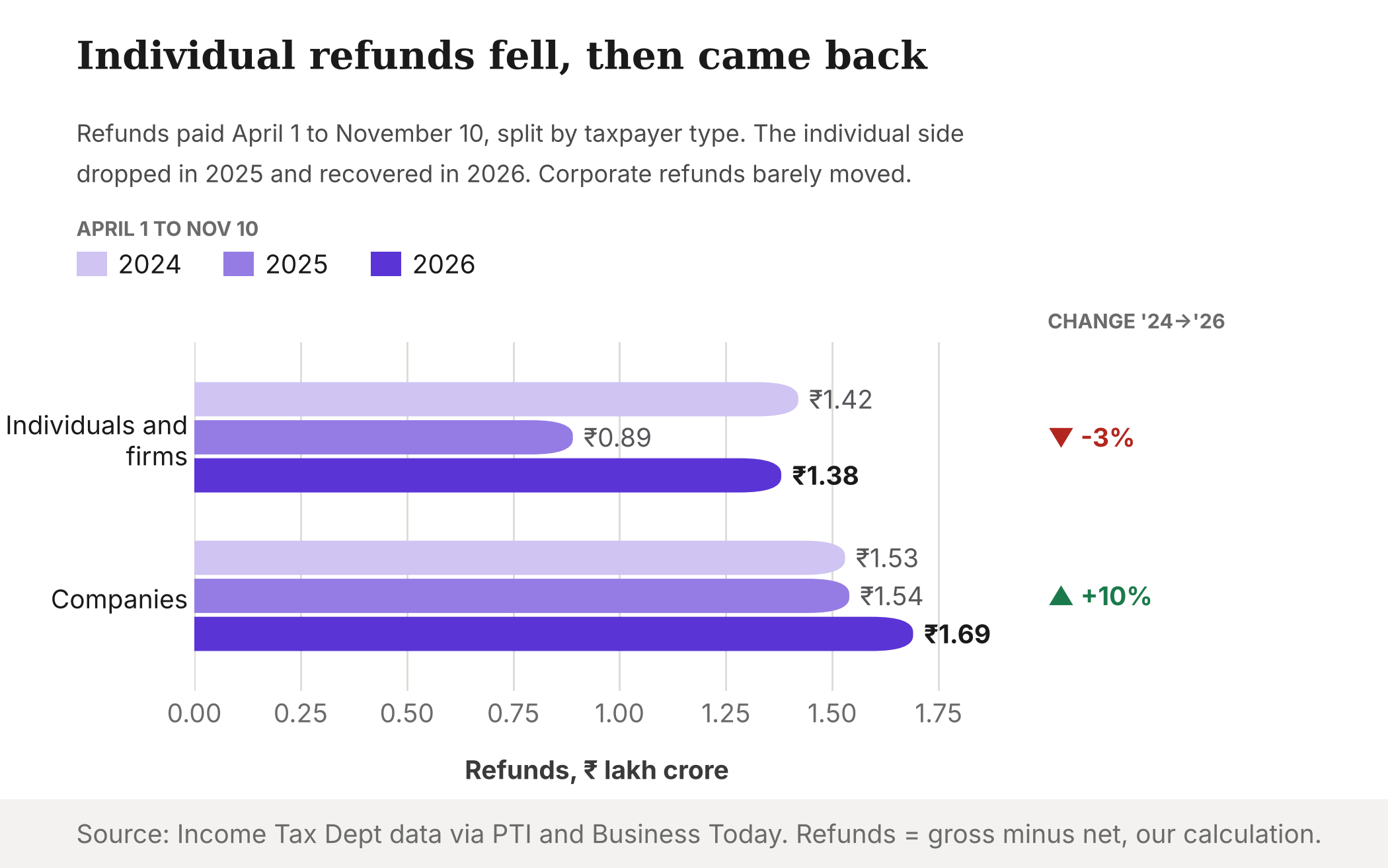
Nearly the whole 2025 dip, and nearly the whole 2026 rebound, happened on the individual side.
Net figures told the opposite story both years
Because refunds moved so much for individuals, the net non-corporate number gave a misleading signal in each year.
In the 2025 window, gross personal income tax rose only from Rs 8.03 lakh crore to Rs 8.08 lakh crore, while the net figure rose from Rs 6.61 lakh crore to Rs 7.19 lakh crore. Taxpayers paid almost exactly what they had paid the year before. The net figure grew about 9 percent because less money went back out.
In 2026 the pattern flipped. Gross non-corporate tax reached Rs 8.94 lakh crore, up 10.6 percent on 2025, yet net non-corporate tax rose just 5.3 percent to about Rs 7.56 lakh crore.
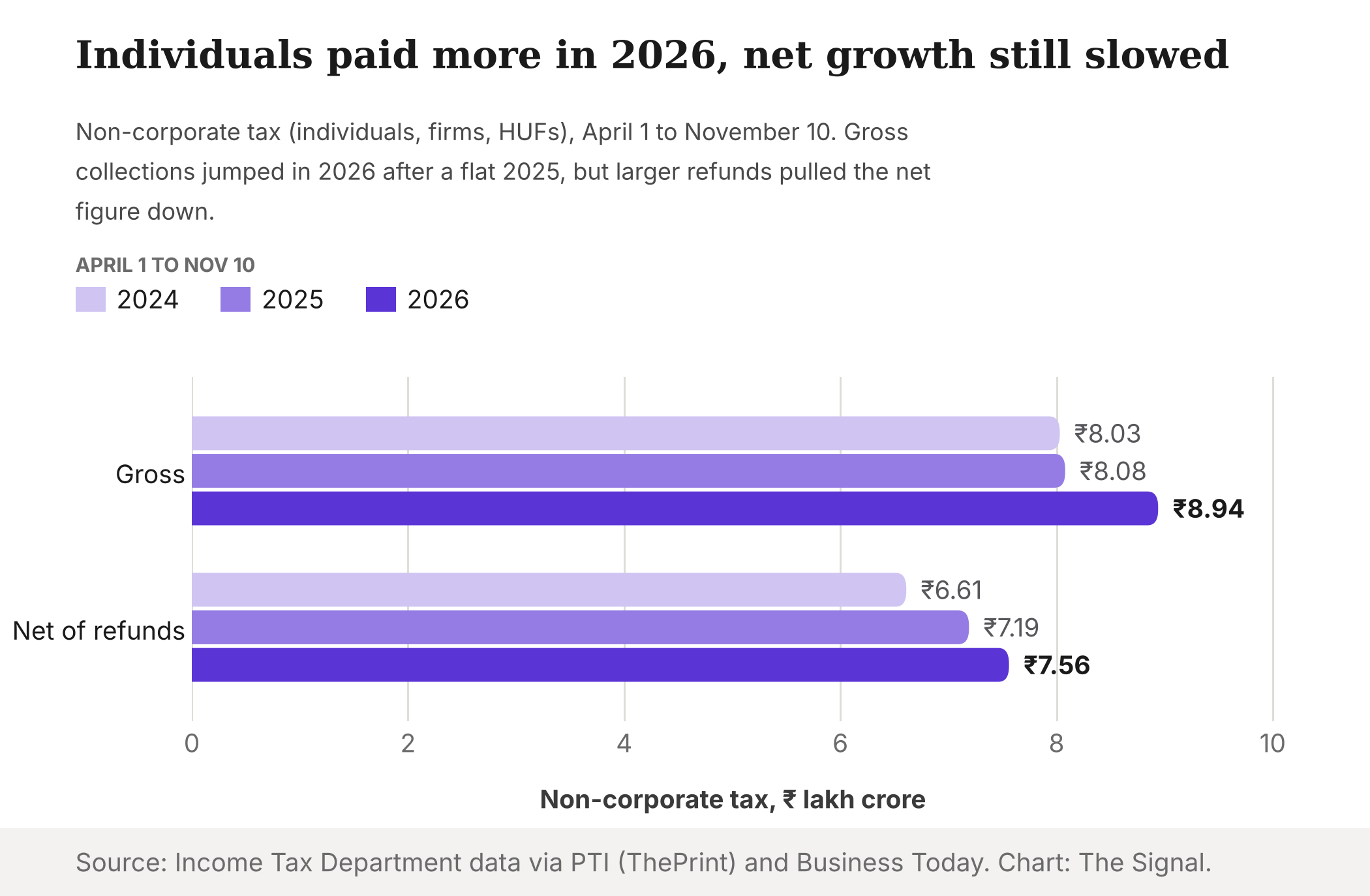
Read the net line alone and individual taxes looked strong in 2025 and soft in 2026. The gross line says the reverse.
Refunds, not payments, drove the net swing for individuals.
| April 1 to November 10 | Gross non-corporate | Net non-corporate | Implied refunds |
|---|---|---|---|
| 2024 | Rs 8.03 lakh crore | Rs 6.61 lakh crore | Rs 1.42 lakh crore |
| 2025 | Rs 8.08 lakh crore | Rs 7.19 lakh crore | Rs 0.89 lakh crore |
| 2026 | Rs 8.94 lakh crore | Rs 7.56 lakh crore | Rs 1.38 lakh crore |
Source: Income Tax Department data reported by PTI, via ThePrint and Business Today. Implied refunds are gross minus net.
Why the 2025 dip looks like timing
The tax department explained the 2025 slowdown at the time. In November 2025, CBDT chairman Ravi Agrawal said the department had found that "some wrong refunds or deductions were being claimed", that low-value refunds were being released, and that he hoped to release the remaining refunds by December, PTI reported. He also linked part of the fall to lower refund claims after TDS rates were rationalised.
The full-year figures suggest most of the money went out eventually. Over FY26 as a whole, refunds fell just 1.09 percent to Rs 4,71,531 crore, per CBDT data reported by Business Today, against an 18 percent fall at the November mark. A refund paid in February instead of September still counts as a refund. It just lands on the other side of the November 10 comparison.
The honest objection
The strongest case against this reading is that refunds are a long-run growth story in their own right. Between FY14 and FY25, refunds rose from Rs 83,008 crore to Rs 4.76 trillion while gross collections grew from Rs 7.21 trillion to Rs 27.02 trillion, and the average refund arrived in 17 days in 2024 against 93 days in 2013, Business Standard reported, citing tax department data. On that view, a bigger refund line is a sign of faster processing, and some of the 2026 rise is genuine. Corporate refunds did rise about 10 percent over two years.
That case is real, and it argues against treating the 26 percent as anything alarming. But it cannot explain the shape of the individual numbers. Faster processing would lift refunds steadily. It would not cut individual refunds by about a third in one year and restore them the next while companies' refunds stayed level.
What this does to the target
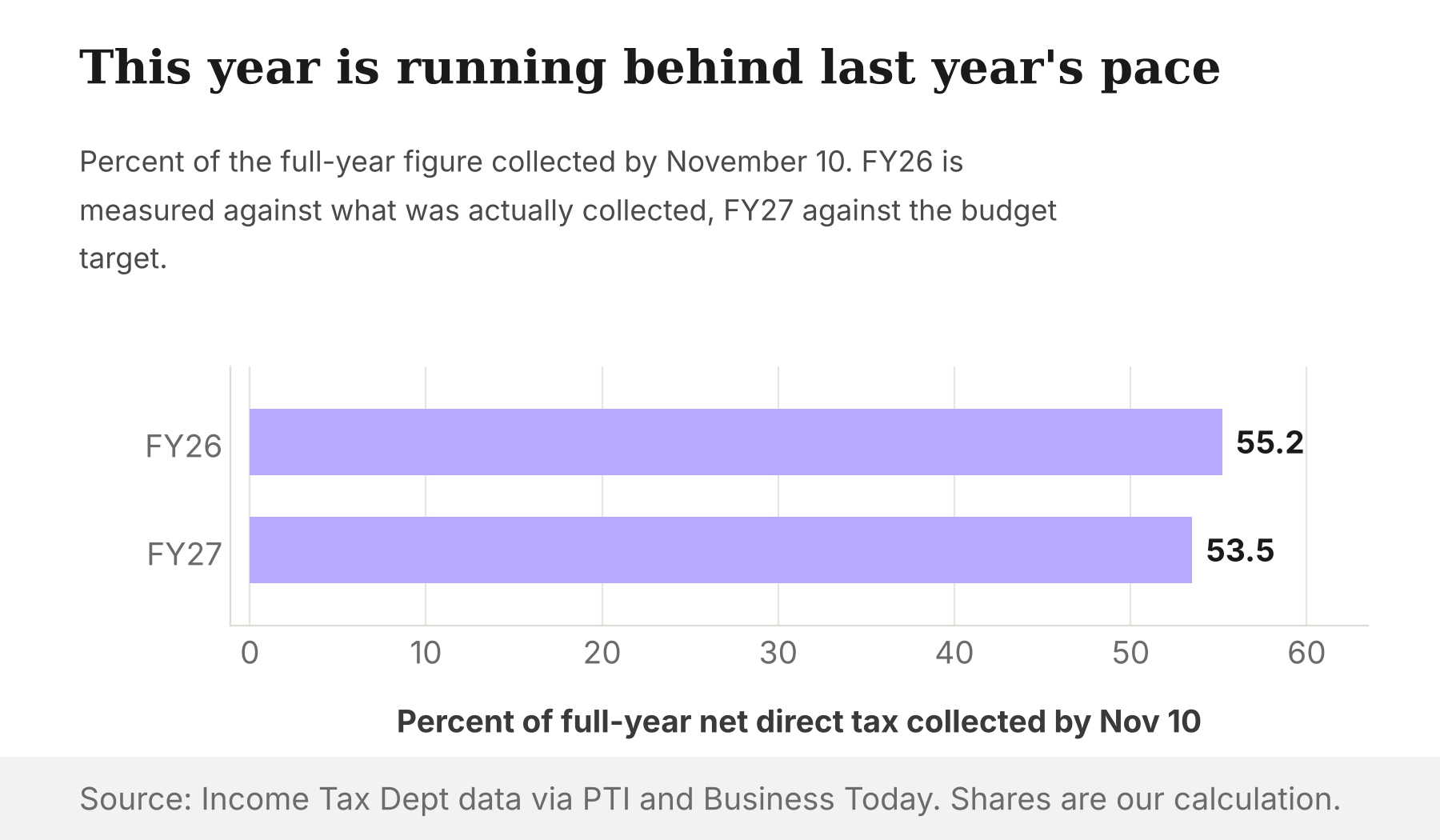
The timing matters because the government has a big number to hit. The budget aims to collect Rs 26.97 lakh crore in direct taxes in FY27, 15 percent more than the Rs 23.40 lakh crore collected in FY26. About 53 percent was in by November 10.
That sounds like a comfortable pace until it is set against last year. By November 10, 2025, net collections stood at Rs 12.92 lakh crore, about 55 percent of what FY26 finally brought in.
To reach Rs 26.97 lakh crore, the government needs about Rs 12.55 lakh crore between November 11 and March 31. The same stretch of FY26 produced about Rs 10.48 lakh crore, so the remaining months must grow nearly 20 percent.
FY26 is a warning about such gaps. The Receipt Budget put FY26 revised estimates at Rs 11,09,000 crore for corporation tax and Rs 13,12,000 crore for taxes on income, a combined Rs 24.21 lakh crore. The year closed at Rs 23,40,406 crore, roughly Rs 80,000 crore short of even the lowered estimate. The FY27 budget pencils in a fiscal deficit of Rs 16,95,768 crore, or 4.3 percent of GDP, down from 4.4 percent in FY26, leaving little room for a similar miss.
There is one reason for cautious optimism inside the refund story. In FY26, refunds that slipped past November landed in the second half and weighed on it. If FY27's refunds are flowing on schedule, less of that drag is still to come. Markets are adding their own help: securities transaction tax swelled 52 percent to Rs 54,078 crore by November 10.
The Signal
The 26 percent refund jump is not the tax department turning generous. It is last year's slow individual refunds dropping out of the comparison, and it hides the better news that individuals' gross payments grew 10.6 percent after a flat 2025. Anyone using the net figure to judge whether individual tax revenue is rising will draw the wrong conclusion in both years. Watch the December advance-tax data and the refund line beside it. If refunds stay near 2024's pace while gross keeps climbing, the target is reachable. If they slip again, the net number will look good for the wrong reason. Refunds move the scoreboard, not the score.
Reporting basis: the April-to-November 2026 collection, refund, corporate, non-corporate and securities transaction tax figures and the FY27 target are Income Tax Department provisional data as reported by PTI, via ThePrint. The comparable 2025 and 2024 figures and the FY26 full-year totals are tax department and CBDT data as reported by Business Today, a separate origin. The CBDT chairman's November 2025 remarks are per PTI, via ETV Bharat, the same wire as the 2026 figures. Long-run refund and processing-time data are per Business Standard, citing tax department sources. FY26 revised estimates, the FY27 fiscal deficit and corporation tax figures are from the Ministry of Finance's Receipt Budget and Budget at a Glance, with the deficit comparison also per PRS Legislative Research. Implied refunds by taxpayer type, the two-year refund change, gross non-corporate growth, the share of full-year collections reached by November 10, the required growth for the rest of FY27 and the FY26 shortfall against revised estimates are The Signal's calculations from those figures.