The International Energy Agency's first report on India's renewables market landed last week with a headline built for a summit stage. Renewable electricity saved India more than $100 billion in coal and natural gas import costs between 2011 and 2025, pv magazine reported from the IEA's India Renewable Energy Market Report 2026, and those cumulative savings are expected to more than double by 2030. It reads like a clean-energy dividend paid in energy security.
Look at the words between the numbers. The savings are on coal and natural gas import costs. None of the $100 billion is oil.
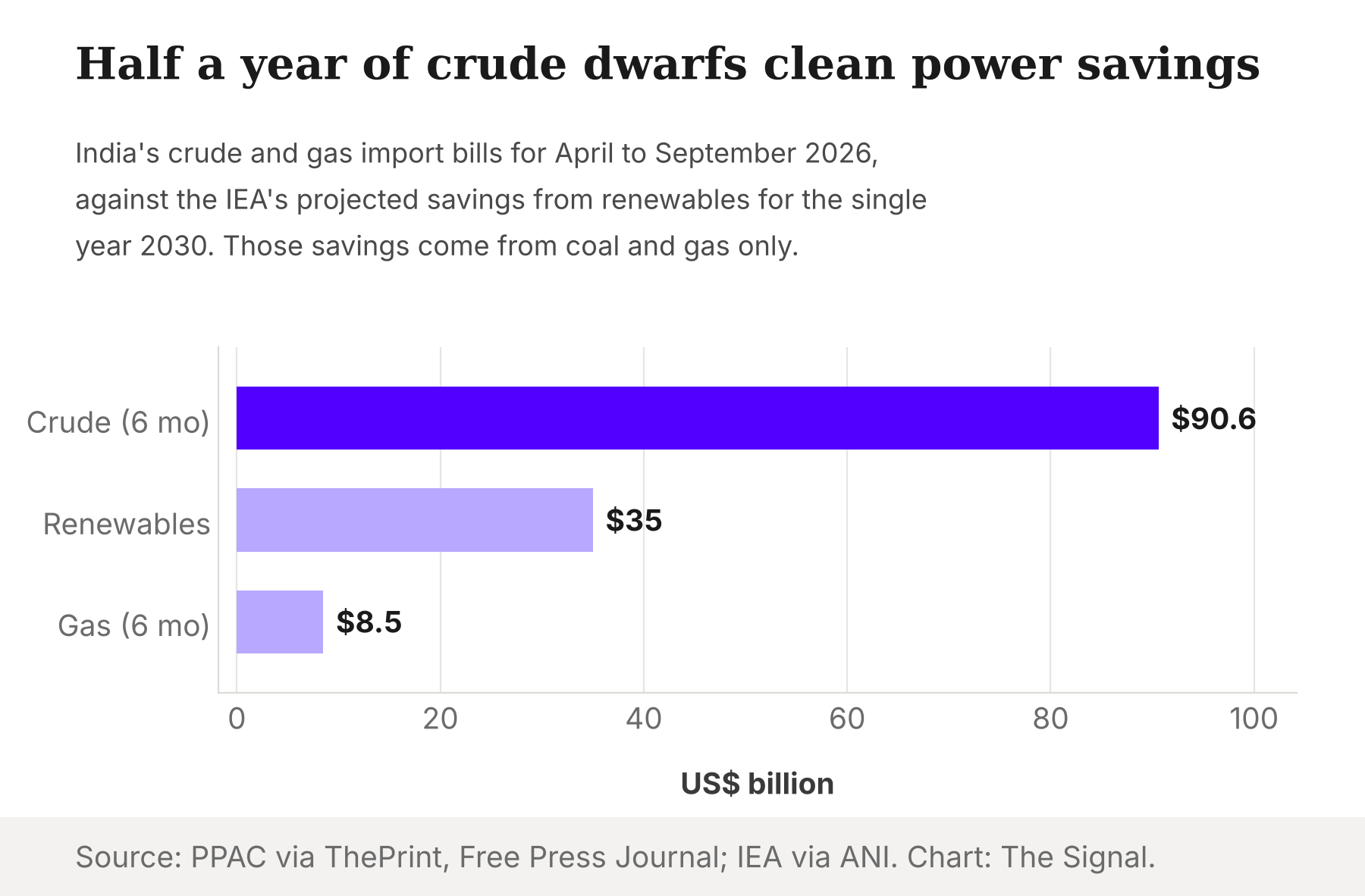
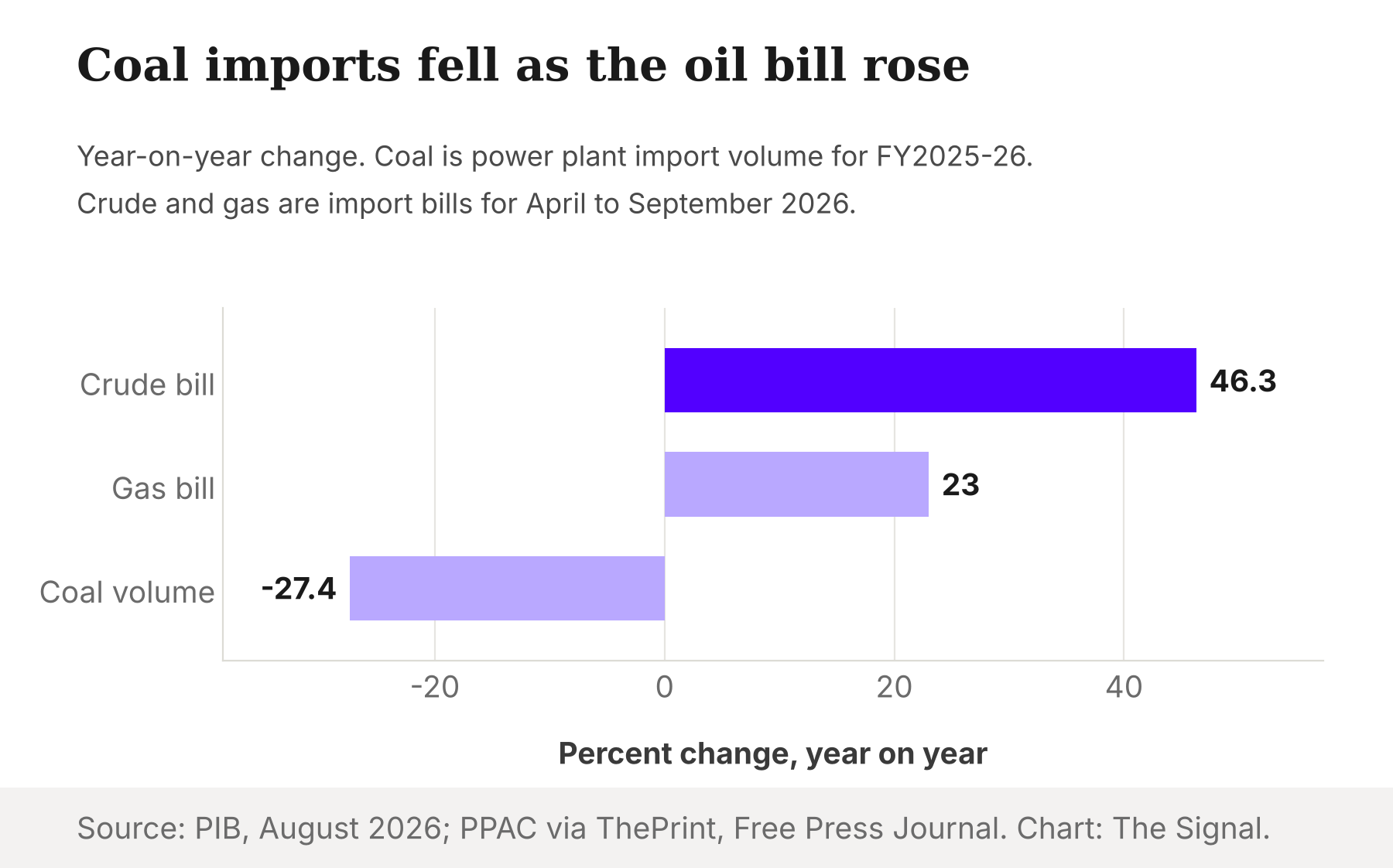
That matters because oil is the import that hurts. India's crude oil import bill rose 46.3 percent to $90.6 billion in April to September 2026, up from $61.9 billion a year earlier, according to Petroleum Planning and Analysis Cell data reported by ThePrint. The fifteen years of renewables savings average out to roughly $7 billion a year. India spent about thirteen times that on crude in a single half-year.
What the savings actually displaced
Solar panels and wind turbines make electricity. In India, the electricity they push off the grid is mostly coal-fired, with some gas. So the import they cut is the coal and LNG a power plant would have burned.
The IEA puts a physical number on it. Without the solar, wind and bioenergy capacity added since 2010, India's coal imports in 2025 would have been around 110 million tonnes higher, OilPrice.com reported from the same IEA report.
The government's own figures show the same direction. Coal imports by thermal power plants fell to 45.4 million tonnes in FY2025-26 from 62.5 million tonnes in FY2024-25, a decline of about 27.4 percent, according to a Press Information Bureau backgrounder. Domestic coal supply did part of that work too, so not every tonne belongs to solar.
The build behind it is real. India crossed 300 GW of non-fossil installed capacity on 31 July 2026, the Ministry of New and Renewable Energy said, including 164.59 GW of solar and 58.14 GW of wind, and renewable generation rose from 190.96 billion units in 2014-15 to 477.79 billion units in 2025-26.
None of that capacity moves a truck, a tractor or a two-wheeler. Those run on refined crude.
The 2030 number, held against the oil bill
The IEA projects annual fossil fuel import savings of about $35 billion by 2030, according to an ANI report on the study, with cumulative savings approaching $240 billion. Solar supplies about 60 percent of that and wind almost 30 percent. The same report notes the 2030 figure would exceed India's entire non-coking coal and natural gas import bill for FY2024-25, and that it assumes fuel prices stay near their 2024-25 averages.
That is a genuine achievement on its own terms. By 2030, renewables are on course to save more each year than India paid in FY2024-25 for all of its imported non-coking coal and natural gas.
Now set it against crude. The $90.6 billion India paid for crude in April to September 2026 is about two and a half times the $35 billion that renewables are projected to save across the whole of 2030. Six months of oil outweighs a full year of the best-case clean power dividend, four years out.
Gas sits in between. India's natural gas import bill rose 23 percent to $8.5 billion in April to September FY27 from $6.9 billion a year earlier, per PPAC data relayed by The Free Press Journal. Renewables can lean on that bill through the power sector. They cannot lean on crude.
Where coal and crude part ways
The two charts describe one mechanism. Coal is a power-sector fuel, and the power sector is where India's clean build lives. Every gigawatt of solar has a coal plant it can idle, which is why the coal line falls.
Crude is a transport and industry fuel. A gigawatt of solar has no direct claim on it, and the IEA's own savings tally covers coal and gas costs only. The only bridge between the two is electrification: a vehicle that charges from the grid instead of a pump turns a solar unit into avoided diesel or petrol.
That bridge is being built, but it is narrow. Electric vehicles made up 8.26 percent of vehicle sales in FY2025-26, up from 0.08 percent in FY2015-16, according to a PIB explainer on the EV ecosystem. That is a steep climb in share of new sales. It is a far smaller share of the vehicles already on the road, and those vehicles set this year's oil demand.
So the policy question is not whether India's renewables are working. They are, against coal. It is whether gigawatts should be counted as oil insurance. On these numbers, they should not.
The honest objection
The strongest case against this framing is that it asks renewables to do a job no one assigned them. Solar and wind were built to decarbonise and secure the grid, not to replace crude, and on that job the numbers are impressive: a 110 million tonne coal counterfactual, power plant coal imports down by more than a quarter in one year, and a 2030 savings figure bigger than India's whole FY2024-25 bill for non-coking coal and gas. Every dollar not spent on coal is a dollar of foreign exchange kept, and dollars are fungible. A smaller coal bill does cushion the rupee when crude spikes.
All true. The disagreement is over which risk the dividend covers. This year's shock arrived through crude, the import that rose 46.3 percent in six months, not through coal. A cushion sized at about $35 billion a year in 2030 is meaningful against a coal and gas exposure and modest against a crude exposure of $90.6 billion per half-year. Renewables reduce India's total import bill. They do not reduce its exposure to the oil price, and only electrified transport links the two.
The Signal
The IEA's $100 billion is a real number about the wrong import for this moment. India's clean build is shrinking its coal problem: power plant coal imports are falling and the counterfactual says they would be 110 million tonnes higher without it. Its oil problem is untouched, and the crude bill grew by $28.7 billion in half a year. The next $140 billion of savings the IEA projects to 2030 will again come from coal and gas unless electric vehicles move from 8 percent of new sales to a real share of the fleet. Watch the PPAC crude bill, not the gigawatt counter. The panels are beating coal. The bill that moved this year was oil.
Reporting basis: the $100 billion savings estimate for 2011 to 2025, the 110 million tonne coal counterfactual, and the $35 billion annual and roughly $240 billion cumulative projections for 2030 all come from a single origin, the International Energy Agency's India Renewable Energy Market Report 2026, as reported by pv magazine, OilPrice.com and an ANI wire report respectively; The Signal could not access the IEA's own pages for this piece, so these rest on that coverage. India's crude and natural gas import bills for April to September 2026 come from the Petroleum Planning and Analysis Cell, as reported by ThePrint and, for gas, by The Free Press Journal relaying Moneycontrol. Thermal power plant coal imports are from a Press Information Bureau backgrounder, non-fossil capacity and renewable generation from the Ministry of New and Renewable Energy via PIB, and the EV sales share from a PIB explainer. That is five independent origins: the IEA, PPAC, the Ministry of New and Renewable Energy, coal-import data compiled by the government and published in a PIB backgrounder, and PIB's research explainer on EV sales. The 15-year average saving, the crude-to-savings multiples, the roughly $140 billion of further savings to 2030, and the $28.7 billion rise in the half-year crude bill are The Signal's calculations from those figures.