On November 10, IIFL Finance's board cleared a deal that reads like one more foreign bet on Indian finance. The lender said it would raise Rs 6,414 crore through a primary capital infusion led by Blackstone, with Blackstone's funds putting in Rs 5,000 crore for about 16% through convertible preference shares that turn into equity at Rs 602 a share within 18 months. The rest comes from the promoters and a co-investor: promoters Nirmal Jain and R Venkataraman are putting in Rs 1,264 crore through warrants, and Anchorage Capital another Rs 150 crore.
The usual read is about the stock: a marquee name has endorsed a mid-sized lender. That read is fair, but it misses the more useful part.
It is worth slowing down on the word "primary". Blackstone is not buying anyone's shares. It is paying IIFL Finance, which issues new stock and keeps the cash. That detail is what separates this wave of foreign money from the foreign money that has been leaving.
Two kinds of foreign money moved in opposite directions
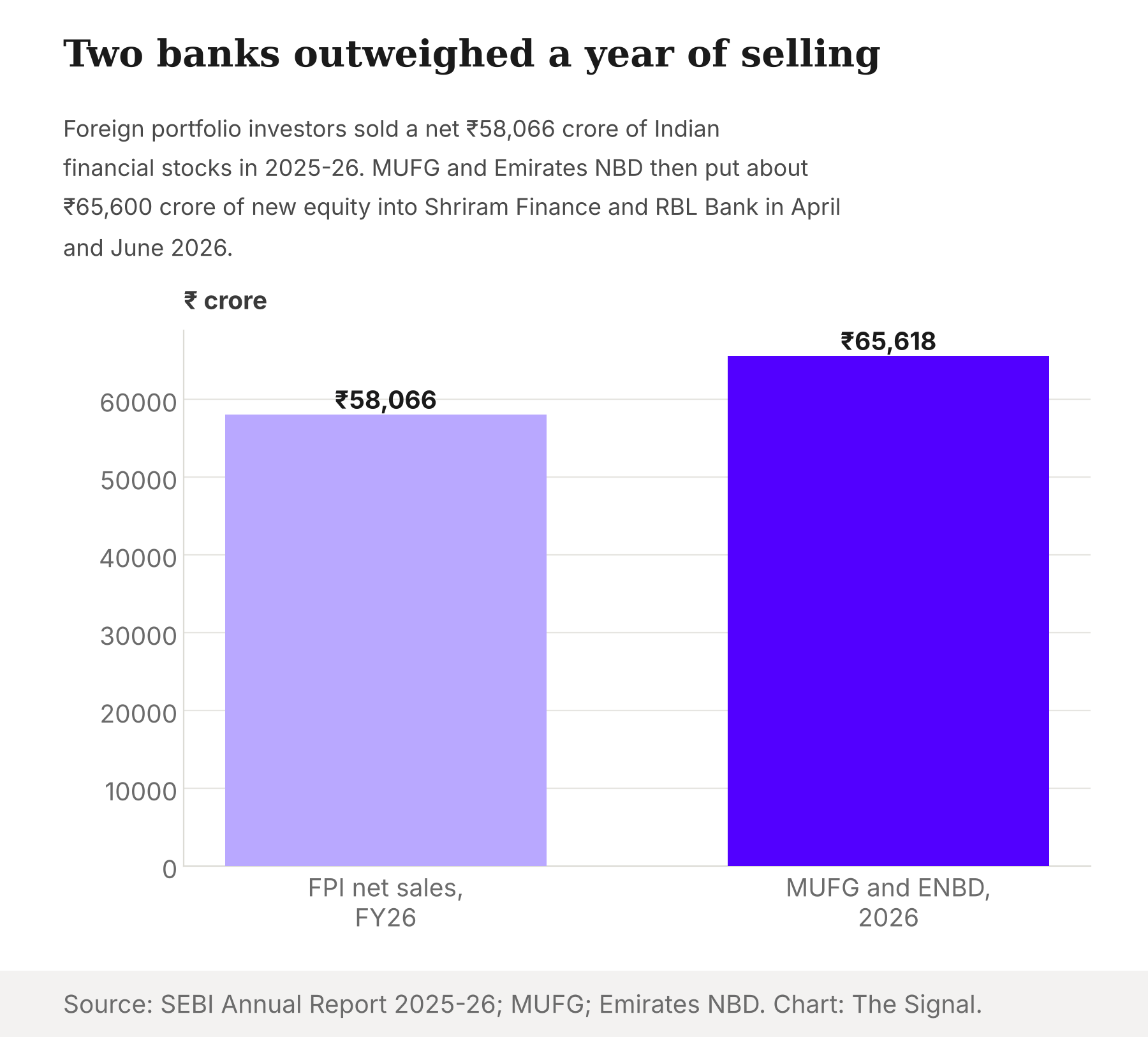
The foreign money that left was portfolio money. SEBI's Annual Report 2025-26, using NSDL data, shows foreign portfolio investors sold a net Rs 58,066 crore of Indian financial services stocks in 2025-26, second only to IT at Rs 81,239 crore. That was part of a broader retreat: total FPI net outflows of Rs 1,52,692 crore were the highest for any financial year on record. Every rupee of it was a secondary trade. A foreign fund sold a bank share to someone else, and the bank itself did not gain or lose a rupee of capital.
The foreign money that arrived took a different route. MUFG Bank completed its Shriram Finance investment on April 8, 2026, subscribing to new shares at Rs 840.93 each for about INR 396.18 billion, or Rs 39,618 crore. Two months later, Emirates NBD completed its RBL Bank deal through a preferential issue, a primary infusion of about USD 2.75 billion (roughly INR 260 billion).
Add MUFG's Rs 39,618 crore to Emirates NBD's roughly Rs 26,000 crore and the total is about Rs 65,600 crore of new equity, paid straight onto two Indian lenders' balance sheets between April and June 2026. That is more than the Rs 58,066 crore foreign portfolio funds pulled out of listed Indian financial stocks in the whole of 2025-26.
Not every big foreign deal paid the lender
The distinction matters because one of the largest foreign deals did not work this way. Japan's SMBC built its Yes Bank stake by buying from existing holders. SBI sold 13.19% to SMBC for Rs 8,889 crore, and seven other lenders sold the remaining 6.81% for about Rs 4,594 crore, a Rs 13,483 crore deal at Rs 21.50 a share. That money went to SBI and the other sellers. Yes Bank's own capital did not change.
The other deals in the run are primary. In October 2025, Federal Bank's board approved a preferential issue of warrants to Blackstone-managed funds at Rs 227, a committed capital infusion of Rs 6,196.5 crore. IIFL Finance's Rs 5,000 crore from Blackstone is the newest. Federal Bank and IIFL Finance are committed amounts that still depend on approvals and conversion. Shriram Finance and RBL Bank have closed.
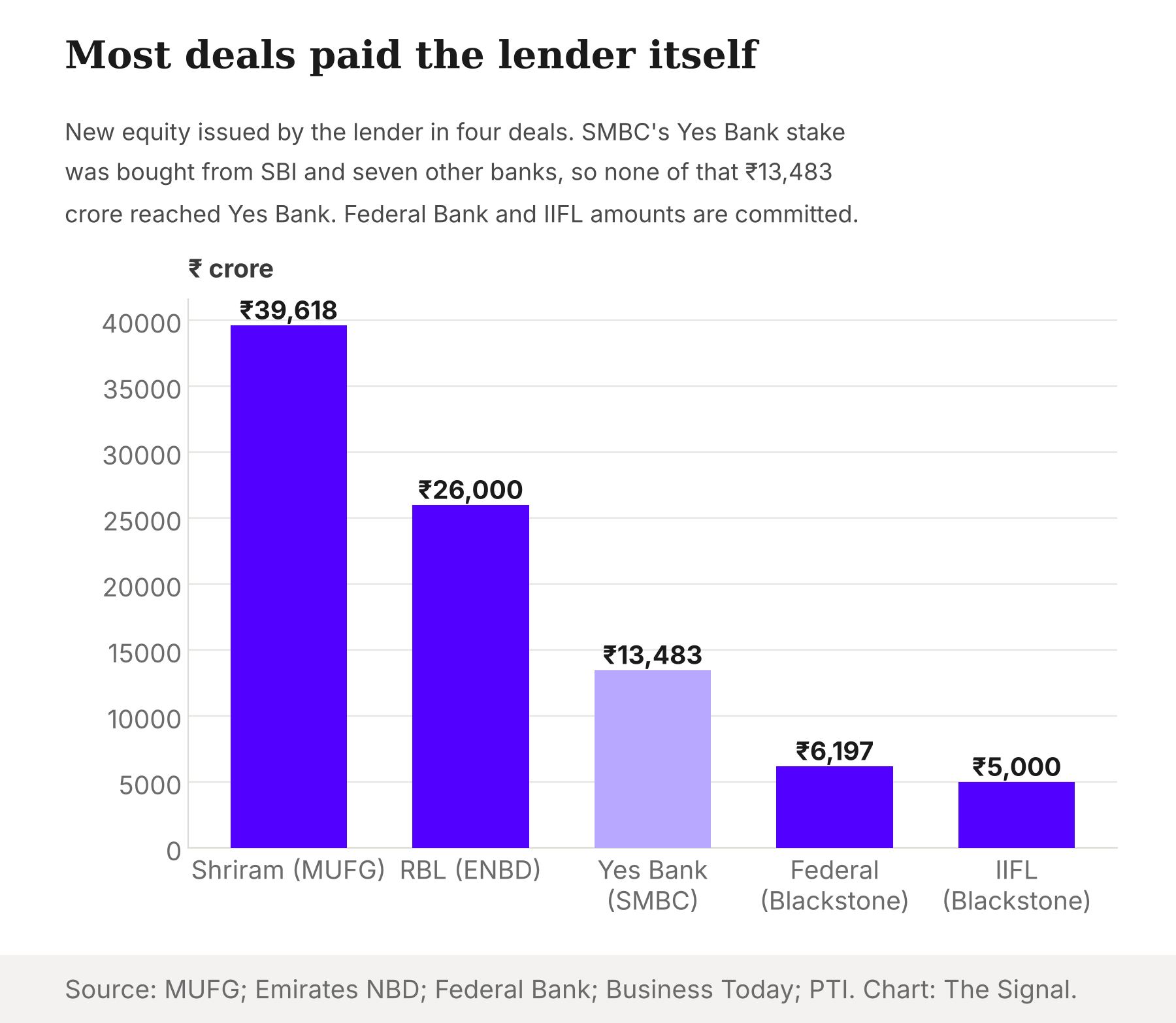
Across the four primary deals (Shriram, RBL, Federal and IIFL), committed new equity comes to about Rs 76,800 crore. Set against the Rs 13,483 crore Yes Bank sale, roughly 85 rupees in every 100 across the five deals went to the lender rather than to a selling shareholder (our calculation).
Why lenders want equity, not admirers
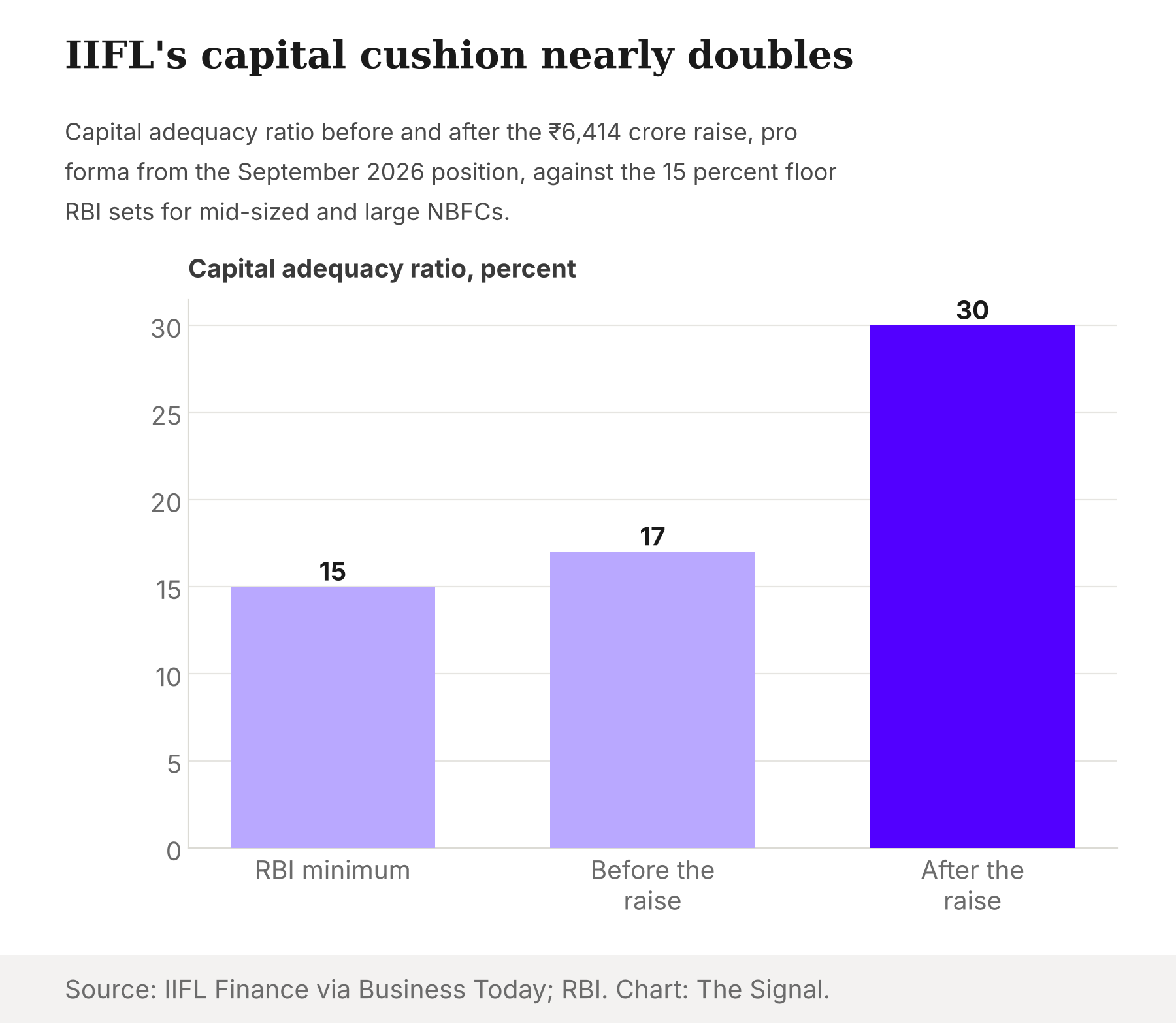
For a lender, new equity is not a vote of confidence. It is lending capacity. The Reserve Bank caps how far a lender can stretch its capital. RBI's capital adequacy directions require NBFCs in the middle layer and above to hold a minimum capital ratio of 15% of risk-weighted assets. Put the other way, every rupee of capital can support at most about Rs 6.7 of risk-weighted loans at that floor.
That is why the IIFL deal matters more to IIFL's loan book than to its share price. The company projects its capital adequacy ratio rising from around 17% to nearly 30% on a pro forma basis. IIFL Finance sat two points above the floor at 17%, and at 30% it has twice the floor.
Scale also explains the size of the bet. IIFL Finance has a market value of about Rs 26,746 crore, so the full Rs 6,414 crore raise equals nearly a quarter of what the whole company was worth before it.
The four primary deals at a glance
| Lender | Foreign investor | New equity (Rs crore) | Status |
|---|---|---|---|
| Shriram Finance | MUFG Bank | 39,618 | Completed April 2026 |
| RBL Bank | Emirates NBD | about 26,000 | Completed June 2026 |
| Federal Bank | Blackstone funds | 6,196.5 | Committed, via warrants |
| IIFL Finance | Blackstone funds | 5,000 | Board-approved November 2026 |
Source: MUFG Bank; Emirates NBD and RBL Bank; Federal Bank; Business Today.
The honest objection
The strongest case against reading much into this is that the two flows are not the same kind of thing. Portfolio selling is spread across hundreds of stocks and reflects a view on the whole sector. Strategic stakes are lumpy, concentrated in five names, and priced by buyers who want board seats and control rights a portfolio fund never asks for. Foreign funds still own a lot: financial services remained their largest equity holding at Rs 19.0 lakh crore, or 30.5% of their equity assets, at the end of March 2026. A few large deals do not reverse a sector-wide judgment. And capital is not credit. A lender sitting at twice its regulatory floor can also be a lender with idle money and a lower return on equity.
That case is right about breadth and wrong about effect. Portfolio selling moves prices, but it does not change what a lender can lend. Primary capital does. The portfolio money that left in 2025-26 did not shrink any lender's balance sheet. The new equity that MUFG and Emirates NBD put in grew two of them. Whether the new capital turns into new loans is the lenders' choice. It now exists, and it did not before.
The Signal
The foreign money leaving Indian finance and the foreign money arriving are not the same money, and they do not do the same thing. Portfolio funds have been selling shares to other investors. Strategic buyers have been handing lenders fresh equity, which under RBI's rules is the raw material for new loans. Blackstone's IIFL Finance deal is small next to MUFG's, but it is the same shape.
What to watch is not the next FPI flow print. It is what IIFL Finance, Shriram Finance and RBL Bank do with the capital over the next four quarters: faster loan growth, or ratios left sitting well above the floor. Foreign funds sold the shares. Foreign banks bought the balance sheets.
Reporting basis: the IIFL Finance deal terms, its promoter and Anchorage contributions, its market value and its projected capital ratio are per Business Today, reporting the company's board announcement of November 10, 2026, and rest on that single outlet. Foreign portfolio flows and holdings for 2025-26 are from SEBI's Annual Report 2025-26, which compiles NSDL data. The minimum capital ratio for NBFCs is from the Reserve Bank of India's capital adequacy directions. The Shriram Finance terms are per MUFG Bank's completion release; the RBL Bank terms are per the joint Emirates NBD and RBL Bank announcement, via the Government of Dubai Media Office; the Federal Bank terms are per Federal Bank's own press release; and the Yes Bank sale is per PTI, as carried by The Week. The combined totals for the two completed deals and for the four primary deals, the share of deal value that went to lenders, the loans-per-rupee-of-capital figure and the raise as a share of market value are The Signal's calculations from those figures.