The standard story about a falling export is a currency story. When the rupee weakens, Indian goods get cheaper in dollars, and shipments should rise. The rupee averaged 95.51 to the dollar in September 2026 against 88.32 in September 2025, a fall of about 8 percent. By that logic, India's soybean meal sellers should be having a good year.
They are having a terrible one. India's total oilmeal exports in April to July 2026 were 1,105,833 tons against 1,516,981 tons a year earlier, down 27 percent, according to the Solvent Extractors' Association of India (SEA), which compiles the data from DGFT figures. The headline is bad. The split underneath is worse.
One product did all the damage
Soybean meal exports in April to July 2026 were 187,312 tons, against 676,992 tons in the same months of 2025. That is a fall of 72 percent, or almost 490,000 tons. The whole oilmeal category lost about 411,000 tons over the same period. Soybean meal on its own lost more than the entire category.
How is that possible? Because the other big product did not fall. Rapeseed meal exports were 756,739 tons in April to July 2026, against 740,777 tons a year earlier, a rise of 2 percent. Its gain offset part of the soybean loss and no more.
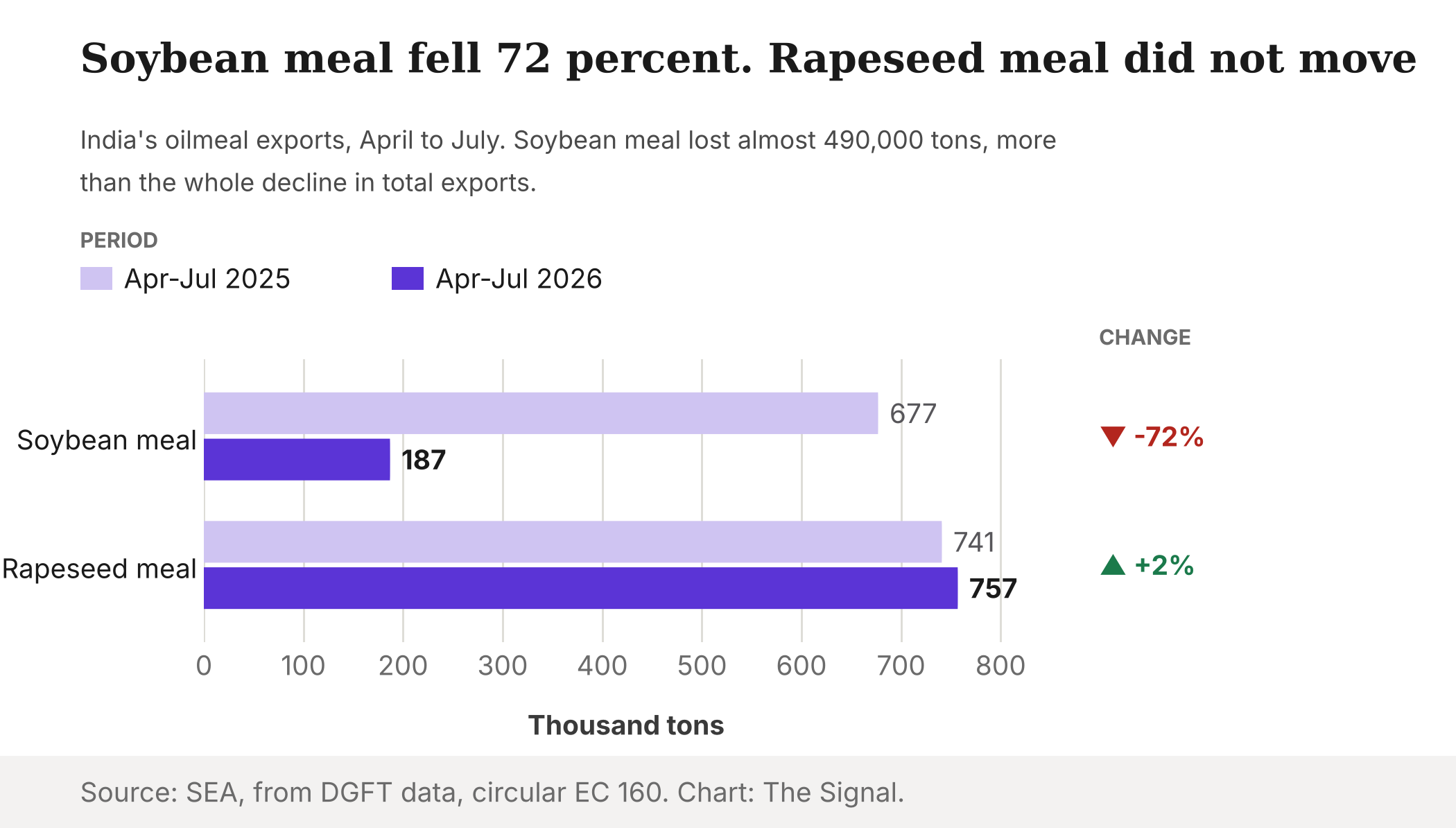
The mix of the trade has changed with it. Soybean meal made up about 45 percent of India's oilmeal exports in April to July 2025 and about 17 percent in the same months of 2026. Rapeseed meal is now about 68 percent of what India ships. India's oilmeal export business has become, in practice, a rapeseed meal business, and China alone took 350,739 tons, nearly half of all rapeseed meal exports, about 46 percent of the total.
The slide is not confined to those months. Soybean meal exports were 2,133,047 tons in 2023-24 and 1,555,651 tons in 2025-26, while total oilmeal exports fell from 4,885,437 to 3,768,710 tons, declines of 27 percent and 23 percent over two years. This year is a collapse on top of a decline.
The price explains it, not the rupee
The reason is not hard to find in the SEA's own numbers. Indian soybean meal was quoted at around US$613 per tonne in July 2026, compared with international prices of approximately US$428 per tonne. That is a premium of 43 percent. The SEA's own verdict is that this made Indian supplies "totally out priced" in the international market.
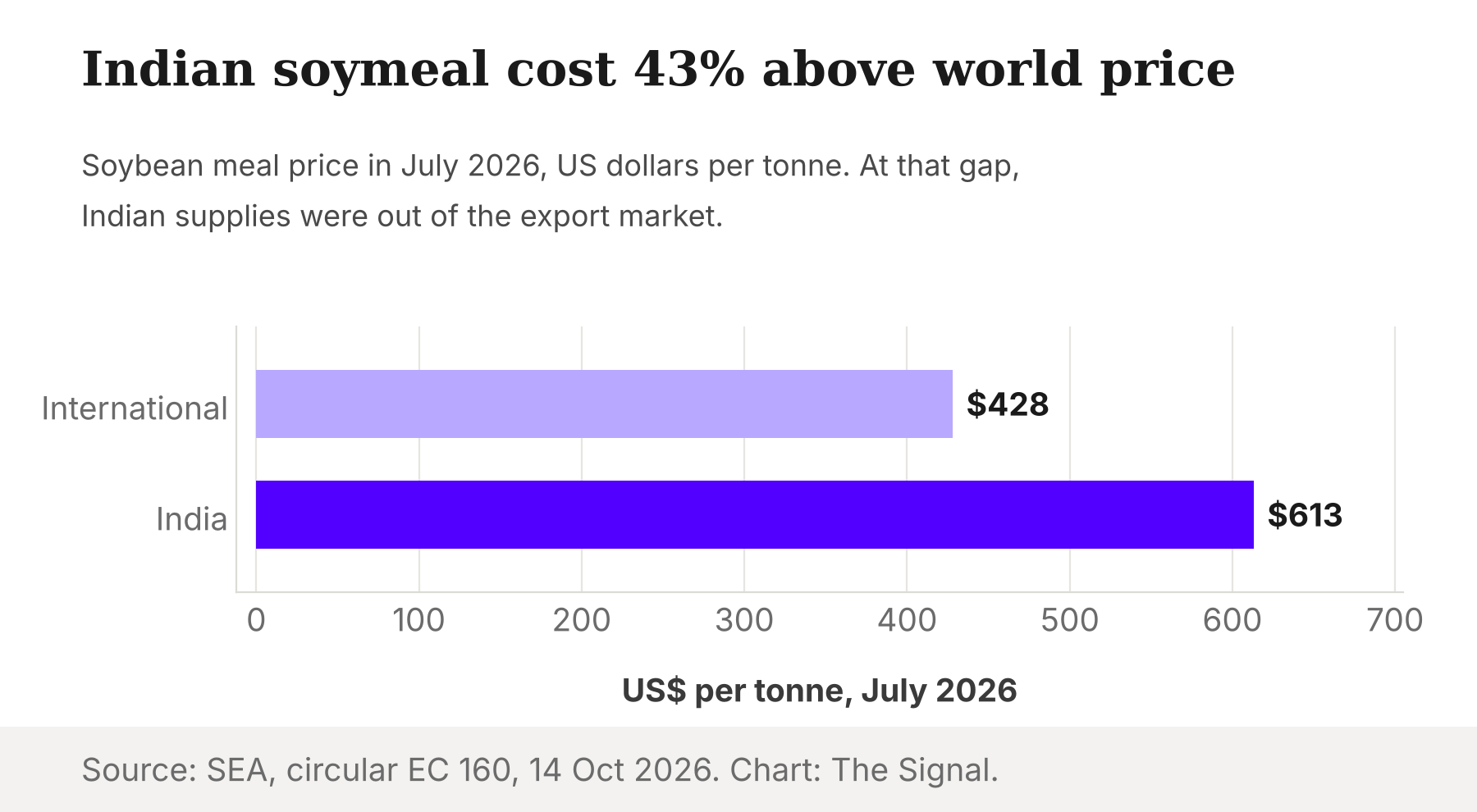
A buyer choosing between two sellers of the same commodity does not care about the exporter's currency. They compare the dollar price on the invoice. A weaker rupee can only help an exporter who passes it through to the dollar price, and the July quote shows the premium survived it. The SEA ties this to stiff competition from cheaper supplies from Argentina and Brazil, and to Red Sea disruptions that forced vessels onto longer routes, raising freight costs and delivery times, particularly for Europe and West Asia. That last point deserves attention. On the SEA's reading, higher domestic soybean meal prices and demand from poultry and livestock feed makers reduced the incentive and availability for exports. Indian meal is priced by the buyers at home, and the domestic market is paying more than the world will.
What a tonne of meal is worth against a tonne of beans
There is a second pressure on the price floor, and it sits upstream. The Cabinet set the 2026-27 kharif minimum support price for yellow soybean at Rs 5,708 per quintal, up Rs 380 from Rs 5,328. That is a rise of 7 percent, and it works out to Rs 57,080 per tonne of beans.
Now set that against the meal price. The SEA's September 2026 average for Indian soybean meal was US$530 per tonne, down from US$622 in August. At the September rupee rate of 95.51, that is about Rs 50,600 per tonne, a figure that is The Signal's calculation. A tonne of meal at that export price fetches less than a tonne of beans at the support price. A crusher therefore cannot earn its margin on meal sold abroad at world-competitive prices. It has to find that margin elsewhere, in the oil, or in a domestic meal market willing to pay more. The MSP is a floor on what farmers are offered, not a market price, so this is a comparison of benchmarks, not a statement about any one plant's books. But it points to the same place as the export data: meal exported at world prices is a thin business for an Indian crusher.
The honest objection
The strongest case against alarm is that the price gap is already closing. The SEA's soybean meal price fell from US$622 in August to US$530 in September, a drop of about 15 percent in a month, and a lower Indian price should win back some buyers. That case is real. But the circular gives no international price for September, so the gap itself cannot be measured. Nor does the later data show a recovery in volume yet: for April to August, SEA data as reported by the Free Press Journal show oilmeal exports down 28.51 percent to 12.82 lakh tonnes and soybean meal exports down 73 percent to 2.05 lakh tonnes from 7.57 lakh tonnes. A price cut helps only if it goes far enough to cross the world price.
The Signal
The lesson of the soybean meal collapse is that a cheaper currency does not buy competitiveness when the domestic price is set by something else. Here, that is a feed market at home that pays more than the world will, and a support price that sets a high cost of beans. Rapeseed meal, which still grew in April to July 2026, is the product that still finds buyers abroad.
Watch two things. If the September price cut deepens until Indian meal is back near the world price, volumes should follow within a few months. If it does not, India's soybean crushers become domestic-market businesses by default, and an oilmeal export line that ran at 4,885,437 tons in 2023-24 becomes a rapeseed story. The market does not reward a weaker rupee. It rewards the lower price.
Reporting basis (SEA circular EC 160): all April to July 2026 export volumes, monthly prices and exchange rates are from the Solvent Extractors' Association of India's circular EC 160 of 14 October 2026, which the association states is compiled from DGFT data; they rest on that one origin. The soybean support price is from the Press Information Bureau's release on the Cabinet decision of 13 May 2026. The April to August totals are per the Free Press Journal, reporting SEA data, and the SEA's own release for that period was not checked. The percentage shares, the tonnage losses, the 43 percent price premium, the 8 percent rupee move, the per-tonne rupee figures and the MSP-versus-meal comparison are The Signal's calculations from those figures.