The headline from Beijing on Tuesday was a round number. China's year-to-date trade surplus reached $1.04 trillion through October 2026, against a record $1.2 trillion for all of 2025. The usual reading follows at once: China is flooding the world with goods, and every importer with a deficit, India included, is a victim.
It is worth slowing down on that. The same release says the surplus is shrinking, not growing, and the reason sits on the import side.
The surplus fell because China is buying more
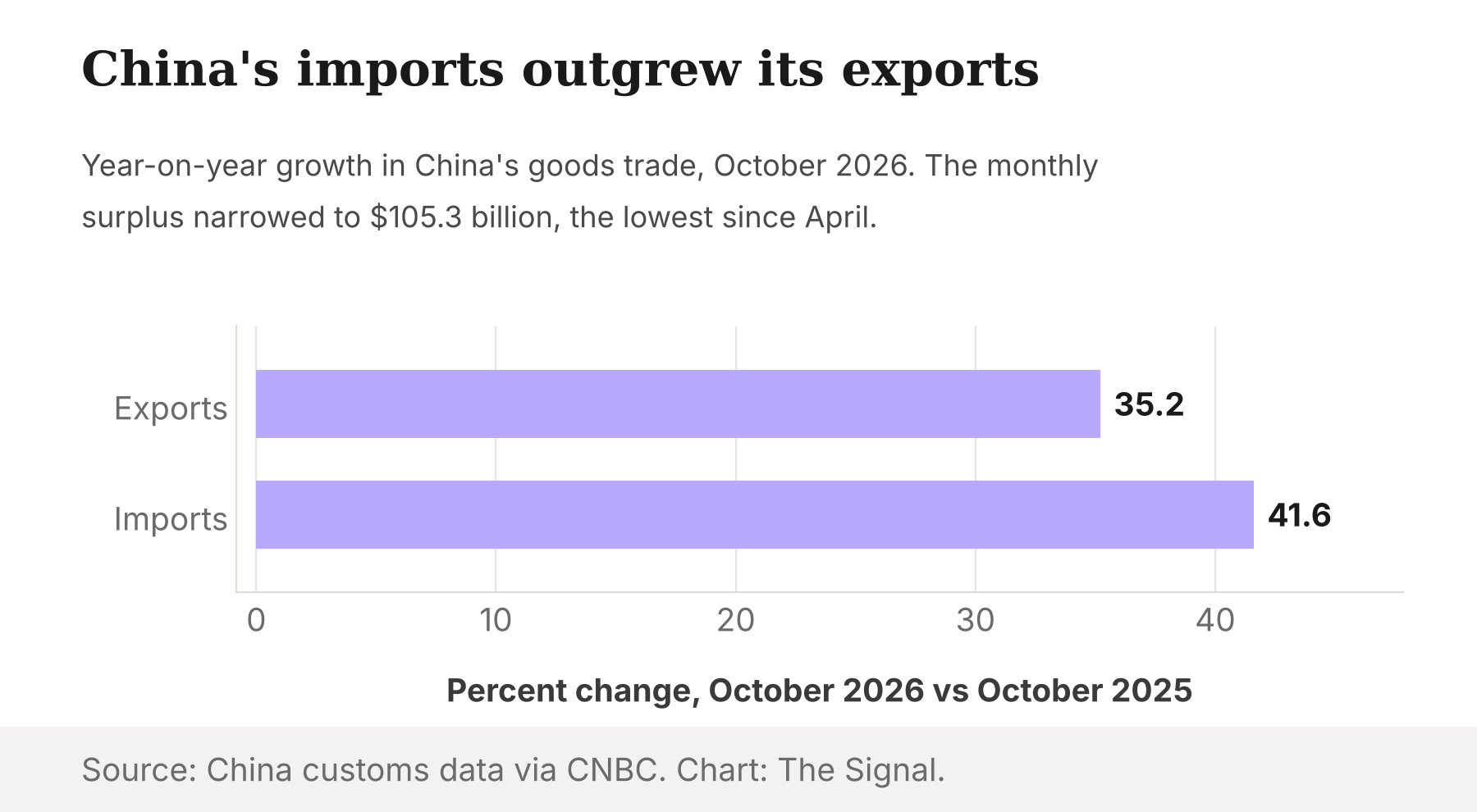
In October 2026, China's goods exports rose 35.2 percent and imports rose 41.6 percent from a year earlier, according to CNBC reporting China's customs data. Imports outran exports. As a result, the monthly surplus dropped to $105.3 billion, the lowest since April, according to LSEG data cited by CNBC.
The engine of the boom is hardware for artificial intelligence. CNBC reports that much of the export surge reflects robust demand for China's chips and other AI-related hardware. That is a global supply chain running hot in both directions, not one country shipping finished goods into a void.
India sits inside the same chain
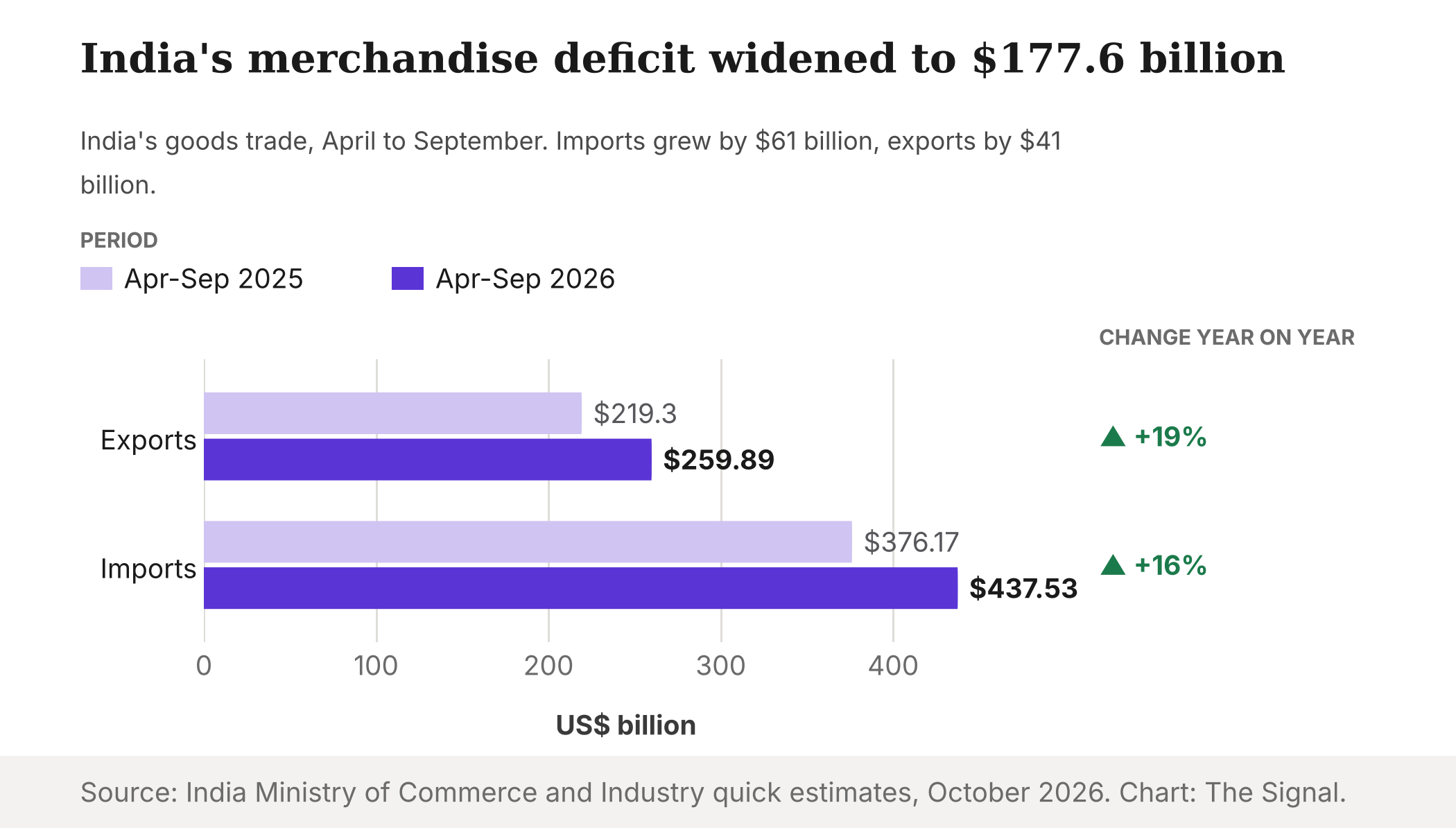
India's own numbers show the pattern. In April to September 2026, India's merchandise imports were $437.53 billion, against $376.17 billion a year earlier, according to the Commerce Ministry's quick estimates. China was the fastest-growing of India's top import sources by value change, up 27.82 percent over the same period.
On its face, that fits the dumping story. But look at what India was doing at the same time. In September, India's electronic goods exports rose 70.44 percent, from $3.11 billion to $5.31 billion. And India's exports to China grew 36.07 percent in April to September, faster than its imports from China grew.
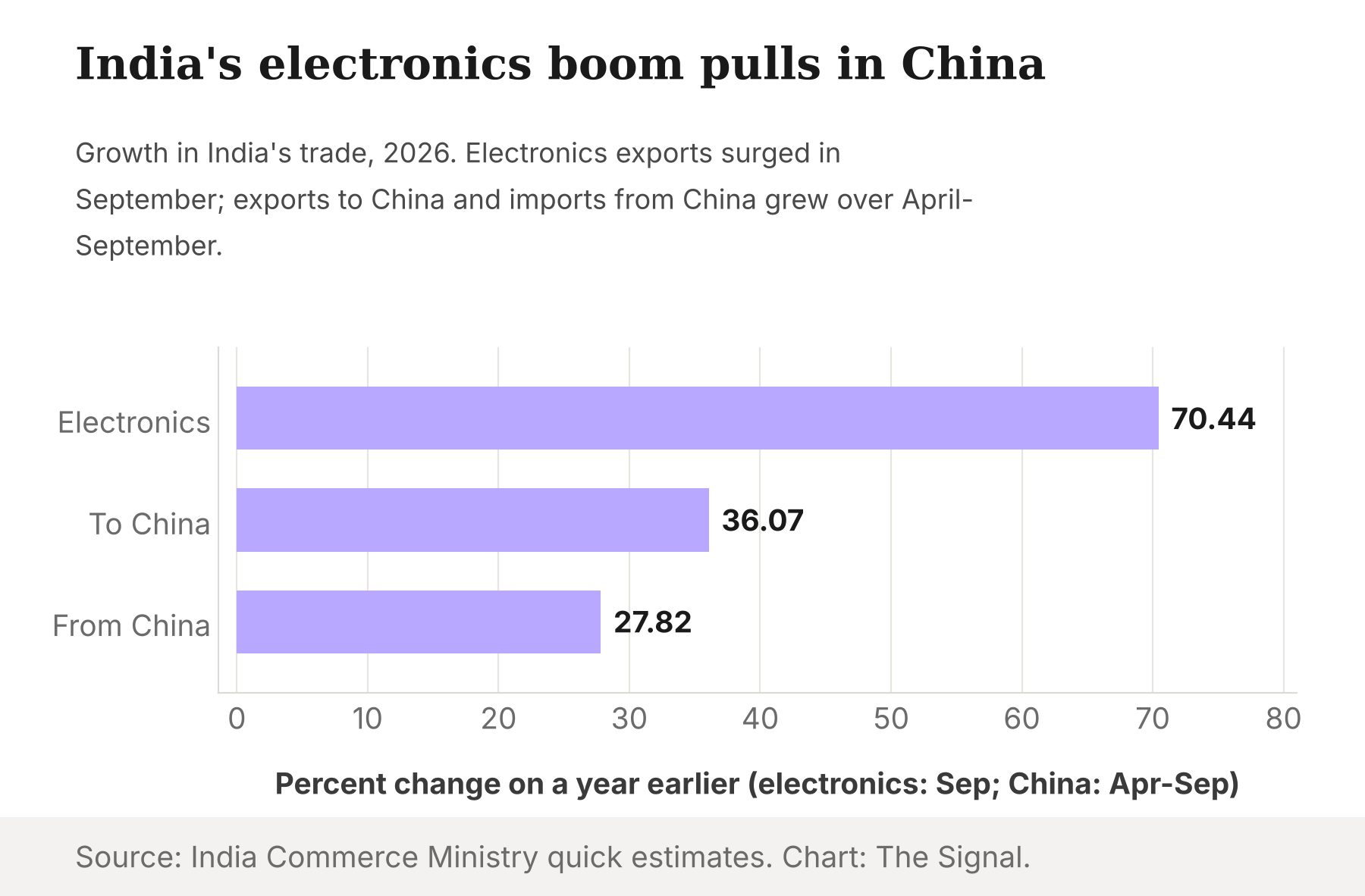
Those are not the numbers of a country that is only absorbing finished goods. They are the numbers of a country that is assembling more electronics and exporting them, while buying inputs to do it.
The number that carries the thesis
The most telling figure is the composition of the deficit. In the year to March 2026, imports of goods under HS Chapter 85, the electrical and electronic category, accounted for $43.1 billion of India's trade deficit with China, roughly double the FY19 level, ThePrint reports. In that same year, India imported $131.6 billion of Chinese goods, almost 17 percent of its imports, according to Bloomberg reporting carried by ThePrint.
So one category, electronics, carries $43.1 billion of the deficit, per ThePrint. The sources do not break that category into components and finished devices, so we cannot say how much of it is inputs. The timing is suggestive, though: electronics exports rose 70.44 percent in September while imports from China kept growing.
What the deficit is, and is not
India's overall goods gap is widening. In April to September 2026 the merchandise deficit was $177.64 billion, against $156.88 billion a year earlier, the Commerce Ministry says. Imports added about $61 billion over the year while exports added about $41 billion. The deficit widened because imports grew in absolute dollars faster than exports, even though exports grew faster in percentage terms.
This is the point where the two stories meet. A bigger bill for Chinese inputs and a bigger export book can rise together. If so, the deficit with China is partly the cost of the factory, not just a sign of lost ground.
The honest objection
The strongest counter is that a deficit is a deficit. India imported $131.6 billion of Chinese goods in the year to March 2026, and no amount of re-labelling changes who holds the surplus. Dependence on one supplier for almost 17 percent of imports is a risk whatever the inputs are for. If Beijing restricted exports of the goods India assembles, factories could stall.
That case is real. It argues for caution about supply chains, not for the dumping diagnosis. The two have different remedies: tariffs answer dumping, but tariffs on inputs raise the cost of exactly the electronics India is trying to sell abroad.
The Signal
China's $1.04 trillion year-to-date surplus is a story about the AI hardware cycle, and the monthly surplus narrowed as China imported more. India's share of the bill appears set largely by what its own factories need to buy. Watch two numbers next month: whether India's electronics exports keep growing at this pace, and whether imports from China keep growing slower than the exports they help to make. If imports pull ahead, the deficit is turning from an input cost into a dependence. A trade gap is a price, and the question is what it buys.
Reporting basis: China's October trade growth, monthly surplus and year-to-date total are per CNBC, reporting China's customs data and LSEG, which is the only source verified for those figures. India's merchandise trade, import-source growth, electronics export growth and export-destination growth are from the Commerce Ministry's September 2026 quick estimates, which we read directly. The FY26 electronics deficit is per ThePrint, and the FY26 import total is per Bloomberg, as carried by ThePrint. The import and export dollar increases are The Signal's calculations from those figures.