On 16 October 2026, China's commerce and science ministries proposed adding 12 solar technologies to its export control catalogue, covering polysilicon, wafer and cell manufacturing, plus the key and core equipment that carries them. The easy read in India is alarm: the country's solar factories are built on Chinese machines, so a Chinese export curb must be a threat. The easy counter-read is calm. Beijing's own spokesperson says equipment not named in the notice is in principle outside it, the list is a draft, and public comment runs only to 15 November, five days from today.
Both reads miss where the draft lands. The question is not whether China can starve India of solar panels. It is which stage of the supply chain India has promised to build next, and whether that stage sits inside the controlled list.
The mandate with a threshold
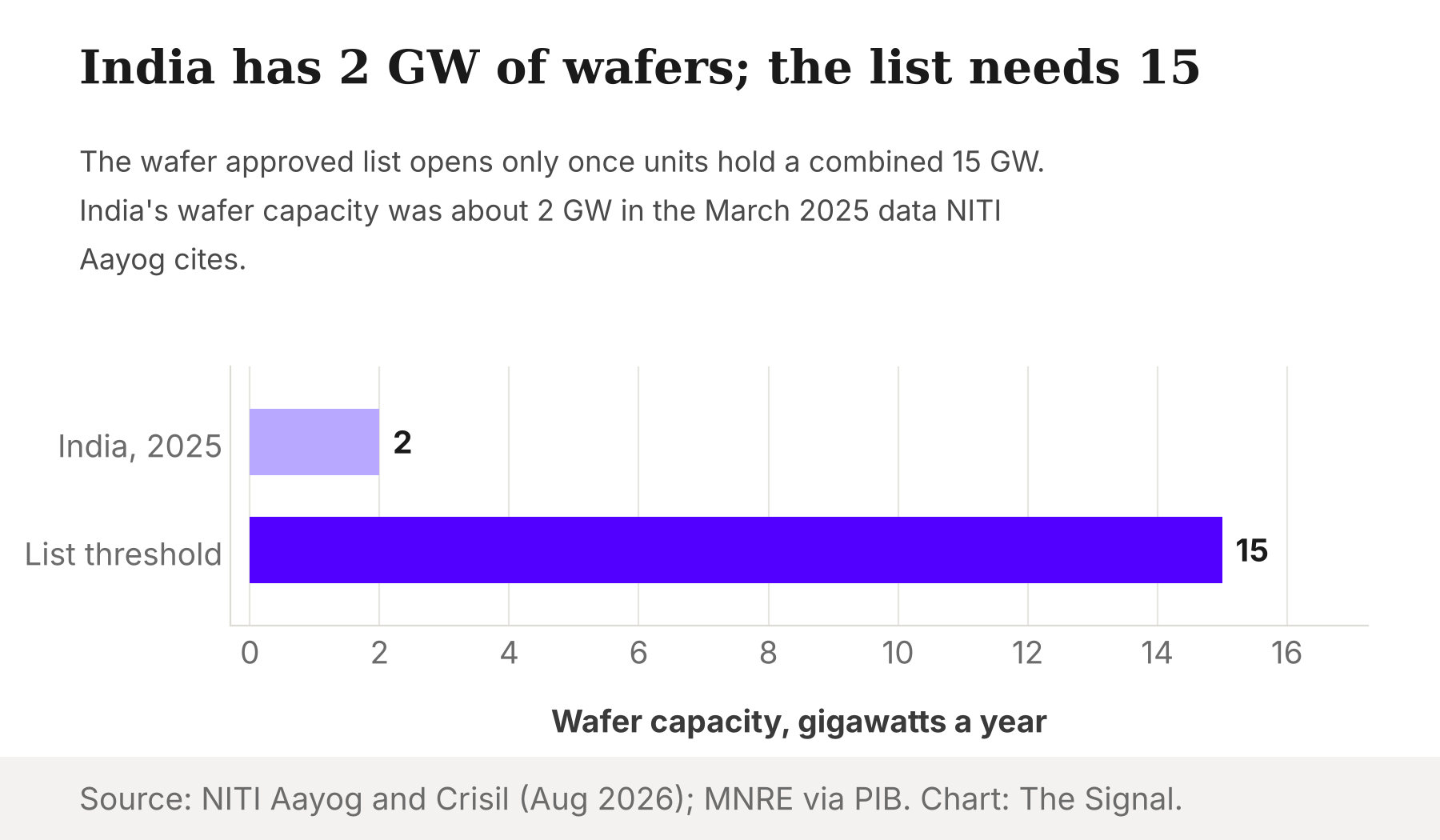
India's Ministry of New and Renewable Energy has extended its approved-manufacturer lists up the chain. An ALMM List-III for ingots and wafers takes effect on 1 June 2028, and from then every project must use listed wafers. The initial list is issued only when at least three independent units hold a combined 15 GW of capacity.
That is the number to hold against the current base. NITI Aayog and Crisil put India's wafer capacity at about 2 GW, measured in the data the report cites for March 2025. India needs 7.5 times that capacity before its own wafer list can open.
India has about 2 GW of wafer capacity against the 15 GW its wafer list requires.
The gap is not a surprise to the government. It is the point of the mandate. The same logic worked downstream: module capacity rose to 100 GW by August 2025, up from under 3 GW in 2014, after approved lists forced the build. The wafer list repeats the playbook one stage further up, where the factories are harder.
Where the dependence actually sits
The further upstream, the thinner India's own base. NITI Aayog and Crisil report polysilicon import dependence close to 100%, wafers above 90%, cells above 60% and modules above 40% of available supply after exports.
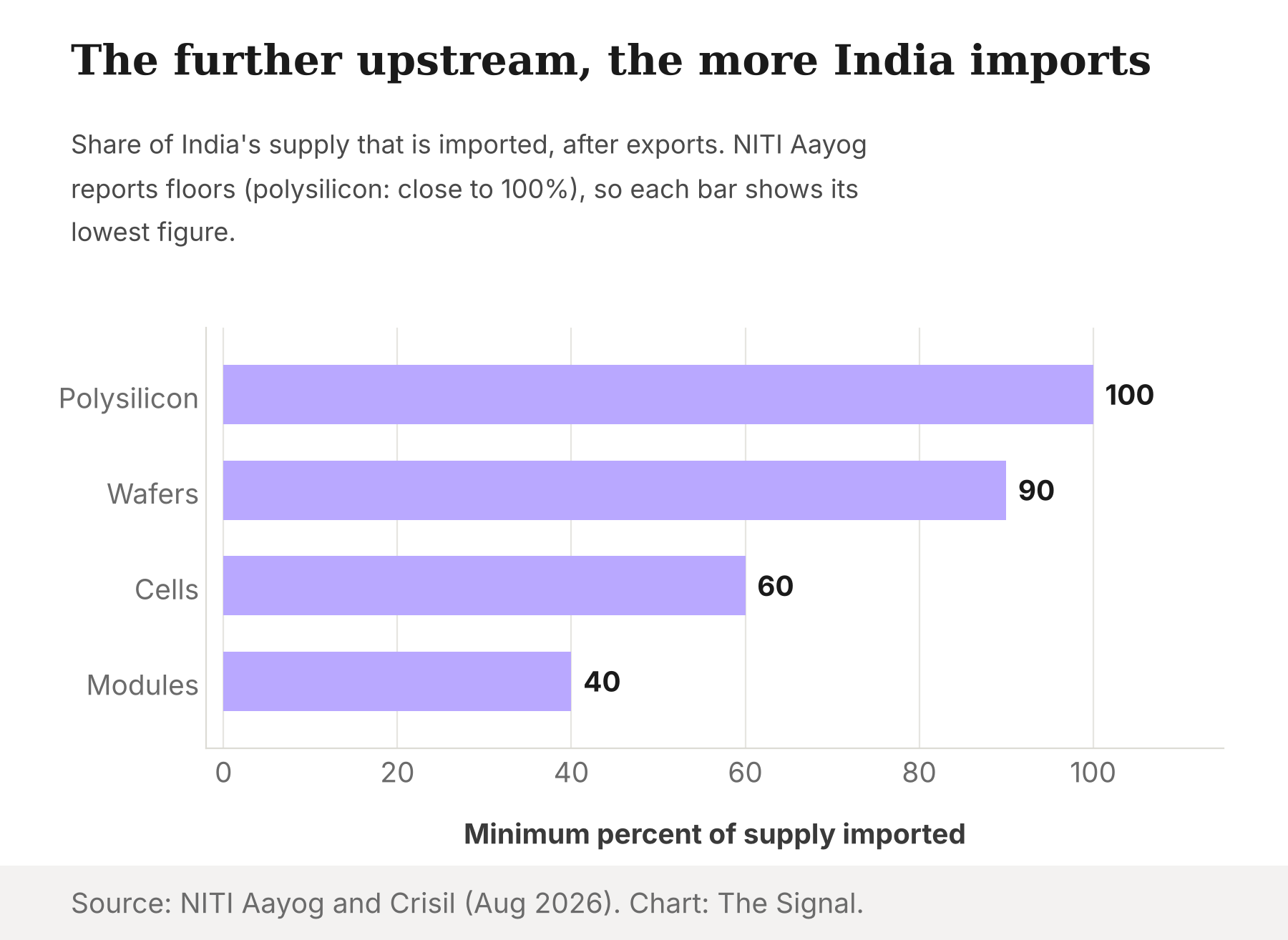
The supplier is concentrated. In 2025, China held 95% of the global wafer installed base while India held less than 1% of wafer capacity. And the machines follow the same map: more than 80% of the value of the chain, along with the necessary capital goods, is concentrated in China.
What Beijing has and has not put on the table
The draft is narrower than the headlines suggest. MOFCOM says 14 of the 40 technologies across AI, biomedicine and solar are proposed for prohibition, including perovskite and tandem cell module production technology, and 26 for restriction, including polysilicon engineering technology at 30,000 tonnes a year or more per line. The spokesperson's framing is that products made with the controlled technologies are outside the scope, so finished panels, and cells and wafers as products, are not what is controlled.
The part that matters for a factory builder is the registration clause. From the notice date until the revised catalogue takes effect, exporters must register listed technologies on a MOFCOM platform before exporting them, including licensing for overseas use. The spokesperson added that PV technology exports usually travel with production-line export, installation, commissioning and upgrading, and that exporters doing those things must apply for a technology export licence.
This is the mechanism. India buys complete lines, and a complete line ships with process know-how. A control on the know-how is a control on the commissioning, even when the machines themselves are not on any list. Trade press agrees the draft reaches equipment: PV Tech reports it covers the core equipment that embodies the technologies, and Mercom India reports the 12 technologies as export restrictions on solar manufacturing.
Why the timing matters to India's money
India has staked public money on the upstream build. The PLI scheme for high-efficiency modules has an outlay of Rs 24,000 crore. NITI Aayog warns that the majority of the capital goods market for the solar value chain is concentrated in China, industry players have voiced concern about supply of wafer, cell and module equipment from Chinese firms, and limited access could delay PLI commissioning. That warning predates the draft. The draft gives it a date and a form.
The honest objection
The strongest case for calm is that the controls are targeted and the machines are mostly outside them. Beijing says unlisted equipment is not covered, products are not covered, and the draft names specific thresholds rather than whole categories. NITI Aayog itself notes that equipment availability may have improved since the problem was first raised. On that view, India's mainstream wafer and cell lines can still be bought, and the draft chiefly targets the frontier: the most advanced cells and the largest polysilicon plants.
That case is real. The notice carries its technical thresholds in an annex, and this piece rests on the notice text and the ministry's Q&A, not on a line-by-line reading of every threshold. But it answers a different question. A narrow list can still bind a mandate that is itself narrow. India's wafer list needs three independent units and 15 GW by a fixed date, and those units are likely to be commissioned with Chinese vendors, in a regime where every listed technology export must be registered first. The risk is not an embargo. It is delay and discretion, applied at the one stage where India has no alternative supplier and a statutory deadline.
The Signal
Beijing's draft does not stop India's solar industry. What it does is put a registry between India and the stage it has set a date for. The wafer list opens only at 15 GW from a base of about 2 GW, with the capital goods concentrated in China, the supplier that is now counting its exports.
Watch two things. First, whether the final catalogue after the 15 November comment window keeps the thresholds narrow, or widens them to the mainstream lines Indian firms are buying. Second, whether India's 2028 date moves. If the wafer deadline slips, the registry did the work without a single machine being refused. A mandate is only as firm as the line that fills it.
Reporting basis: the Chinese export-control proposal, its interim registration rule and the prohibited-versus-restricted split are per the Ministry of Commerce's own notice and spokesperson Q&A, read in the original Chinese; the notice's annex of technical thresholds was not reviewed, so threshold details are not reported here. The two trade-press reports (PV Tech and Mercom India) report the same ministry draft and count as one origin with it for the underlying facts. India's capacity and import-dependence figures, China's share of wafer capacity, the capital-goods concentration and the PLI outlay are from NITI Aayog and Crisil Intelligence's August 2026 report, which is the single source for them. The ALMM List-III date and 15 GW threshold are from the Ministry of New and Renewable Energy, via a Press Information Bureau release. The 2 GW wafer figure is the report's March 2025 data point and may be out of date. The 7.5 times ratio is The Signal's calculation from the 15 GW threshold and the 2 GW capacity figure.