The headline number for the Pradhan Mantri MUDRA Yojana (PMMY), the government's collateral-free loan scheme for small businesses, is easy to like. As of 27 March 2026, the scheme had disbursed Rs 40.07 lakh crore across more than 57 crore accounts, and women are its majority borrowers. A PIB summary of an SBI Research report says women account for 68 percent of all Mudra beneficiaries. Read that line alone and the scheme looks like a success for women entrepreneurs.
It is worth slowing down on that. Count rupees instead of accounts and the picture changes. In FY2024-25, women borrowers accounted for 59.81 percent of loan accounts, with a 37.45 percent share of the disbursed amount, according to the PIB's April 2026 explainer. Divide one by the other and the average loan to a woman works out to about 63 percent of the average loan across all borrowers.
The scheme reaches many women. It reaches them with smaller loans, and the gap has not closed in a decade.
The share has slipped on both counts
The earlier record comes from an impact assessment funded by NITI Aayog and carried out by KPMG, using MUDRA Ltd data. In FY2015-16, women held 79 percent of accounts and 60 percent of the amount sanctioned. By FY2021-22 those shares were 71 percent and 49 percent.
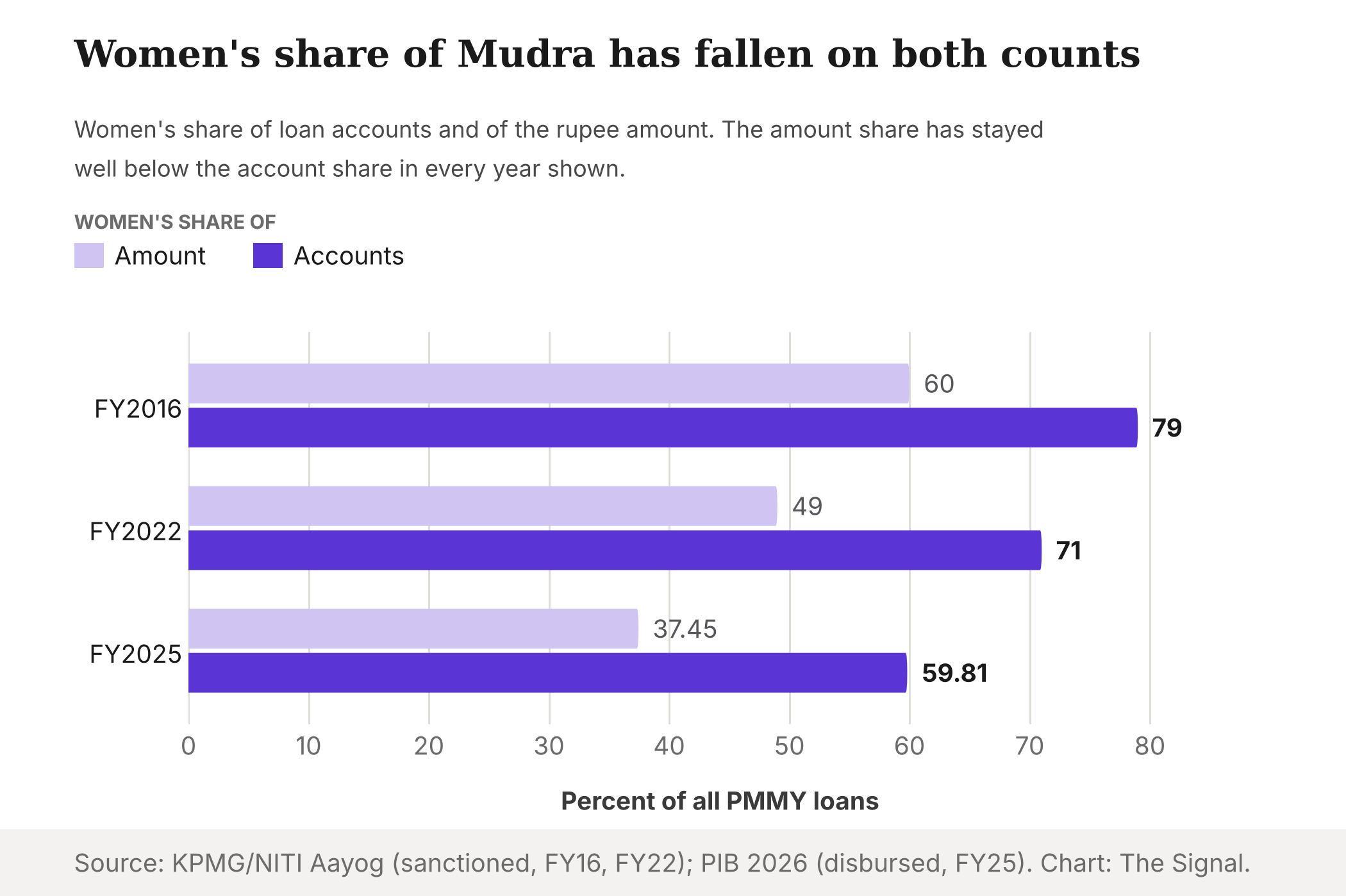
One caution on the comparison. The first two years are shares of the amount sanctioned in the KPMG assessment, while the FY2025 figure is a share of the amount disbursed in the PIB explainer. The two measures are not identical, so read the trend as direction rather than as a precise series.
Direction is clear enough. Per the KPMG tables and the PIB explainer, the women's amount share dropped from 60 to 49 to about 37 percent, and their account share from 79 to 71 to about 60 percent. Divide one by the other for each year and the women's average loan, relative to the scheme average, went from about 76 percent to about 69 percent to about 63 percent.
Where the money sits
The reason is loan size. Mudra sorts loans into tiers. Shishu covers loans up to Rs 50,000, Kishor runs above Rs 50,000 up to Rs 5 lakh, Tarun runs above Rs 5 lakh up to Rs 10 lakh, and a Tarun Plus tier above Rs 10 lakh was added in 2024.
In FY2023-24, women were disbursed Rs 1,08,472.51 crore under Shishu, Rs 1,00,370.49 crore under Kishor and Rs 13,454.27 crore under Tarun, per MUDRA Ltd data reproduced in a PIB backgrounder. Those three figures total Rs 2,22,297 crore. Shishu was 48.8 percent of it, Kishor 45.2 percent and Tarun 6.1 percent.
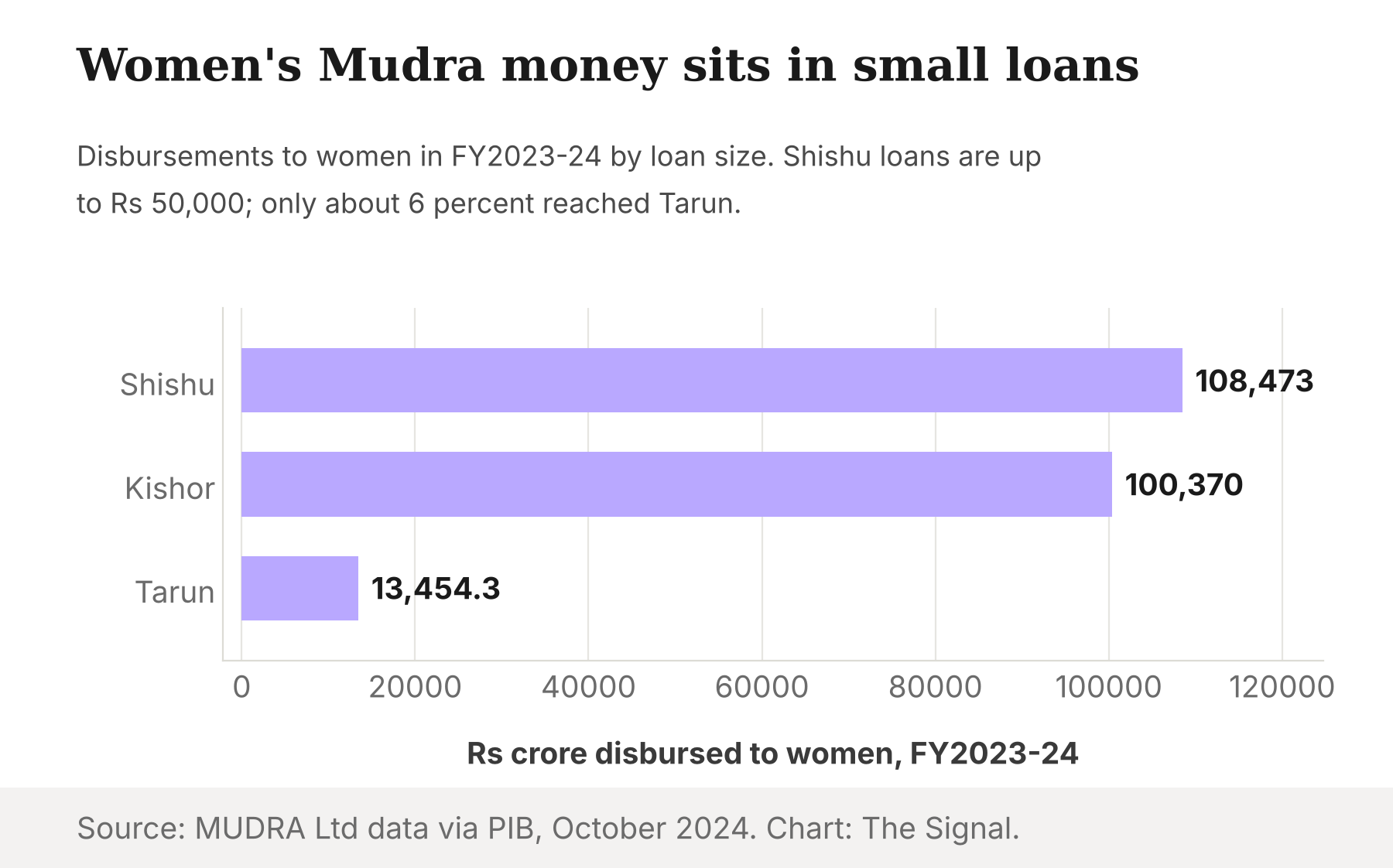
Per the same PIB backgrounder, nearly half of the money women received in FY2023-24 came in loans of Rs 50,000 or less, and only about one rupee in sixteen reached the Rs 5 lakh to Rs 10 lakh tier.
The tier mix has been changing, which is the encouraging part. In FY2015-16, 98 percent of women's accounts and 84 percent of their sanctioned amount were in Shishu. By FY2021-22 Shishu was 79 percent of women's accounts and 54 percent of their amount, while Kishor had grown to 21 percent of accounts and 42 percent of the amount. Women are moving up the ladder.
A tier effect is not the whole story
If the gap were only a matter of tiers, women would hold the same share of money as of accounts within each tier. They do in Shishu and do not in Kishor. In FY2021-22, women held 73 percent of Shishu accounts and 72 percent of Shishu money. In Kishor they held 71 percent of accounts but 51 percent of the money.
So even among loans of the same band, women's loans were smaller on average than the loans in the rest of that band. The data cannot say why. A loan officer's judgment, a borrower's own request for less, and the kind of business involved could each play a part, and nothing in these sources separates them.
There is also a moving target underneath. The scheme as a whole is shifting toward larger loans. Kishor loans rose from 5.9 percent of accounts in FY2016 to 44.7 percent in FY2025. If everyone else climbs faster than women do, the women's ratio falls even while women's own loans grow. The SBI report notes that the per-woman disbursement rose at a 13 percent annual rate between FY2016 and FY2025, to Rs 62,679.
The honest objection
The strongest case against reading this as a shortfall is that a small loan is the right product for a first loan. Many borrowers want a small working-capital line for a stall or a tailoring unit, and a bigger loan would only be a bigger debt. On that view, the Shishu concentration reflects what the businesses need, not what lenders withhold, and a majority share of accounts is the real achievement.
That case is credible, and the data supports part of it: the account share is still near 60 percent. But it explains why women borrow small at the start. It does not explain why the gap persists within Kishor, nor why the amount share kept falling while the scheme matured. A demand-side story predicts women catching up as their businesses grow. The numbers show women's share of the money falling while the scheme as a whole moves up the tiers.
The Signal
Mudra's gender story is told in accounts, and accounts are the generous measure. In rupees, the FY2025 picture is a 37.45 percent share for women against 59.81 percent of the accounts.
The tier-by-gender splits this piece could verify run to FY2023-24, and the Tarun Plus tier, started in 2024, is too new to show in them. Watch whether women's share of Kishor and Tarun money rises once the newer tiers are reported. If the amount share stays below 40 percent while the account share holds near 60 percent, the scheme is counting women faster than it is funding them.
Reporting basis (see the PIB explainer): The FY2024-25 account and amount shares, the cumulative disbursement total and the loan tier definitions are from the Press Information Bureau's April 2026 explainer on PMMY, which relays Ministry of Finance data. The FY2023-24 tier disbursements to women are MUDRA Ltd figures as reproduced in a PIB backgrounder from October 2024. The 68 percent women's share and the per-woman disbursement figure are from SBI Research, as summarised by the PIB, and rest on that single secondary summary. The FY2016 and FY2022 shares and tier splits are MUDRA Ltd data from the KPMG impact assessment funded by NITI Aayog. The sanctioned-amount basis of the FY2016 and FY2022 figures differs from the disbursed-amount basis of FY2025. The average-loan ratios, the tier percentages of women's FY2023-24 disbursements and the rupee total are The Signal's calculations from those figures.