Ten years after the November 2016 note ban, the argument that India is leaving cash behind looks airtight. UPI's annual transaction value grew to about ₹314 lakh crore in 2025-26, according to a Press Information Bureau factsheet citing NPCI data, up from just ₹0.07 lakh crore when the system began. India's nominal GDP for the same year was ₹346.36 lakh crore, according to MoSPI's provisional estimates. Put the two together and UPI moved about 91 percent of the size of the economy in a single year.
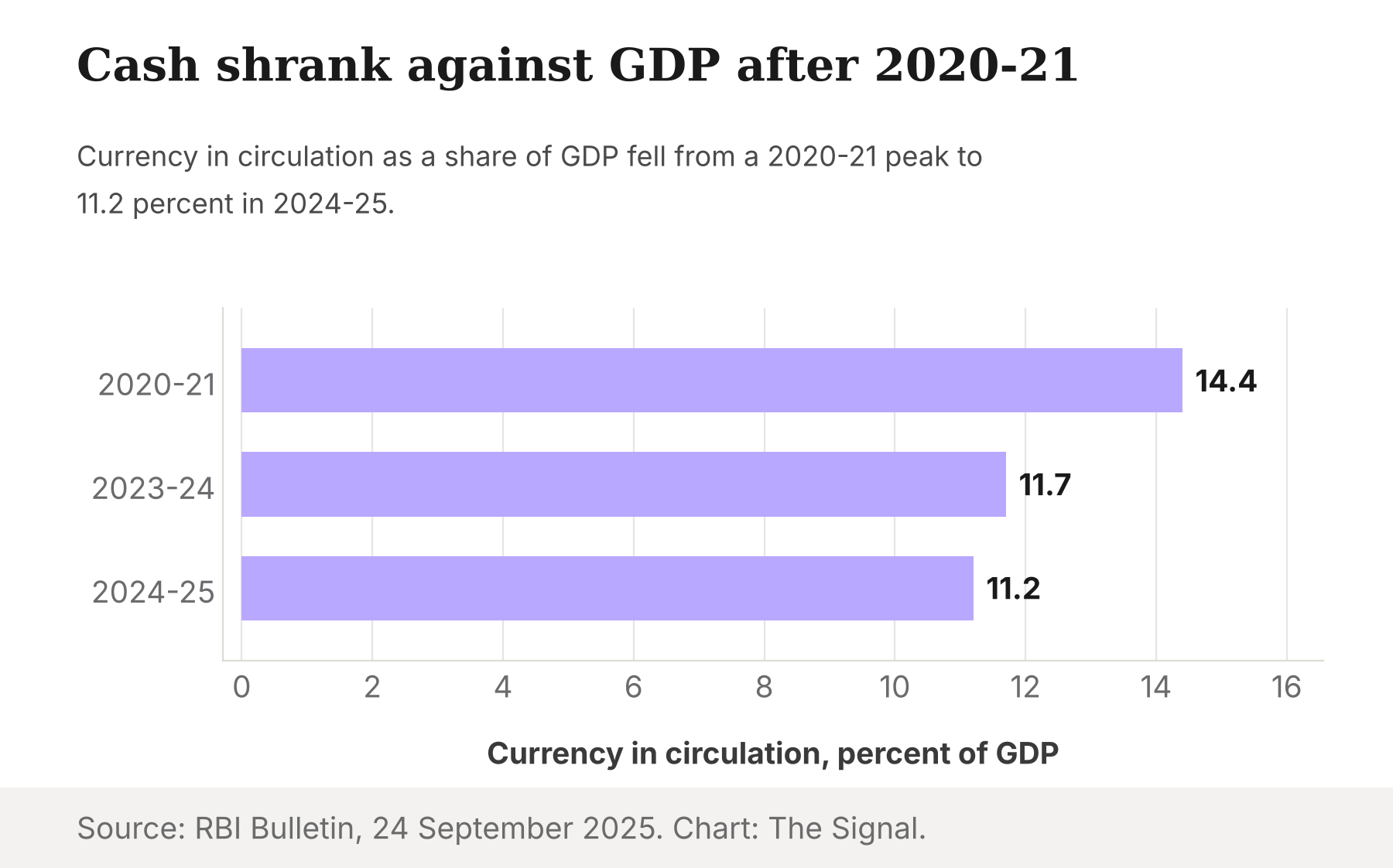
The Reserve Bank of India's own research supports the optimistic read. An RBI Bulletin article of 24 September 2025 reports that currency in circulation, the cash held by the public and banks, fell from a peak of 14.4 percent of GDP in 2020-21 to 11.7 percent in 2023-24 and 11.2 percent in 2024-25. The same article concludes that higher UPI adoption is associated with lower cash demand.
It is worth slowing down on that, because the latest numbers point the other way.
The slide in cash has reversed in growth terms
Cash is a stock, and the question is whether it grows slower or faster than the economy. For years it grew slower: the RBI Bulletin article of September 2025 reports that currency growth slowed to 4 to 6 percent in recent years, which is why the ratio to GDP fell.
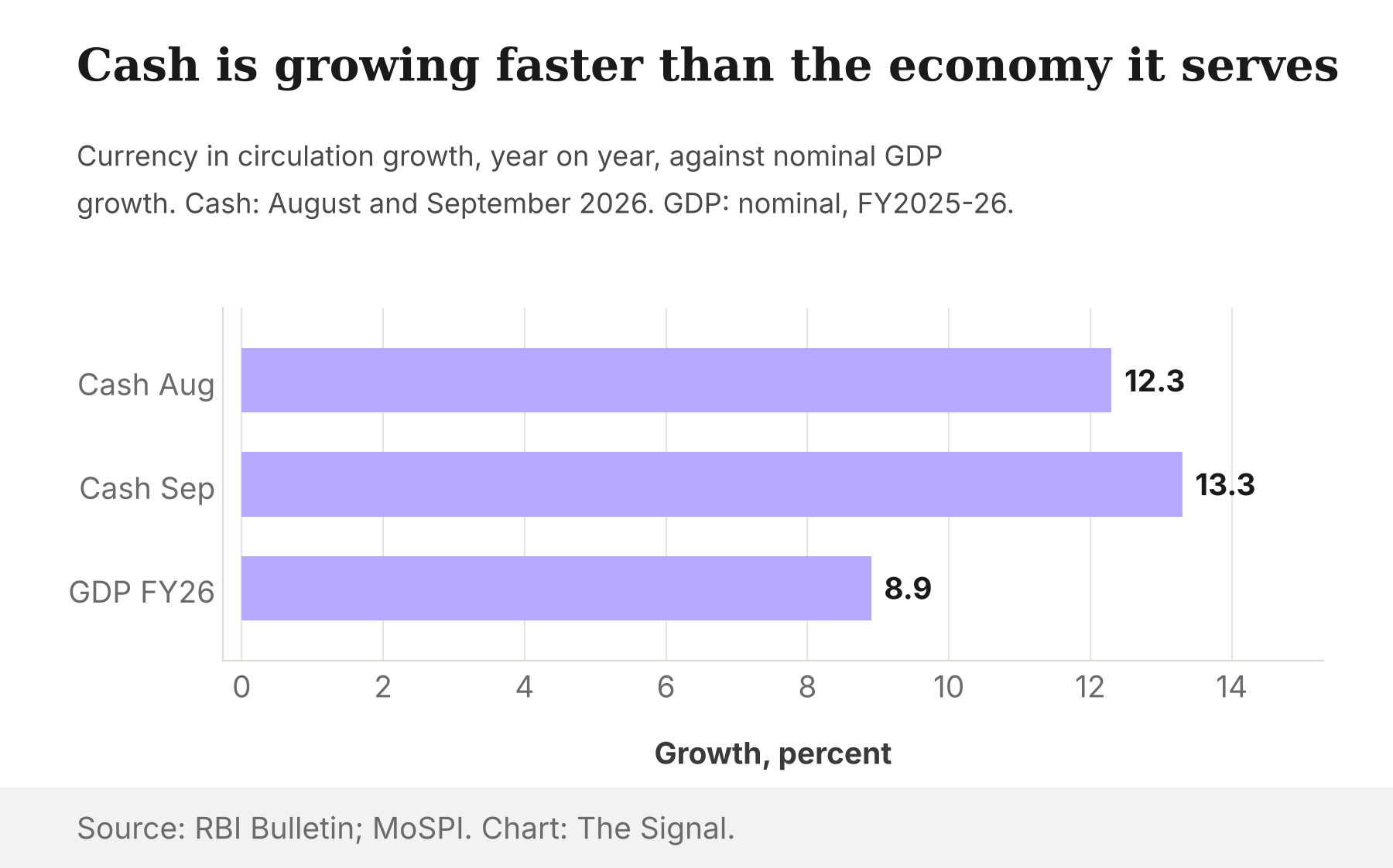
That has changed. The RBI's October 2026 Bulletin reports currency in circulation growth at its highest year-on-year print in five years as of 30 September 2026. The growth rate was 13.3 percent at the end of September, up from 12.3 percent at the end of August.
Nominal GDP grew 8.9 percent in 2025-26, MoSPI estimates. The periods differ: the cash figures are for the twelve months to August and September 2026, and the GDP figure is for the fiscal year to March 2026. Still, 13.3 against 8.9 means cash is growing at roughly one and a half times the pace of the economy, a reversal of the pattern behind the falling ratio.
The level is large too. The RBI's weekly table shows banknotes in circulation worth ₹43,14,760 crore in the week ended 23 October 2026, which is ₹43.15 lakh crore. That is the latest weekly figure the RBI has published as of 9 November.
Two systems growing at once
The usual story treats UPI and cash as rivals, where one gain is the other's loss. The numbers say otherwise. UPI's annual value of about ₹314 lakh crore in 2025-26 is more than seven times the ₹43.15 lakh crore stock of banknotes in the week ended 23 October 2026. A flow and a stock are different things, so the comparison shows scale, not substitution. But it makes one point plain: India can run a payment system that handles almost the entire value of its economy each year and still hold more cash every month.
The RBI's own research hints at why. Its September 2025 Bulletin finds that the substitution effect "moderates, possibly reflecting saturation or behavioural inertia" as UPI adoption matures. In other words, the first wave of users swapped cash for UPI. Later users add UPI without giving up cash.
What the ratio does next
Here the data stops. The latest cash-to-GDP ratio in the sources we could verify is 11.2 percent for 2024-25. We have no official ratio for later years, so the claim that the ratio is now rising is an inference, not a reported fact. The inference is simple, though. If a numerator grows faster than a denominator, the ratio rises, and cash growth of 13.3 percent exceeds GDP growth of 8.9 percent.
The honest objection
The strongest case against reading this as a reversal is base effects. Because cash growth had slowed to 4 to 6 percent, a jump to 13.3 percent may be a catch-up, not a new trend. The ratio also started far below its 14.4 percent peak in 2020-21, so a modest rise would still leave India well short of that level.
That case is real, and nothing here says UPI is failing. But it answers a different question. The point is not that cash is back at its 2020-21 peak. It is that the expectation that digital payments would steadily shrink cash relative to the economy has stopped holding, at least for now.
The Signal
India has built a payment system that moves about 91 percent of GDP in a year (UPI against GDP), and cash growth is at a five-year high. Both are true because cash does more than pay. It is also a store of value and a safety net, and UPI does not retire those functions.
That matters for policy built on the assumption that cash is fading. Any plan that depends on shrinking cash demand, from payment pricing to currency printing schedules, now has to reckon with a stock that is growing faster than the economy. Watch the RBI's next annual figures for the 2025-26 ratio. If it has turned up, the promise that followed the note ban has quietly stalled.
Reporting basis: The currency-in-circulation figures come from the Reserve Bank of India, through its weekly banknote table and its September 2025 and October 2026 Bulletins. Nominal GDP comes from MoSPI's provisional estimates for 2025-26. UPI annual value comes from a Press Information Bureau factsheet that cites NPCI data, so we verified the relay and not NPCI's own statistics page. The piece rests on three independent origins (RBI, MoSPI and NPCI via PIB), and every cash figure comes from a single origin, the RBI. The UPI-to-GDP share, the comparison of UPI value to the banknote stock and the comparison of cash growth to GDP growth are The Signal's calculations from those figures. The claim that the cash-to-GDP ratio is now rising is our inference, since no official later ratio was available.