On 6 November the Reserve Bank of India published its annual census of cross-border investment held by Indian companies. The headline is tidy. In rupee terms, the ratio of inward FDI to outward direct investment (ODI) moderated to 4.2 times at end-March 2026 from 5.5 times a year earlier. Foreign money in India is still far larger than Indian money abroad, but the gap is closing fast.
The easy read is that Indian business is going global. Outward direct investment stock at market value rose to ₹16,71,463 crore from ₹11,86,744 crore, a jump of about 41 percent. Inward FDI stock, at ₹70,71,945 crore, rose only 8.5 percent. Read the rupee figures and the story is an outward boom.
It is worth slowing down on that. The rupee is the unit doing much of the work.
In dollars, the picture changes
The same release reports both stocks in US dollars at financial year-end exchange rates. Inward FDI stock fell from $761,542 million to $747,134 million, while outward stock rose from $138,669 million to $176,586 million. That is a fall of about 2 percent for foreign money in India and a rise of about 27 percent for Indian money abroad.
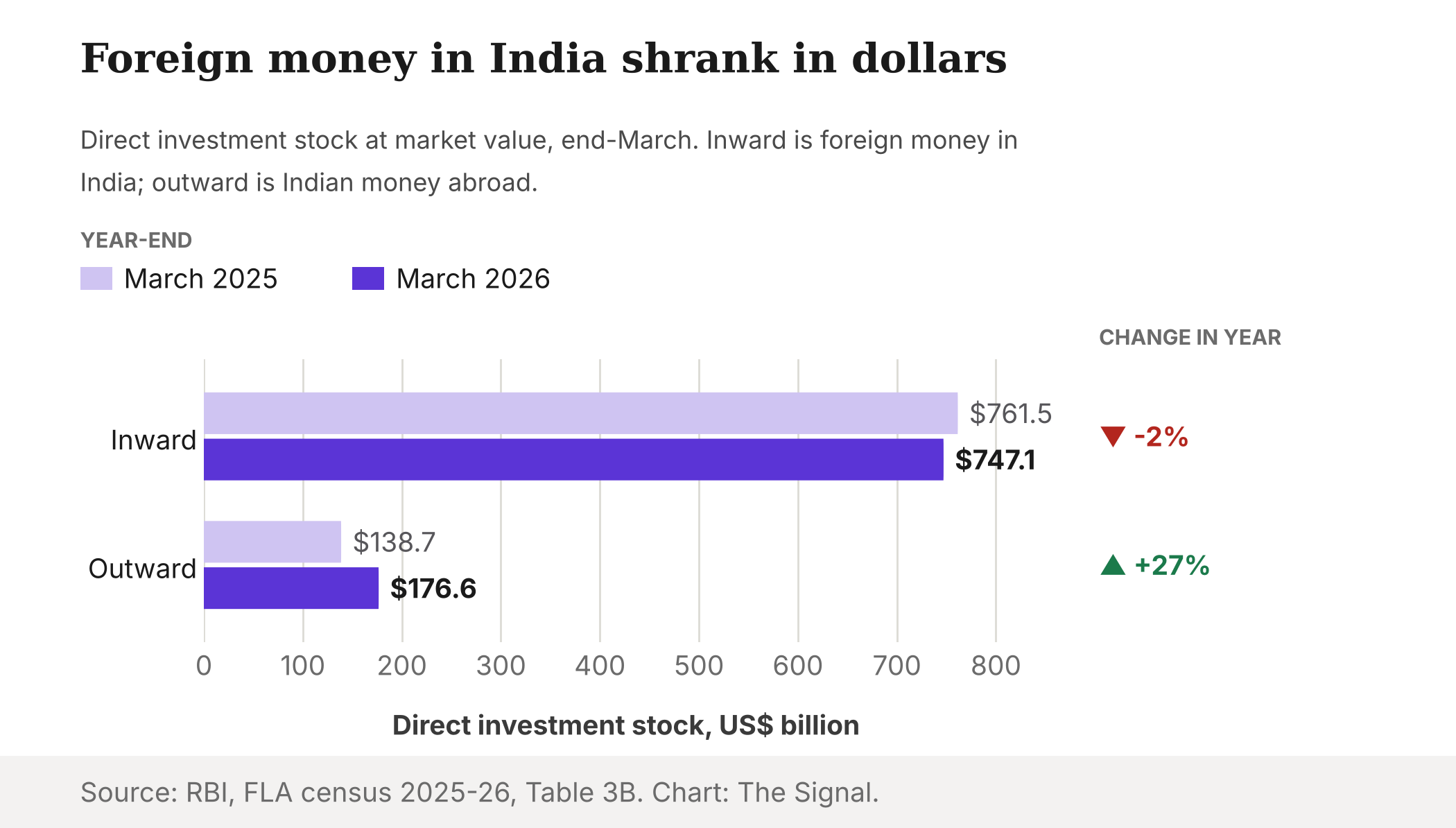
The gap between the rupee and dollar readings is the currency. Dividing each rupee total in the RBI's Table 3B by its dollar total implies year-end rates of roughly ₹85.6 per dollar in March 2025 and ₹94.7 in March 2026, a rupee about 11 percent weaker (our calculation). A weaker rupee inflates every foreign-currency asset when it is translated into rupees. It lifts the 27 percent dollar rise in outward stock to 41 percent in rupees. It also lifts the inward stock's 2 percent dollar fall to an 8.5 percent rupee gain.
The ratio itself does not depend on the currency, since both stocks are converted at the same rate. What the dollar view shows is how it narrowed: not because foreign investors added to India more slowly, but because the dollar value of what they hold here went down while Indian holdings abroad went up.
Most of the outward surge was loans
The second thing to look at is what kind of money went out. The census splits outward stock into equity and debt. Outward equity rose from ₹10,09,490 crore to ₹13,30,455 crore, while outward debt rose from ₹1,77,254 crore to ₹3,41,008 crore. Equity grew by about a third. Debt grew by about 92 percent, nearly doubling.
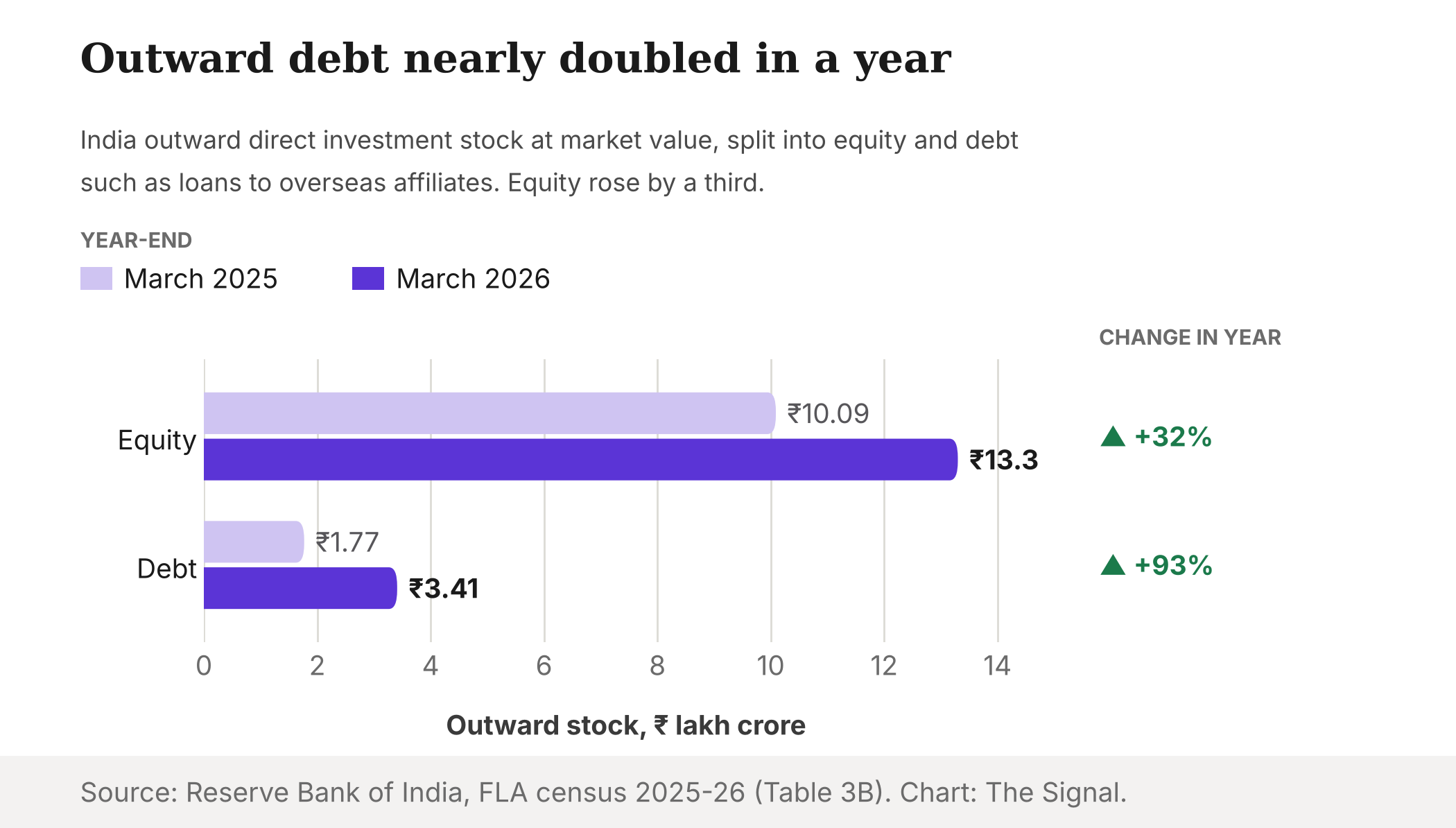
Debt is still only about a fifth of the ₹16,71,463 crore outward stock, so most of the dollar growth sits in equity. But the debt line is where the year's change is sharpest.
The destinations are concentrated. Singapore, the United Arab Emirates and the United States were the top ODI destinations, together accounting for more than 50 percent of the stock. Two of those three are financial and holding-company hubs as much as markets, so the census cannot say how much of this capital ends up in operating businesses there.
Other RBI data point the same way, more softly
The quarterly statistics tell a similar story at a smaller scale. In the International Investment Position, direct-investment assets abroad were US$279.6 billion in June 2025 and US$316.1 billion in June 2026, while direct-investment liabilities went from US$571.7 billion to US$560.9 billion. That is about a 13 percent rise in assets and a 2 percent fall in liabilities. The direction matches the census. The size is much smaller, because the IIP uses a different valuation basis and a different date range.
The flow data add a reason this matters. In the balance of payments, net FDI inflows increased to US$6.9 billion in 2025-26 from US$1.0 billion in 2024-25. Over the same year, FPIs recorded net outflows of US$16.4 billion, and foreign exchange reserves fell US$23.6 billion on a BoP basis. Net FDI is gross inflows minus repatriation and minus Indian outward investment, so a rising outward flow directly shrinks the headline number the government watches.
The honest objection
The strongest case against reading this as a shift is that these are stocks, not flows. The RBI itself warns that variations in outstanding assets and liabilities would differ from balance-of-payments flows because they also include valuation changes due to price and exchange rate movements. A bull market abroad, a fall in the rupee, or a revaluation of an unlisted subsidiary can move the stock without a single new rupee leaving the country. The census is also provisional, and one year is a short run. In the previous round, ODI grew 17.9 percent against 11.1 percent for FDI in rupee terms, so the outward tilt is not new.
That case is real, and it is why this article leads with the dollar figures. But it does not erase the direction: the inward stock fell in dollars while the outward stock rose, and the IIP agrees on the sign.
There is also a contrary reading of the inward side: listed and unlisted companies each hold about half of FDI equity, and the listed half is valued at share prices, so a falling dollar value need not mean investors left. The census does not separate price from quantity, and this analysis cannot either.
The Signal
The headline ratio is a story about India's currency as much as India's companies. A narrowing from 5.5 to 4.2 times looks like maturing outward ambition, and some of it is. But in dollars, foreign holdings in India lost ground in a year when reserves drew down and portfolio investors sold. Indian companies, meanwhile, pushed more capital out, with outward debt growing fastest.
Watch two things in the next census and the monthly ODI data. First, whether outward debt keeps outgrowing outward equity, which would mean parent companies are funding foreign operations rather than buying new ones. Second, whether the inward stock recovers in dollars if the rupee steadies. If it does, much of this year's narrowing was valuation. If it does not, India is exporting capital faster than it is importing it. A ratio can close from either side, and only one of them is good news.
Reporting basis: every figure here comes from one origin, the Reserve Bank of India, read on its own site: the provisional FLA census release of 6 November 2026, the 2024-25 census release, the Q4 2025-26 balance-of-payments release and the June 2026 International Investment Position release. The census release does not state a growth rate for outward stock. The percentage changes, the implied exchange rates and the IIP comparisons are The Signal's calculations from those figures.