Indian car registrations fell in October, and the headline wrote itself. Passenger-vehicle retail came in at 5,07,768 units, down 14.23 percent on a year earlier, according to the Federation of Automobile Dealers Associations (FADA), which compiles registration data from the transport ministry's records. If you read only the top line, demand is cooling just as Diwali arrives.
It is worth slowing down on that. The fall is mostly a calendar effect. Diwali falls on 8 November this year, with Dhanteras on 6 November, while in 2025 Navratri and Diwali both landed in October, which inflated last year's base. Work backwards from FADA's figures and the October 2025 comparison month was about 5.9 lakh cars (our calculation from the 5,07,768 units and the 14.23 percent fall). A month with half the festival cannot be expected to match a month with all of it.
So the retail number is not the problem. The problem is what sits unsold behind it.
The number that carries the story
Dealers hold about 44 days of stock, against a benchmark of 21.
FADA reports that passenger-vehicle channel stock held at around 43 to 45 days in October, unchanged from September, "against record wholesale dispatches from manufacturers". The yardstick is FADA's own: in September it called 21 days the recommended benchmark, and said stock had risen five days over August-end, with 60 percent of dealers holding more stock for the festivals. Stock is roughly double what the dealers' own body calls healthy.
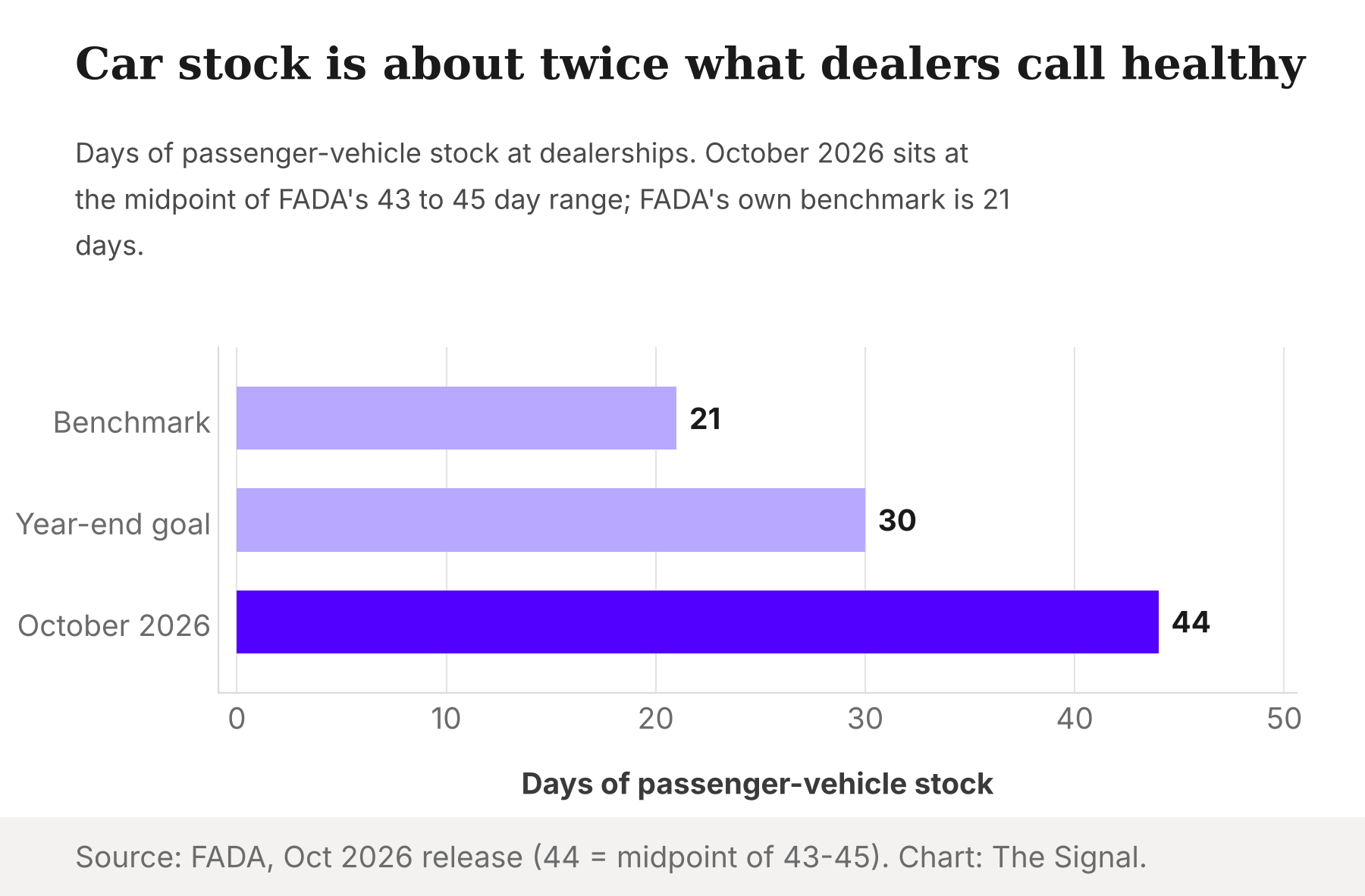
Translate the days into cars. October's retail pace works out to about 16,400 registrations a day (5,07,768 units over 31 days). Twenty-three days of excess stock at that pace is roughly 3.8 lakh cars sitting beyond what dealers say they need. That is our calculation, and it assumes the days figure is measured at October's selling rate, which FADA does not state. Treat it as a scale, not a count.
Why factories keep shipping
The supply side explains the pile. Autocar Professional, citing a PTI report, says domestic passenger-vehicle dispatches crossed 5 lakh units for the first time in October, with the industry estimated at 5.25 to 5.3 lakh, up 14 to 15 percent on 4.60 lakh a year earlier. That is an estimate rather than a final industry tally, so the chart below uses its low end.
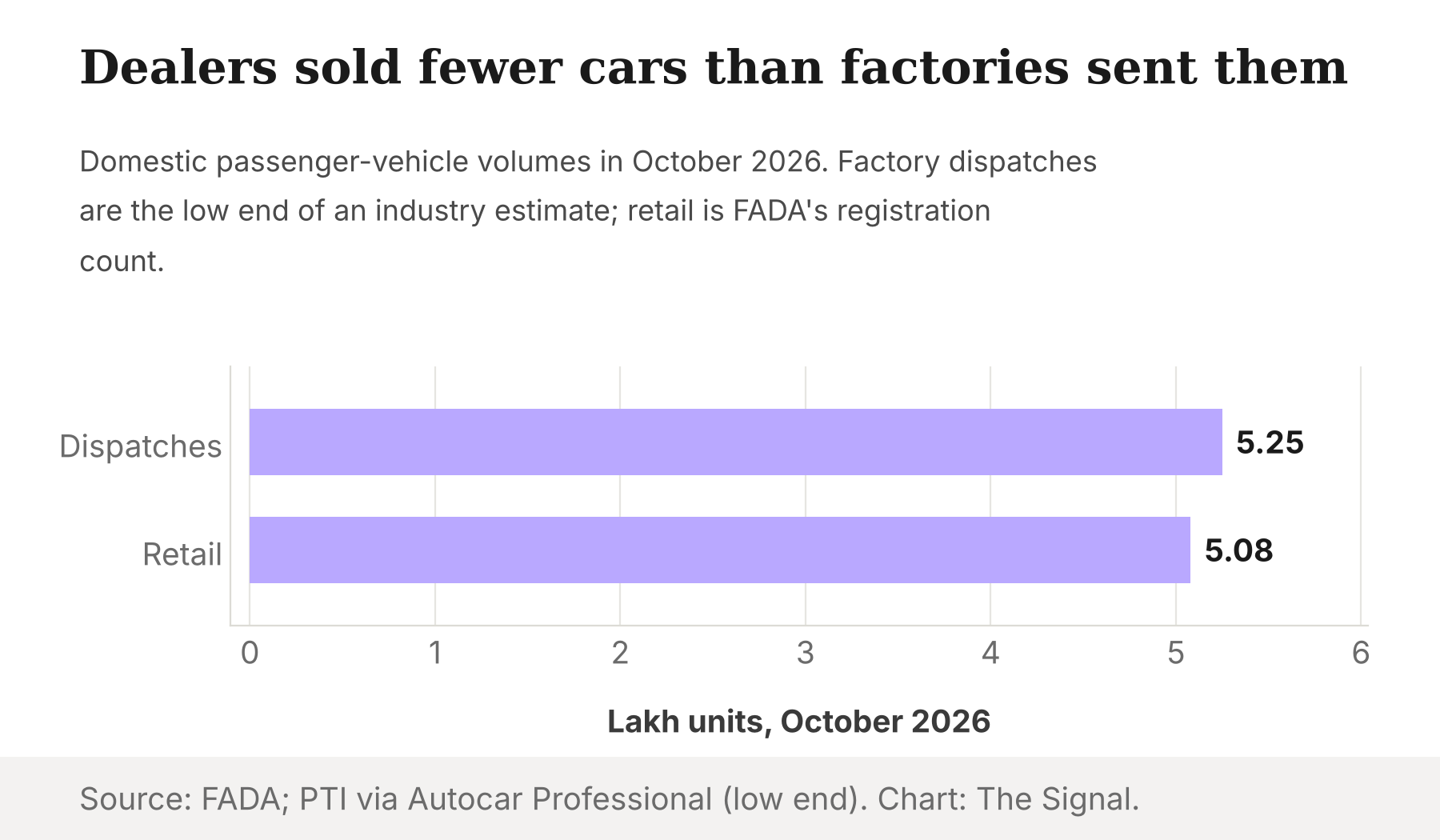
The gap is small, roughly 17,000 cars in a month, and dispatches and registrations are counted at different points, so it should not be over-read. What it shows is that October did not drain the lots. In a month with Navratri and a strong launch pipeline, stock merely held. FADA also says entry-level cars were the softer spot, and that last year's GST price advantage faded after manufacturers raised prices.
Money got more expensive at the wrong moment
Carrying stock costs interest, and rates have just turned. The RBI's Monetary Policy Committee unanimously raised the policy repo rate by 25 basis points to 5.50 percent on 7 October 2026. The central bank projects CPI inflation of 5.2 percent for 2026-27, with 6.0 percent in the third quarter, which hints that the tightening may not be a one-off.
Dealers feel it first. In FADA's survey, about 31 percent reported a moderate or material effect on financing costs and EMIs from the first repo-rate increase in over three years. A dealer who owns 44 days of stock on borrowed money, and sells to buyers who now pay more per month, has little room to wait.
The honest objection
The strongest counter is that this is normal. Dealers stock up before the biggest retail wave of the year, and the wave is only now arriving. FADA expects the pressure to ease: it forecasts inventory falling back to a 30-day range by the end of the calendar year. Dealers are also upbeat on the month: 51.65 percent expect November sales to grow, 34.71 percent expect them flat and 13.64 percent expect a fall. Commercial vehicles, the least festival-dependent segment, rose 2.29 percent to a best-ever October, which argues against a broad demand slump.
All of that is fair, and it explains why this is not a crisis. It does not close the gap. Thirty days is still above FADA's 21-day benchmark, and dealers are wary of a post-festive lull once the Diwali peak passes. A good Diwali clears the lots. It does not change who is paying to hold them.
The Signal
The October fall of 14.23 percent will be forgotten once November registrations print against an easier base. The stock number, 43 to 45 days, will not be, because it decides what happens next. Factories that ship ahead of demand end up asking dealers to carry the cost, and dealers who cannot carry it push buyers toward better offers. Watch two things after Diwali: whether FADA's November release shows stock moving toward 30 days, and whether manufacturers slow dispatches rather than wait for discounts to do the work. A showroom is a loan, and the lender just raised the rate.
Reporting basis: retail registrations, inventory days, the dealer survey and the November outlook are from FADA's own October and September 2026 releases, which compile transport-ministry registration data across 1,468 of 1,469 regional transport offices as of 4 November 2026. Inventory is FADA's view as an industry body and rests on that one origin. The wholesale dispatch figure is per Autocar Professional, reporting a PTI estimate, and is not a verified industry tally. The repo-rate decision and inflation projection are from the Reserve Bank of India's own October 7 resolution and Governor's statement. The October 2025 retail base, the 3.8 lakh excess-stock scale and the dispatch gap are The Signal's calculations from those figures.