The tidy story goes like this. India imports most of its crude, oil has been expensive, and the dollars to pay for it are arriving from Indians abroad. Petroleum, crude and products imports rose 21.3 percent year on year to $35.0 billion in July-August 2026, according to the RBI's Governor. Meanwhile, personal transfer receipts, mostly remittances, rose to $42.9 billion in April-June 2026 from $33.2 billion a year earlier, the RBI's balance of payments release reports. And the Governor's statement says net inflows under non-resident deposits rose sharply to $119.2 billion during April-August 2026. Put those three together and the oil bill looks covered.
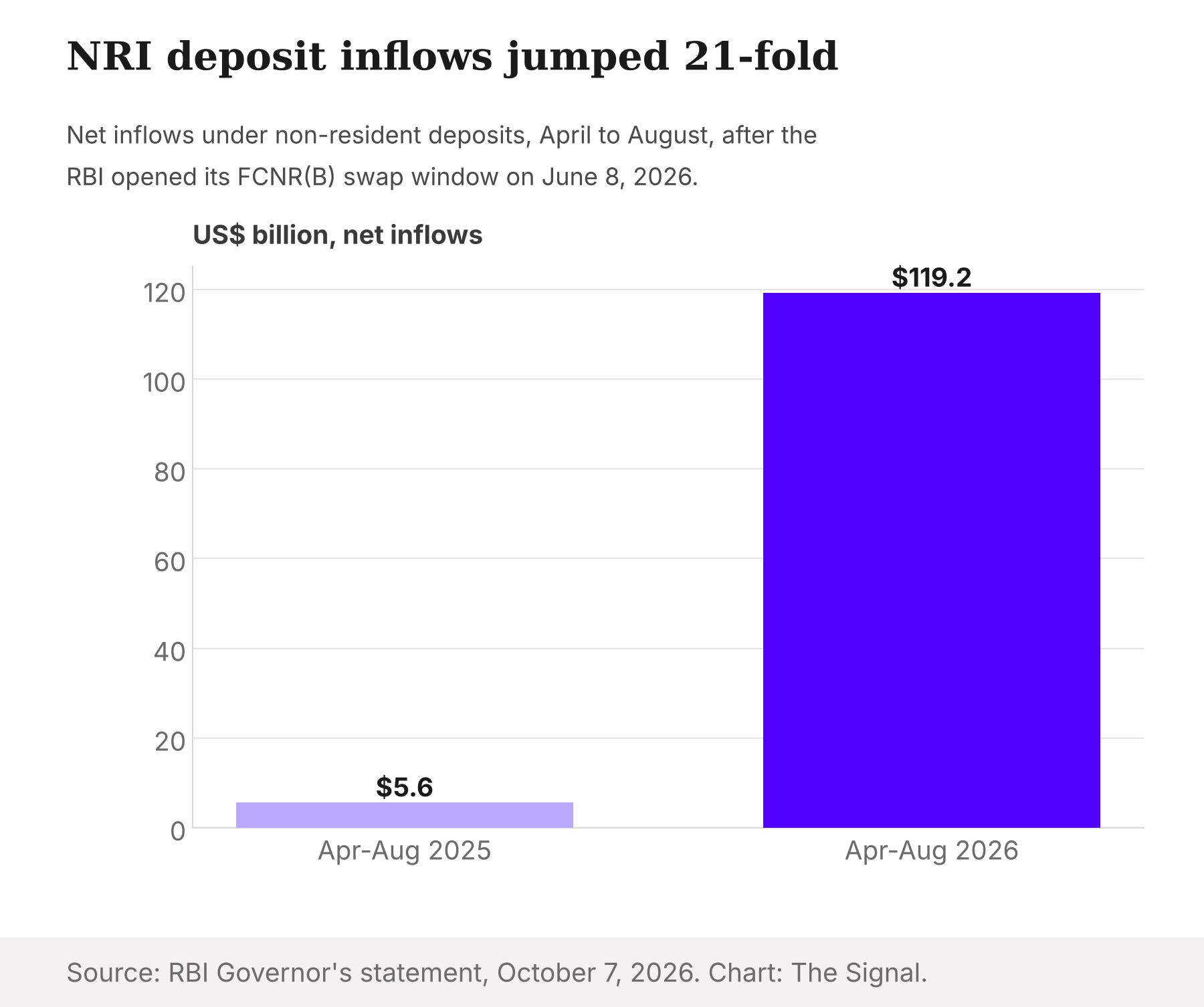
It is worth slowing down on the size of that last number. The Governor's statement puts the scale in context: $119.2 billion against $5.6 billion a year earlier. That is a 21-fold jump in five months. Oil prices did not rise 21-fold. Something other than the oil bill moved these deposits.
The deposits are bigger than the gap they supposedly fill
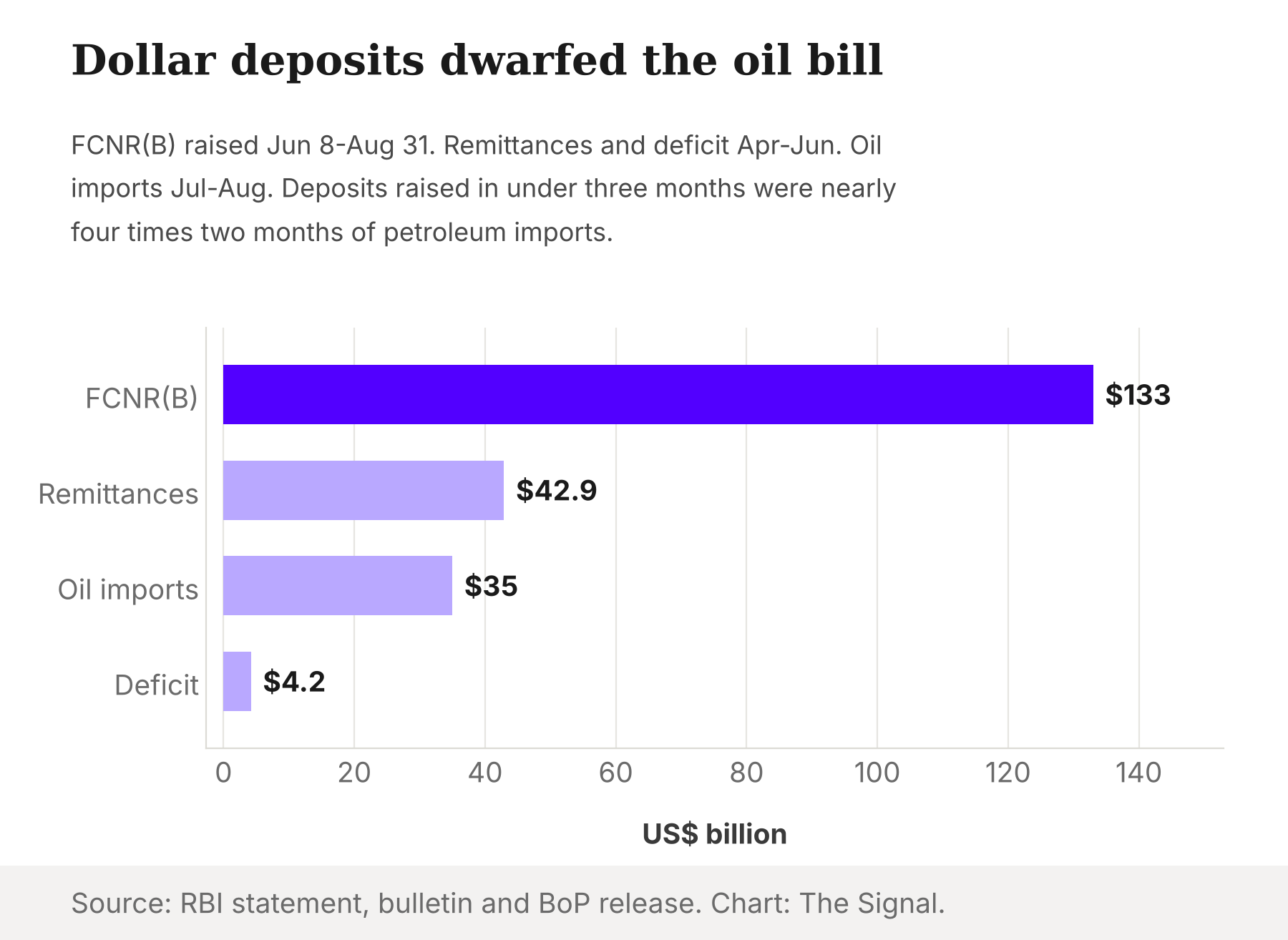
Start with what actually needed financing. India's current account deficit was $4.2 billion, or 0.5 percent of GDP, in April-June 2026. Remittances alone in that quarter, at $42.9 billion, were about ten times the deficit. The remittance flow was already doing the job that the "NRIs are paying the oil bill" story gives to deposits.
Now the deposit flow. A single category, FCNR(B), which means foreign-currency deposits that non-resident Indians hold in Indian banks, did most of the work. The RBI's October Bulletin says a total of $133 billion was mobilised through FCNR(B) deposits during June 8-August 31, 2026. An earlier RBI release, using provisional bank data, counted $127.2 billion of FCNR(B) forex inflows up to August 31. Against the $35.0 billion petroleum bill for July-August, $133 billion raised in under three months is 3.8 times as much. The periods differ, so this is a scale check, not a ledger. But the direction is not subtle.
For context, the RBI says India's forex reserves stood at $734.6 billion on October 2, 2026. The FCNR(B) haul is about 18 percent of that figure. These are not top-ups.
What actually pulled the money in
The date range gives the cause away. The FCNR(B) figures start on June 8, 2026, the day the RBI introduced a swap facility for fresh FCNR(B) deposits in its circular RBI/2026-27/99. The circular covers deposits of three to five years, and it says the swap will be undertaken at par. In plain terms, a bank can hand the RBI the dollars it raised and get them back at maturity at the same exchange rate. As we read that, the exchange-rate risk over the life of the deposit moves from the bank to the central bank. That is our reading of the structure, not an RBI statement, and the circular does not itself say who bears the hedging cost.
The timing points to a price, not an oil shock. The central bank offered to take the currency risk on dollar deposits, banks went and raised them, and the inflow followed the window.
The cost shows up as liquidity, then as a clock
Two consequences are already visible in the RBI's own account. First, liquidity. The Governor says system liquidity averaged a daily surplus of ₹5.9 lakh crore since the August policy meeting. Second, policy. In the same October 7 statement, the MPC raised the repo rate by 25 basis points and moved to a calibrated tightening stance, and noted that elevated energy prices and trade policy uncertainty pose upside risks to the current account deficit. The statement does not tie the two moves together, and we do not claim they are connected. But a central bank reporting a large liquidity surplus while it raises rates is not what a country that simply needed dollars for oil looks like.
Then the clock. Each deposit under the scheme runs three to five years. The circular adds that the underlying deposits carry a one-year lock-in, after which banks may allow early withdrawal at their discretion. Money mobilised in mid-2026 therefore falls due between 2029 and 2031. The dollars it brought in today come with a repayment date attached.
The honest objection
The strongest case against this reading is that it is cheap insurance, and the insurance is warranted. Oil is volatile. Brent fell more than 16 percent in the week to November 6 and closed at $98.32 a barrel, CNBC reported, which still leaves crude near the level that squeezed India's import bill this year. The RBI says elevated energy prices pose upside risks to the current account deficit. A central bank that builds a large dollar cushion before a shock is doing its job, and $734.6 billion of reserves is a better place to face a shock from than a thinner one.
That case is fair. But it changes what the story is. If the deposits are a defensive buffer, they are insurance, not financing for oil. The Governor's statement puts the reserves at $734.6 billion and the non-resident deposit inflow at $119.2 billion, so the inflow equals about 16 percent of reserves. Insurance has a premium, and here it is the exchange-rate risk the circular says is swapped at par. The honest label for the inflow is a dollar buffer bought with a central-bank guarantee, not an NRI subsidy to the oil bill.
The Signal
The tidy story has the right numbers and the wrong verb. Deposits did not pay for oil. Petroleum imports were $35.0 billion in July-August, the quarterly deficit was $4.2 billion, and FCNR(B) deposits alone raised $133 billion.
Three things settle whether this was prudent. First, how Brent behaves after falling more than 16 percent in the week to November 6: a lower crude bill makes the buffer look larger than needed. Second, whether the RBI publishes the cost of carrying the swaps, because the circular is silent on it. Third, the 2029 to 2031 maturities that follow from the three-to-five-year tenor, when the dollars owed come back into view. A buffer built on a guarantee is only as strong as the guarantee's balance sheet.
Reporting basis: every figure comes from the Reserve Bank of India: the Governor's statement, the swap circular, the forex inflow release, the balance of payments release and the October Bulletin. The two FCNR(B) totals differ because one is the provisional bank-reported position and the other is the Bulletin figure for a slightly different window. The Brent move is per CNBC, a single secondary source. The multiples, percentages and maturity window are The Signal's calculations from those figures, and the reading of the swap's risk transfer is The Signal's interpretation of the circular.