On 6 November, Karnataka's Department of Legal Metrology released lab results for 14 petrol samples from seven districts. Ethanol content ranged from 13.5% to 31.2%, and 11 of the 14 were above the 20% E20 limit. The highest reading came from an Indian Oil Corporation sample. The next, at 30.5%, was Hindustan Petroleum's.
The easy read is a state picking a fight with the Centre, and there is a fight in it. But the numbers raise a narrower question that does not depend on who is right politically: when India says its petrol is E20, who checks that at the pump, and where is the result published?
What the mandate actually says
A 17 February 2026 notification from the Petroleum Ministry requires oil companies to sell petrol with ethanol content up to 20 percent (E20), meeting Bureau of Indian Standards specifications and a minimum octane rating of 95, from 1 April 2026. It replaced a 2021 notification that permitted up to 10%.
The wording is a ceiling, "up to 20 percent". Petrol at 19% ethanol sits inside it. Petrol at 31.2% sits outside it. That makes the national figure a poor guide to any single litre, which is the point worth slowing down on.
The government's own FAQ puts ethanol's share of petrol at 14.6% in 2023-24, 19.2% in 2024-25 and 20% in 2025-26 (November to June). That is a programme average across the supply year. An average of 20% says nothing about how tightly individual pumps cluster around it.
What Karnataka's samples show
Ethanol content of the 14 samples Karnataka published, by company.
| Company | Ethanol (%) |
|---|---|
| IOCL | 31.2 |
| HPCL | 30.5 |
| HPCL | 27.0 |
| BPCL | 26.5 |
| Nayara | 26.1 |
| Shell | 25.5 |
| BPCL | 24.2 |
| BPCL | 22.6 |
| HPCL | 22.4 |
| IOCL | 20.8 |
| Nayara | 20.6 |
| BPCL | 19.9 |
| MRPL | 19.2 |
| Shell | 13.5 |
Source: Karnataka Department of Legal Metrology results, as reported by The South First.
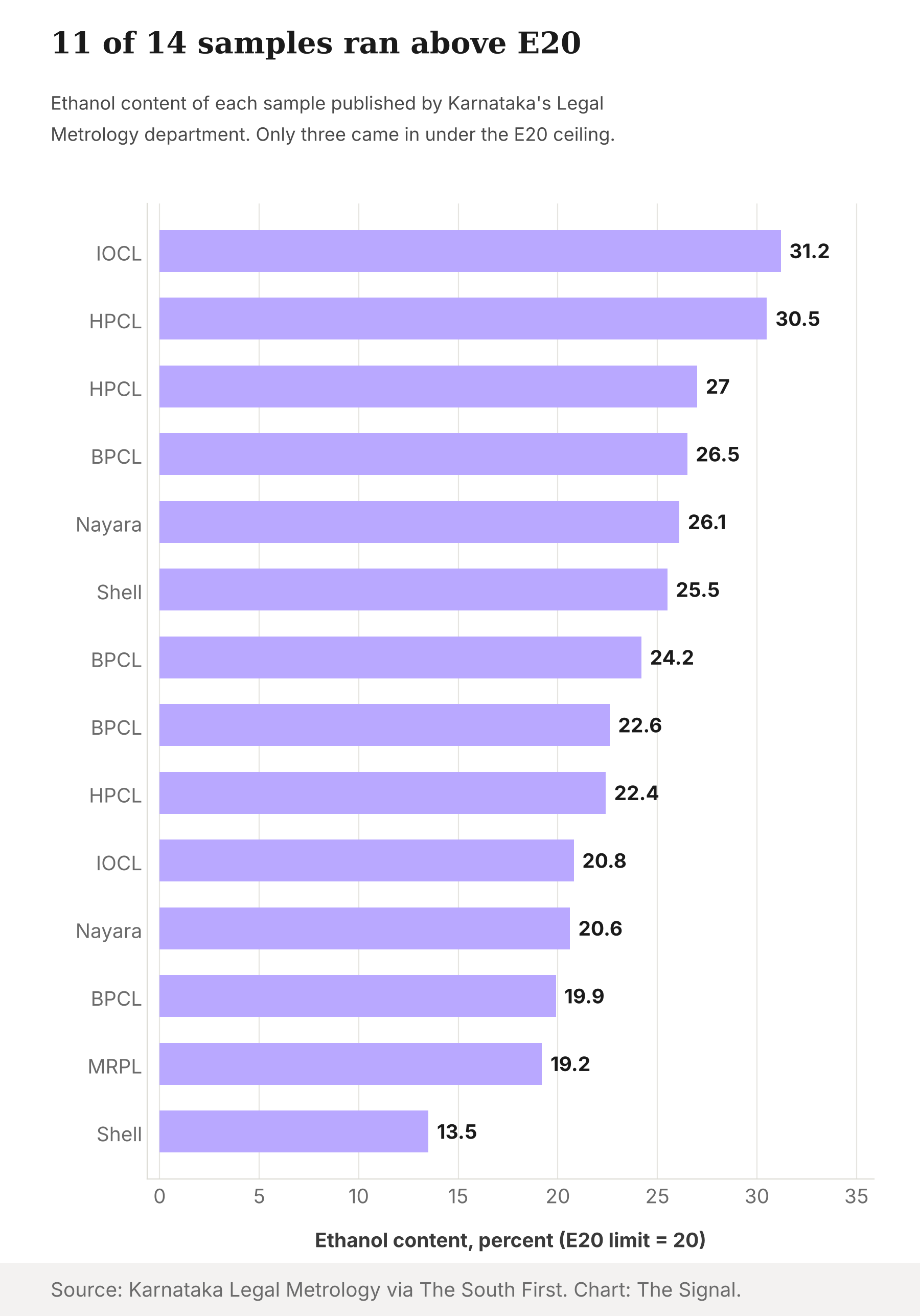
Taking the 14 published readings together, 11 of 14 is 79% of them. They average 23.6%, 3.6 points above the ceiling, and the worst, at 31.2%, is 56% above it. Five of the six companies named, all but MRPL, have at least one sample above 20%, so this does not look like one supplier's problem.
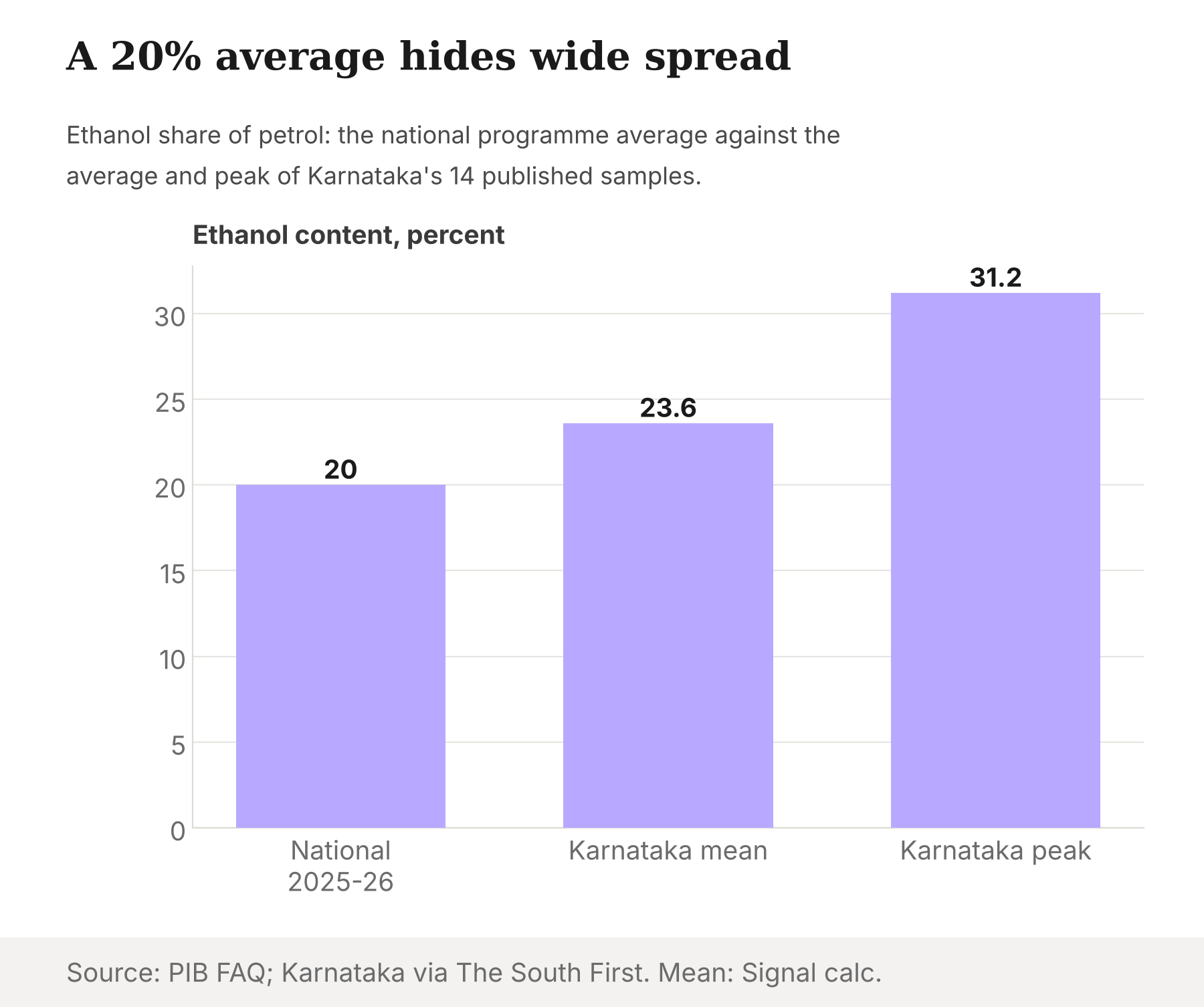
The chart compares different things, a national supply-year average and a sample of pumps in one state, and it is not a claim that the national average is wrong. It shows why an average cannot confirm what a pump delivers.
The disclosure gap
Karnataka says it first sent samples to the oil companies' own laboratories with a questionnaire on ethanol content. Food Minister Rizwan Arshad said none of the companies answered for any of the 63 samples collected, so the state sent them to accredited private labs.
That is a state government's account, and the companies' side is not yet on the record. As of 6 November 2026, none of IOCL, HPCL, BPCL, Nayara, Shell or MRPL had responded to the specific findings in the coverage reviewed.
The Centre's position is that the system is policed. Its FAQ says ethanol and blended petrol must meet strict BIS specifications, checked at every stage from distillery to depot to retail pump, and that state Chief Secretaries have been asked to enforce zero tolerance against adulteration. If that checking happens at the pump, the results are not in the public record where a driver, or a state government, can find them. The first public pump-level dataset on the question came from Karnataka.
Why the mileage stakes are real
The ministry says some vehicles may see a 3 to 5 percent reduction in fuel economy on E20. The Karnataka figures are about fuel that is richer than E20. The sources reviewed do not say how much further mileage would fall at 25% or 31%, and this piece does not guess. Karnataka itself estimates an annual cost to motorists of about Rs 1.01 lakh crore, a state estimate this piece has not been able to verify independently.
The honest objection
Karnataka's data has real limits. The state collected 63 samples but published results for 14, and the coverage does not say how those 14 were chosen. If they were the suspicious ones, 79% above the limit overstates the true rate. Fourteen samples from seven districts of one state cannot describe a national fuel supply. Ethanol testing method matters too, and the published coverage does not detail it. The state is also a political actor in a dispute with the Centre.
All of that is fair, and it argues for a larger, neutral sample, not for dismissing the one that exists. The published spread, 13.5% to 31.2%, shows that "E20" on the pump can describe a range of fuels.
The Signal
India built a blending programme that hit its headline number, and the number is an average. The mandate is a per-litre ceiling that, on the public record, only one state has tested at the pump. Whether Karnataka's 14 samples are typical is the question that matters, and it is answerable: a published, pump-level sample from the oil companies or the Centre would settle it in a week.
Watch for two things: whether the companies release their own ethanol readings for the same outlets, and whether any other state repeats the test. Until then, the only pump-level result this piece found in public is Karnataka's, and it says the ceiling was broken.
Reporting basis (South First, News Minute): the test results and the disclosure dispute are the Karnataka Department of Legal Metrology's and Food Minister Rizwan Arshad's account, as reported by The South First and The News Minute; neither was independently checked against the department's original statement, and the oil companies have not responded in the coverage reviewed. The February 2026 notification is per SCC Online's report of the Ministry of Petroleum and Natural Gas order. The blending shares, fuel economy range and BIS-checks claim are from the Government of India's Ethanol Blended Petrol Programme FAQ of 10 July 2026, published by the Press Information Bureau. The 79% share, the 23.6% mean, the 3.6-point gap and the 56% margin are The Signal's calculations from those figures.