On 4 November the Union Cabinet approved a Rs 2,814 crore scheme over five years, running from fiscal 2026-27 to 2030-31, to build four lithium and nickel processing units. The headline reading is straightforward: India depends on imports for battery materials, so it will pay to make them at home. The ministry that answers for electric vehicles has already conceded the dependence. In a March reply to the Lok Sabha it said the entire current demand for lithium is met through imports, and that Indian EV makers rely on Chinese midstream processing.
It is worth slowing down on what the scheme actually buys. It subsidises the refining step. It does not supply what goes into the refinery.
The subsidy doubled before it was approved
The rate is the first thing that moved. In February, S&P Global Mobility's AutoTechInsight reported that the proposed plan included a 15 per cent capital subsidy for eligible investments in lithium and nickel processing. The Cabinet approved a rate of 30 per cent of eligible investment, twice as much.
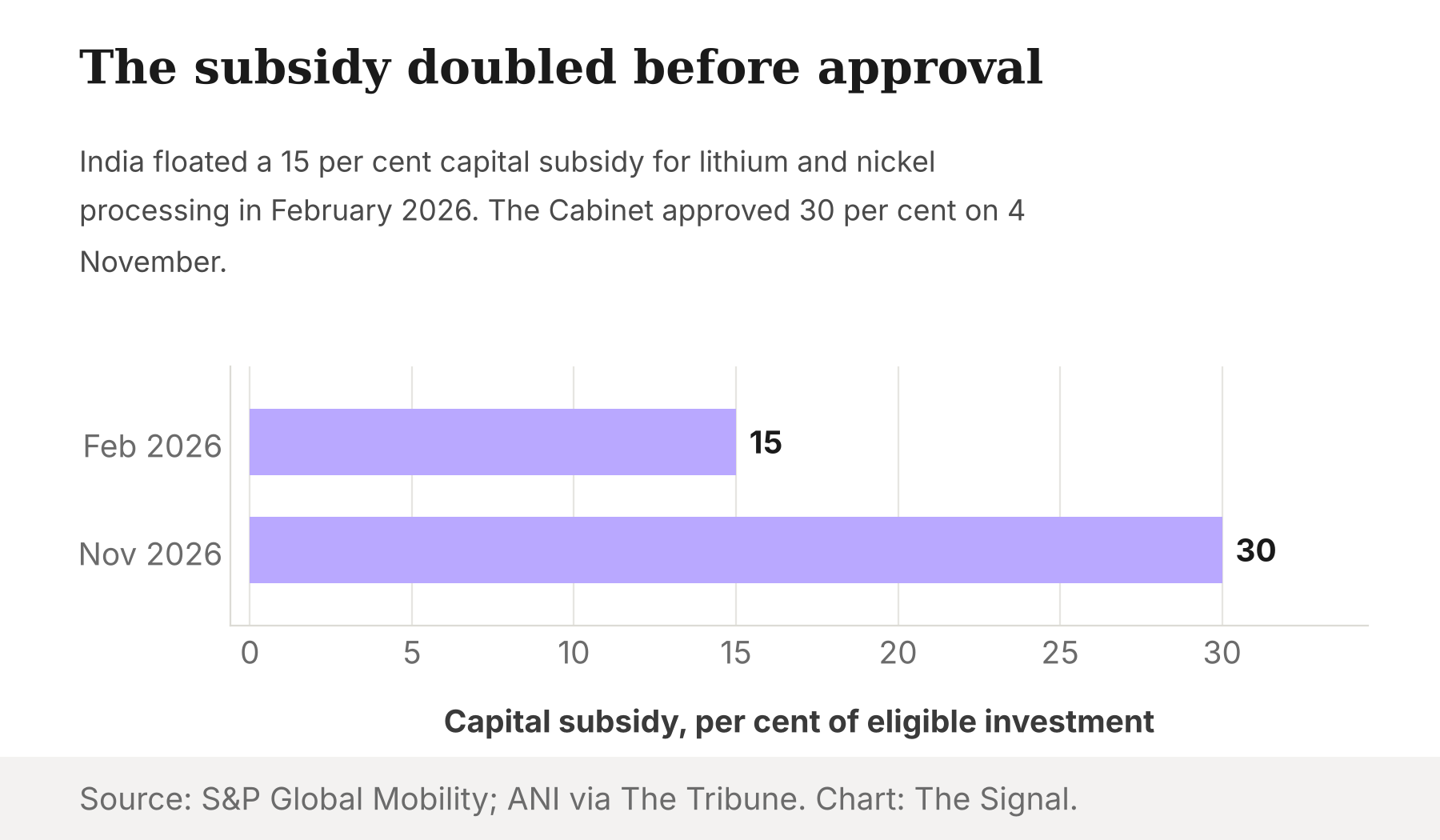
A subsidy does not double because the first offer was generous. It doubles when a plant at 15 per cent still does not clear its cost of capital. The same ANI report that carries the approval lists high capital requirements, limited availability of suitable technologies and constrained access to raw materials as the barriers the scheme is meant to address. The extra 15 points cover the first two. The third is left standing.
The money is spoken for
The outlay is tightly built around the four plants. Support carries a ceiling of Rs 500 crore per lithium beneficiary and Rs 900 crore per nickel beneficiary. With two of each, the ceilings add up to Rs 2,800 crore, or 99.5 per cent of the Rs 2,814 crore outlay. Almost nothing is left over for a fifth plant, a cost overrun or a second round.
| Item | Figure |
|---|---|
| Total outlay, five years | Rs 2,814 crore |
| Capital subsidy rate | 30 per cent of eligible investment |
| Ceiling per lithium beneficiary | Rs 500 crore |
| Ceiling per nickel beneficiary | Rs 900 crore |
| Ceilings for two lithium and two nickel units (our calculation) | Rs 2,800 crore |
Source: ANI, as carried by The Tribune. The final row is The Signal's calculation.
That is a deliberate design: a small, concentrated bet on four plants rather than a broad programme. It also means the scheme's success depends on a handful of firms securing feedstock.
The ore is somewhere else
Here the numbers turn against the self-reliance framing. The US Geological Survey puts world lithium mine production at an estimated 290,000 tons in 2025, measured as contained lithium, and India does not appear among the countries listed as producers. For nickel the picture is more concentrated. USGS lists Indonesia at 2.6 million tons out of a world total of 3.9 million tons in 2025, two-thirds of the world's mined nickel, and again India is not a listed producer.
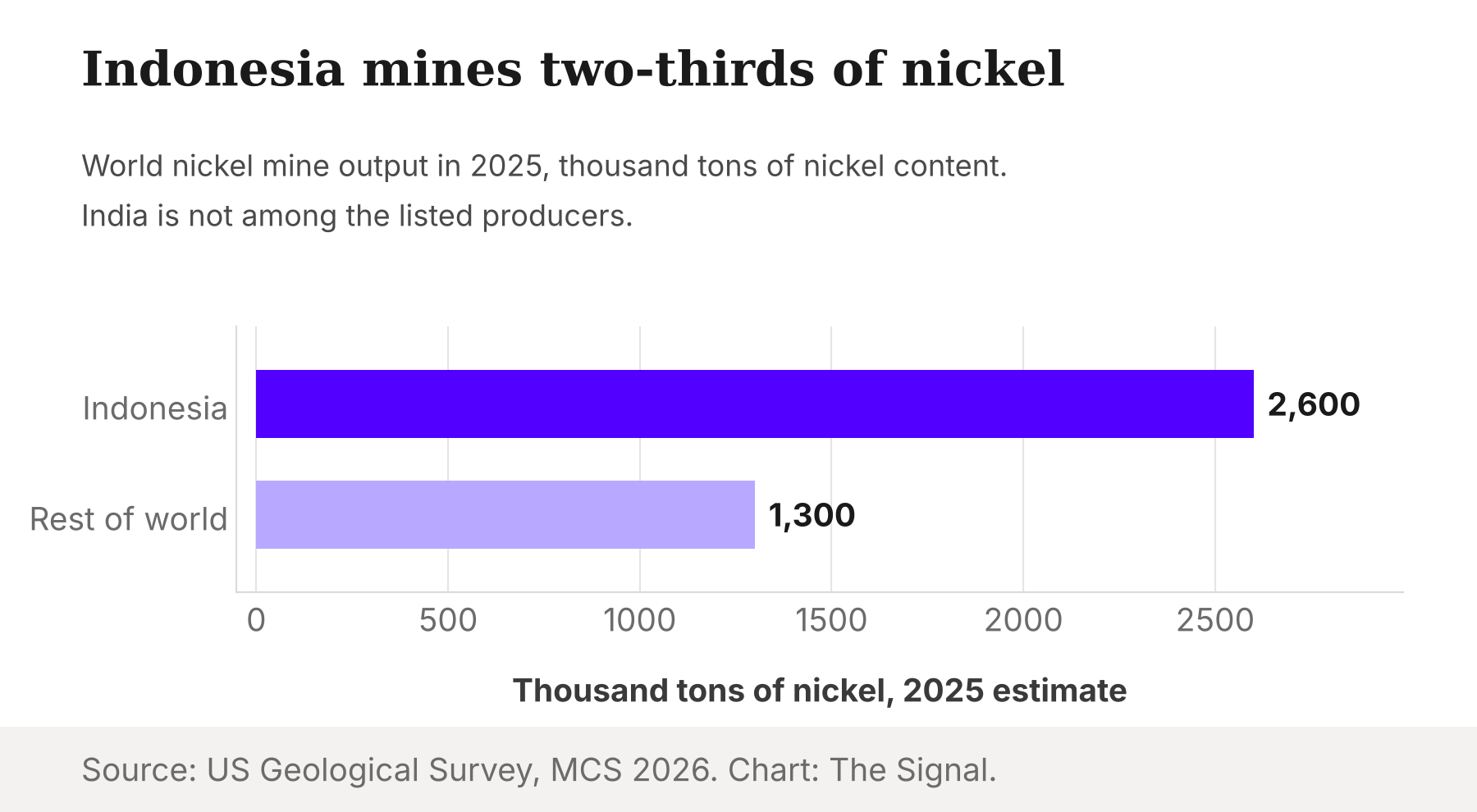
The scheme's own wording points the same way. It targets conversion of lithium and nickel ores or intermediary products, which means the plants will run on material mined elsewhere. If that material comes from the same few countries that supply refiners today, India has moved the dependence one step upstream. It has not removed it.
The honest objection
The strongest case for the scheme is that processing is where the leverage sits. The Lok Sabha reply itself names Chinese midstream processing as the point of exposure for Indian EV makers, not mining. Buying ore on open markets and refining it at home is a real gain over buying finished chemicals from one supplier, because ore has more sellers than refined product. Ore is also easier to stockpile. On that view, owning the midstream is the right place to start.
That is a fair argument, and none of the figures above contradict it. What it cannot answer is price and access. A plant needs a reliable ore contract for years, and the scheme text carries no figure on how the four beneficiaries will secure one.
The Signal
The Cabinet has shown it will pay twice what it first offered to get four plants built, and it has capped the bill at almost exactly the outlay. What it has not shown is where the ore comes from. Watch the two beneficiaries chosen for each mineral, and whether their first announcements name a mine or only a plant site. A refinery with a subsidy and no feedstock contract is still an importer.
Reporting basis: The scheme's terms, caps, timeline and stated barriers are as reported by ANI via The Tribune; The Signal did not check the Cabinet's own release, so these rest on a single wire origin. The February 15 per cent proposal is as reported by S&P Global Mobility's AutoTechInsight. The lithium import statement is from the Ministry of Heavy Industries' Lok Sabha answer of 17 March 2026, which in turn cites the Society of Indian Automobile Manufacturers. Production figures are from the US Geological Survey's Mineral Commodity Summaries 2026 (lithium, nickel), whose tables do not list India as a producer; we read that as absent from the listed producers, not as proof of zero output. The 99.5 per cent ceiling share and the two-thirds nickel share are The Signal's calculations from those figures.