
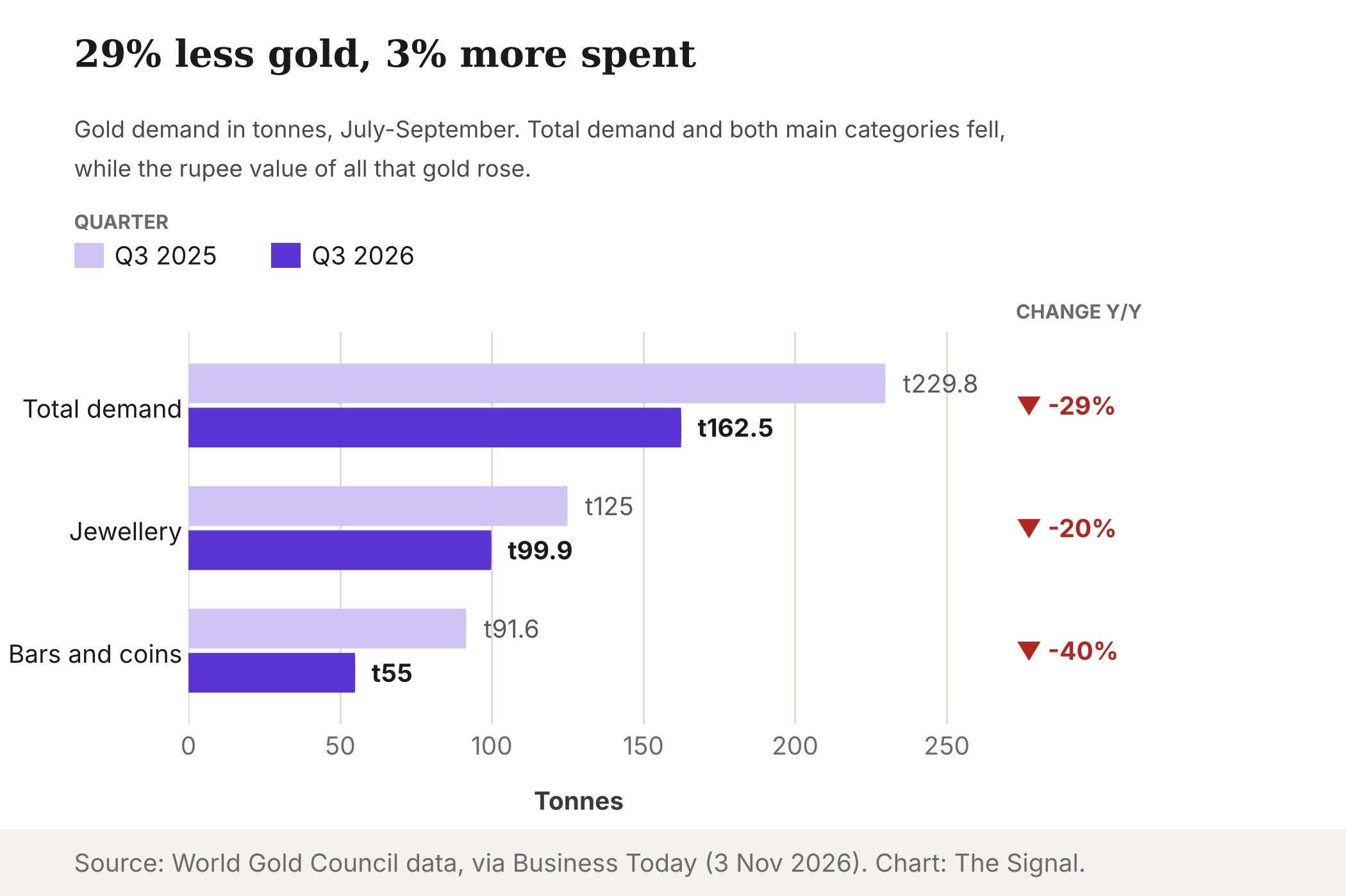
The headline reading of India's latest gold numbers is simple. In May the government raised the import duty on gold, and in July to September demand collapsed. India's gold demand fell 29 percent to 162.5 tonnes in the quarter, from 229.8 tonnes a year earlier, with jewellery down 20 percent to 99.9 tonnes and bars and coins down 40 percent to 55 tonnes, according to World Gold Council data reported on 3 November. A tax went up, and buyers stayed home.
The bill went up while the tonnes went down
It is worth slowing down on that. In the same report, the rupee value of India's gold demand rose 3 percent to Rs 2,41,900 crore from Rs 2,35,090 crore. Indians bought 29 percent less metal and spent slightly more money. That arithmetic only works if each gram got far more expensive, and the duty is only one of the reasons it did. The international price alone averaged US$4,262 an ounce in the quarter, per the World Gold Council.
The slump is bigger than the duty's own forecast
The government's move was large. India raised its gold import duty from 6 percent to 15 percent, the steepest increase on record, the World Gold Council noted in May. The same note estimated that jewellery and bar-and-coin demand could decline by around 50 to 60 tonnes in 2026, about 10 percent.
Now compare that with what one quarter did. Using the same quarterly figures, jewellery plus bars and coins fell from 216.6 tonnes in July to September 2025 to 154.9 tonnes in the same months of 2026, a drop of 61.7 tonnes. One quarter has already used up the council's full-year duty estimate. The two are not like for like, because the quarterly drop also carries the effect of a price that had already risen. But the gap says the duty was never the main force on the buyer. It was one more push on a market already priced out.
The tonnes that do not show up in the data
If the duty is not mainly cutting demand, what is it doing? The evidence points at supply. The council reports that higher duties tend to bring more unofficial gold, citing a 0.52 correlation between duty and unofficial imports, excluding 2020-21. SBI Research made the same warning when the duty rose, saying that imposition of duty has its consequences in diverting the physical supply to grey channels.
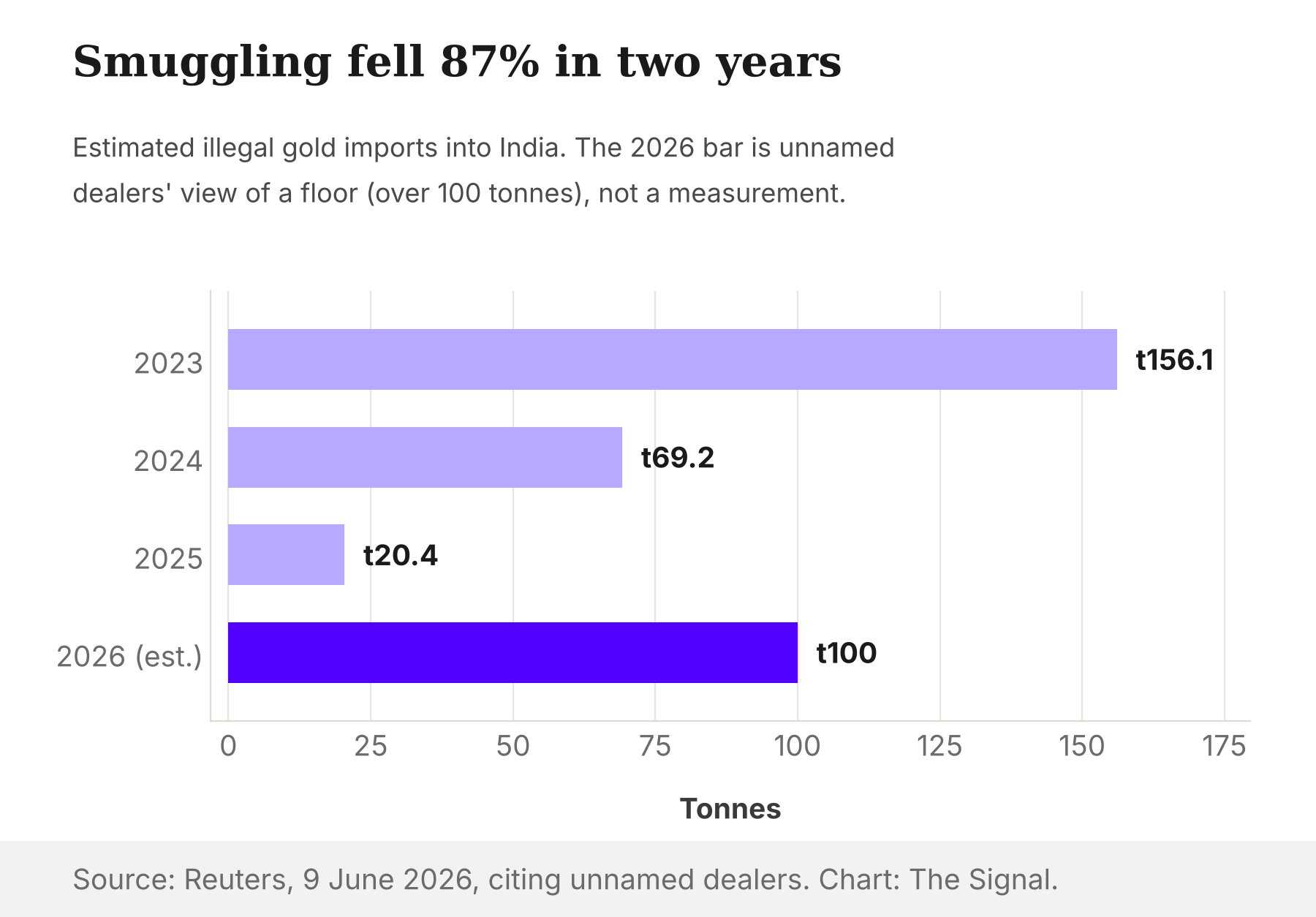
The scale is where the evidence thins. Reuters reported in June that gold smuggling fell from 156.1 tons in 2023 to 69.2 metric tons in 2024 and, in the same report, said it had dropped to 20.4 tons in 2025 after the earlier duty cut. It also said unnamed dealers expect illegal imports to exceed 100 tons in 2026. That 2026 figure is an expectation from people in the trade, not a count.
What the seizures and the discount say
Enforcement data is real but small. More than 150 kg of smuggled gold was seized across India in just three months after the hike, against around 70 kg in the first five months of 2026, The Hitavada reported, citing enforcement data. Seizures roughly doubled in a shorter window. Yet 150 kg is 0.15 tonnes, or 0.15 percent of the 100 tons dealers talk about. Either seizures catch very little, or the dealers' figure is too high. Nobody can say which.
The price signal is harder to dismiss. After a 15 percent duty, domestic gold should trade above the international price. Instead, domestic prices sat below import parity, with the discount widening to US$78 an ounce by 11 September, and the council wrote that the availability of unofficial supply is also cited as a contributing factor behind the widening discount. A discount means more gold is on offer inside India than buyers will take at the landed cost.
The honest objection
The strongest counter is that recycling, not smuggling, explains the glut. The council's own reading of the data is that imports are low because supply is already adequate: gold imports fell sharply in September to US$1.8 billion, which it linked to old gold being recycled through exchange programmes. That is plausible, and it needs no crime. When prices run this high, households sell and swap old jewellery. The council also lists unofficial inflows alongside it, so the two explanations are not rivals, but nobody has split the supply between them.
The discount has also faded. Domestic discounts narrowed sharply in October, from about US$66 an ounce in September to US$8 on 16 October, as festive buying began. A market with smuggling running wide open would struggle to close that gap this fast.
The Signal
The official statistics may now describe a smaller market than the one that exists. The council itself points to recycled old gold and unofficial inflows as part of domestic supply, and neither shows up as an import. The 29 percent fall in recorded demand is therefore not a clean measure of what the duty did.
Watch two numbers. The first is the discount to import parity through the wedding season: if it stays near zero as demand returns, recycling was the story. If it reopens, someone is selling gold that did not pay 15 percent. The second is the full-year seizure total against the dealers' 100 tons. Whether the duty cut the gold, or only moved it out of the statistics, is a question the data cannot yet answer.
Reporting basis: the demand, jewellery and bar-and-coin figures are World Gold Council Gold Demand Trends data for July to September 2026, as reported by Business Today, which is the only outlet verified for the India split. The duty rate, the 50 to 60 tonne estimate and the 0.52 correlation are from the World Gold Council's May update, and the discounts and September imports are from its September and October updates. The smuggling history and the 100-ton expectation are per Reuters, citing unnamed dealers, via Kitco, and rest on that single source. The seizure counts are per The Hitavada, citing unnamed enforcement data. The warning on grey channels is SBI Research, as reported by Business Today. The 61.7 tonne decline, the 216.6 and 154.9 tonne sums and the 0.15 percent seizure share are The Signal's calculations from those figures.