India's informal economy just grew faster than the government has ever measured it growing. The National Statistics Office's quarterly bulletin on unincorporated enterprises reports that employment in the unincorporated non-agricultural sector reached 15.03 crore in July to September 2026, up 16.86% on the same quarter of 2025. The bulletin itself calls it the highest-ever quarterly growth in the sector. These are the tailors, repair shops, small stores and workshops that operate as proprietorships and partnerships rather than companies.
The easy read is that small business India is hiring. The same bulletin says otherwise.
A 16.86% rise to 15.03 crore implies roughly 12.86 crore workers a year earlier, so about 2.17 crore more people at work in the sector. The question that decides what this number means is who those 2.17 crore are. The answer sits in the bulletin's own composition table, and it is mostly not employees.
Owners, not payrolls
The NSO reports that working owners made up 61.99% of the sector's workforce in July to September 2026, up from 59.98% a year earlier, and that the total number of hired workers increased by about 5%. Its key-indicators table puts hired workers at about 3.49 crore, or 23.22% of the workforce, with a further 14.79% classed as other workers, including unpaid family workers.
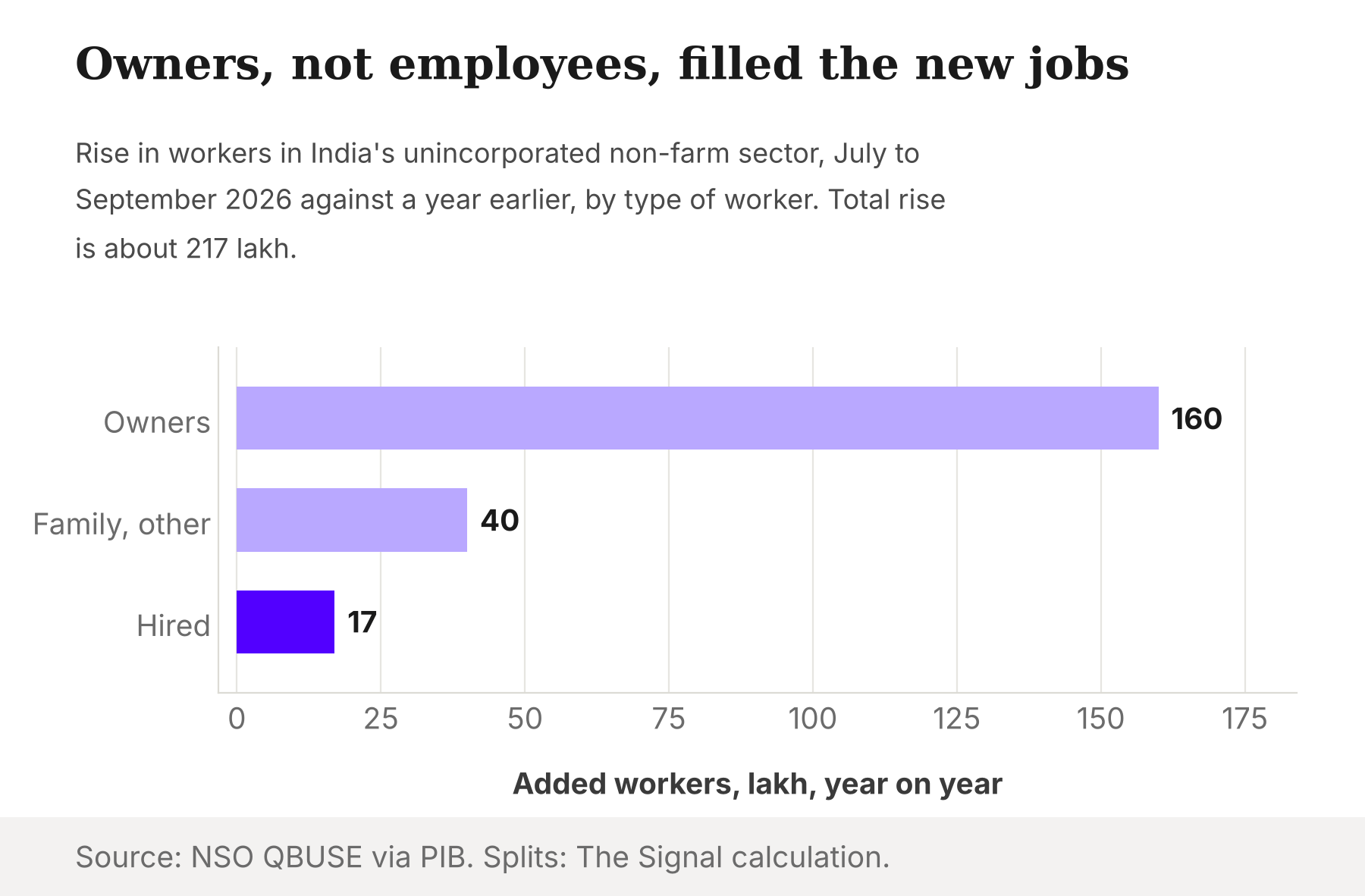
Run those shares against the totals and the split is lopsided. Working owners rose from about 7.71 crore to about 9.32 crore, a gain of roughly 1.6 crore, or about 21%. Unpaid family and other workers added about 40 lakh. Hired workers, growing about 5%, added only around 17 lakh. Of the 2.17 crore new workers, fewer than one in ten was someone hired to work for another person's business.
The establishment count tells the same story from the other side. The NSO counted 9.47 crore establishments, up 18.81% from 7.97 crore a year earlier. Units grew faster than workers. The sector averaged about 1.59 workers per establishment in July to September 2026, slightly down from about 1.61 a year earlier. Only 12.16% of establishments employed hired workers, which means close to nine in ten ran on the owner and family alone.
So the record quarter was mainly a record in the number of owner-run units without hired staff. That is a different economy from one where small firms grow and take on staff.
Services did the lifting
The growth also landed in one place. The NSO reports that "other services" establishments grew 29% and their employment 33%, while trade employment rose 8.36% and manufacturing employment just 3.52%.
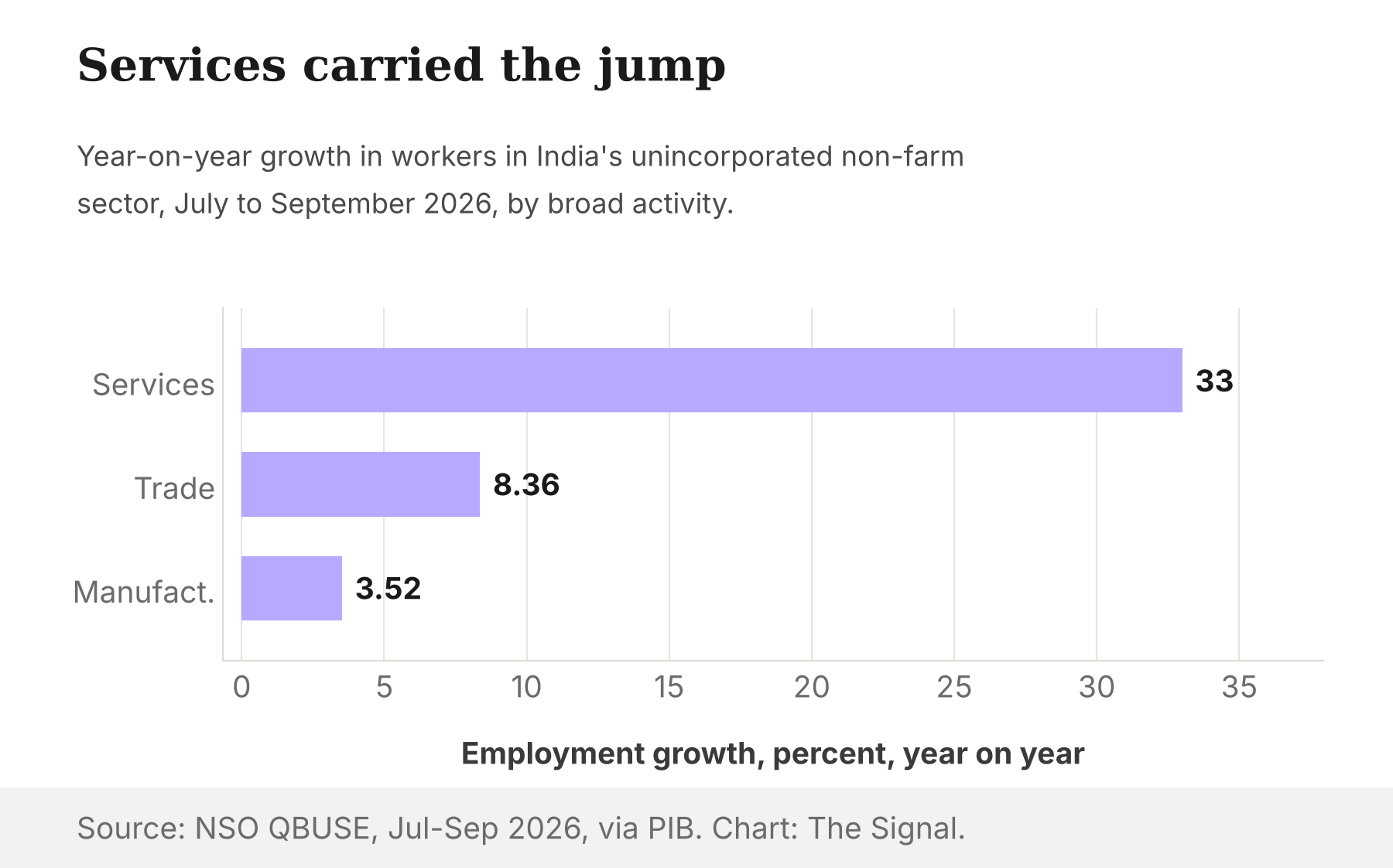
Manufacturing is where small units most often grow into employers, because a workshop that wins orders needs hands. Its employment grew just 3.52%. The services surge sits in activities like repair, personal services and transport, where a new unit usually means one more person working for themselves.
What the July to September 2026 bulletin shows, in one table
| Measure, July to September 2026 | Value | Year-on-year change |
|---|---|---|
| Workers | 15.03 crore | +16.86% |
| Establishments | 9.47 crore | +18.81% |
| Working owners' share of workers | 61.99% | up from 59.98% |
| Hired workers | about 3.49 crore | about +5% |
| Establishments with hired workers | 12.16% | not reported |
Source: NSO, Quarterly Bulletin of Unincorporated Sector Enterprises, July-September 2026, via PIB.
A number that moved too fast
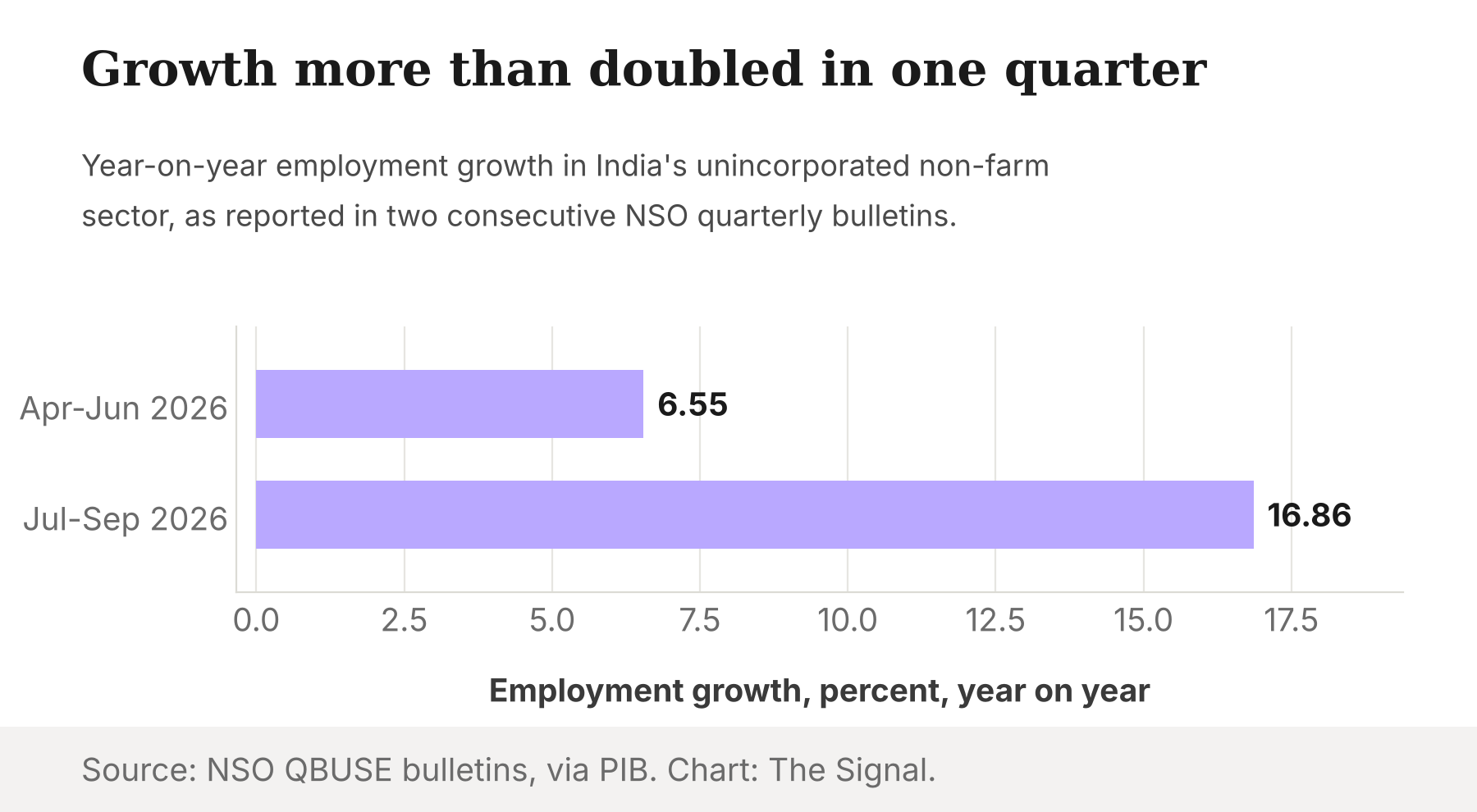
There is a second reason to read the headline figure carefully: the series has jumped. The previous bulletin reported employment of 13.70 crore in April to June 2026, up 6.55% on a year earlier. One quarter later the count was 15.03 crore and the growth rate was 16.86%, more than double. That is 1.33 crore more workers between two consecutive quarters.
The household survey does not show a jump of that kind. The NSO's Periodic Labour Force Survey reports that the worker population ratio for people aged 15 and above was 52.7% in July to September 2026, only 0.5 percentage points higher than a year earlier. The two surveys measure different things. One counts workers inside establishments, the other counts people and their main activity, and a person who runs a stall part-time may report farming as their main activity. But a 17% rise in one and a 0.5-point rise in the other is a gap that a careful reader should notice before treating either as the final word.
On the direction of the shift, the household survey agrees. The PLFS bulletin notes that urban self-employment rose 0.4 percentage points over the year while urban regular wage employment declined marginally.
Why the composition matters now
This is no longer only a labour-market curiosity. MoSPI's guide to the new GDP series says the household sector's level estimates are now prepared from annual surveys such as the Annual Survey of Unincorporated Sector Enterprises and the PLFS, rather than proxy indicators. The quarterly bulletin is the high-frequency edition of that same enterprise survey. The way it counts informal workers now feeds into how India measures informal output.
The pattern is not new. The ILO and the Institute for Human Development found that nearly two thirds of India's incremental employment after 2019 was self-employment, mostly unpaid women family workers. A quarter in which owners and family workers supply nine in ten new informal jobs fits that trend.
The honest objection
The strongest case against this reading is that own-account growth can be the good kind. Not every one-person unit is a fallback. The NSO reports that women made up more than 31% of the sector's workforce, up from 28.70% a year earlier. Cheaper digital payments and easier registration lower the cost of starting a business. On this view, crores of people are choosing to become entrepreneurs, and the fact that hired workers still grew about 5% shows real firms are expanding too.
That case is real, and the survey cannot settle motive. It does not ask whether an owner would rather have a salaried job. But the weight of the evidence points one way. Units grew faster than workers, manufacturing barely added staff, and the hired share fell, as it also did in April to June 2026, when it slipped to 22.77% from 24.38%. Entrepreneurship that scales shows up as hiring. This quarter mostly showed up as more owners.
The Signal
The record informal jobs number is true, and it is the wrong number to celebrate on its own. What grew was the count of people running very small units, overwhelmingly without employees, mostly in services. The full-year enterprise survey for 2025 counted 12.81 crore workers, so the next annual round will show whether this quarter's jump holds or was partly an artefact of a volatile quarterly sample. Watch two lines in the next bulletins: the hired-worker share and manufacturing employment. If both stay flat while totals keep climbing, India is adding owners faster than it is adding jobs anyone can apply for.
Reporting basis: employment, establishment, worker-composition, sector and women's share figures for July to September 2026 are from the National Statistics Office's Quarterly Bulletin of Unincorporated Sector Enterprises, via a Press Information Bureau release; the April to June 2026 figures and the 2025 annual ASUSE estimates are from the previous bulletin, also via PIB. The worker population ratio and employment-status shares are from the NSO's Periodic Labour Force Survey quarterly bulletin for July to September 2026, a separate survey by the same statistical office. The description of the new GDP series' data sources is from MoSPI's own FAQ. The post-2019 self-employment finding is from the ILO and Institute for Human Development's India Employment Report 2024. The load-bearing finding, the composition of the new workers, rests on a single origin, the NSO's enterprise survey. The year-earlier totals, the changes by worker type, the workers-per-establishment ratios and the quarter-on-quarter change are The Signal's calculations from those figures; the hired-worker change is approximate because the NSO reports its growth only as about 5%.