On Sunday, November 22, Tata Steel's board approved what looked like a clean exit. APL Apollo Tubes will pay a lump sum of up to ₹11,700 crore for Tata Steel's tubes business and ₹16,300 crore for all of Tata Steel Colors, its coated-steel subsidiary, up to ₹28,000 crore in all, according to Upstox's summary of the filing. Tata Steel, carrying net debt of ₹91,423 crore at the end of September 2026, would be trimming its downstream arm to focus on making steel. The price alone equals about 31 percent of that debt.
That reading lasts until the second filing. On the same day, Tata Steel agreed to buy 26.38 percent of APL Apollo from promoter-group entity S Gupta Holding at ₹2,100 a share, about ₹15,510 crore in cash, Investing.com reported. Crossing that threshold forces an open offer, and Tata Steel will bid for up to another 26 percent at ₹2,301.40 a share, a maximum of about ₹16,756 crore, which could lift its holding to about 52.38 percent.
Tata Steel is selling its tubes business to a company it is buying.
The money goes round
Put the two filings side by side. Tata Steel receives up to ₹28,000 crore. It pays about ₹15,510 crore for the promoter stake and up to about ₹16,756 crore more if every public shareholder it bids for tenders. At full acceptance, Tata Steel pays out ₹32,266 crore, about ₹4,266 crore more than it takes in, and ends up owning a majority of the buyer.
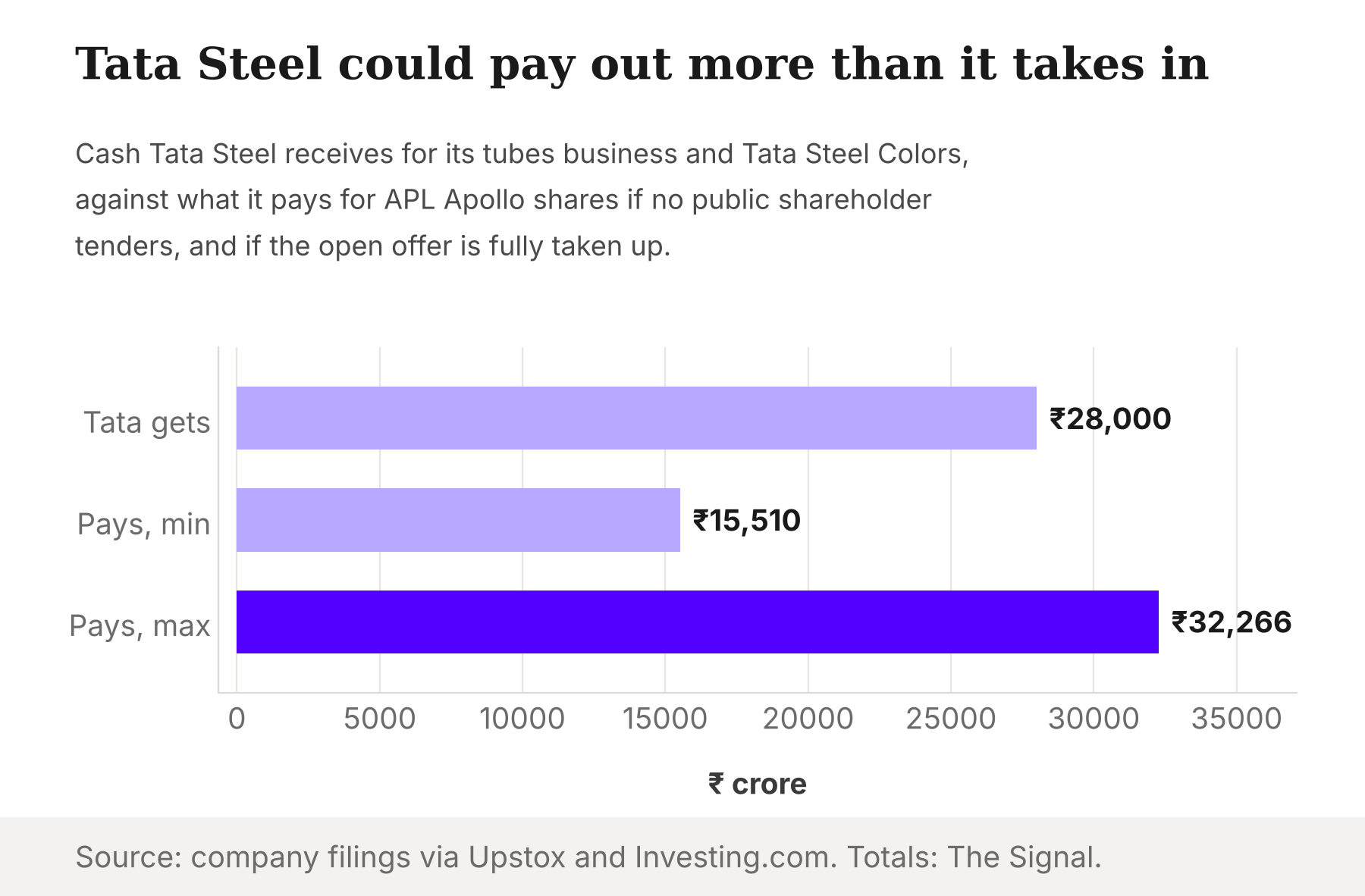
If no public shareholder tenders, Tata Steel keeps ₹12,490 crore of the sale proceeds and holds the 26.38 percent promoter stake, about a quarter of APL Apollo. Either way, it has not left the tubes market. It has traded full ownership of a division for a large stake in, and possibly control of, the listed company that will own that division.
What changes hands, and in which direction
| Leg | Who pays whom | Amount |
|---|---|---|
| Tubes business | APL Apollo pays Tata Steel | up to ₹11,700 crore |
| Tata Steel Colors (100%) | APL Apollo pays Tata Steel | ₹16,300 crore |
| Promoter stake (26.38%) | Tata Steel pays S Gupta Holding | about ₹15,510 crore |
| Open offer (up to 26%) | Tata Steel pays public shareholders | up to about ₹16,756 crore |
Sources: Upstox and Investing.com, reporting the companies' filings.
Who funds the purchase
The awkward question is where APL Apollo finds ₹28,000 crore. Emkay Global, as reported by Business Today, put APL Apollo's cash at ₹1,150 crore and its net worth at ₹5,740 crore as of the quarter ended September 2026, and asked the same thing. The price is nearly five times APL Apollo's net worth and about 24 times its cash.
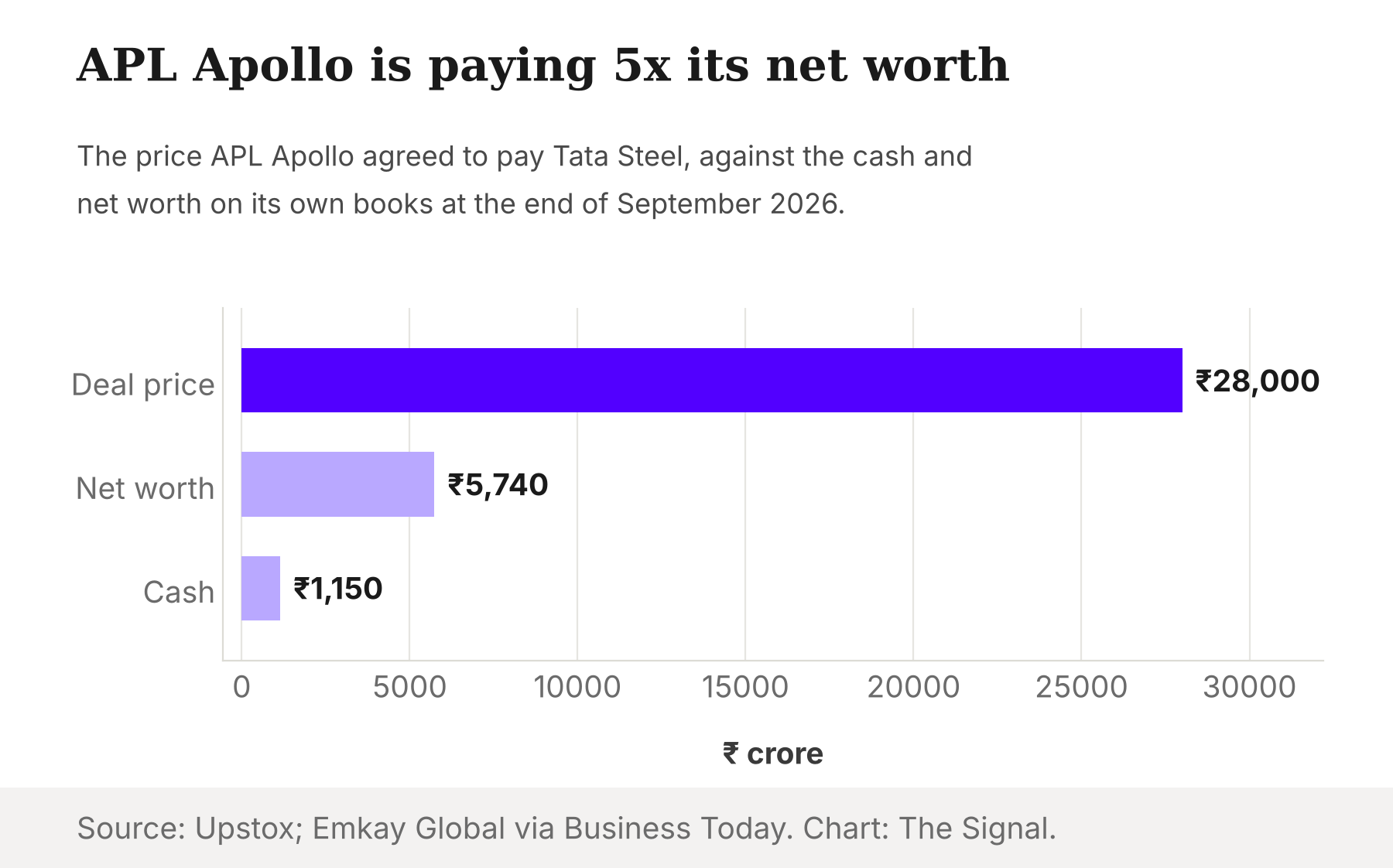
A company that small cannot pay a bill that large from its own balance sheet. It has to raise equity, borrow, or both. Here the swap closes its own loop. If Tata Steel ends up with a majority and control, APL Apollo becomes a Tata Steel subsidiary, and whatever APL Apollo raised to pay Tata Steel shows up again in Tata Steel's consolidated accounts. Some of the ₹28,000 crore could leave Tata Steel's balance sheet as debt reduction and return as a subsidiary's liability.
The calendar matters too. Completion of the business sale is expected on or before March 31, 2028, and the Tata Steel Colors leg needs Competition Commission of India approval. The cash that looks like deleveraging today arrives over more than a year.
Two businesses, two very different prices
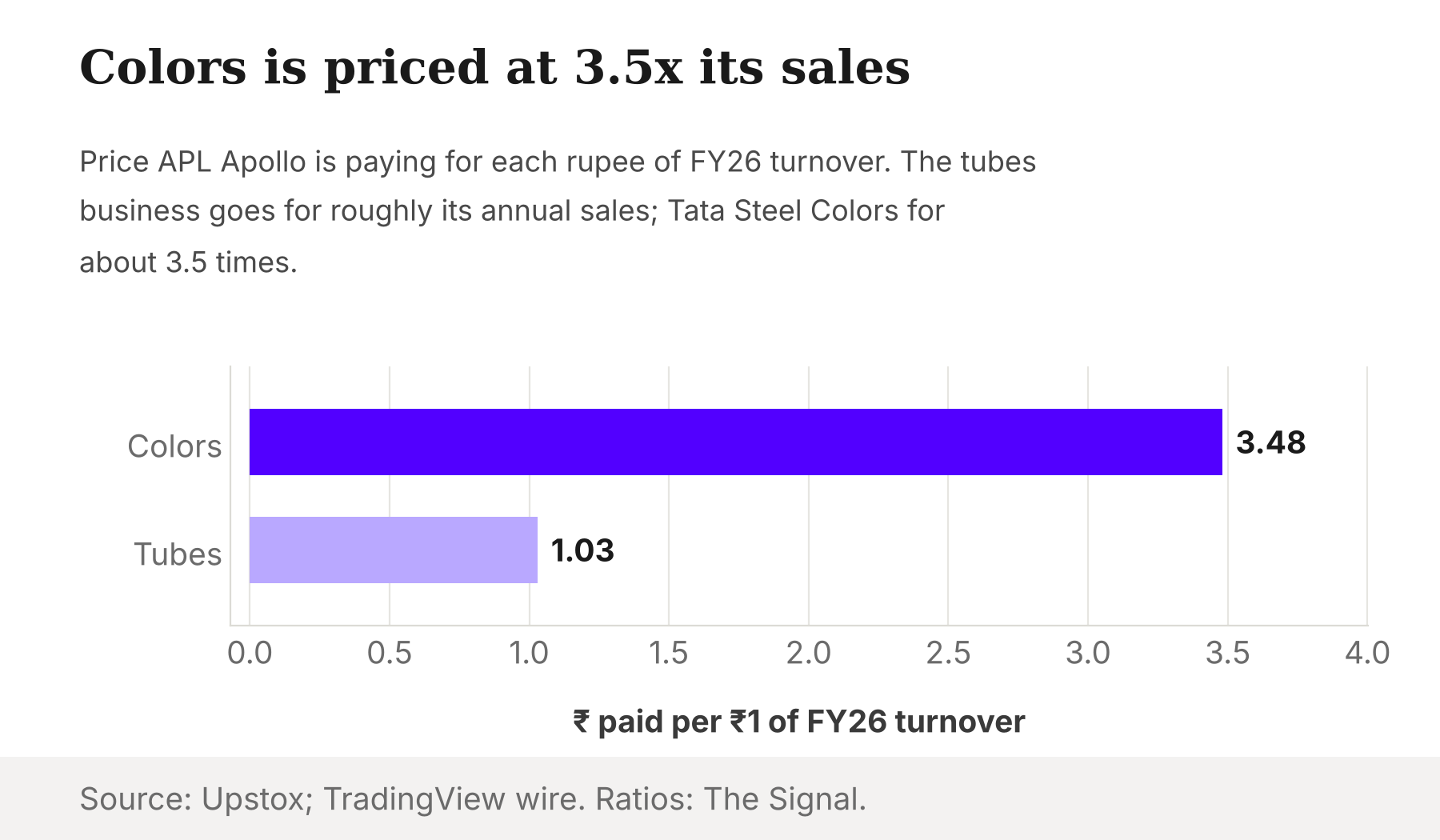
The ₹28,000 crore headline also blends two prices that look nothing alike. The tubes business had turnover of about ₹11,375 crore in FY26, 4.9 percent of Tata Steel's consolidated revenue, and a net worth of ₹3,274 crore at March 2026, according to a wire report of the disclosure. At ₹11,700 crore it sells for roughly one year of sales. That is a business Tata Steel built into a big one: its tubes division crossed one million tonnes of production and sales in FY25.
Tata Steel Colors is a different story. It had FY26 turnover of about ₹4,680 crore and, per Upstox's summary, profit after tax of ₹85 crore. APL Apollo is paying ₹16,300 crore for it: about 3.5 times sales and roughly 192 times its FY26 profit.
Nobody pays 192 times earnings for the earnings. The premium is a bet on capacity yet to be built. Business Today reports that APL Apollo has 5 MTPA of tubes capacity today, the combined company would start at 7.5 MTPA, and the plan adds 3 MTPA of tubes plus 5 MTPA of colour-coated capacity, the colour-coated part through contract manufacturer SG Tech Engineering, which is linked to APL Apollo's promoter group. The richest price in the deal is attached to the smallest profit, and Tata Steel is on both sides of it.
Why the public gets a better price than the promoter
One detail looks backwards. The promoter sells at ₹2,100 a share; the public is offered ₹2,301.40, about 9.6 percent more. Normally the seller of a controlling block gets the premium.
The answer is SEBI's formula, not generosity. Acquiring 25 percent or more of a listed company's voting rights requires an open offer, which must cover at least 26 percent of the shares. The offer price must be the highest of several benchmarks, including the negotiated price and the volume-weighted average market price over the sixty trading days before the announcement. Because the negotiated price was ₹2,100, an offer at ₹2,301.40 means one of the market benchmarks came out higher, and the formula passes that higher price to public shareholders. The promoter group keeps a separate stake in the expansion: the related company that is to build the new colour-coated capacity.
The honest objection
The strongest case for the deal is that it is good strategy dressed in odd plumbing. Tata Steel's India steel business earned EBITDA of ₹17,790 a tonne in the September quarter, a 25 percent margin. Owning half of a focused tubes and coatings company may be worth more than owning all of a division inside a steel giant. Tata Steel itself says the deal sets the basis for both superior profitability and high growth potential. And if few shareholders tender, Tata Steel does bank real cash.
That case is serious. It is also an argument for buying APL Apollo, not for calling this a divestment. Emkay called the deal a strategic reset rather than an unambiguously positive portfolio rationalisation, and noted that no long-term supply agreement between Tata Steel and APL Apollo had been disclosed. A steelmaker taking control of a large tube maker would normally lock in the steel it sells to it. On the filings so far, it has not.
The Signal
Read as a sale, the deal shrinks Tata Steel. Read as what it is, Tata Steel is using APL Apollo's balance sheet to buy itself a bigger downstream business, at a price for Tata Steel Colors that only future capacity can justify. Three things will show which reading wins: how many shareholders tender at ₹2,301.40, how APL Apollo raises ₹28,000 crore, and whether a supply contract with Tata Steel appears before the 2028 closing. If APL Apollo borrows and Tata Steel takes control, the debt this sale was meant to retire will be back on Tata Steel's books under a new name.
Reporting basis: the sale prices, closing date and CCI condition are per Tata Steel's exchange disclosure as summarised by Upstox; the stake purchase, open-offer terms and the 52.38 percent figure are per the companies' filings as reported by Investing.com; FY26 turnover and net worth of the two businesses are per a wire report of the disclosure carried on TradingView; the Tata Steel Colors profit figure rests on Upstox's summary alone. APL Apollo's cash and net worth and the supply-agreement point are per Emkay Global, via Business Today, which also reported the capacity plans and Tata Steel's rationale from the company's disclosure. Net debt, India EBITDA per tonne and tubes volumes are from Tata Steel's own releases. The open-offer thresholds and pricing formula are from SEBI's Takeover Regulations. The deal documents themselves were not independently reviewed. The net cash flows, the price-to-sales and price-to-earnings multiples, the share of net debt, the open-offer premium and the deal-to-net-worth ratios are The Signal's calculations from those figures.