On 4 November 2026, the Union Cabinet approved a Viability Gap Funding scheme for grid-scale energy storage with total financial support of Rs 14,500 crore over FY2026-27 to FY2030-31, aimed at 92 GWh of storage capacity not yet commissioned. The headline reads as a very large battery subsidy, and 92 GWh sounds like a leap from the earlier battery schemes.
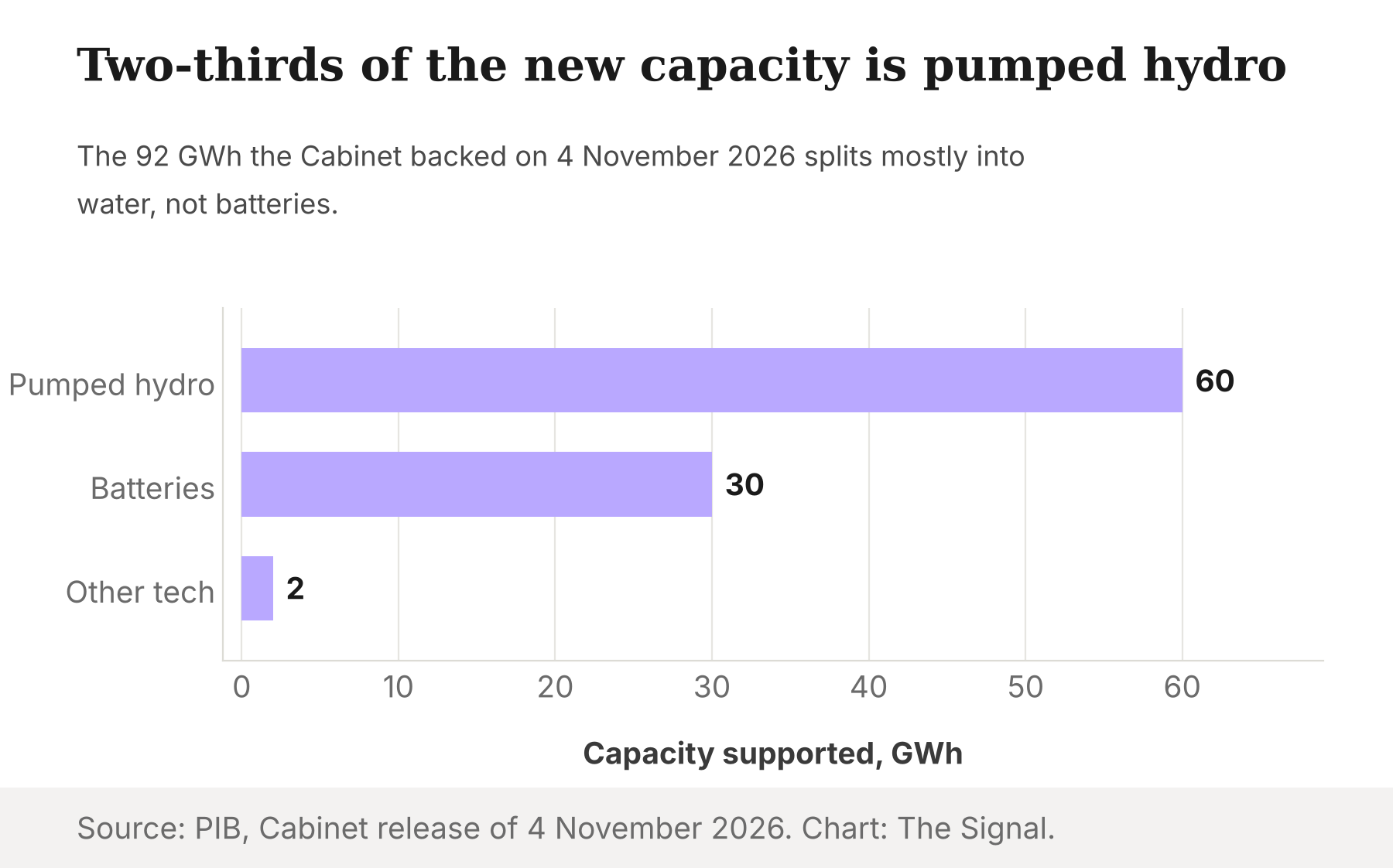
It is worth slowing down on that. Read the capacity split and the story changes. The scheme envisages 60 GWh of hydro pumped storage, 30 GWh of battery storage and 2 GWh of alternative technologies, with a total estimated investment of Rs 97,600 crore. Pumped hydro is 60 of the 92 GWh, about 65 percent. Batteries are 30 GWh, about a third.
The second number is the share
Divide the support by the investment it is meant to unlock. Rs 14,500 crore against Rs 97,600 crore is about 15 percent. The first battery scheme, approved in 2023, was written differently: it offered financial support of up to 40 percent of the capital cost for 4,000 MWh of battery storage by 2030-31.
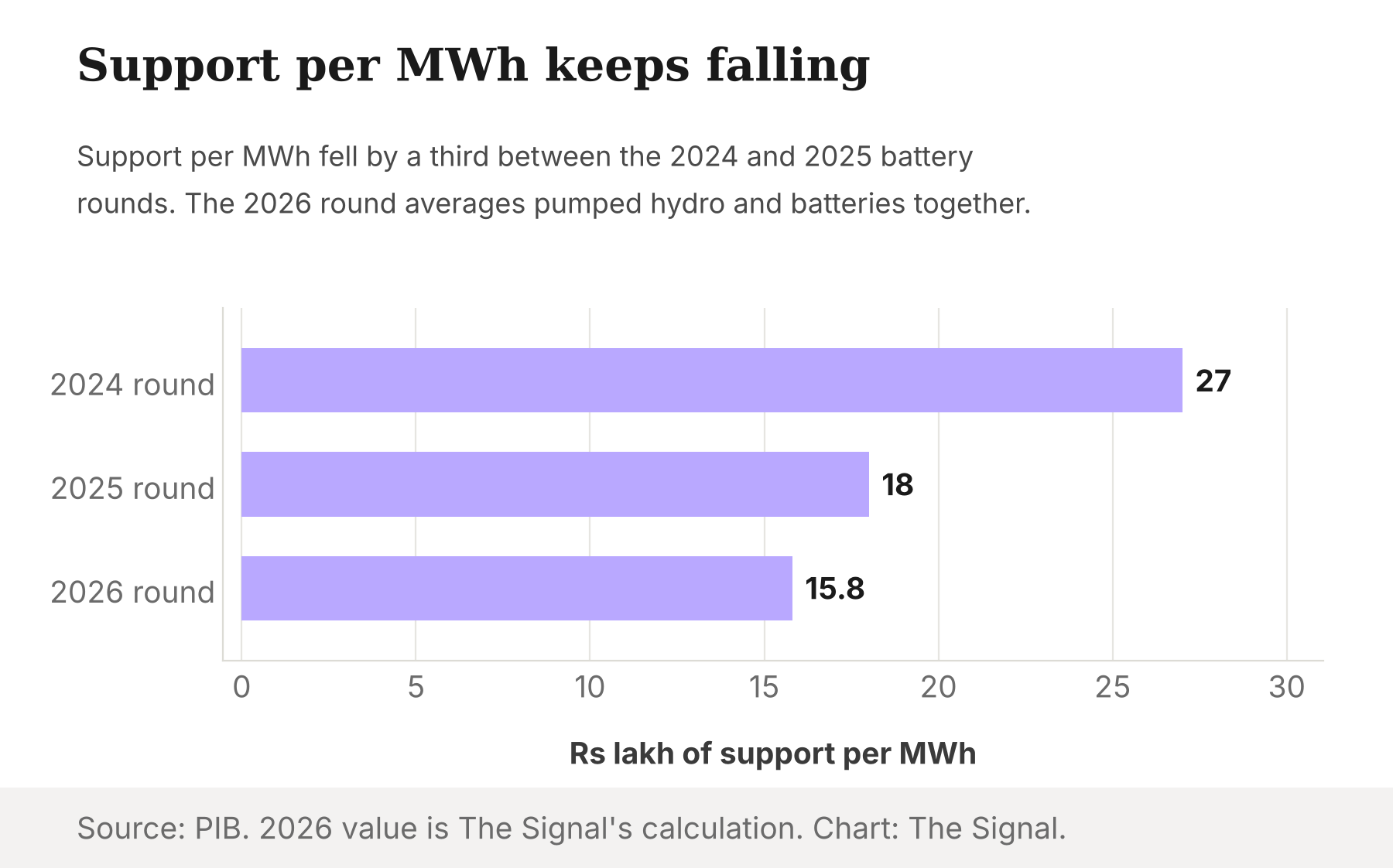
The two figures are not a like-for-like pair. The 40 percent was a ceiling for batteries, and the 15 percent is an average across all storage technologies. The Cabinet release does not publish a support rate for each technology. But the direction is clear across the rounds that do publish a rate. The March 2024 scheme paid Rs 27 lakh per MWh on Rs 3,760 crore for 13,220 MWh, and the June 2025 scheme paid Rs 18 lakh per MWh on Rs 5,400 crore for 30 GWh. That is a one-third cut in support per MWh in about fifteen months.
The new scheme, Rs 14,500 crore spread over 92 GWh, works out to about Rs 15.8 lakh per MWh on average. That blends hydro and batteries, so it is not the rate for either technology. It is simply what the money buys.
Why the battery subsidy is thinning
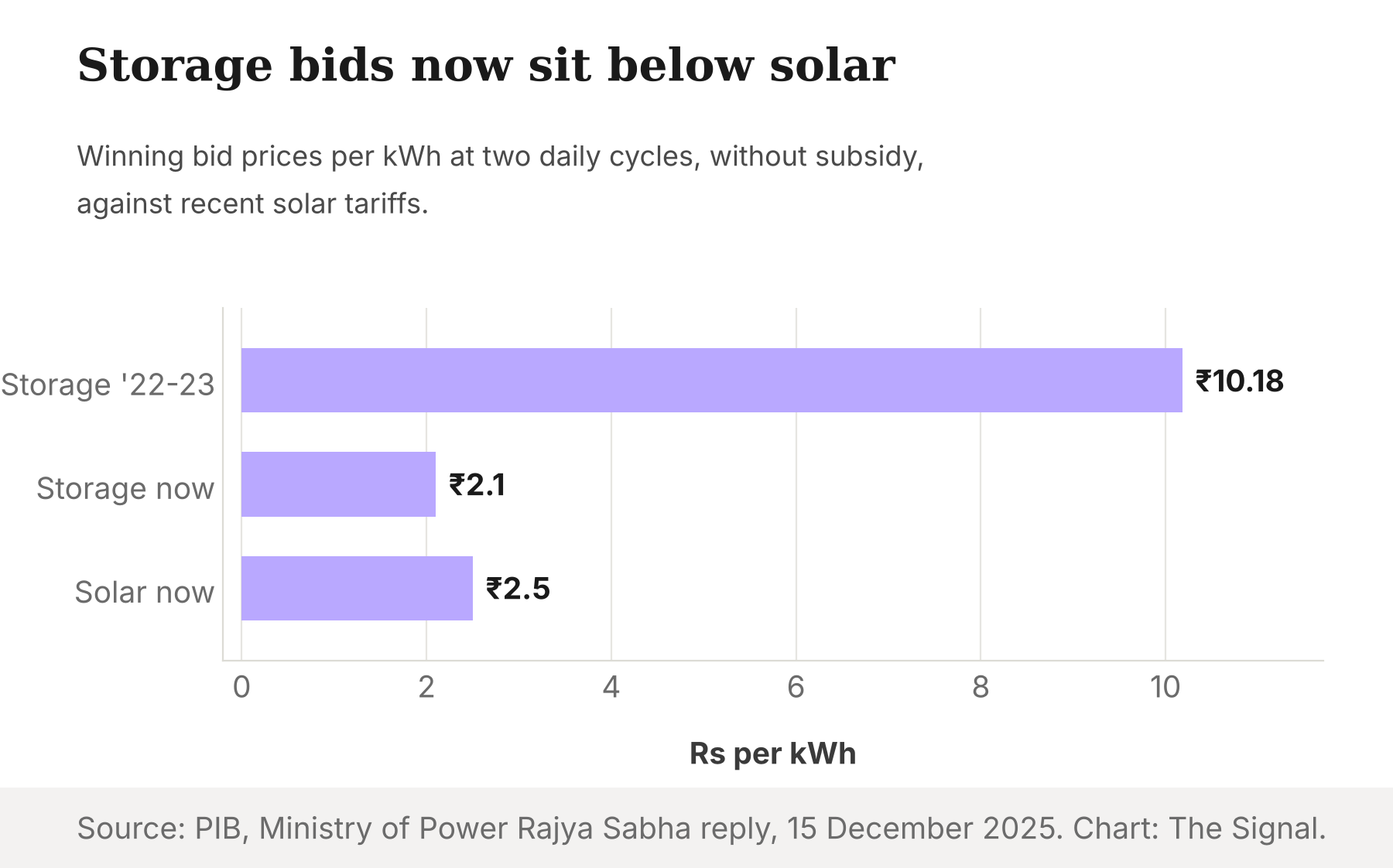
The cause is price. Battery storage discovered through competitive bidding cost about Rs 10.18 per kWh in 2022-23 at two cycles a day, and about Rs 2.1 per kWh without any subsidy in recent bids, according to the Ministry of Power in December 2025. That is a fall of about 79 percent. The same release put recent solar tenders at about Rs 2.5 per kWh, so a unit of storage now bids below a unit of daytime solar.
Falling prices already stretched the first scheme. The Ministry of Power told the Lok Sabha on 23 July 2026 that the scheme was approved for 4 GWh on Rs 3,760 crore and that, owing to the decline in battery prices, supported capacity was enhanced to 13.8 GWh within the same outlay. The same budget now covers about 3.5 times the capacity it was approved for.
The consequence is a change in what the subsidy is for. When a battery bid at Rs 2.1 per kWh sits below solar at Rs 2.5, a subsidy that covers a large share of its cost is paying for something the market is starting to do alone. Pumped hydro is a different product. It takes years to build and lasts for decades. A subsidy aimed there is paying for patience, not for a price the market has already found.
The delivery gap
There is a second reason to look past the 92 GWh. Money approved is not money spent. In the same Lok Sabha reply, the ministry said 0.5 GWh of the first scheme's capacity had been commissioned and Rs 168.04 crore of the Rs 3,760 crore had been disbursed. That is about 4.5 percent of the money and under 4 percent of the 13.8 GWh target, as of July 2026.
The need is far larger than any one scheme. The Cabinet release puts the grid-scale storage India requires at 411 GWh by 2031-32. The 92 GWh would cover about 22 percent of that. The rest has to come from projects that win bids without help, which is the bet the thinner subsidy is making.
The honest objection
The strongest case for the new design is that it is the right design. Batteries no longer need a large subsidy, so the money should move to the technology that still does. Pumped hydro has long lead times and heavy up-front costs, and a supported 60 GWh of it could pull projects through that would never be bid otherwise. On that reading, a lower average support per MWh is not a retreat. It is the subsidy being aimed at what is genuinely hard to finance.
That case has force, and the data do not refute it. What they do not show is whether 15 percent is enough for pumped hydro. The release gives no rate for hydro, and the first battery scheme offered up to 40 percent. If hydro developers need more than the average on offer, the 60 GWh target is where the scheme will fall short, and the delivery record on batteries suggests approvals alone will not close the gap.
The Signal
The headline number, 92 GWh, is a count of what the state hopes will be built. Three smaller numbers say more: 60, 15 and 4.5. Sixty is the GWh of the target that is pumped hydro, not batteries. Fifteen is the percent of project cost the support is meant to cover, and four and a half is the percent of the first scheme's money that had been paid out by July 2026. Watch the per-technology support rates when the guidelines follow, and watch the first pumped-hydro bids. If hydro bidders come in near the average, the redesign worked. If bids stall, India will have solved the problem batteries already solved. A subsidy that follows falling prices is rational, but it only counts once the capacity is running.
Reporting basis: the Cabinet's release is the source for the scheme's size, period, capacity split, investment estimate and the 411 GWh requirement, as published by the Press Information Bureau on 4 November 2026. The per-MWh support rates for the March 2024 and June 2025 schemes are from a Press Information Bureau release of a Rajya Sabha reply by the Ministry of New and Renewable Energy. The 2022-23 and recent battery bid prices and the solar tender price are from a Press Information Bureau release of a Ministry of Power reply to the Rajya Sabha of 15 December 2025. The 2023 scheme's 40 percent ceiling is from the Prime Minister's Office release on the Cabinet decision. The enhancement from 4 GWh to 13.8 GWh and the disbursement and commissioning figures are from the Ministry of Power's Lok Sabha reply of 23 July 2026. All of these are Indian government sources, and none is independent of the others, so the piece rests on official statements rather than third-party verification. The 15 percent share, the 65 percent pumped-hydro share, the Rs 15.8 lakh per MWh average, the 79 percent price fall, the 3.5 times capacity multiple, the 4.5 percent disbursement share and the 22 percent coverage figure are The Signal's calculations from those figures.