On 24 September 2026 the government cut the basic customs duty on crude edible oils. The aim was plain: lower domestic landed costs, give consumers relief and contain food-price inflation. The duty on crude sunflower oil fell from 10% to nil, and the duty on crude soybean oil and crude palm oil fell from 10% to 5%. The first import numbers for the month that followed are now in, and they show what a lower duty does to the volume of oil coming through the ports.
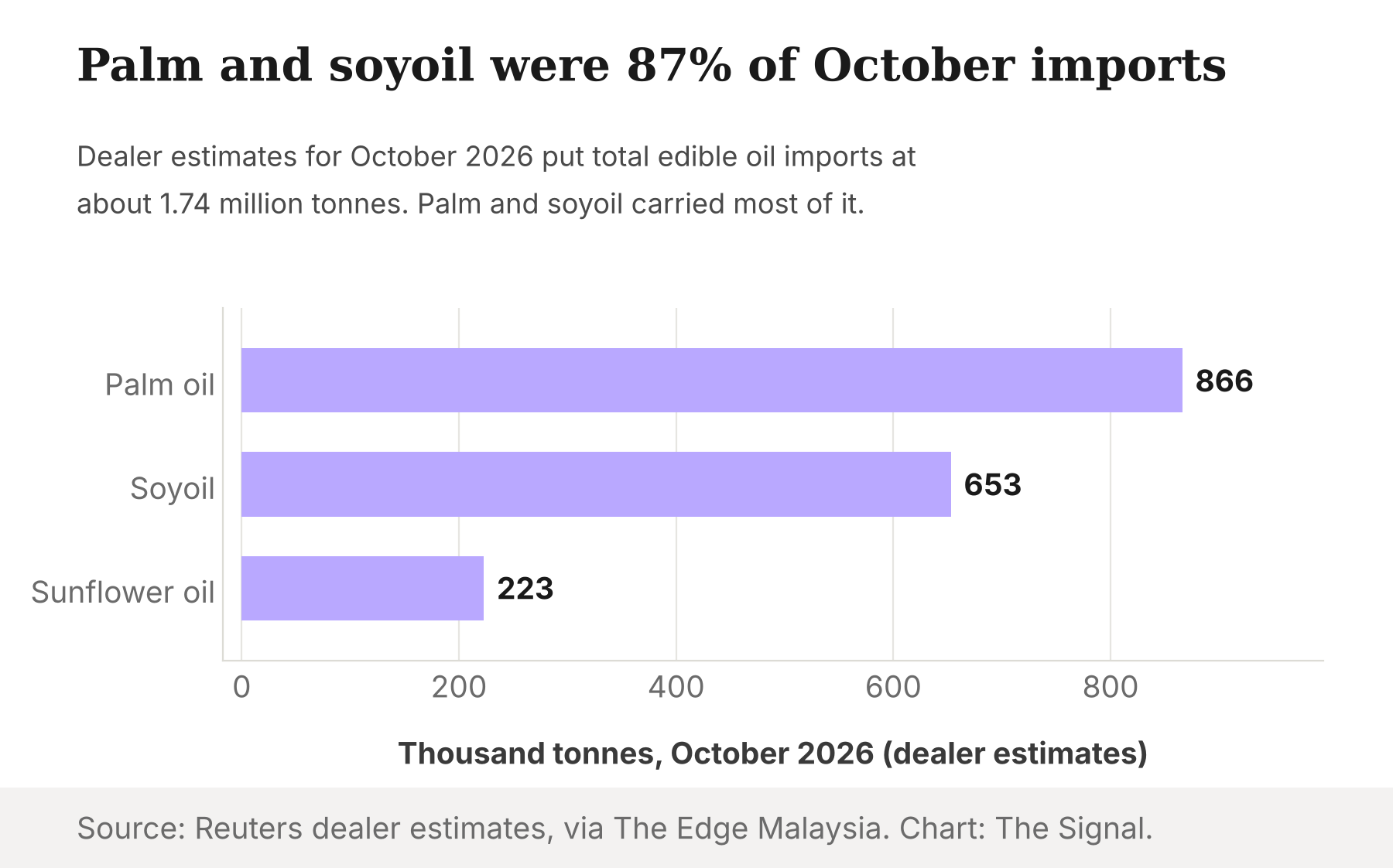
Dealer estimates compiled by Reuters put India's October edible oil imports at 1.74 million tons, up 13% on September and the highest in more than two years. Palm oil imports rose about 6% to roughly 866,000 tonnes, the highest in more than a year. Soyoil rose 6% month on month to 653,000 tons, which Reuters calls an all-time peak. These are trade estimates, not official data. The Solvent Extractors' Association of India (SEA) usually publishes its own October figures in mid-November, and they may differ.
The September dip sets up the jump
The October surge looks sharper against what came just before it. SEA data show edible oil imports fell 7% in September to 15.44 lakh tonnes, down from 16.58 lakh tonnes a year earlier. Over the first 11 months of the oil year, from November 2025 to September 2026, total imports were up 3% at 151.64 lakh tonnes, against 146.83 lakh tonnes a year earlier.
So the year was running only slightly ahead until the duty cut. Then one month added 13% to the monthly run rate. Reuters ties the buying to three things: lower prices that led refiners to build stocks ahead of the festive season, worries about thin domestic supply after El Nino damage to oilseeds, and the September duty cut. It does not rank them, and neither can we.
What the duty cut can and cannot do
A lower duty does two things at once. It lowers the price of imported oil, which is the point. It also makes imported oil more attractive against the domestic crop, which is the side effect. When the home crop is already short, that side effect is the larger one.
The home crop is short on the margin. USDA's New Delhi office forecast in March that India's soybean production would fall 3% in 2026/27, its second straight decline, because prices were below production costs. That was before this year's monsoon. By late September, the agriculture minister put the rainfall deficit at about 12%, and soybean acreage had fallen. The minister said there would be no significant drop in kharif foodgrain output. The same reporting gave no soybean or oilseed production figure, so how far the oilseed crop will fall is not yet known.
The structural backdrop matters more than any one month. USDA says India will continue to rely on imports for about two-thirds of its vegetable oil needs. With a dependence that high, a duty cut works mostly as a subsidy to the imported share of every kitchen's cooking oil. It cannot add any domestic supply.
The bill behind the volume
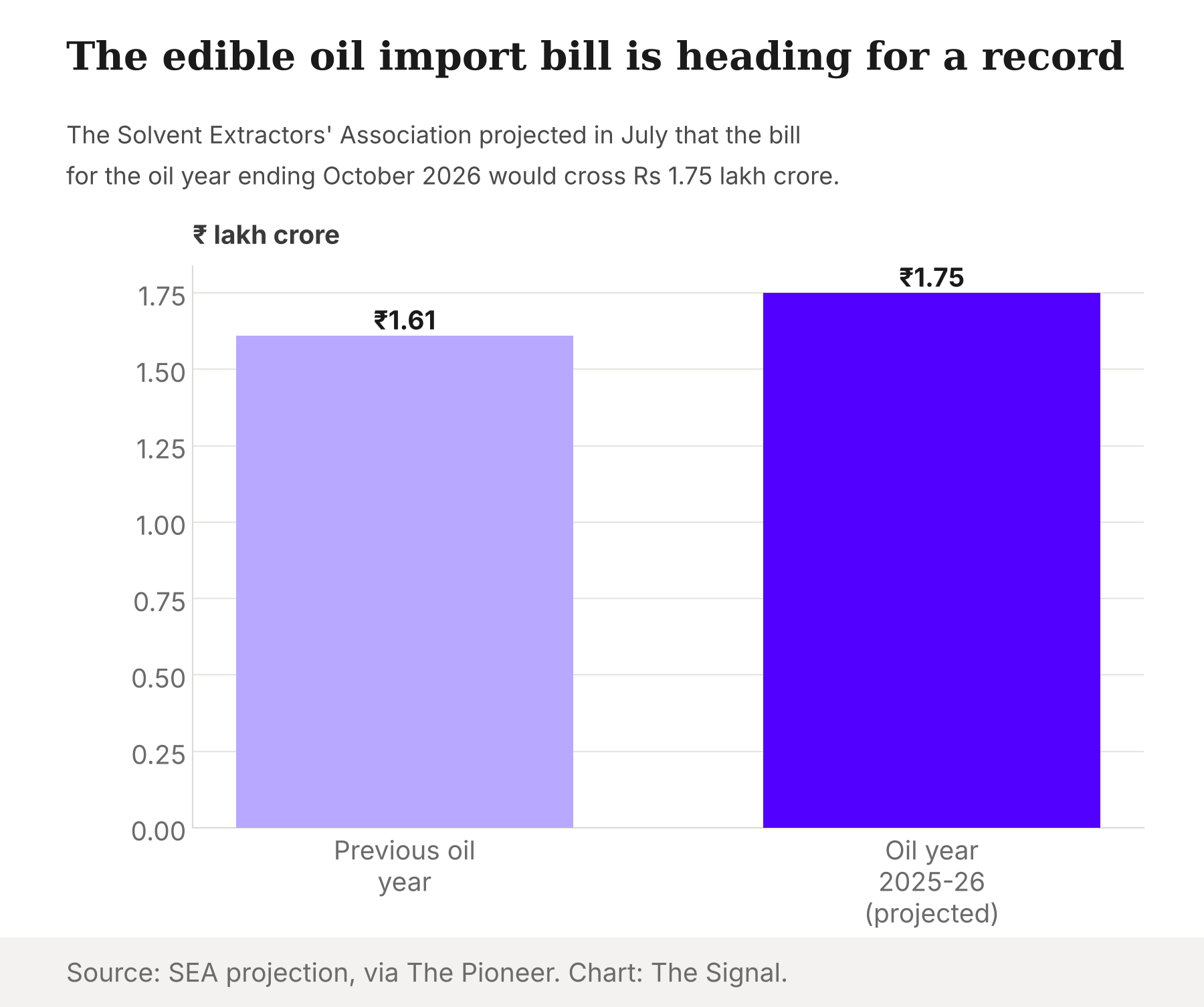
Volume is only half of it. In July, SEA projected that the edible oil import bill would cross an unprecedented Rs 1.75 lakh crore for the oil year ending October 2026, against Rs 1.61 lakh crore the year before. That works out to a rise of about Rs 14,000 crore. The projection came before the duty cut and before October's volume, so the final figure could land higher or lower. The same report blamed higher volumes and a weaker rupee.
The honest objection
The strongest case for the duty cut is that it worked as designed. Prices were rising, a festive season was coming, and the government wanted relief. Palm oil in particular was cheap enough that Reuters expects it to keep imports elevated in November. Cheaper oil on the shelf is a real benefit to households, and some of October's volume was refiners restocking at lower prices, which would have happened to some degree anyway.
That case holds up on prices. We have no retail price data in hand to test it, and the government's own advisory asked industry to pass the full saving to consumers, which is a request rather than a result. What the numbers do show is the cost side: more tonnes, in a year when the bill was already heading for a record.
The Signal
A duty cut is a trade-off between household prices and import dependence, and October is the first month that shows both sides. Imports are up 13% in a month, and two-thirds of India's vegetable oil already comes from abroad. Watch three numbers next: SEA's official October volumes in mid-November, whether the soybean crop estimate falls with the 12% rainfall deficit, and whether the final import bill clears Rs 1.75 lakh crore. A duty cut can ease a price. It cannot grow a crop.
Reporting basis: the October volumes are dealer estimates compiled by Reuters and relayed by The Edge Malaysia, not official data. The September and year-to-date volumes are SEA figures as relayed by PTI in the Free Press Journal, and the import bill projection is SEA's, relayed by The Pioneer. The duty changes come from a Press Information Bureau release, the only source we verified for the rates. The oilseed outlook is from USDA's Foreign Agricultural Service, and the rainfall and acreage remarks are the agriculture minister's, as reported by PTI in ThePrint. The 87% palm-and-soyoil share and the roughly Rs 14,000 crore rise in the bill are The Signal's calculations from those figures.