
October's GST number is the kind that gets a victory lap. Business Today, reporting Finance Ministry data, says gross collections rose 22.9 percent to Rs 2,31,290 crore in October 2026, against Rs 1,88,125 crore in October 2025. The usual reading follows: festive demand is strong, consumers are spending, the tax base is widening. Read the top line and the Indian consumer looks unstoppable.
It is worth slowing down on that. The headline blends two very different streams of money, and they are not growing at the same speed.
Two taxes under one number
GST is collected in two places. One is on sales inside India. The other is on goods as they arrive at the port, where the Integrated GST on imports is charged alongside customs duty.
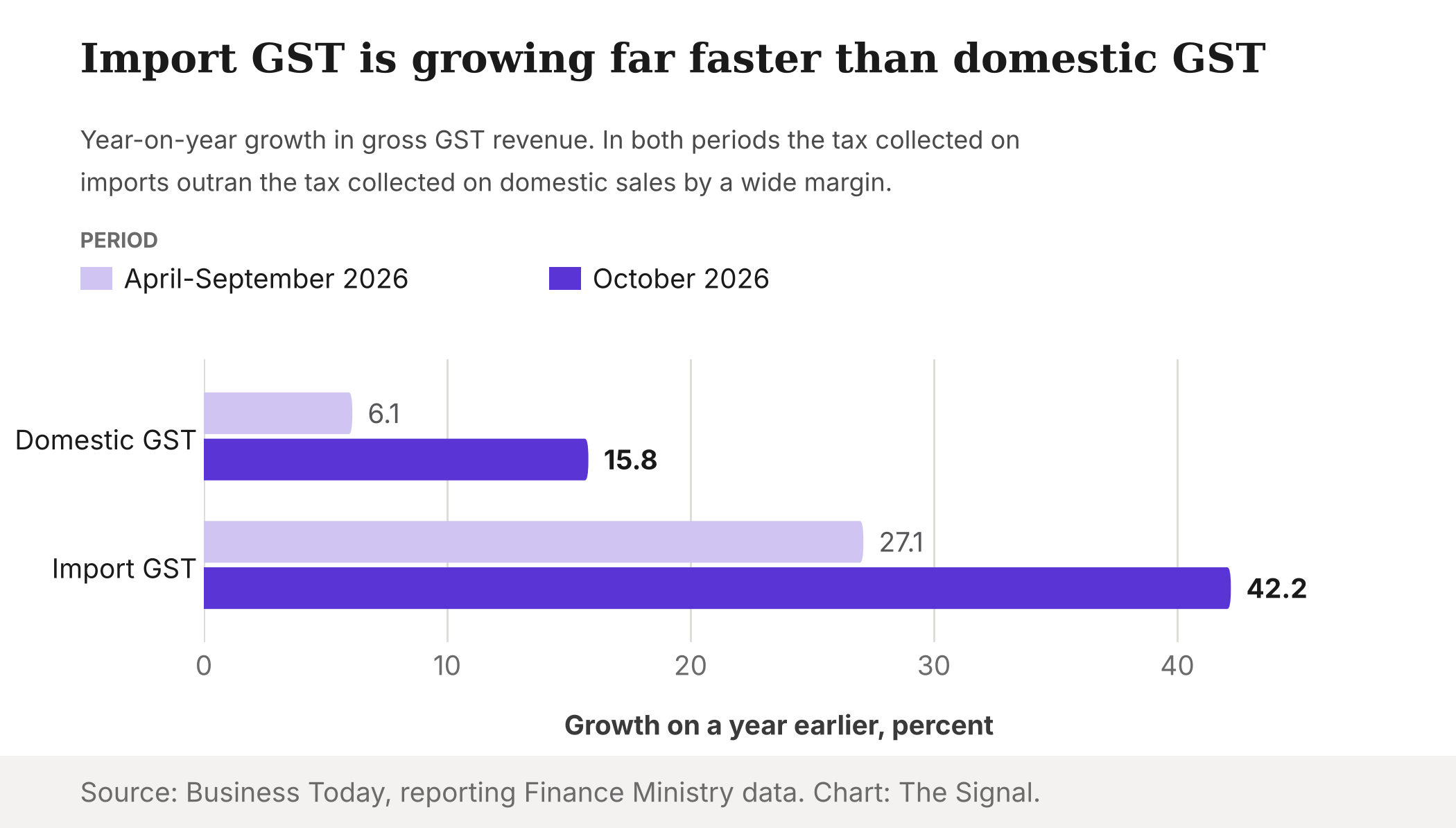
In October, gross domestic GST revenue rose 15.8 percent to Rs 1,59,044 crore, while GST on imports jumped 42.2 percent to Rs 72,246 crore, per the same report. Imports are roughly a third of the total, yet they supplied far more than a third of the growth.
The gap is not a one-month blip. Between April and September 2026, gross GST on imports rose 27.1 percent to Rs 3.72 lakh crore, while gross domestic GST rose only 6.1 percent to Rs 8.74 lakh crore. Over those six months, tax on imports grew about four times as fast as tax on domestic sales. October narrowed the multiple to under three, but only because domestic collections finally picked up.
The number that carries the thesis
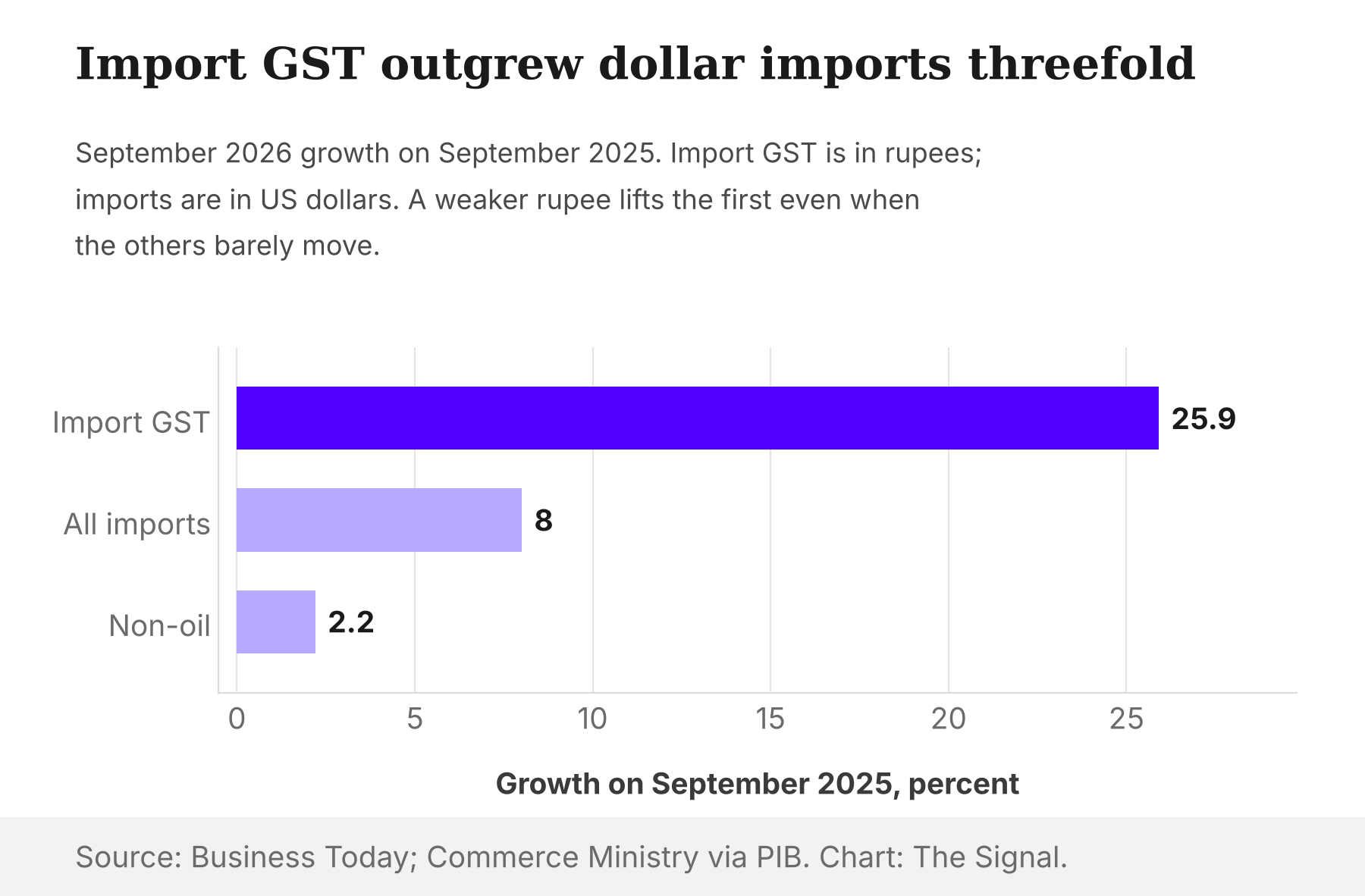
The cleanest test is September, the last month for which both GST and trade data are out. GST on imports rose 25.9 percent to Rs 65,525 crore that month. Over the same month, merchandise imports were US$ 74.61 billion against US$ 69.08 billion in September 2025, according to the Commerce Ministry's release via the Press Information Bureau.
That is dollar growth of 8.0 percent (PIB). Import GST grew 25.9 percent (Business Today). The tax on imports grew more than three times as fast as the imports themselves.
Two forces can widen a gap like that. The first is the currency. GST on imports is levied in rupees on the rupee value of the shipment, so when the rupee weakens, the same dollar cargo produces a bigger tax bill. Trading Economics puts USD/INR at about 95.04 on 2 November 2026, with the rupee down 7.12 percent over the previous 12 months. Eight percent more dollar goods, priced in a rupee roughly 7 percent weaker, is about 16 percent more rupee value. That explains well over half of the 25.9 percent.
The second is what is being imported. Subtract oil from the total: non-petroleum imports were US$ 56.27 billion against US$ 55.05 billion a year earlier, up just 2.2 percent. By subtraction, petroleum imports were US$ 18.34 billion against US$ 14.03 billion, up about 31 percent. Oil is the one large import line growing faster than the rupee is falling, which suggests dearer crude is part of the tax story too.
The honest objection
The strongest case against this reading is that imports are growing for real reasons, and that real imports are a sign of a strong economy. There is evidence for it. Non-petroleum, non-gems and jewellery imports were US$ 51.64 billion in September 2026 against US$ 42.33 billion a year earlier, a rise of 22.0 percent in dollars. Strip out oil and precious metals, and India is still buying much more machinery, components and other goods than it was.
That case is real. It also needs a footnote: the same release shows gold imports falling 81.27 percent and silver 49.11 percent in September, so the headline import total hides large swings underneath. The rise in the rest of the basket is genuine demand, but it is demand priced in a weaker rupee, which inflates the rupee tax on it again.
The domestic stream is not weak either. Fifteen point eight percent growth in October is a respectable figure, and a festival month is a fair explanation for part of it. The point is narrower than "demand is fake". It is that the headline number overstates how much of the gain came from Indian shoppers.
The Signal
A GST surge led by imports is a different fiscal event from one led by domestic consumption. It says the import bill is rising in rupee terms, as the rupee's 7.12 percent slide over 12 months would suggest. A revenue beat that comes from a weaker currency and dearer crude is the other side of the same shock, not a separate piece of good news.
Watch the split next month. If domestic GST growth holds while import GST growth fades, the festive demand story deserves the credit. If import GST keeps outgrowing domestic GST by a wide margin, as it did in the April to September data, the headline is mostly the rupee and the oil price talking. A tax haul is only a sign of strength once you know who paid it.
Reporting basis: GST collection figures are from Finance Ministry data, as reported by Business Today, and rest on that single outlet's reporting; the primary release was not independently checked. Import values, the petroleum split and the gold and silver changes are from the Ministry of Commerce and Industry's September 2026 trade release, via the Press Information Bureau. The exchange rate and its 12-month change are from Trading Economics. The import growth rates, the petroleum import figures and the approximate 16 percent rupee-value estimate are The Signal's calculations from those figures.