The headline version of India's new aviation rules is reassuring. From 1 January 2027, the new regulations are set to take effect, and under them the government can step in when airfares run away. Passengers who were stung by sudden fare spikes get a legal backstop. The government gets a tool it already used once.
It is worth slowing down on how that tool is written. The power is real, but nothing in the text tells an airline, a passenger or a court what a runaway fare looks like.
What the rule says
Under the Bharatiya Vayuyan Niyam, 2026, as Business Today reported on 2 November 2026, "If the Centre determines that an extraordinary situation has arisen, it may issue written directions deemed necessary and expedient in the public interest." The same report says the intervention must stay proportionate and lasts only for a specified period.
Read that sentence for what it leaves out. The report describes no fare ceiling or numerical threshold, and nothing that would count as extraordinary. The Centre decides when the situation has arisen, and the Centre decides what to direct. The only limits are proportionality and a time limit, and both are judged after the fact.
That is a discretion, not a rule in the sense an airline can plan around. The distinction matters because of what happened the last time the government used the power.
The precedent is 107 days long
The Civil Aviation Ministry imposed temporary distance-based fare caps on 6 December 2025, during the IndiGo disruption, and All India Radio reported in December 2025 that "these caps will remain in force until the situation fully stabilises." The caps were tiered by distance. Airlines could not charge more than Rs 7,500 for routes up to 500 km, with higher ceilings for longer routes.
The Centre withdrew them with effect from Monday, 23 March 2026. From 6 December 2025 to 23 March 2026 is 107 days, by our calculation. The end date came from a ministry review, not from a published test. The withdrawal order itself carried a warning: regulatory action, including the reintroduction of fare caps, could be taken if there is an unjustified surge.
So the 2025 episode had a start date, an end date and a standing threat, all set by announcement. The new rule turns that practice into law without adding the one thing the practice lacked, which is a stated test.
The market the rule has to work in
The reason this matters is concentration. IndiGo accounted for 65.4% of domestic traffic in September 2026, according to DGCA data reported by Business Today. The other airlines together carried the remaining 34.6 percent.
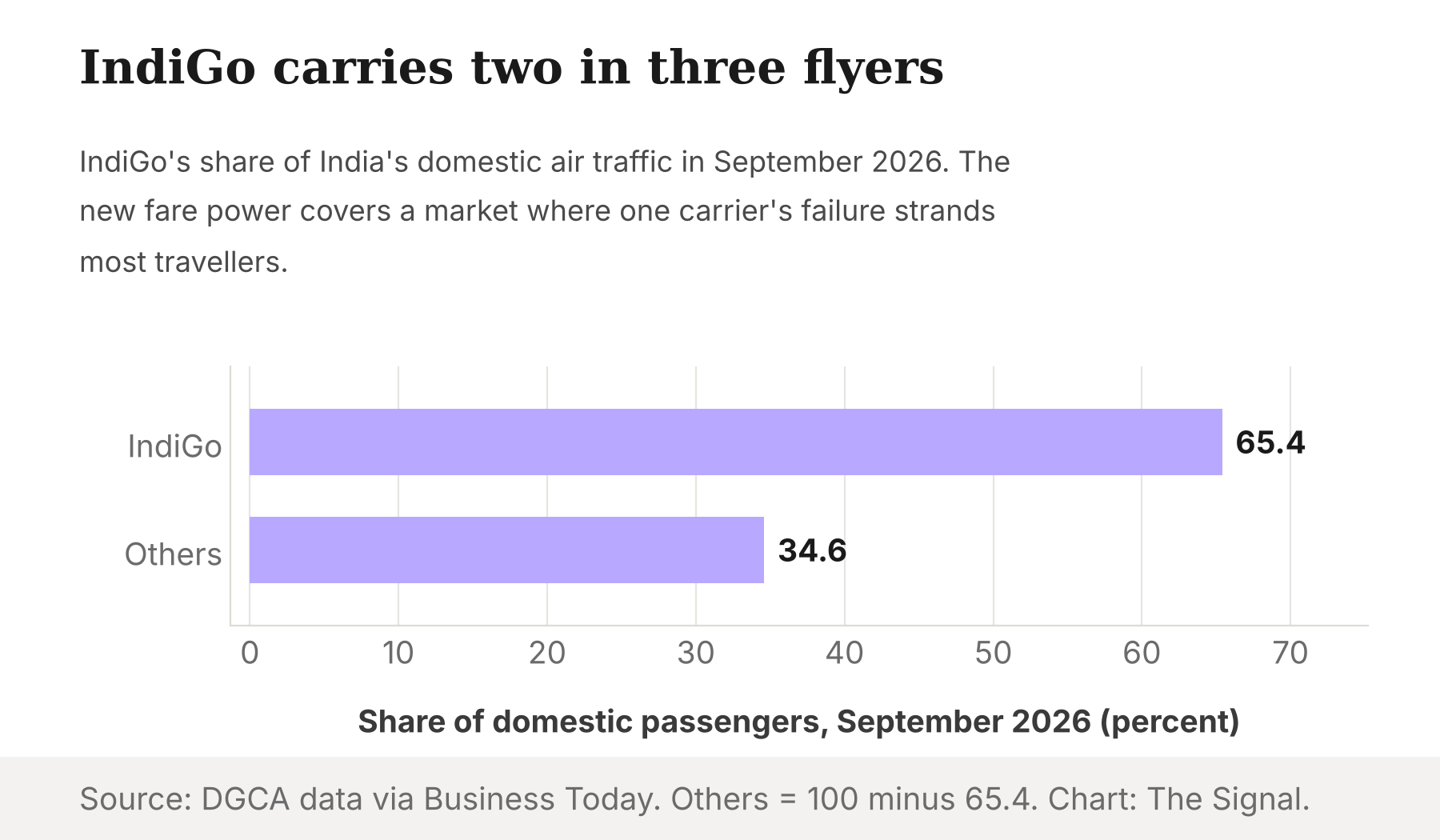
When one carrier moves two of every three passengers, an operational failure at that carrier is a market-wide event. Rivals cannot absorb the stranded travellers at the old price, because they do not have the seats. Fares spike, the government calls it extraordinary, and the cap goes on. That is the sequence of December 2025. The structure that produced it has not changed.
The traffic data adds an uncomfortable detail. Domestic air passenger traffic in India declined 6.49% month-on-month in September 2026, to 118.23 lakh passengers from 126.43 lakh in August. The same report notes that the DGCA report does not identify the reasons behind the fall. January to September 2026 traffic slipped 0.82% year-on-year to 1,223.53 lakh from 1,233.70 lakh, the first time the year-to-date figure has turned negative.
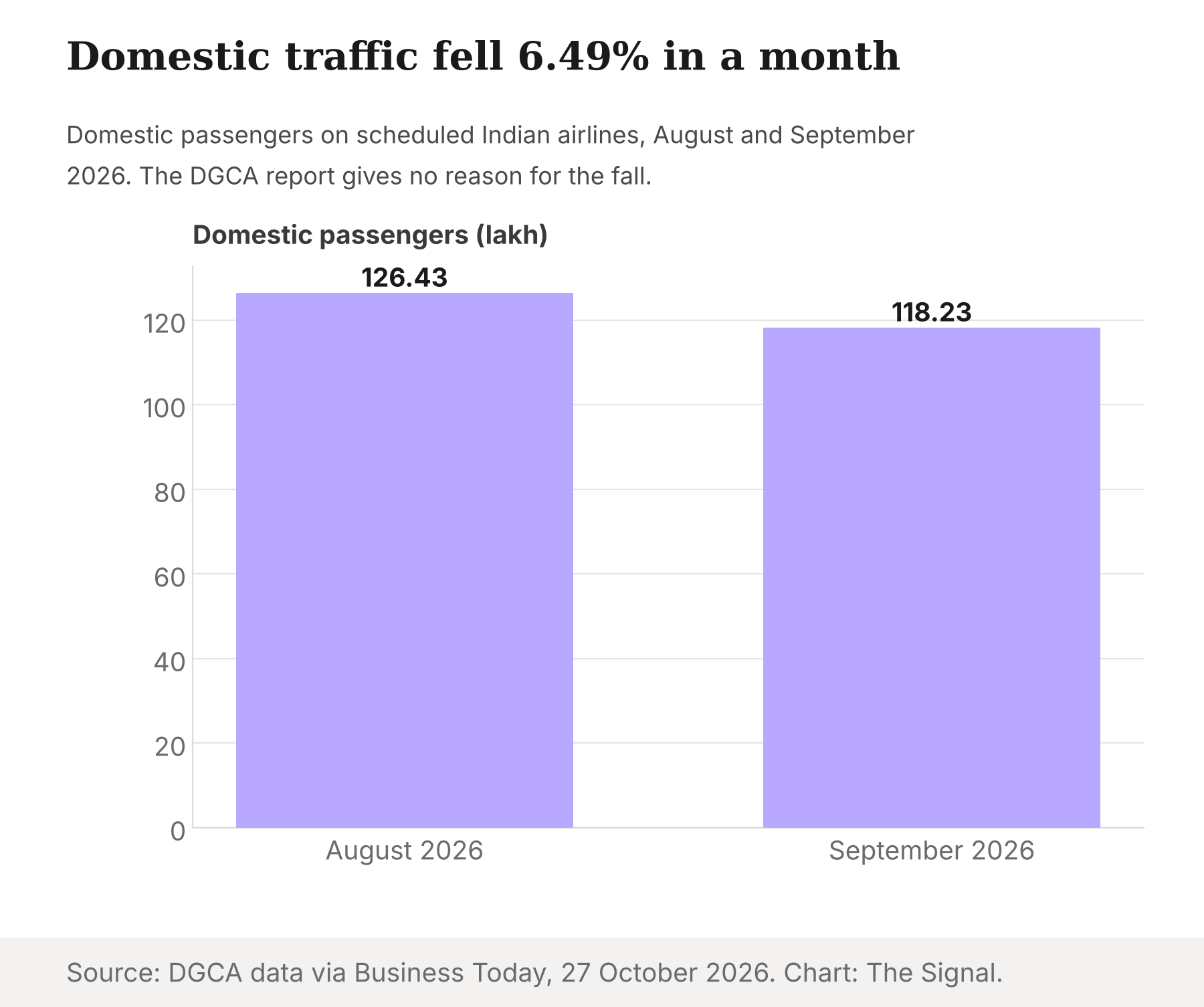
A monthly fall is not evidence of weak demand by itself, and the report states that the September decline cannot, by itself, be attributed to weaker travel demand. But it means the next extraordinary situation may arrive in a market where demand is soft and one airline dominates, which is exactly where an unstated trigger is hardest to apply evenly.
The honest objection
The strongest defence of the drafting is that a numerical trigger would be worse. A fixed threshold, say a fare rise of a set percentage, invites airlines to price just under it and invites the government to be bound in situations nobody foresaw. Civil Aviation Minister Naidu told the Lok Sabha in December 2025 that "The government has exclusive powers in extraordinary circumstances", and the same debate heard that capping is not the only answer. On this view, flexibility is the feature. Emergencies are different from each other, and a rule that listed them would be obsolete on arrival.
That case is real. It also has limits. Discretion works when the actor is predictable, and what markets price is predictability. An airline deciding how many seats to hold for a festival weekend cannot tell whether a fare spike will be read as ordinary pricing or as an extraordinary situation. A passenger cannot tell either. The 107-day precedent suggests the answer will come from the ministry's reading of events, not from a published test. A proportionality limit and a time limit are useful guardrails, but they constrain the response, not the decision to respond.
The rulemaking itself ran slowly
The rules arrive after a long wait. On 13 July 2026 the Supreme Court directed the Centre to place the rules framed under the Bharatiya Vayuyan Adhiniyam, 2024 on record within two weeks, in a petition that also sought guidelines on unpredictable airfare fluctuations. On 16 October 2026 the Solicitor General told the Court the rules would be published within two weeks, and the Court listed the matter again for 16 November 2026. The Business Today report of 2 November sits inside that window.
The Court's next hearing is the nearest test of whether the discretion will be questioned. Petitioners have argued for guidelines to control fare swings, and a rule with no stated trigger is an obvious thing to put before judges.
The Signal
The new rule, as Business Today reported it, moves the airfare question from whether the government will step in to who decides what counts as an emergency, and it answers with the government's own judgment. For passengers that is a safety net. For airlines it is an uncapped uncertainty, priced into every festival-season schedule.
Watch three things. First, whether the Court's next hearing produces any request for a defined trigger. Second, whether September's monthly fall in domestic traffic is followed by another, which would test the rule in a softer market. Third, whether the next disruption at the dominant carrier is treated as extraordinary within days or weeks. The 2025 cap took more than three months to leave. A rule that never says when it applies will also never say when it ends.
Reporting basis: the text and effective date of the Bharatiya Vayuyan Niyam, 2026 are per Business Today's report on the rules, and rest on that single outlet's account, not on the Gazette notification. The December 2025 cap and the July 2026 Supreme Court direction are per All India Radio, with the lowest distance tier per Business Today. The March 2026 withdrawal is per Scroll. The minister's remarks are per The Tribune's report of the Lok Sabha debate. The October 2026 hearing is per LawChakra. Domestic traffic and IndiGo's share are DGCA figures as reported by Business Today. The length of the cap and IndiGo's complementary share are The Signal's calculations from those figures.