
The headline version of India's steel story is a good one. In September 2026, India produced 13.9 million tonnes of crude steel, up 1.9 percent on a year earlier, while the United States is estimated to have produced 7.2 million tonnes and Japan 6.3 million, according to the World Steel Association's monthly release. Add the American and Japanese figures and you get 13.5 million tonnes. India, on its own, out-made both.
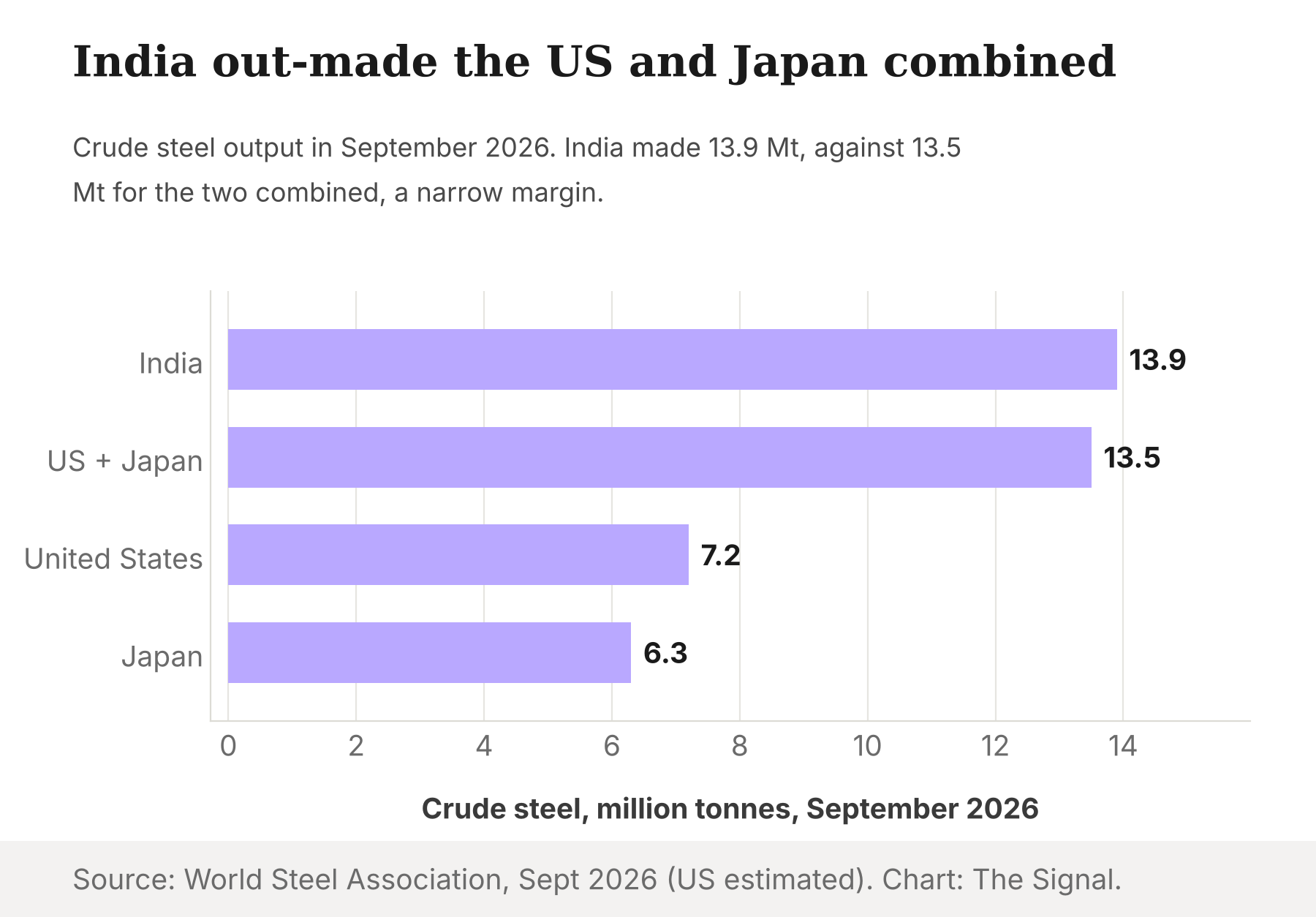
Two caveats keep that line honest. It is one month, not a year, and the margin is 0.4 million tonnes, about 3 percent. The American number is also an estimate. But the direction is not in doubt. The Ministry of Steel reports that India's crude steel production reached 164.89 million tonnes in 2025, a 10.4 percent increase on 2024. A country that size is plainly a steel superpower.
It is worth slowing down on what comes next, because the same country is buying steel from abroad.
The country that makes the steel is a net buyer of it
In April to September 2026, India's finished steel imports were 4.148 million tonnes, up 23.8 percent, while exports were 3.547 million tonnes, up 26.2 percent, per provisional Joint Plant Committee data reported by SteelOrbis. Subtract one from the other and India bought about 0.6 million tonnes more than it sold in the first half of FY 2026-27.
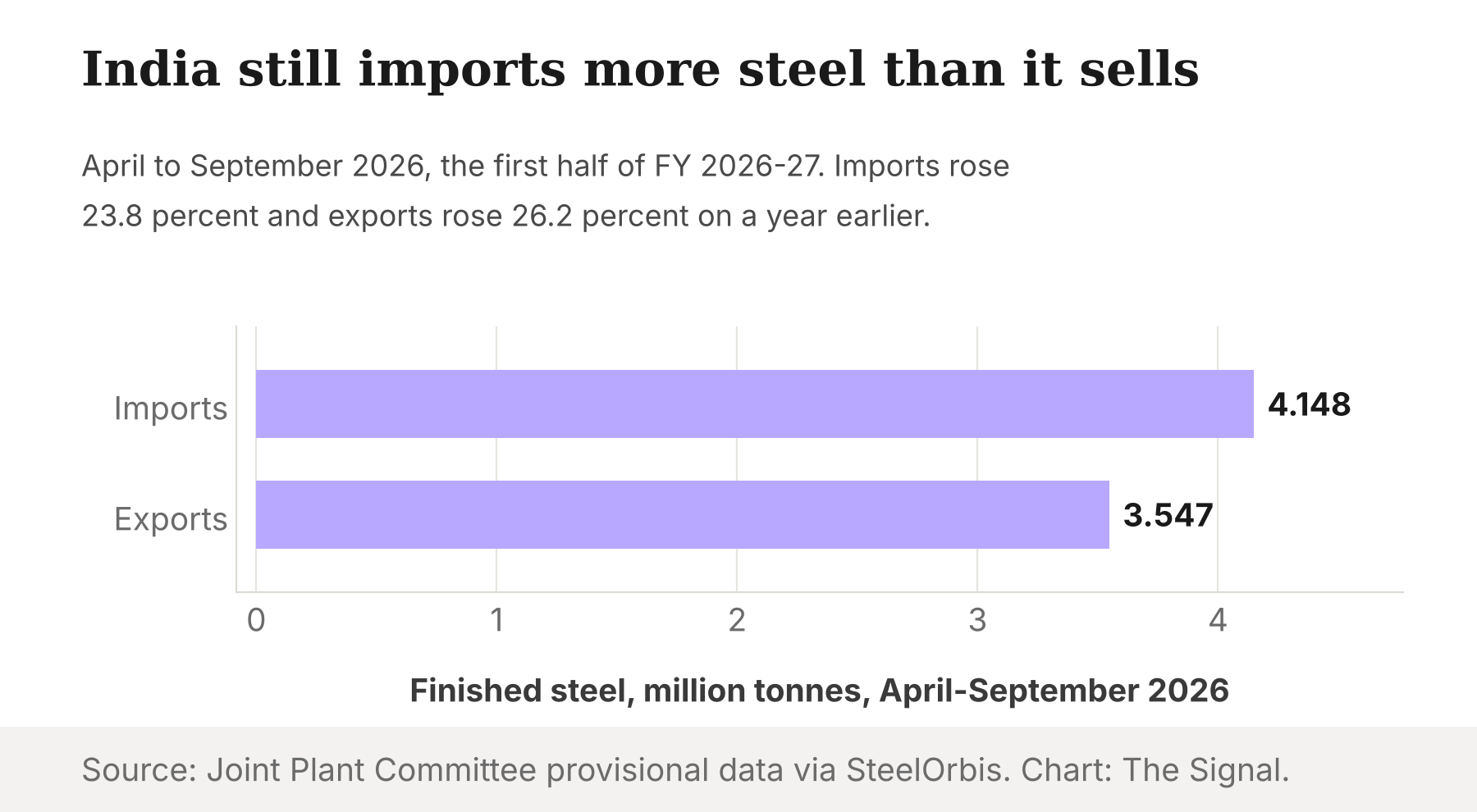
This is not a blip. The Ministry of Steel notes that India had been a net importer of steel since April 2024, excluding only five months. In April 2026 alone, imports exceeded exports by 0.21 million tonnes. By June, the April to June gap had widened to 0.47 million tonnes.
Demand is outrunning the furnaces
The reason is arithmetic about growth, not a failure of the mills. Finished steel consumption in India rose 8 percent to 14.4 million tonnes in September 2026. Crude output that month grew 1.9 percent. The two series measure different stages of production, so the comparison is a guide to direction rather than an exact balance. Even so, a market growing more than four times faster than its supply has to close the difference somewhere.
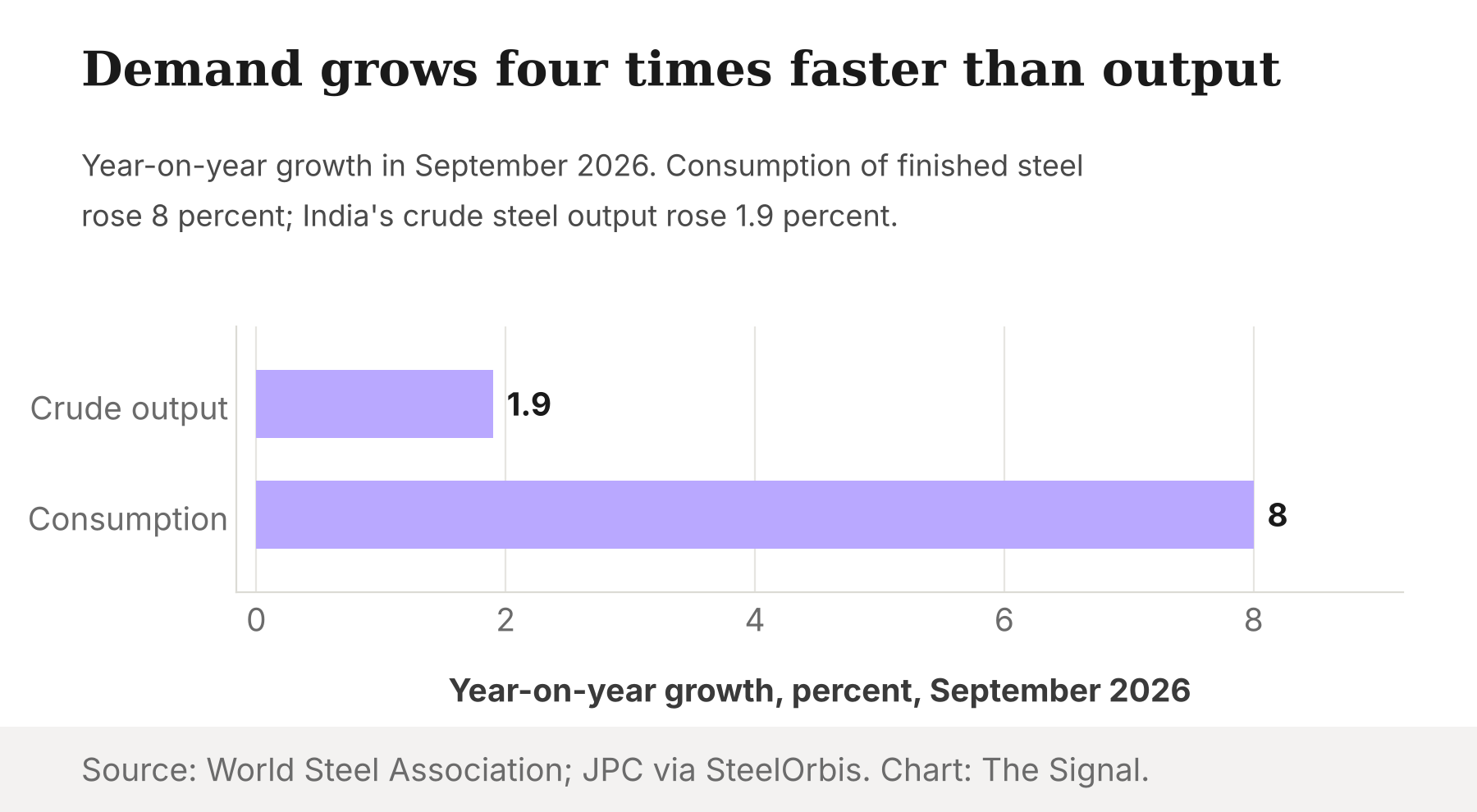
The Ministry's own April to June figures point the same way. Finished steel consumption in April to June 2026 was 41.57 million tonnes, up 8.3 percent. Output has not kept pace with that growth.
A tariff wall, and imports are climbing anyway
India does not lack a policy response. A tapering safeguard duty of 12 to 11 percent runs for three years on key flat steel products, under a Finance Ministry notification dated 30 December 2025. Yet finished steel imports are up 23.8 percent in the first half of this fiscal year. The Ministry's chart of sources shows China supplying 32.0 percent of India's finished steel imports in April to June 2026 in the provisional data.
The strength is also the weakness. A duty is a price signal. It raises the cost of some imports, but it cannot create the tonnes a booming construction and manufacturing economy needs this quarter.
The honest objection
The strongest counter is that exports rose faster than imports, 26.2 percent against 23.8, and that a net gap of about 0.6 million tonnes is small beside a production base of 164.89 million tonnes in 2025. On that view India is simply a large, open steel market that trades in both directions, as the United States and Japan do.
That is fair, and the trade gap is not a crisis. But it answers a different question. The point is not the size of the deficit. It is that a country whose rank suggests surplus is, month after month, a net importer with imports exceeding exports by 0.47 million tonnes in April to June.
The Signal
India's crude steel rank tells you about its mills, and the net trade line tells you about its economy. With consumption up 8 percent and crude output up 1.9 percent, rank by volume stops predicting who sells to whom. Watch the monthly Joint Plant Committee release: if consumption keeps outgrowing output, the net import gap will widen even under the safeguard duty. For now, the appetite is winning.
Reporting basis: crude steel output for India, the United States and Japan is from the World Steel Association's September 2026 release, as reproduced by AJOT; the American figure is the Association's estimate. Calendar 2025 output, the net-import history and the April, May and June 2026 trade and consumption figures are from the Ministry of Steel's monthly economic reports, which cite provisional Joint Plant Committee data. The April to September trade totals and the September consumption figure are Joint Plant Committee data as reported by SteelOrbis and rest on that single trade-press relay. The safeguard duty details are per Taxscan's report of the Finance Ministry notification, which was not checked against the notification itself. The combined US and Japan output, the 3 percent margin, the net import gap of about 0.6 million tonnes and the growth multiple are The Signal's calculations from those figures.