The labour numbers released on November 10 read like good news. MoSPI's PLFS Quarterly Bulletin for July-September 2026 reports an unemployment rate of 5.1% for people aged 15 and above, measured on current weekly status (whether a person found work in the past seven days). The press note adds that the rate improved from 5.4% in April to June 2026, and that the countryside did the work: rural unemployment fell to 4.3% from 4.8%, while urban unemployment sat at 6.8% against 6.7%.
Read at the top line of the bulletin, rural India found jobs over the summer. It is worth slowing down on that. The quarter looks good against April to June, and that is exactly the comparison the farm calendar would predict.
The dip arrives on schedule
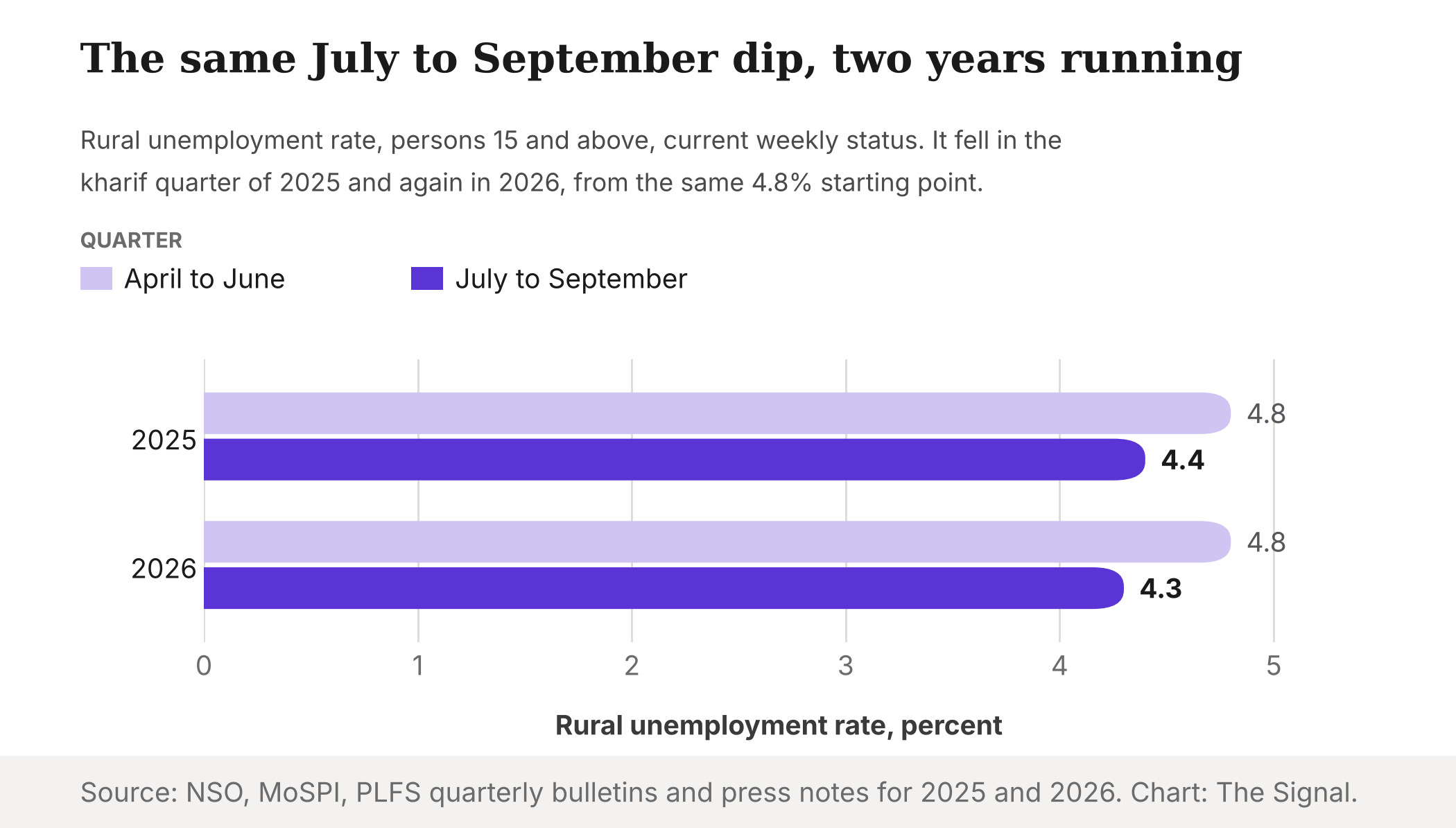
April to June is the lean season before the monsoon crop. July to September is when kharif sowing and transplanting pull people into the fields. Compare like with like and the 2026 improvement mostly disappears. MoSPI's July-September 2025 press note, via PIB, reports that rural unemployment fell from 4.8% to 4.4% over the same two quarters a year earlier. The April-June 2026 press note reports that rural unemployment in that quarter was at the same 4.8% as in April to June 2025.
So both years started from 4.8%. In 2025 the kharif quarter took 0.4 points off; in 2026 it took 0.5. The number that carries the story is the year-on-year one, and MoSPI's own press note says it plainly: rural unemployment "remained largely unchanged" at 4.3% in July to September 2026, against 4.4% in July to September 2025.
Two seasons is also all the record holds. MoSPI's January-March 2026 press note states that quarterly bulletins up to December 2024 covered urban areas only, and that the April-June 2025 bulletin was the first with rural estimates. There is no third July to September quarter to check the pattern against, so the pattern rests on two seasons, plus MoSPI's own reading of the first one.
Source: MoSPI PLFS press notes for July-September 2025, via PIB, April-June 2026 and July-September 2026. Chart: The Signal.
Where the workers went
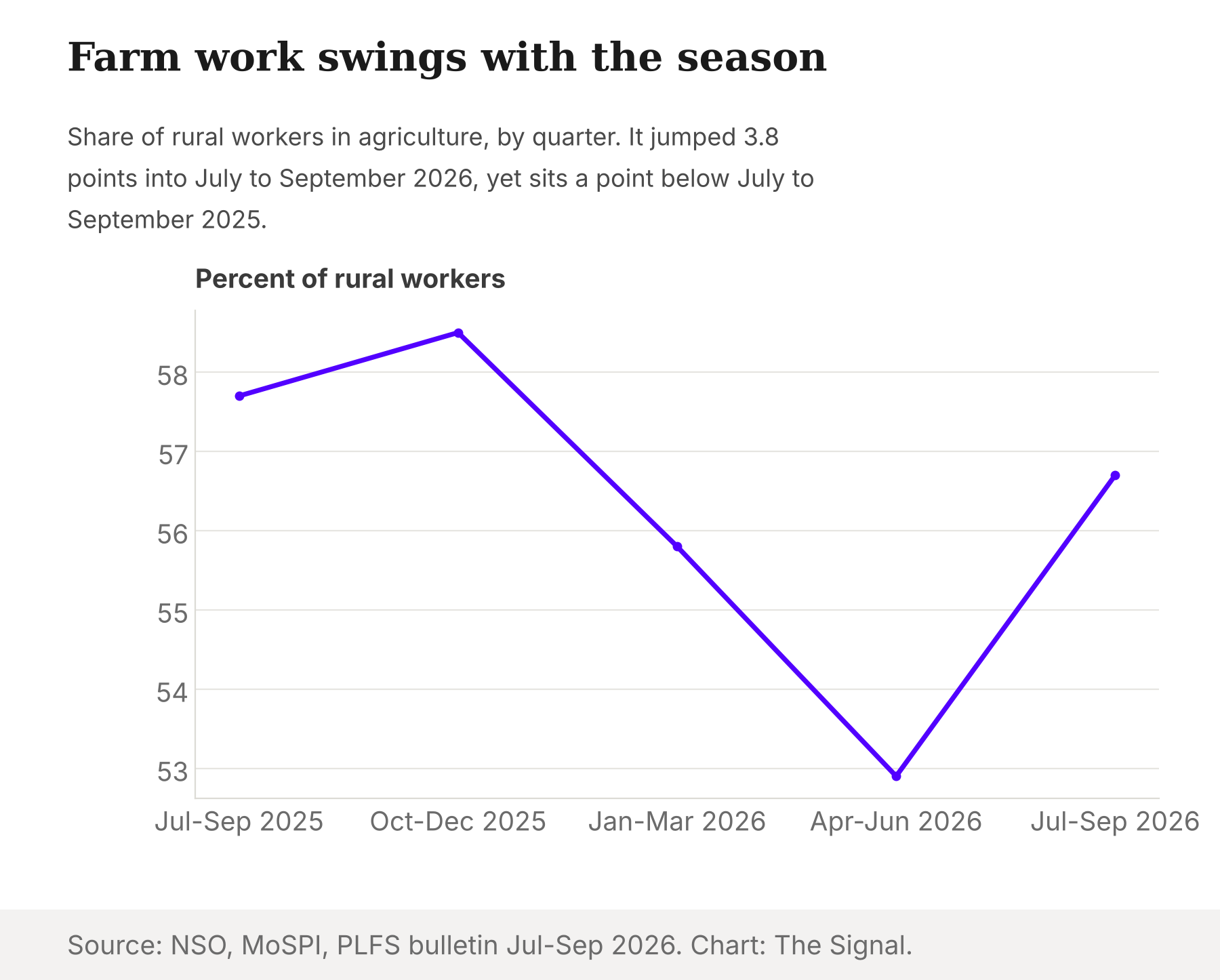
The mechanism shows up in what rural workers were doing. MoSPI's July-September 2026 press note reports that the share of rural workers in agriculture rose from 52.9% in April to June 2026 to 56.7% in July to September. The secondary sector, which includes construction and manufacturing, fell from 24.4% to 21.9%, and services from 22.7% to 21.4%.
The farm gain came with more family labour. The bulletin's Statement 3 shows contributing family workers, people who help in a household farm or enterprise without a wage, rising from 16.1% to 17.6% of rural workers between the two 2026 quarters. Regular wage and salaried work slipped from 16.1% to 15.6% over the same stretch. The press note puts the rise in rural self-employment at 1.3 percentage points, to 62.7%.
None of this is a new reading. MoSPI's July-September 2025 press note, via PIB, states that the rise in rural farm employment from 53.5% to 57.7% in that quarter "can be attributed to Kharif agricultural operations." The 2026 jump of 3.8 points is the same movement, slightly smaller than the 4.2 points of 2025.
One wrinkle makes the pattern sturdier, not weaker. The India Meteorological Department's end-of-season statement reports that the 2026 southwest monsoon delivered 87% of its long period average, the fourth-lowest all-India rainfall since 2001. The seasonal shift into farm work still showed up. The data here cannot say how a weak monsoon changed the quality of that work, only that the calendar effect survived it.
Source: MoSPI PLFS releases: July-September 2025 press note, via PIB, October-December 2025 bulletin, January-March 2026 press note and July-September 2026 press note. Chart: The Signal.
What happened after the 2025 kharif quarter shows the low does not snap back at once. MoSPI's October-December 2025 bulletin reports rural unemployment at 4.0% in that quarter, lower still than the 4.4% of July to September, while the farm share of rural workers peaked at 58.5%. Only then did it turn: the January-March 2026 press note reports that rural unemployment "edged up marginally to 4.3% from 4.0%," before returning to 4.8% in April to June. On one year of data, the rural rate bottoms out through the harvest quarter and climbs back in the lean months before the next monsoon.
The year-on-year picture is quieter, and slightly better
If the quarter's drop is the calendar, the useful test is whether this kharif season looked any different from the last. On the job mix, as the press note records, it did, a little.
A year on, rural work moved slightly away from casual labour and toward salaries.
| Rural workers, % of total | Jul-Sep 2025 | Apr-Jun 2026 | Jul-Sep 2026 | Change over the year (points) |
|---|---|---|---|---|
| Own-account worker or employer | 44.0 | 44.0 | 44.3 | +0.3 |
| Unpaid family helper | 17.9 | 16.1 | 17.6 | -0.3 |
| Regular wage or salary | 15.0 | 16.1 | 15.6 | +0.6 |
| Casual labour | 22.2 | 22.5 | 21.7 | -0.5 |
| Agriculture (sector share) | 57.7 | 52.9 | 56.7 | -1.0 |
Source: MoSPI PLFS Quarterly Bulletin, July-September 2026, Statements 3 and 4. Change column is The Signal's calculation.
MoSPI's press note confirms that over the year rural self-employment "remained stable while regular wage/ salaried employment increased by 0.6 percentage points." And the bulletin's Statement 4 shows the agriculture share at 56.7% in July to September 2026, below 57.7% a year earlier. The press note adds that the rural secondary-sector share rose from 21.0% to 21.9% over the year.
More people were also at work. The press note reports that the rural worker population ratio, the share of all rural adults with work, was 0.9 percentage points higher than a year earlier. Across the country it estimates 57.9 crore employed people aged 15 and above in the quarter.
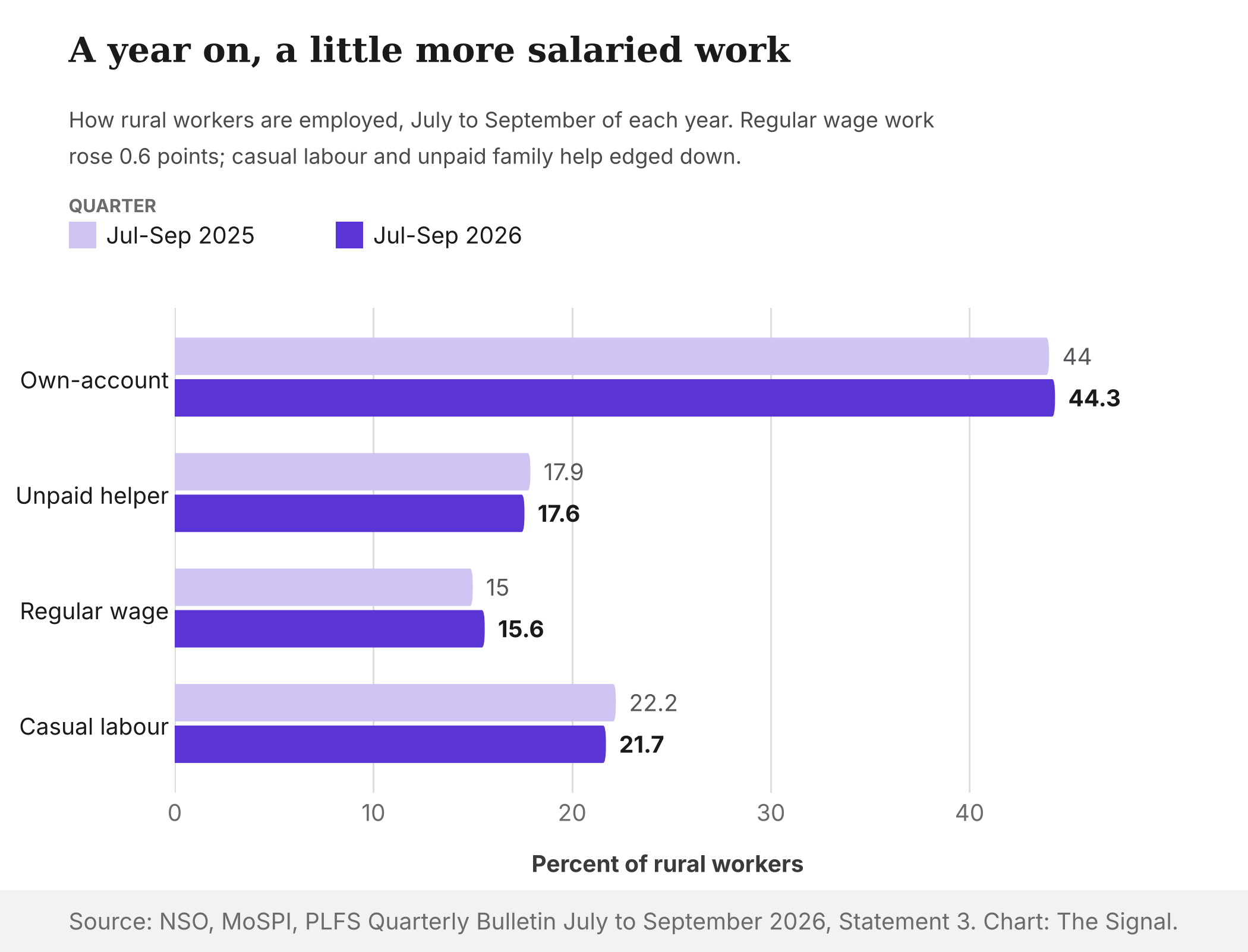
Source: MoSPI PLFS Quarterly Bulletin, July-September 2026, Statement 3. Chart: The Signal.
The cities and the young did not get the seasonal lift
The urban and youth numbers show what the countryside looks like without a planting season to absorb people. The bulletin reports urban unemployment at 6.8% in July to September 2026, against 4.3% in rural areas. Statement 5 of the bulletin shows unemployment among 15 to 29 year olds at 15.3%, down from 15.9% in April to June 2026 but above the 14.8% of July to September 2025. On the year-on-year test that matters here, youth unemployment went the wrong way.
The honest objection
The strongest case against this reading is that a seasonal swing does not cancel a real gain. Rural participation rose too: the press note reports rural labour force participation up to 58.1% from 56.9% between the two 2026 quarters. When more people look for work and unemployment still falls, that is usually a healthy sign. And the year-on-year mix did improve: more salaried work, less casual labour, a smaller farm share.
That case is right about direction and wrong about size. The participation jump is quarter-on-quarter, the same window the kharif effect dominates. Against the comparable quarter, the rural unemployment rate moved by 0.1 point and the salaried share by 0.6. Those are real, but they describe a labour market edging forward, not one that turned a corner over the summer. The 0.5-point quarterly fall in rural joblessness is mostly the farm calendar doing what it did in 2025.
The Signal
The July to September PLFS quarter has flattered rural India in both years on record, because it is the quarter in which paddy goes into the ground. Reading it against April to June measures the monsoon calendar. Reading it against the same quarter a year earlier measures the economy, and that reading is modest: rural unemployment of 4.3% against 4.4%, salaried work up 0.6 points, casual labour down half a point, youth unemployment up. The test comes with the October to December 2026 bulletin, and the bar is lower than it looks: rural unemployment fell to 4.0% in October to December 2025, so another dip is the seasonal default, not a sign of recovery. If rural joblessness lands at or below that mark while the salaried share keeps edging up, the slow improvement is real. If youth unemployment stays above a year earlier, the headline 5.1% will keep hiding the group it fails. A harvest is not a hiring cycle.
Reporting basis: every labour-market figure in this piece comes from one origin, the National Statistics Office of MoSPI, through its Periodic Labour Force Survey: the July-September 2026 Quarterly Bulletin and press note, the October-December 2025 Quarterly Bulletin, the January-March 2026 and April-June 2026 press notes, and the July-September 2025 press note as published by PIB. The load-bearing numbers therefore rest on a single statistical source with no independent check, and MoSPI is also the source of the kharif attribution for 2025. The monsoon rainfall figure is from the India Meteorological Department, a second, separate origin. The quarterly and year-on-year point changes, the comparison of the 2025 and 2026 seasonal moves, and the change column in the table are The Signal's calculations from those figures.