SpiceJet's decline is now plain in the government's own ledger. DGCA's monthly domestic traffic report shows SpiceJet carried 0.73 lakh passengers in September 2026, a 0.6% share of India's domestic market, below Star Air's 0.7%. September 2026 is the latest month the regulator has published. The natural read follows: with the third national carrier gone in all but name, India has become a two-airline country, and the consequences for fares and choice start now.
That read gets the direction right and the timing wrong.
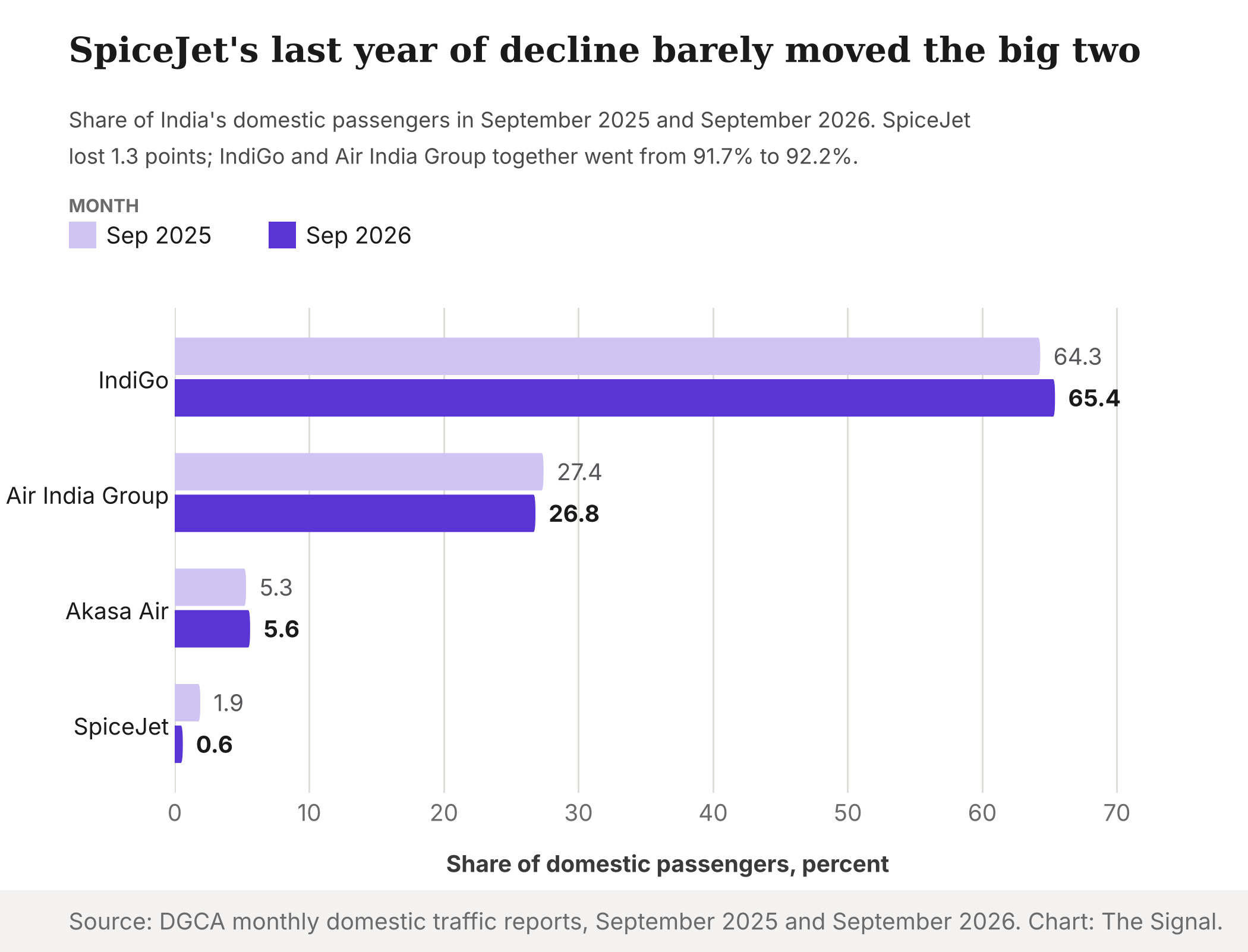
The figure that undoes it is 91.7%. DGCA's report for September 2025 shows IndiGo held 64.3% of domestic passengers and the Air India Group 27.4%, together 91.7%, a full year before SpiceJet's final slide. In September 2026, DGCA's data show the pair at 65.4% and 26.8%, or 92.2%. SpiceJet's last year of decline moved the big two's combined share by half a percentage point. The duopoly was not a result of SpiceJet's 2026 collapse. It was the market SpiceJet collapsed into.
The transfer happened years ago
To see where SpiceJet's passengers went, look further back. DGCA's December 2019 report shows SpiceJet carried 21.44 lakh domestic passengers that month, a 16.5% share, with IndiGo at 47.5%. Across calendar 2019, the same report puts SpiceJet at 14.9% of the market. DGCA's annual summary shows domestic airlines carried 1,441.71 lakh passengers in 2019, up 3.74% on 2018. SpiceJet was a real national airline in that market, carrying roughly one domestic flyer in six.
By September 2025 it was down to 1.9%. Between those two dates, IndiGo's share rose from 47.5% in December 2019 to 64.3% in September 2025, a gain of 16.8 points, close to the 14.6 points SpiceJet lost. The two numbers do not prove a one-for-one handover, since other carriers also rose and fell in those years. But the scale matches, and the direction is clear.
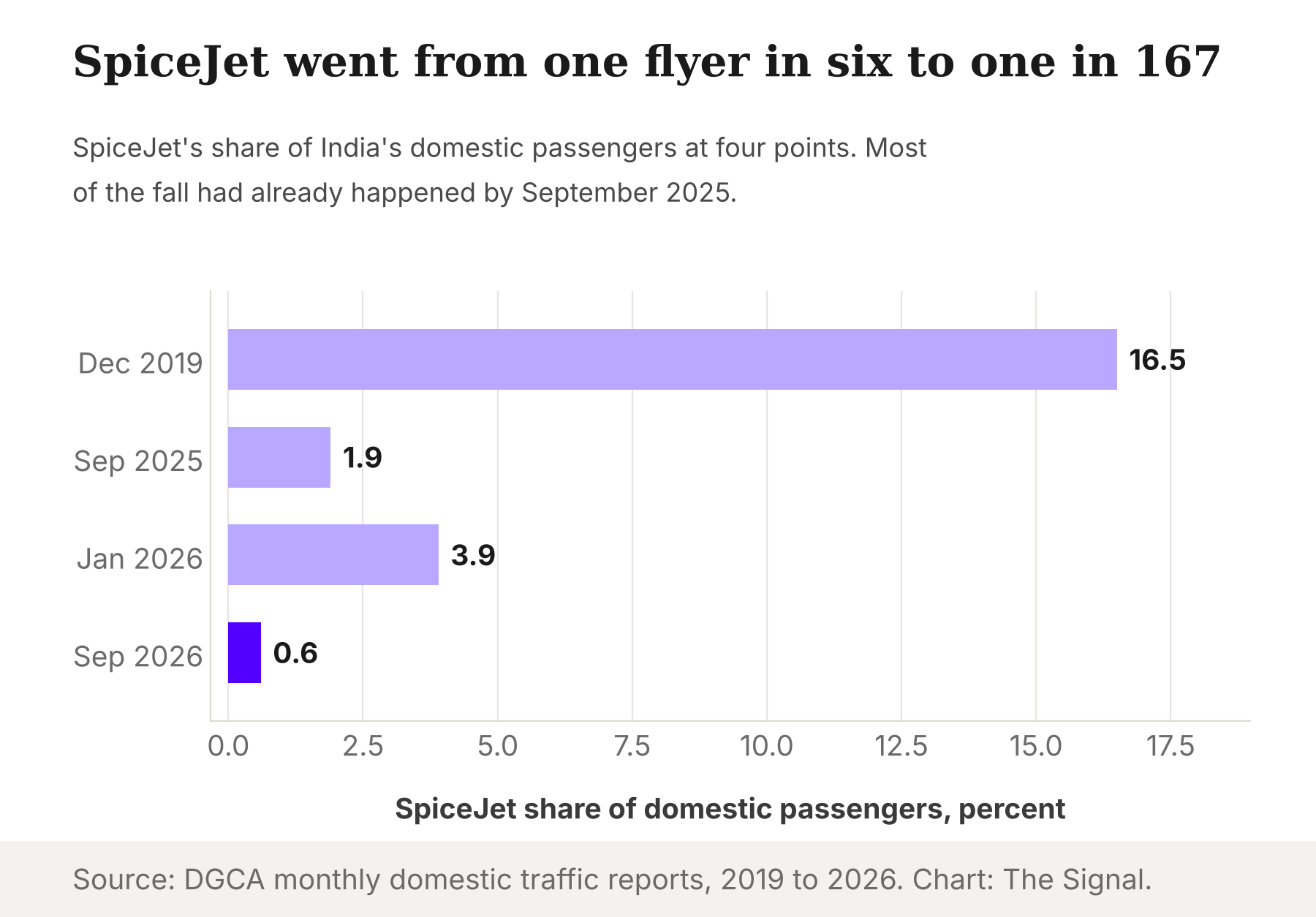
Put the endpoints side by side and the decay is stark in plain counts. SpiceJet flew 21.44 lakh domestic passengers in December 2019 and 0.73 lakh in September 2026, about one passenger for every 29 it once carried. December is a peak travel month and September is not, so the ratio flatters the fall slightly. It does not change its shape.
What 2026 actually moved
The 2026 chapter is small, and it is worth measuring exactly. DGCA's monthly tables show SpiceJet held 3.9% of domestic passengers in January 2026 and 0.6% in September 2026, a loss of 3.3 points in eight months. Over the same months, IndiGo went from 63.6% to 65.4%, Akasa Air from 4.8% to 5.6%, the Air India Group from 26.5% to 26.8%, and Fly91 from 0.2% to 0.5%.
IndiGo took more than half of what SpiceJet lost in 2026.
| Airline | Share, Jan 2026 (%) | Share, Sep 2026 (%) | Change (percentage points) |
|---|---|---|---|
| IndiGo | 63.6 | 65.4 | +1.8 |
| Akasa Air | 4.8 | 5.6 | +0.8 |
| Air India Group | 26.5 | 26.8 | +0.3 |
| Fly91 | 0.2 | 0.5 | +0.3 |
| SpiceJet | 3.9 | 0.6 | -3.3 |
Source: DGCA monthly domestic traffic report, September 2026. Changes are The Signal's calculation.
Taken over the full nine months, the picture is the same. For January to September 2026, DGCA's cumulative table gives IndiGo 64.8% of domestic passengers, the Air India Group 25.7%, Akasa Air 5.5% and SpiceJet 2.6%, or 32.10 lakh passengers.
None of this happened in a booming market. DGCA's report shows domestic airlines carried 1,223.53 lakh passengers in January to September 2026, 0.82% fewer than in the same months of 2025, and 118.23 lakh in September 2026 alone, down 6.49% from August. In a flat market, one airline's loss is directly another's gain. In 2026, IndiGo was the main beneficiary.
SpiceJet lost the ability to fly, not its customers
The most telling figures in the September 2026 report are operational. DGCA's data show SpiceJet cancelled 20.29% of its scheduled flights that month, against an industry rate of 1.15%. The same report shows 39.36% of SpiceJet's September 2026 flights ran more than two hours late, against about 1.19% of all domestic flights.
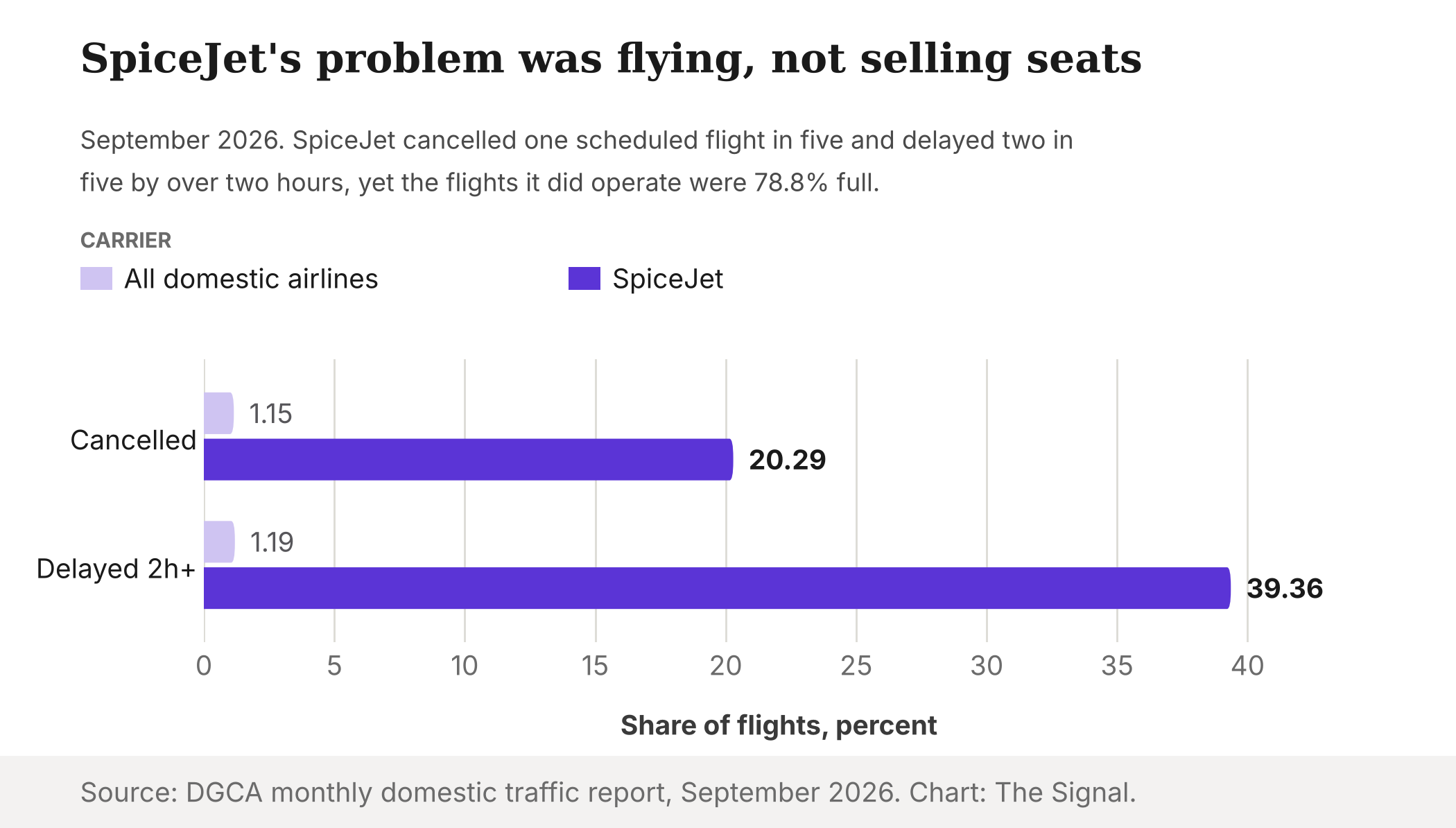
Yet the seats it did fly were mostly sold. DGCA's seat-factor table shows SpiceJet's flights were 78.8% full in September 2026, against 81.1% for IndiGo. An airline that customers had abandoned would fly emptier planes. SpiceJet's planes were nearly as full as the market leader's. The constraint was supply: the airline could not reliably put aircraft in the air.
It did not lack permission, either. The Ministry of Civil Aviation's Winter Schedule 2025 release shows SpiceJet was cleared for 1,568 domestic departures a week for October 2025 to March 2026, out of 26,495 nationally, against 15,014 for IndiGo and 1,027 for Akasa Air. That is roughly 224 flights a day on paper. What happens to those slots as SpiceJet fails to fly them is the next question for airports and the regulator.
SpiceJet ran the worst operation in the market while still filling its seats.
| Measure, September 2026 | SpiceJet | IndiGo | All domestic airlines |
|---|---|---|---|
| Flights cancelled (%) | 20.29 | not reported here | 1.15 |
| Flights delayed over two hours (%) | 39.36 | not reported here | 1.19 |
| On-time performance at ten major airports (%) | 16.6 | 91.1 | not reported here |
| Complaints per 10,000 passengers | 14.3 | 1.0 | 2.09 |
| Seat factor (%) | 78.8 | 81.1 | not reported here |
Source: DGCA monthly domestic traffic report, September 2026, on-time, complaints and seat-factor tables.
The customer experience followed. DGCA's data show SpiceJet's on-time performance at India's ten major airports was 16.6% in September 2026, against 91.1% for IndiGo, 90.8% for Akasa Air and 81.7% for the Air India Group. It drew 14.3 complaints per 10,000 passengers that month, against an industry average of about 2.09 and 1.0 for IndiGo.
How concentrated the market now is
A standard way to measure concentration is the Herfindahl-Hirschman Index: square each firm's market share and add them up. A market with one firm scores 10,000. Using DGCA's September 2026 airline shares, India's domestic market scores about 5,028. Using the September 2025 shares, it scored about 4,917. Using the December 2019 shares for the carriers DGCA listed, it scored about 2,860. Those are our calculations. The year of SpiceJet's final collapse added about 110 points; the six years before it added more than 2,000.
Part of that rise is consolidation inside one group rather than airlines vanishing. Vistara and AirAsia India flew as separate brands in 2019; a Competition Commission of India release shows the regulator approved Vistara's merger into Air India in September 2023, and that Air India Limited counts Air India Express and AIX Connect, formerly AirAsia India, as wholly owned subsidiaries. For passengers the effect is the same: fewer independent sellers of seats.
The honest objection
The strongest counter-argument is that the 2026 numbers are just the visible part of a fresh opening. SpiceJet's exit, on this view, frees routes and airport capacity that challengers can now claim, and the challengers are already moving. DGCA's tables show Akasa Air's share rose from 4.8% in January 2026 to 5.6% in September 2026, and Fly91's from 0.2% to 0.5%. Akasa is also running a strong operation. Its on-time performance was 90.8% in September 2026, and its flights were 88.1% full, the highest seat factor among the major carriers that month. An airline with full planes and punctual flights wants more aircraft.
That case is real, and Akasa is the one to watch. But the numbers so far answer it. Of the 3.3 points SpiceJet gave up between January and September 2026, Akasa and Fly91 together took 1.1; IndiGo alone took 1.8. And the challengers are entering a market whose top two already held 91.7% in September 2025. Picking up SpiceJet's last scraps does not dent that.
The Signal
The headline event of 2026 is a SpiceJet story, not a market-structure story. India's domestic aviation became a two-airline market between 2019 and 2025, as a carrier that held 16.5% of passengers in December 2019 shrank and IndiGo grew into the space. The 2026 collapse mostly confirmed it. That matters for what to watch. If fares or service in India's skies change from here, the cause will be the concentration already in place rather than the loss of a 0.6% player. India has already had a preview: when IndiGo's operations broke down in 2025, the Ministry of Civil Aviation invoked its regulatory powers and ordered all airlines to keep to fare caps, citing unusually high fares. The test for competition is Akasa's next twelve months of DGCA data: whether its share keeps climbing from 5.6%, and whether the combined share of the top two finally stops rising. SpiceJet did not leave a gap. It left a receipt.
Reporting basis: every market-share, traffic and operational figure in this piece comes from the Directorate General of Civil Aviation (DGCA), through its monthly domestic air traffic reports for December 2019, September 2025 and September 2026; no second independent source corroborates them, and the piece rests on that one official series. The slot schedule is from the Ministry of Civil Aviation's Winter Schedule 2025 release and the fare-cap directive from its Year End Review 2025, both one origin, the ministry; the Vistara merger approval is from a Competition Commission of India release. All three were published by the Press Information Bureau. The September 2026 report is the latest DGCA has published as of this writing. Market shares, passenger counts, cancellations, delays, on-time performance, complaint rates and seat factors are as reported by DGCA. The combined IndiGo and Air India Group shares, the share changes between months, the 29-fold passenger ratio, the daily flight equivalent of SpiceJet's weekly slots and the Herfindahl-Hirschman Index scores are The Signal's calculations from those figures.