India's bad-loan story has a tidy ending. The RBI's Financial Stability Report (June 2026) states that the gross NPA ratio of scheduled commercial banks fell to 1.8% at end-March 2026, a multi-decadal low, and the annual slippage ratio eased to 1.2% in 2025-26. The corporate write-offs that defined the last crisis have all but stopped. Minister of State for Finance Pankaj Chaudhary told Parliament, as reported by the Free Press Journal, that write-offs of loans to large industries and services peaked at ₹1,48,753 crore in 2018-19 and fell to ₹20,485 crore in 2025-26, about 86% lower.
Read the top line and the clean-up is over. The state banks that carried the last cycle have shrunk their problem, and the system looks healthier than it has in decades.
It is worth slowing down on that. A gross NPA ratio measures the bad loans still on the books. A loan that has been written off is no longer on the books. So the ratio the RBI reports can fall for two different reasons: borrowers pay, or banks clear the loans away. Which one is doing the work matters, and the answer now differs sharply by who owns the bank.
The number that carries the story
The RBI's Report on Trend and Progress of Banking in India 2024-25 (Table IV.9) shows that in 2024-25 private banks wrote off loans equal to roughly 45% of the gross NPAs they started the year with. For public sector banks, the figure was about 27%. Private lenders cleared close to half their bad-loan stock in a single year, at a pace well above the state banks.
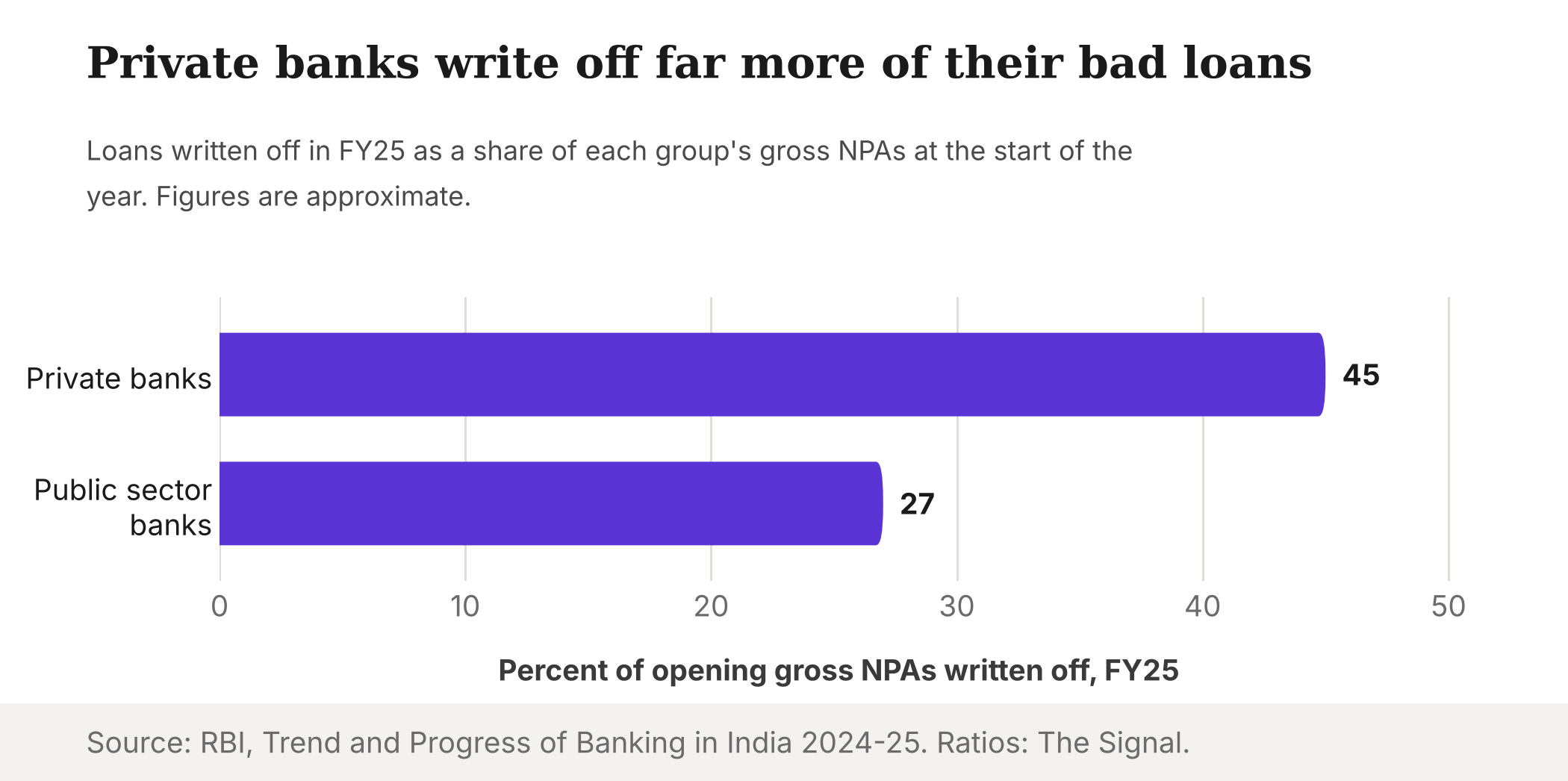
This is not the same as saying private banks now write off more money. They do not. In rupees, state banks still lead, and the plain record matters here because a popular version of this story gets it wrong.
In each year from FY23 to FY25, state banks wrote off more in rupees than private banks.
| Year to March | All banks written off (₹ crore) | Public sector banks (₹ crore) | Private banks (₹ crore) | Public sector share | Private share |
|---|---|---|---|---|---|
| FY23 | 2,17,193 | 1,27,990 | 83,947 | 59% | 39% |
| FY24 | 1,69,106 | 1,12,515 | 48,202 | 67% | 29% |
| FY25 | 1,57,563 | 91,176 | 58,544 | 58% | 37% |
Source: RBI, Report on Trend and Progress of Banking in India, 2022-23, 2023-24 and 2024-25. Shares are of the all-bank total and exclude foreign and small finance banks.
The private share has not climbed in a straight line. The RBI's Report on Trend and Progress of Banking in India 2022-23 (Table IV.10) shows that it was already near 39% in 2022-23. It dipped to 29% in 2023-24 and rebounded to 37% in 2024-25. What changed between those last two years is direction. Set the 2023-24 and 2024-25 RBI tables side by side, and private write-offs rose about 21% in 2024-25 while state-bank write-offs fell about 19%.
The state-bank side of 2025-26 is already known. Minister of State for Finance Pankaj Chaudhary told the Lok Sabha in a written reply that the 12 public sector banks wrote off ₹70,528 crore in 2025-26 on provisional RBI data, down from ₹91,261 crore on the same basis a year earlier, about 23% lower. No matching rupee figure for private banks has been published yet.
Where the new bad loans come from
The more telling shift is upstream of the write-off. The RBI's Report on Trend and Progress of Banking in India 2024-25 (Table IV.9) shows that private banks added ₹1,21,735 crore of fresh gross NPAs in 2024-25, against ₹82,762 crore at public sector banks. That gap is not new. The 2023-24 report shows private additions of ₹1,16,801 crore against ₹84,435 crore for state banks, and the 2022-23 report shows ₹1,10,064 crore against ₹98,291 crore.
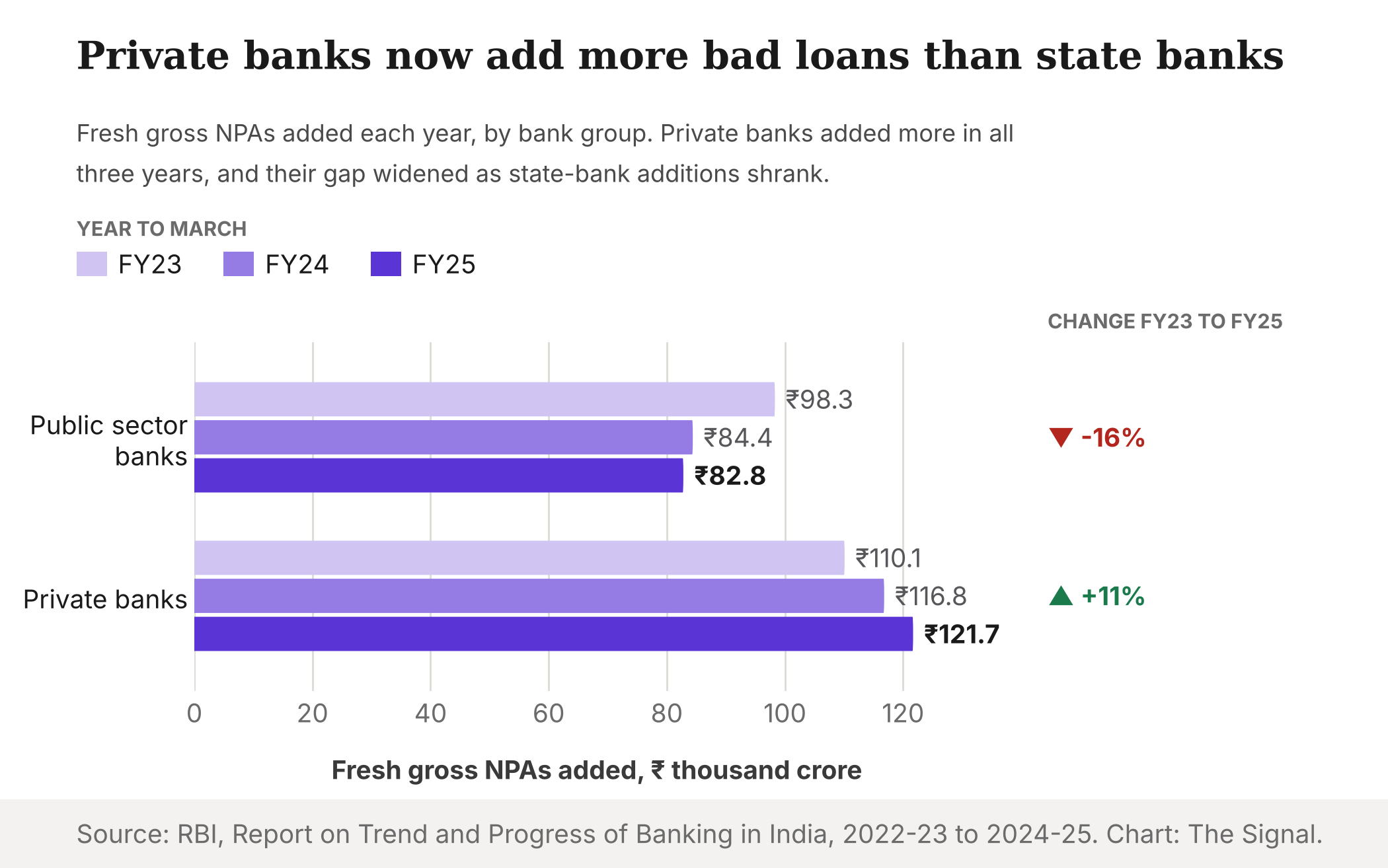
So the two groups are running different machines. State banks are still working through an older stock: in 2024-25 they wrote off ₹91,176 crore while adding ₹82,762 crore of new bad loans, per the RBI's 2024-25 report. Private banks are generating fresh bad loans at a growing clip and clearing them out quickly.
The source of those fresh bad loans points at retail credit without collateral. The RBI's Financial Stability Report (December 2025) states that unsecured retail loans made up 53.1% of all retail-loan slippages at scheduled commercial banks as of September 2025. The same report says private banks had the higher share of fresh slippages in unsecured loans, and that their write-offs "continue to remain elevated".
Even the state banks show the drift. The same Lok Sabha reply shows their write-offs of retail loans roughly doubled, from ₹4,478 crore in 2021-22 to ₹9,085 crore in 2025-26, while industry write-offs fell from ₹46,246 crore to ₹17,266 crore. Retail made up about 11% of state-bank write-offs in 2025-26, up from about 8% a year earlier.
Why a fast write-off flatters the ratio
Here is the mechanism. A personal loan or card balance that sours goes into the NPA count. If the bank writes it off within the year, it leaves the count again. The ratio a reader sees at year-end shows only what is left.
The RBI's Financial Stability Report (June 2026) states that the gross NPA ratio was 1.7% for unsecured retail loans and 0.7% for secured retail loans at end-March 2026. Both look small. But a 1.7% stock ratio sits alongside a flow in which unsecured loans supply more than half of retail slippages, per the December 2025 report. The stock looks calm partly because the flow keeps being cleared.
The RBI has flagged the trend in each report since mid-2025. Its June 2025 Financial Stability Report states that the write-offs-to-GNPA ratio rose to 31.8% in 2024-25 from 29.5% a year earlier, "led by PVBs and FBs", while state-bank write-offs declined marginally. The December 2025 report states that in the first half of 2025-26 the write-off ratio fell for public sector banks but "shot up" for private and foreign banks. The June 2026 report states that write-offs relative to GNPAs stayed elevated through 2025-26, particularly at private and foreign banks.
What comes back after the write-off
A write-off is an accounting step, not forgiveness. Banks keep chasing the money. How much they get back is where the two groups part again.
ThePrint's analysis of Ministry of Finance data given to the Rajya Sabha shows that over 2019-20 to 2023-24, public sector banks recovered 21.3% of the amounts they wrote off. Private and foreign banks recovered 13.7%. Across all banks, only about 18.5% of five years of write-offs had come back.
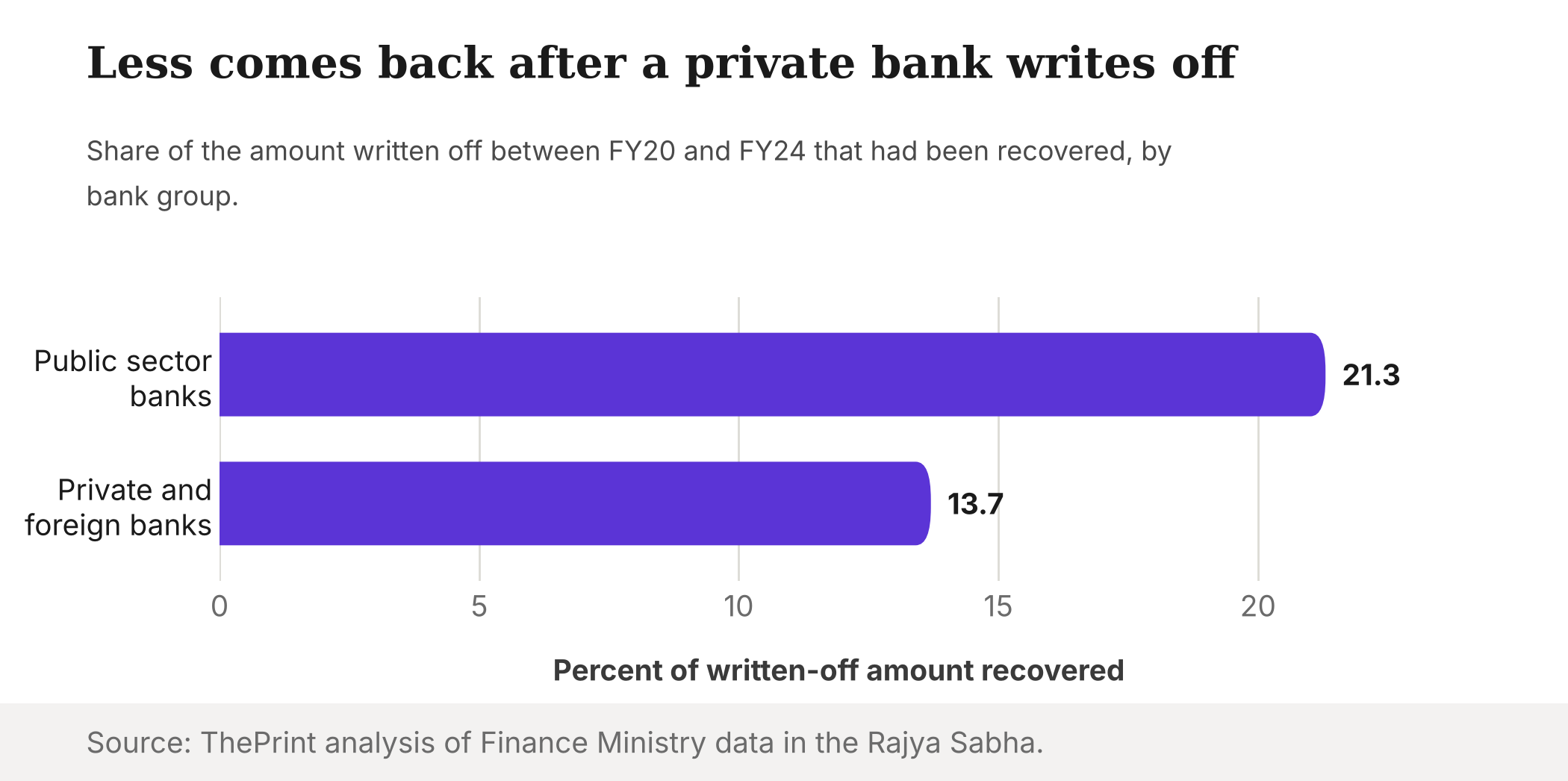
That gap is consistent with the loan mix. A defaulted corporate loan has assets behind it, which can be sold or restructured. An unpaid card balance usually has nothing. The state banks, meanwhile, are leaning on collections: the Ministry of Finance said in a PIB release that their total recoveries, including from written-off accounts, were ₹86,971 crore in 2025-26, with their slippage ratio down to 0.7%. Of that, ₹42,889 crore came from written-off accounts, per the Lok Sabha reply, against ₹70,528 crore written off in the year. Part of those recoveries relate to loans written off in earlier years, so the two figures are not a clean recovery rate.
The honest objection
The strongest case against this reading is that fast write-offs are prudence, not concealment. A bank that clears a hopeless card balance in months is being realistic about its value, and holding it on the books would only delay the same loss. Private banks also lend more to retail borrowers, so a bigger flow of small defaults is what their business model should produce. And in rupees, the numbers are not alarming: private banks wrote off ₹58,544 crore in 2024-25, below their ₹83,947 crore in 2022-23, per the RBI's 2024-25 and 2022-23 reports.
That case is right about intent. It does not change what the headline ratio can show. When a growing share of bad loans is cleared within the year, the year-end stock stops telling a reader how much credit is going bad. The loss still lands in the profit and loss account, and the recovery data say less of it comes back at private lenders. The cost is real. It just does not show up in the number most people quote.
The Signal
India's bad-loan problem did not end. It changed owners and changed speed. State banks are finishing a long clean-up of corporate loans. Private banks are running a faster cycle: more fresh bad loans than the state banks every year from 2022-23 to 2024-25, cleared out at close to half the opening stock in 2024-25, with less recovered afterwards, per the RBI's 2024-25 report.
Two releases will test this. The RBI's 2025-26 Trend and Progress report should give the private-bank rupee figure for write-offs in the year to March 2026, which the June 2026 Financial Stability Report describes only as elevated for private banks. Watch whether private fresh additions keep rising while the system ratio keeps falling. If both hold, the 1.8% headline is measuring how fast banks clear the floor, not how little is spilled. A clean ledger is not the same as a clean loan book.
Reporting basis: bank-group write-offs and fresh NPA additions for 2022-23 to 2024-25 are from the RBI's Report on Trend and Progress of Banking in India for each year (2024-25). The write-off ratios, unsecured-loan slippage share and retail NPA ratios are from the RBI's Financial Stability Reports of June 2025, December 2025 and June 2026, which come from the same RBI supervisory data and count as one origin with the Trend and Progress figures. Public sector bank recoveries for 2025-26 are from the Ministry of Finance, via PIB. Provisional 2025-26 public sector bank write-offs, recoveries from written-off accounts and the sector-wise split are from a Ministry of Finance written reply to Lok Sabha Unstarred Question 2392 (3 August 2026), based on RBI data; the totals, the year-on-year change and the retail shares are The Signal's sums of its bank-wise and sector-wise tables. Corporate write-off totals are from a Ministry of Finance written reply in Parliament, per the Free Press Journal's report of it. Recovery rates on written-off loans for 2019-20 to 2023-24 are from ThePrint's analysis of Ministry of Finance data tabled in the Rajya Sabha, and rest on that single secondary analysis. The 2025-26 rupee figure for private-bank write-offs has not yet been published and is not used. The write-offs as a share of opening gross NPAs, the bank-group shares of write-offs, the year-on-year changes, the fall in corporate write-offs since 2018-19, and the changes and conversion to thousand crore in the charts are The Signal's calculations from those figures.