On Wednesday, 25 November, the Union Cabinet approved a Rs 11,000 crore scheme to build construction and infrastructure equipment (CIE) in India, run by the Ministry of Heavy Industries and aimed at machines such as tunnel boring machines, hydraulic excavators, ship-to-shore cranes and off-highway trucks. The easy read is a familiar one. India is building roads, metros and ports at speed, and now it wants to make the machines that build them. Public capital expenditure is budgeted at Rs 12.2 lakh crore in FY2026-27, against Rs 2 lakh crore in FY2014-15, roughly six times higher. A capex boom that size should pull a domestic equipment industry along behind it.
It is worth slowing down on that. The demand the scheme is betting on has not shown up in the most recent full year of industry data, FY2025-26, and the part that did show up went abroad.
The year buyers shrank and imports grew
Domestic construction equipment sales fell about 7% in FY2025-26, to 1,13,229 units from 1,21,301 units in FY2024-25, according to the Indian Construction Equipment Manufacturers' Association (ICEMA), as reported by PTI. That is about 8,000 fewer machines sold at home in a single year. In the same year, ICEMA's figures show imports rose about 17%, mainly in earthmoving, material handling and concrete equipment, while exports grew about 32%.
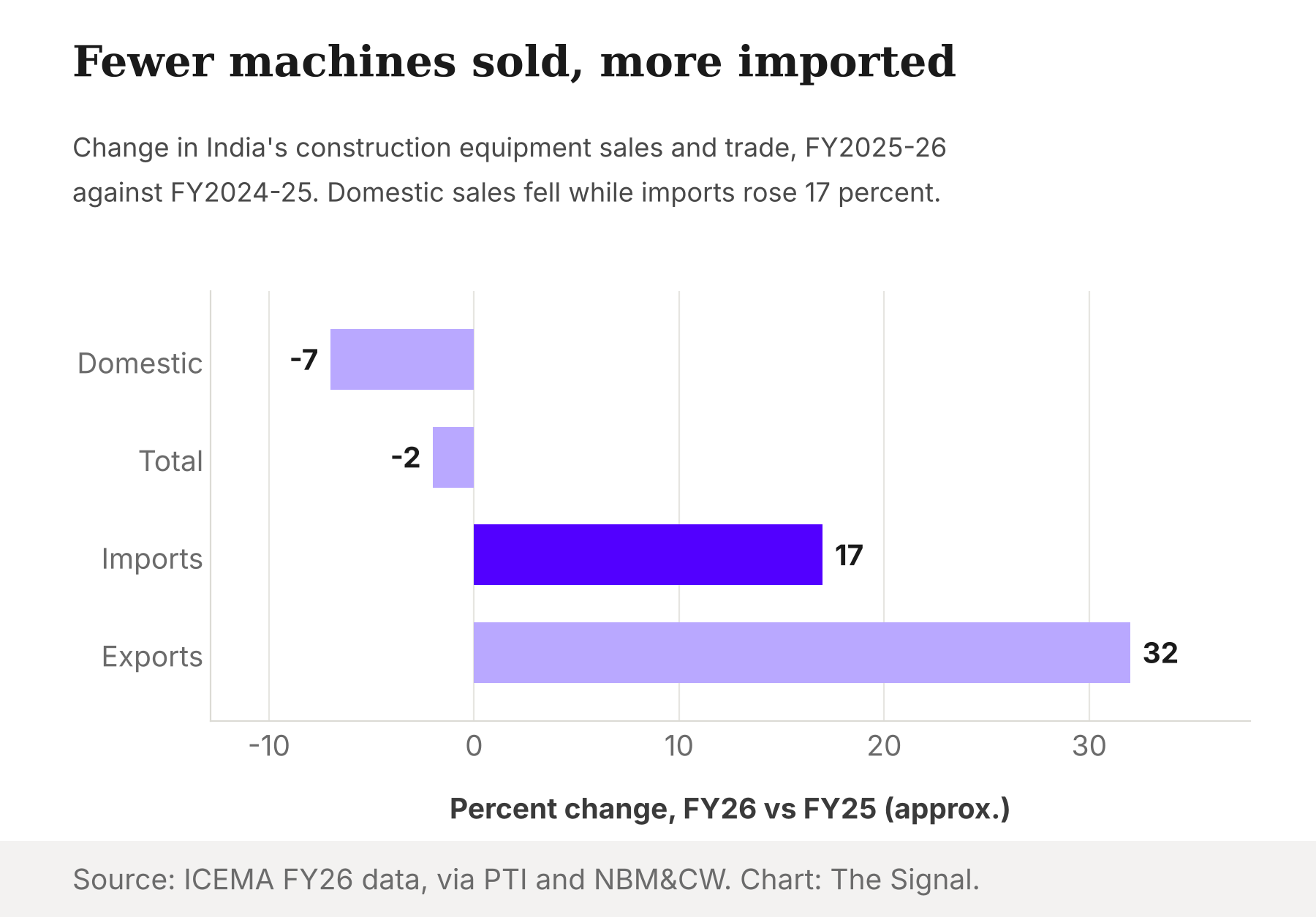
Put the two together and the shape is odd. Indian buyers took fewer machines overall, and imported machines grew their share of a smaller pie. Indian factories, meanwhile, found their growth overseas. The industry is not short of capacity to build machines. It is short of the higher-value ones that buyers still bring in from outside.
What the scheme actually pays for
The design matters more than the headline number. Eligible equipment makers and component manufacturers receive graded incentives of 13% falling to 8% on incremental sales over five years, plus a grant of up to Rs 375 crore for a dedicated testing facility, Business Standard reports. The key word is incremental. A firm earns nothing for holding its sales steady. It earns only on growth above a baseline, and disbursement does not begin until FY2028-29, after a two-year gestation period, per the Cabinet release.
So the scheme is, in effect, a wager that the FY26 slump was a pause. The government's own forecast supports that wager: it puts the CIE market at around Rs 97,500 crore in FY2024-25, the world's third largest after China and the United States, and expects it to more than double to about Rs 2.28 lakh crore by FY2029-30. If that happens, incremental sales will be plentiful and the subsidy will pay out. If execution on the ground stays slow, the money mostly stays in the treasury.
A subsidy sized for half the problem
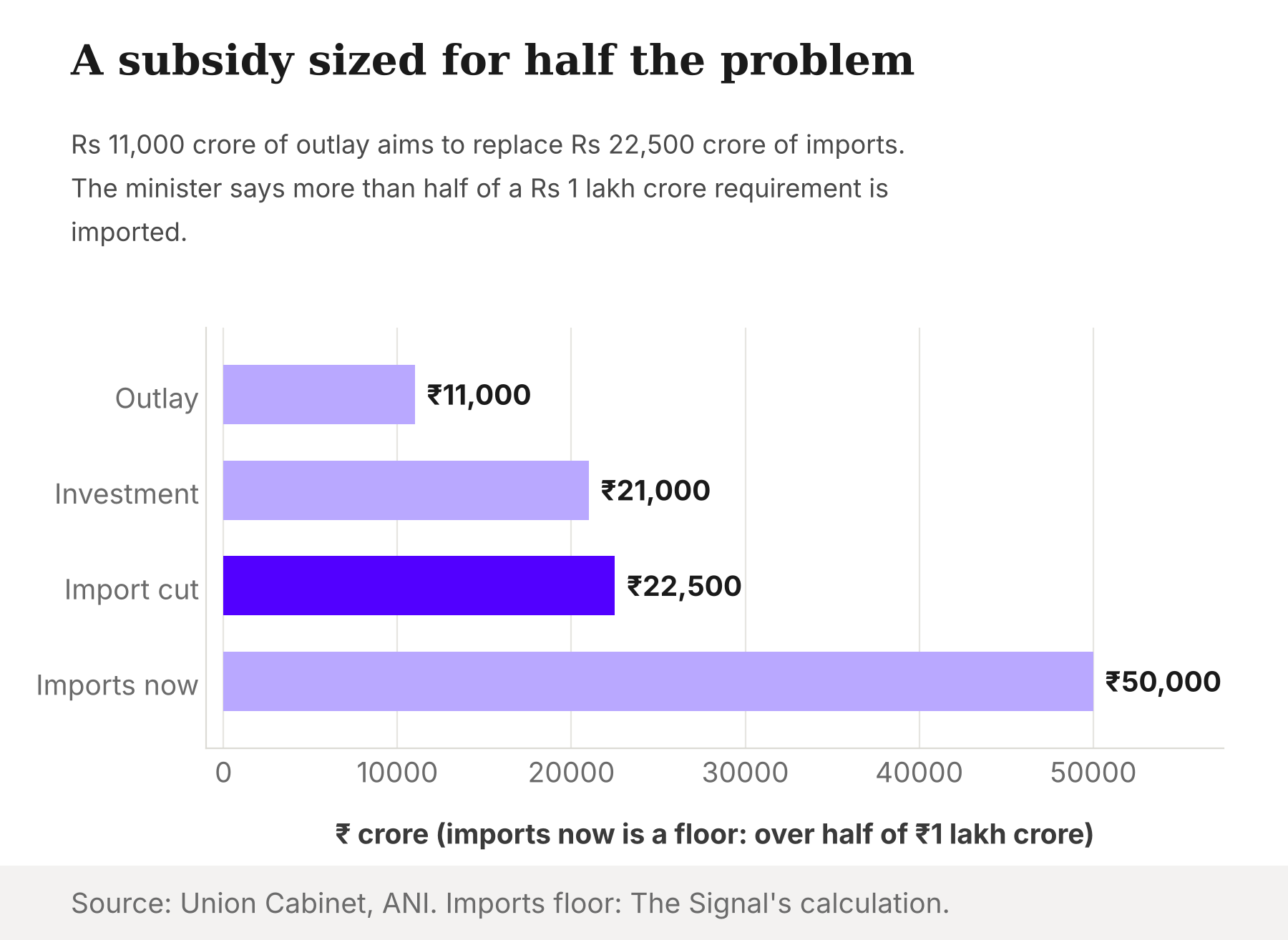
The official targets make the trade-off visible. The eight-year scheme is expected to attract Rs 21,000 crore of investment and enable Rs 22,500 crore of import substitution, ANI reports from the Cabinet briefing. Set Rs 11,000 crore of outlay against Rs 22,500 crore of imports replaced and the government is budgeting roughly 49 paise of support for every rupee of imports it expects to displace.
Now set that target against the size of the gap. Union minister Ashwini Vaishnaw said India's requirement is around Rs 1 lakh crore and that more than half of it is still imported. More than half of Rs 1 lakh crore means imports above Rs 50,000 crore. Even if the scheme hits its target in full, it replaces less than 45% of that.
| Measure | Amount | Source |
|---|---|---|
| Scheme outlay, over eight years | ₹11,000 crore | Union Cabinet |
| Expected investment | ₹21,000 crore | ANI, Cabinet briefing |
| Import substitution target | ₹22,500 crore | ANI, Cabinet briefing |
| Current imports (floor) | over ₹50,000 crore | Minister's "more than half" of ₹1 lakh crore |
| CIE market, FY2024-25 | ₹97,500 crore | Union Cabinet, via Business Standard |
Sources: Union Cabinet release; ANI; The Tribune (ANI); Business Standard. The imports floor is derived from the minister's statement.
That is not a flaw so much as a choice. The scheme does not try to make India self-sufficient. It tries to move the hardest, highest-value machines and the components inside them (engines, transmissions, hydraulics, undercarriages and drive systems) onshore, and accepts that much of the rest will keep coming in.
Why China's tunnel machine rule changes the arithmetic
There is a second reason the timing looks less like routine industrial policy. China's Commerce Ministry announced on 19 October that exports of tunnel boring machines would need a licence from 18 November, and Reuters noted that India remains heavily dependent on imported tunnel boring machines. Tunnel boring machines are named in the Cabinet's own list of target equipment.
That turns part of the import bill from a cost question into a supply question, because Chinese exporters of these machines must now apply for a licence. A metro line or a Himalayan road tunnel that waits for an export licence is a project delay, not a slightly dearer machine. Seen that way, 49 paise per rupee of imports displaced is the price of an option on supply, not just a margin subsidy.
The honest objection
The strongest case against this reading is that FY26 may be one bad year in a cyclical industry, and a CIE market that the government expects to more than double by FY2029-30 would make one soft year irrelevant. On this view, paying only on incremental sales is prudent: it costs nothing if demand stays flat and pays out only when the boom the budget is funding finally reaches the ground. A BCG-CII report cited by Business Today estimates that India's domestic demand for mining and construction equipment exceeded $17 billion in 2025, which is hardly a market in retreat.
That case is real, and it is probably right about the cycle. But it does not answer the composition problem. In FY26 the shrinking part of the market was domestic sales and the growing part was imports. A recovery in demand helps the scheme only if the recovered demand goes to Indian factories, which is exactly what did not happen in the last full year. The incentive rewards growth. It does not by itself decide whose growth it is.
The Signal
India's equipment makers have shown they can sell abroad, with exports up about 32% in FY26. What they have not shown is that they can win the high-value machines Indian contractors keep importing. The scheme is a cheap, conditional bet on both demand returning and that demand landing at home, and China's licence rule on tunnel boring machines raises the cost of losing it. Watch ICEMA's FY27 numbers for one thing: whether domestic sales recover faster than imports. A subsidy for growth is only as good as the growth it captures.
Reporting basis: the scheme's outlay, duration and target equipment are from the Union Cabinet's release, via the Prime Minister's Office; the incentive rates, testing grant and market-size figures are from the same Cabinet decision as reported by Business Standard. The expected investment and import substitution targets are per ANI's report of the Cabinet briefing, and the minister's statement on the Rs 1 lakh crore requirement and its imported share is per ANI, as carried by The Tribune. FY26 unit sales are ICEMA's figures as reported by PTI, and the import and export growth rates are ICEMA's figures as summarised by NBM&CW; ICEMA is a single origin for all of them. China's tunnel boring machine controls are per Reuters. Public capex is from the Union Budget 2026-27, via PIB, and the 2025 demand estimate is from a BCG-CII report as cited by Business Today, a single secondary source. The roughly six-fold capex rise, the unit decline of about 8,000 machines, the 49 paise per rupee subsidy ratio, the Rs 50,000 crore imports floor and the under-45% coverage share are The Signal's calculations from those figures.