
In November, IBM decided that its largest division would stop sponsoring most of its foreign workers in the United States. IBM Consulting employs more than 150,000 of IBM's 264,300 people, and the affected staff can keep working for IBM from outside the US or leave the company at year-end, according to an internal document reported by Bloomberg. The easy read is that Washington's war on the H-1B has claimed a big American employer, and that the $100,000 fee announced for new petitions finally made the program too expensive to bother with.
It is worth slowing down on that. The fee is not being charged. A federal judge in Massachusetts vacated the $100,000 H-1B fee requirement in June 2026, and on July 24 the First Circuit refused the government's request to pause that ruling, leaving US Citizenship and Immigration Services barred from assessing the fee. IBM walked away from a cost that, as of November 2026, it does not have to pay.
So the fee is not the bill IBM is refusing. The bill is the green card.
Where the jobs went
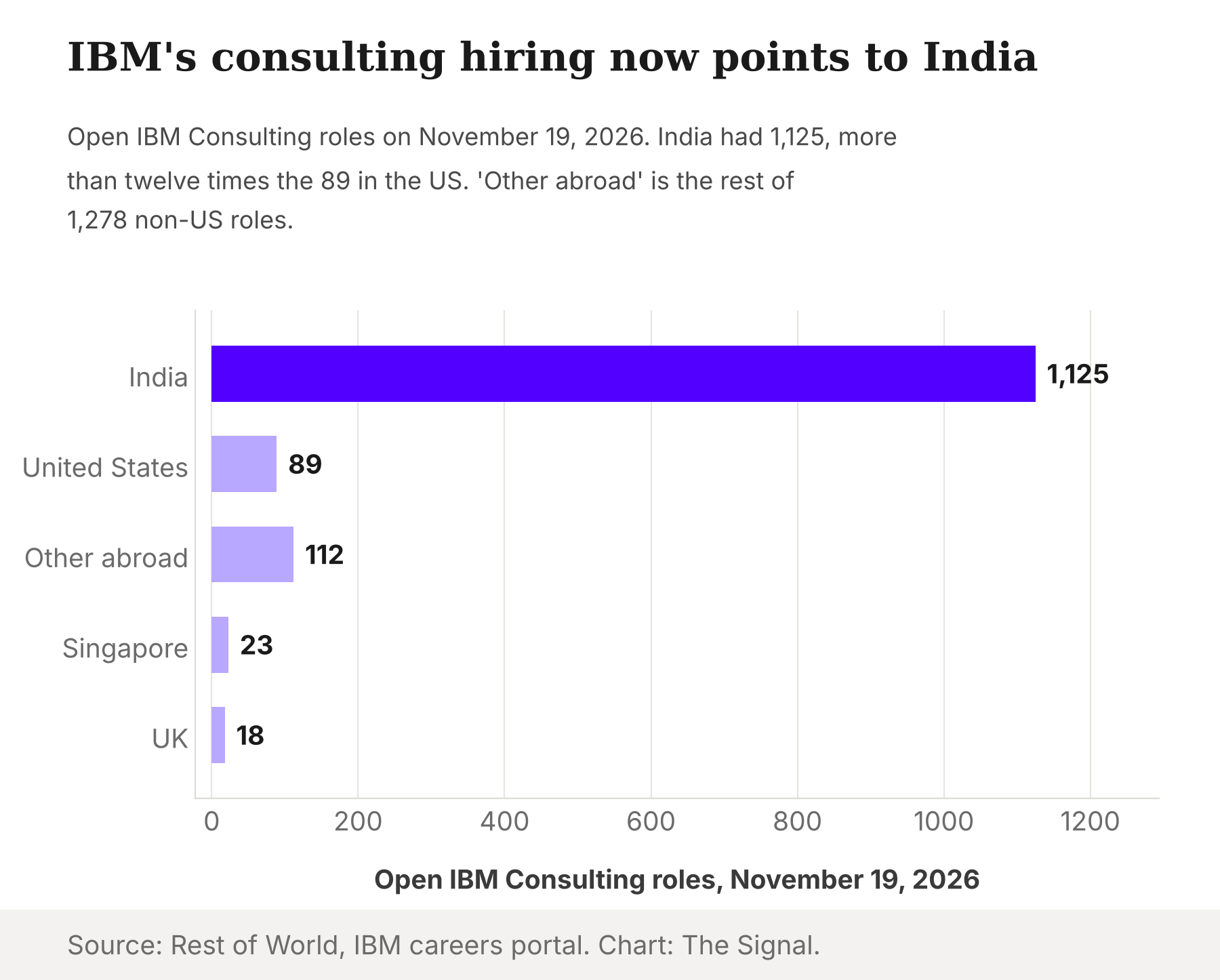
The clearest evidence of what IBM wants is where it is hiring. On November 19, 2026, IBM's careers portal listed 1,278 IBM Consulting openings outside the United States, 1,125 of them in India, against 89 in the United States, according to a count by Rest of World. India alone had more than twelve times as many open consulting roles as America, and 88 percent of everything IBM Consulting was hiring for abroad.
The scale of the visa program at IBM was already small. USCIS data show only 1,611 H-1B petitions were approved for IBM in fiscal 2026, the year that ended in September. Set against a consulting workforce of more than 150,000, that is about one approval for every hundred consulting staff. This was a side door IBM had largely stopped using, and it is now closing it.
Who walks through that door matters from India. Roughly three quarters (73%) of H-1B workers approved in fiscal 2023 were born in India, and India-born workers have received a majority of approvals every year since 2010, Pew Research Center's analysis of USCIS data shows. A sponsorship policy at a US consultancy is, in practice, a policy about Indian engineers.
The thirteen-year promise
An H-1B is a temporary visa. What makes it worth having for many Indian engineers is the green card an employer can sponsor on top of it, and that is where the Indian case stands apart.
Green cards are rationed partly by country of birth, which puts India-born applicants in a line of their own. The November 2026 Visa Bulletin put the EB-2 final action date for India-born applicants at November 1, 2013, and the EB-3 date at January 22, 2014. In plain terms, the State Department is now issuing green cards to Indians whose place in line was secured thirteen years ago.
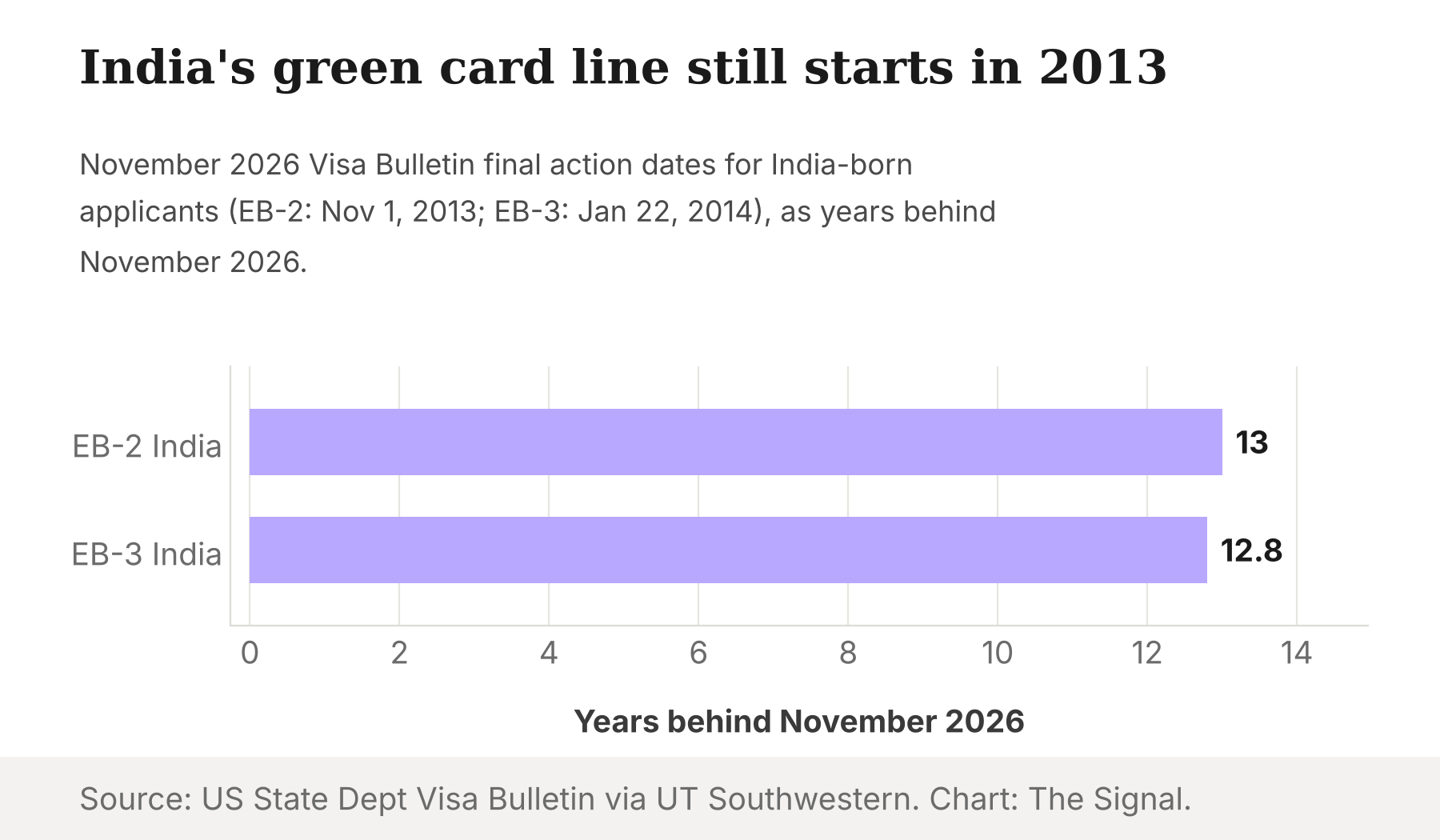
That changes what a sponsorship is. For a worker born almost anywhere else, a green card petition is a project with an end date. For an India-born engineer, it is a commitment the employer carries for over a decade, on the November 2026 bulletin's dates: renewing the H-1B year after year, keeping the job description stable enough to survive scrutiny, and absorbing the legal risk of a filing that, on today's dates, will not resolve until the late 2030s. A consultancy whose business is moving people across client projects is poorly built to hold a promise that long.
The queue became a target
The second change is that the green card route itself became an enforcement front. On October 8, 2026, the Labor Department suspended Cognizant, Infosys, Tata Consultancy Services, HCL Technologies and Capgemini, along with Microsoft and Adobe, from the PERM labor certification program, the first step in most employer-sponsored green cards. Labor Secretary Keith Sonderling said the department would not accept new applications or process pending ones involving those companies.
Read those two facts together and IBM's decision looks less like a reaction to a fee and more like a hedge against a list. The five IT services firms on that list sell the same kind of work IBM Consulting sells. Once a pending green card case can be frozen by an announcement, every case on the books becomes a liability whose size the employer does not control. With Indian applicants waiting thirteen years, that liability has no near end.
| What changed in 2026 | Status by November 2026 | What it means for an employer sponsoring Indian staff |
|---|---|---|
| $100,000 fee on new H-1B petitions | Vacated in June; USCIS barred from collecting it after the July 24 appeals ruling | No new cost today, but no certainty either |
| PERM suspensions, October 8 | Seven named employers cannot file or move pending cases | The green card step can be halted by announcement |
| EB-2 India final action date | November 1, 2013 | A sponsorship started now is a decade-plus commitment |
Sources: SHRM, HR Dive, November 2026 Visa Bulletin via UT Southwestern.
The honest objection
The strongest case against this reading is that it is simply about cost and demand. IBM has offered its own explanation. A spokesperson said IBM Consulting uses US high-skilled visa programs "to address skill shortages" and had "opted to discontinue visa and green card sponsorship for the majority of such roles", and tied the decision to how skill availability and client needs have evolved. Consultancies have moved delivery to India for two decades because Indian salaries are a fraction of American ones. On this view the visa regime is incidental: IBM would be hiring 1,125 people in India whatever the green card queue looked like, and the 1,611 H-1B approvals were already a rounding error.
That case is strong on the hiring, and it is probably right that most of those 1,125 Indian openings would exist anyway. But it does not explain the timing or the target. Offshoring explains why a company stops adding visa workers. It does not explain why it stops sponsoring visas and green cards for most consulting roles, staff already in the US included, weeks after the government showed it could freeze pending cases at rival firms, and while the fee that was meant to be the deterrent cannot legally be charged. The fee was the loud policy. The queue and the suspensions are the ones that change an employer's balance sheet.
The Signal
The policy debate in Washington has been about the $100,000 fee, and the courts have so far stopped it. IBM's move shows that employers are reacting to something quieter. A green card for an India-born engineer is now a thirteen-year obligation that the Labor Department has shown it can suspend mid-stream, and the cheapest way to cancel that obligation is to move the job to where the engineer came from. For India, that means more senior consulting work landing in Indian offices, and fewer Indian engineers in America holding a green card case that someone is still willing to sponsor. Watch whether the other large consultancies that were not suspended in October follow IBM before the courts finish with the fee. If they do, the decisive US immigration policy of 2026 will turn out to be the queue Washington never had to change.
Reporting basis: the year-end choice facing affected staff is per Bloomberg's reporting of an internal IBM document, as relayed by The Next Web, which also carries the IBM spokesperson's statement. IBM Consulting's headcount and IBM's fiscal 2026 H-1B approval count are per Al Jazeera, the latter citing US Citizenship and Immigration Services data. The November 19 count of IBM Consulting openings by country is Rest of World's, from IBM's careers portal, and those figures rest on that single count. The share of H-1B approvals going to India-born workers is from Pew Research Center's analysis of USCIS data for fiscal 2023. The EB-2 and EB-3 India final action dates are from the State Department's November 2026 Visa Bulletin, as tabulated by UT Southwestern. The June 2026 ruling vacating the $100,000 fee is per Stony Brook University's visa office, and the July 24 appeals decision and USCIS's inability to collect the fee are per SHRM. The October 8 PERM suspensions are per HR Dive's account of the Labor Department announcement. The ratio of Indian to US openings, India's share of non-US openings, the approvals per consulting employee and the years behind November 2026 are The Signal's calculations from those figures.