India's grid had a summer of records in 2026. The Ministry of Power told the Lok Sabha in July 2026 that peak demand rose about 12% in April to June 2026 over a year earlier, that an all-time high of 270.8 GW was met in May 2026, and that demand crossed 270 GW twice more in July 2026. The usual reading is about supply: more plants, more transmission, more storage. Air conditioners, on that reading, are weather to be met rather than managed.
It is worth slowing down on that. The number of air conditioners India will install is largely set by heat and income. How much power each one draws is set by a regulator. A May 2026 working paper (not peer reviewed) by UC Berkeley's India Energy and Climate Center estimates that room ACs already contribute 60 to 70 GW, about 25%, of India's peak demand. That makes the Bureau of Energy Efficiency's star label one of the larger capacity decisions in the Indian power system, even though it is never described as one.
The figure that carries the argument
Start with 47. The same Berkeley paper estimates that an accelerated efficiency roadmap would avoid 47 GW of peak demand by 2035, against 15 GW from BEE's already-planned 2028 standard on its own. Set that beside the government's own planning number. The Central Electricity Authority's National Generation Adequacy Plan, prepared in March 2026, puts the minimum additional coal and lignite capacity India needs by 2035-36 at about 86.4 GW, according to a Ministry of Power reply to the Rajya Sabha. The accelerated path's 47 GW is about 54% of that 86.4 GW. The planned 2028 rule alone covers about 17%.
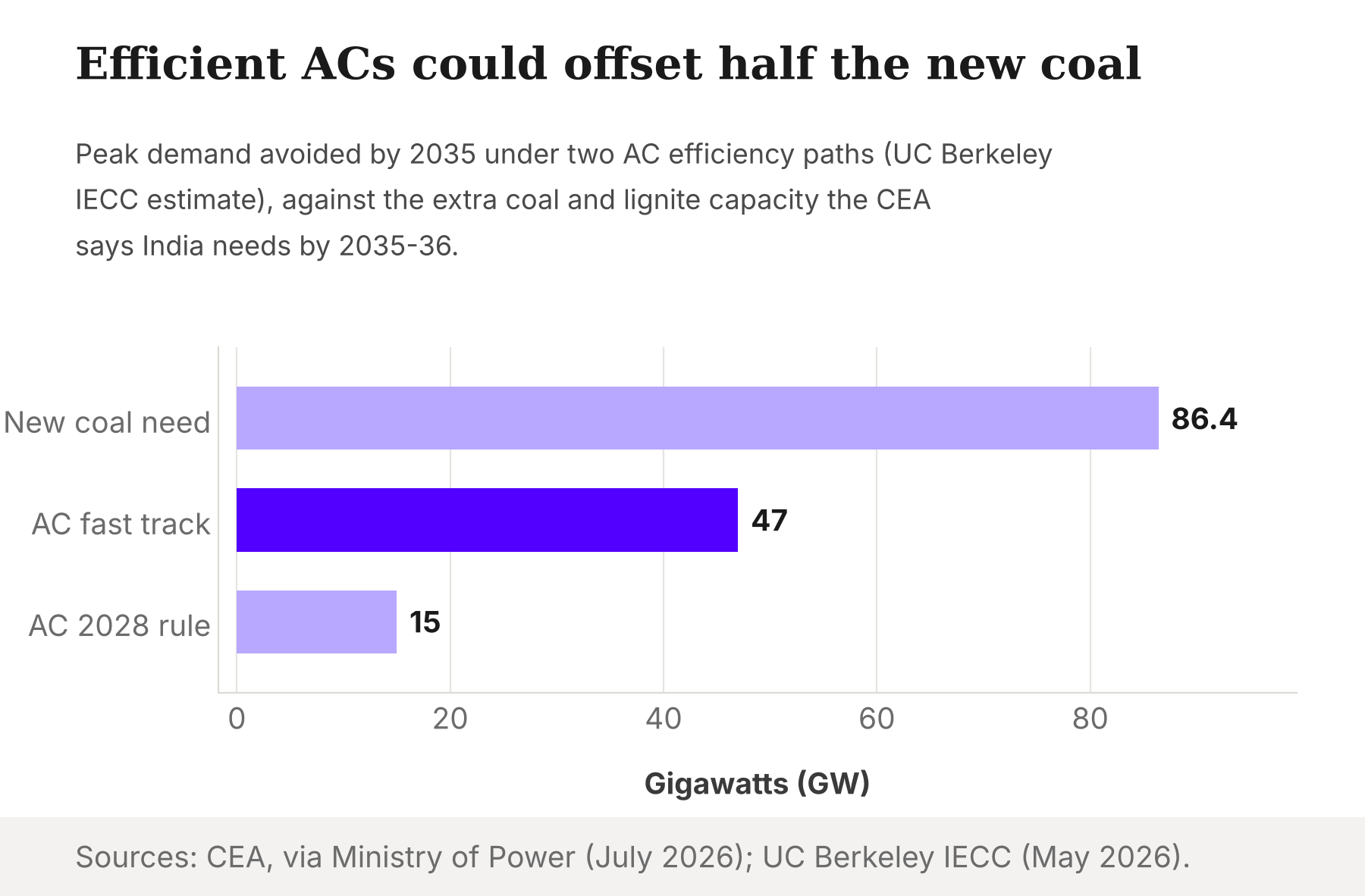
The two numbers are not identical units, and the objection section below deals with that. But the order of magnitude is the point. The Berkeley paper puts the avoided power infrastructure investment under the accelerated roadmap at about ₹8 lakh crore. A rule written for appliance labels is pricing itself against a decade of power plants.
Why the load lands where solar cannot reach
Cooling would matter less if it peaked at noon, when India's solar fleet is at full output. It does not stay there. The Ministry of Power said the daytime peak of 270.82 GW on 21 May 2026 was the fourth straight daily record, with the daytime peak usually falling between 2 pm and 4 pm. But the Berkeley paper notes that night peaks around 11 pm now exceed 250 GW, long after the sun has set.
Someone has to serve those hours, and today it is mostly coal. The ministry told the Lok Sabha that during non-solar peak hours, coal and lignite plants supplied up to about 188.8 GW, around 75% of total generation of 251.4 GW. Gas adds only about 10 GW in those hours during high-demand summer months, the ministry said in a March 2026 release.
The summer 2026 grid, in the hours that decide capacity
| Measure | Value | Period |
|---|---|---|
| All-India peak demand met | 270.8 GW | May 2026 |
| Night peak (around 11 pm) | above 250 GW | 2026 |
| Coal and lignite output at non-solar peak | about 188.8 GW of 251.4 GW | April to June 2026 |
| Room ACs' share of peak demand (estimate) | 60 to 70 GW, about 25% | May 2026 |
| Installed generation capacity | 548.86 GW | June 2026 |
Sources: Ministry of Power, Lok Sabha reply, 23 July 2026; Ministry of Power, Rajya Sabha reply, 20 July 2026; UC Berkeley India Energy and Climate Center, May 2026.
The growth ahead is weighted to the same hours. Berkeley's illustrative calculation has India's evening peak rising 72 GW between 2026 and 2030 at 6.5% annual demand growth, with room ACs about 40% of the increase, leaving an 8 GW firm-capacity shortfall even after plants under construction and storage. Each watt an AC does not draw at 11 pm is a watt of coal or battery capacity that does not have to exist.
The gap between the floor and the shelf
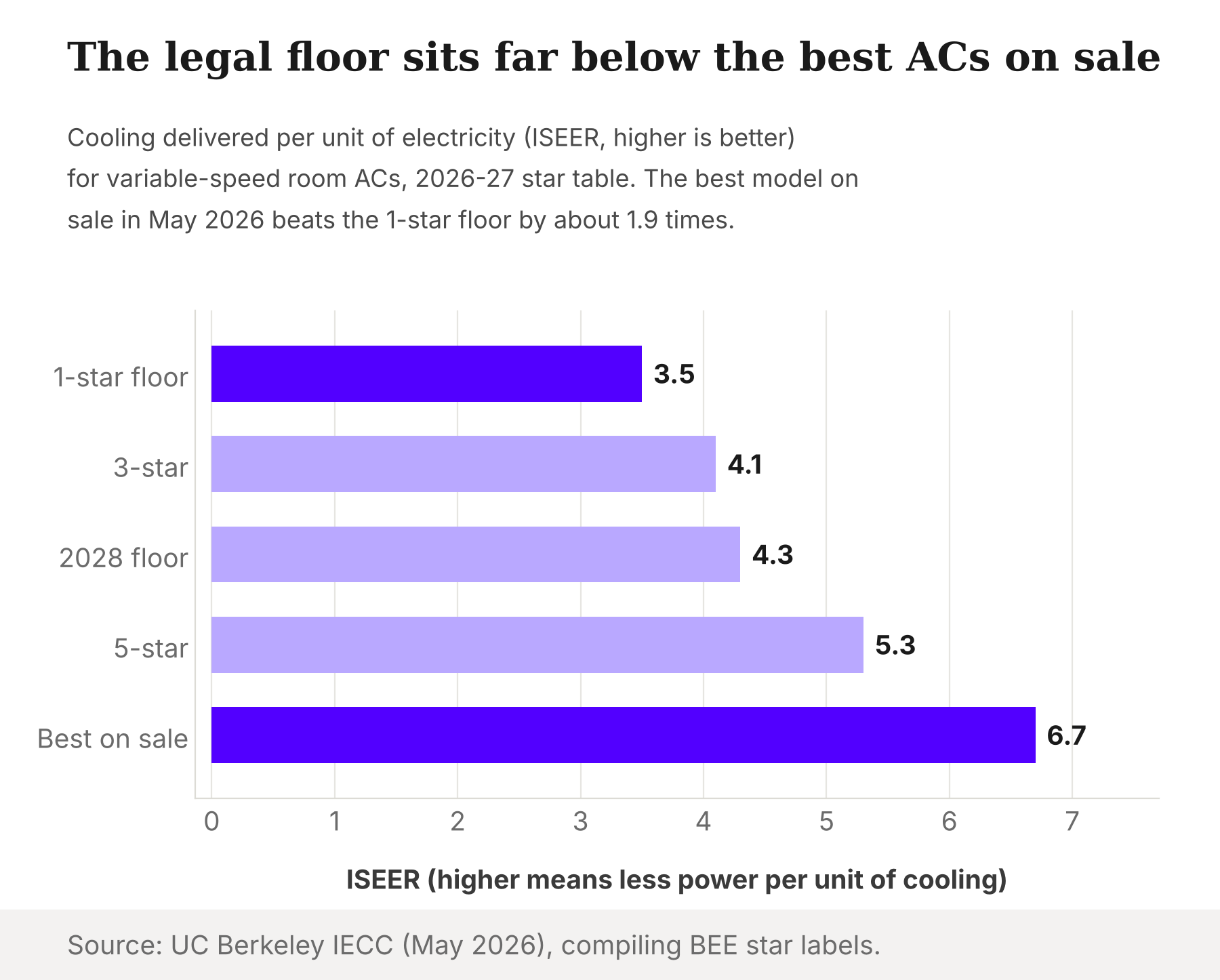
The lever works because India's legal minimum sits well below what is already for sale. In BEE's 2026-27 star table for variable-speed room ACs, as compiled by the Berkeley researchers, the 1-star floor is an ISEER of 3.5 and 5-star is 5.3. ISEER measures the cooling delivered per unit of electricity over a season, so higher is better. As of May 2026 the most efficient models on the Indian market reach 6.7, and more than 1,000 inverter models, about 15% of listings, already beat the 5-star threshold. Against the 3.5 floor, a 6.7 machine delivers the same cooling on roughly half the electricity.
Buyers are not closing that gap on their own. In FY2023, 3-star models were 59% of room AC sales and 5-star 23%, out of 10.8 million units sold, according to the Berkeley group's March 2025 paper. Its May 2026 paper puts 3-star at about 60% of sales and 5-star at about 20%. The middle of the market has barely moved, which is why the floor, not consumer choice, sets the fleet's average.
BEE has raised that floor before. The Ministry of Power said in January 2020 that successive revisions had improved the minimum standard for split ACs by about 43%. The planned 2028 revision drops the 1-star level and lifts the floor to an ISEER of 4.3, nearly 25% above the 2026 minimum. That is still well short of the 5.3 that a 5-star unit clears today.
The count is the slow variable
The stock is growing fast either way. The Berkeley paper estimates India adds 10 to 15 million ACs a year, with another 130 to 150 million likely over the next decade, and that without policy AC-driven peak demand could reach 120 GW by 2030 and 180 GW by 2035. Ownership has a long way to run. The government's India Cooling Action Plan of 2019 estimated about 8% of households had a room AC, and projected 21% by 2027-28 and 40% by 2037-38.
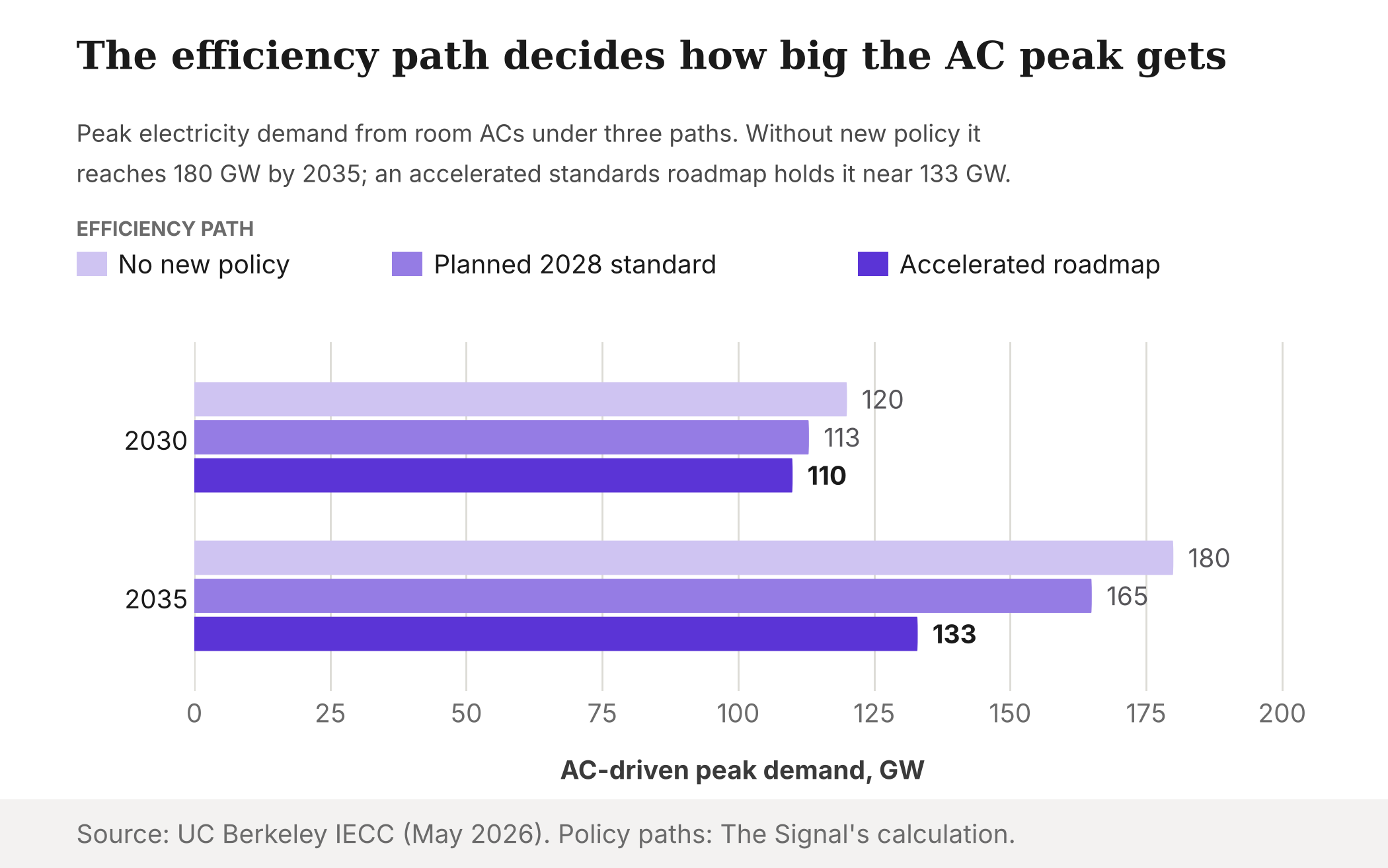
The chart shows where the choice bites. By the Berkeley estimates, the paths sit only 10 GW apart in 2030 but 47 GW apart by 2035. The units running in 2030 are largely sold already; by 2035, a decade of purchases has been made under the tougher rule.
The honest objection
The strongest case against this framing has three parts. First, the savings estimates come from one research group, in working papers that have not been peer reviewed. Second, a gigawatt of avoided AC demand is not the same as a gigawatt of coal capacity: plants are never fully available, the CEA adds reserve margins, and its reply does not say what AC efficiency its own demand projection already assumes. Third, India is building other answers to the night peak. The CEA's adequacy plan projects 786 GW of non-fossil capacity by 2035-36, including 80 GW of battery storage and 94 GW of pumped storage. A cheaper AC also reaches more households sooner, and tighter rules raise sticker prices.
That case is real, and it should temper the 54% figure into a direction rather than a promise. But it does not change the mechanism. Storage is itself capacity that must be built and paid for, and every battery is sized to the load it has to carry. A tougher floor shrinks that load for every option at once, coal, storage and imports alike. And the price argument is weaker against a floor the shelf has already overtaken: more than 1,000 models on sale in May 2026 beat the current 5-star line.
The Signal
India treats AC efficiency as consumer policy and power capacity as infrastructure policy, and plans them in different buildings. The evidence says they are one decision. The planned 2028 floor is worth an estimated 15 GW by 2035, and the faster path about three times that, set against a coal requirement the government's own planners put at 86.4 GW. Watch whether BEE publishes a schedule beyond 2028 before the 2027 summer, and whether the next CEA plan models it. Every AC sold under a weak label is a small power plant India has already ordered.
Reporting basis: peak demand, coal generation in non-solar hours, installed capacity and the CEA's coal, non-fossil and storage projections are from Ministry of Power replies to Parliament in July 2026, the CEA figures relayed in those replies from its March 2026 National Generation Adequacy Plan; the 21 May 2026 daily record is a Ministry of Power statement as reported by Akashvani, and the gas contribution is from a Ministry of Power release via PIB. All figures on ACs' share of peak demand, night peaks, sales mix, market efficiency, unit additions and avoided demand come from a single origin, UC Berkeley's India Energy and Climate Center, in working papers from March 2025 and May 2026 that are not peer reviewed; its star-label thresholds are its compilation of BEE data. The 2019 household ownership estimate is from the India Cooling Action Plan, and the 43% improvement in the split-AC minimum is from a 2020 PIB release on BEE's notification. The avoided-demand shares of the CEA coal requirement, the efficiency ratio between the floor and the best model, and the policy-path values in the chart are The Signal's calculations from those figures.