On Monday, 16 November 2026, Commerce Minister Piyush Goyal put a word on what Indian flyers have felt for two years. India is facing an "acute" shortage of civilian aircraft, he said, and is ready to order 1,000 more planes to meet demand. He gave the arithmetic too: Indian carriers have ordered more than 1,200 planes, and the country needs more than 2,000. The read that follows is simple. India is short of aircraft, so India should buy more of them.
It is worth slowing down on that. Ordering is the one part of this problem India has already done, at scale. In January 2026, Prime Minister Narendra Modi told the Wings India audience that India's airlines had placed orders for more than 1,500 aircraft in recent years. Fleet-tracking data put the backlog higher still.
The order book is twice the fleet
ch-aviation fleet data show that five Indian carriers had 1,741 aircraft on order in January 2026. The planes actually in the country are a much smaller number: Business Standard, citing planespotters data, counted 826 commercial aircraft in India at the end of 2025, of which 723 were operational. Put those side by side and the backlog is 2.1 times the whole fleet, and 2.4 times the part of it that was flying.
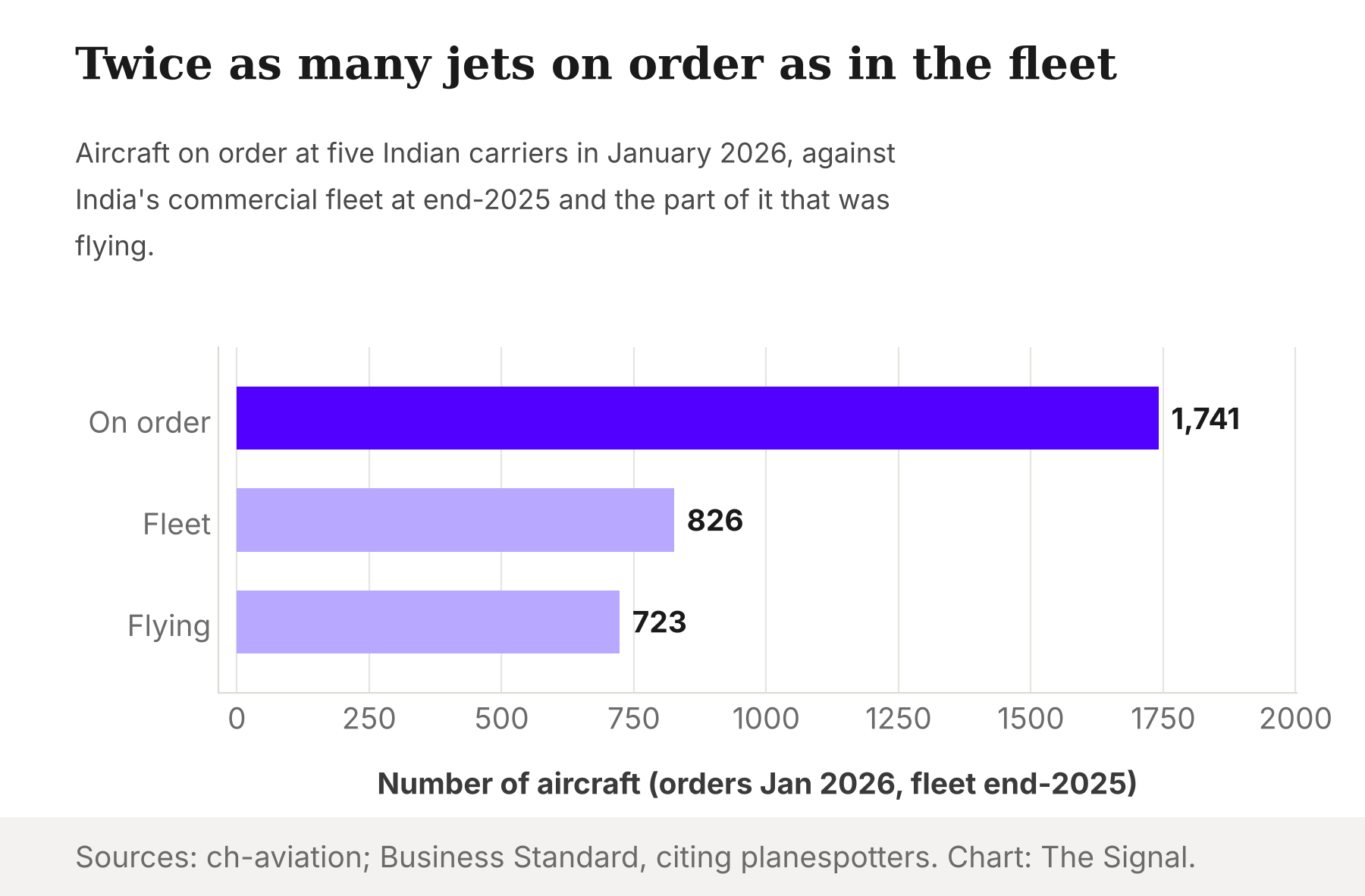
So when Goyal offers 1,000 more orders, he is adding to a queue, not starting one. The question that matters is how fast the queue moves.
Two carriers hold four-fifths of India's order book
| Carrier | Aircraft on order, January 2026 |
|---|---|
| IndiGo | 905 |
| Air India | 511 |
| Akasa Air | 195 |
| SpiceJet | 129 |
| flybig | 1 |
| Total | 1,741 |
Source: ch-aviation fleet data, January 2026. The four-fifths share (1,416 of 1,741) is The Signal's calculation.
IndiGo alone is the sharpest case. It had 905 aircraft on order in January 2026, per ch-aviation, while it operated a fleet of 442 aircraft at 30 September 2026, according to its second-quarter results. The country's largest airline has roughly two planes waiting for every one it flies.
The queue is moving slower, not faster
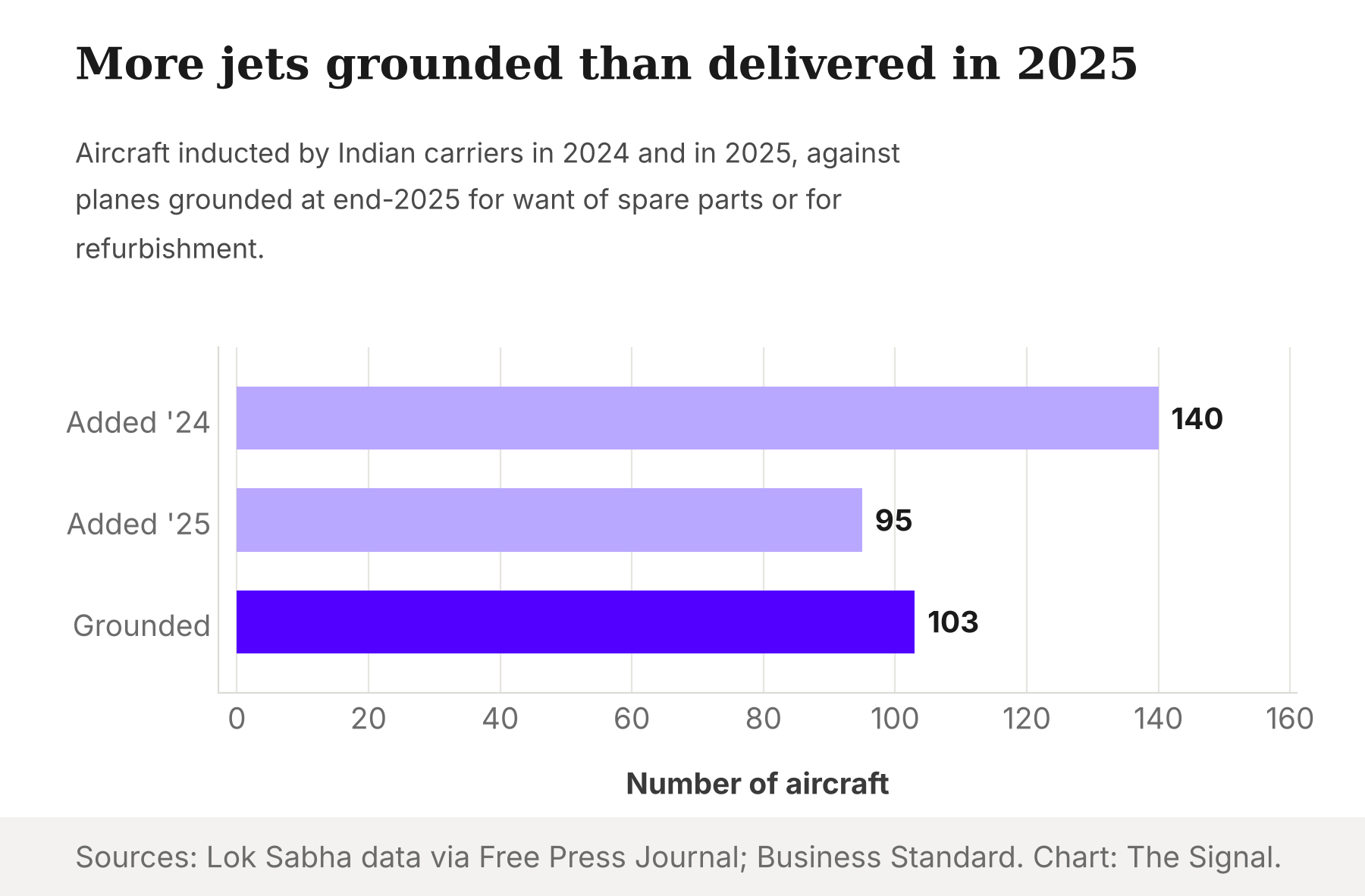
Government data presented in the Lok Sabha show Indian carriers inducted 95 aircraft in 2025, down 32% from a record 140 in 2024. At the 2025 pace, working through a 1,741-plane backlog would take about 18 years, our calculation. That figure is crude, since delivery schedules are not flat and some new planes replace old ones. But it shows which number binds. It is not the order count.
The other drain is planes that exist but do not fly. Of the 826 aircraft in India at end-2025, around 103 were grounded for lack of spare parts or for refurbishment, including 49 IndiGo planes waiting on spares. Set that 103 against the 95 delivered in 2025 and India had more aircraft parked on the ground at year-end than it received all year.
The engine problem is global, which is why Indian money cannot buy its way out of it. Leeham News reported in July 2026 that at the peak around 650 Pratt & Whitney GTF-powered A320neos were grounded worldwide, and one operator expects the PW1100G engine to remain an issue for another two or three years. India's airlines compete for the same repair slots and the same production lines as everyone else.
The shortage also lands unevenly. The Ministry of Civil Aviation told the Lok Sabha in July 2026 that some UDAN regional routes were discontinued early because of factors including aircraft shortage and supply chain issues. When planes are scarce, the thin routes go first.
Demand is shrinking at the same time
Here the simple story breaks a second time. A pure plane shortage would show up as packed flights and passengers turned away. The 2026 data look different. ICRA's monthly update, based on MoCA and DGCA data, shows domestic traffic of 118.2 lakh passengers in September 2026, 6.5% lower than 126.4 lakh a year earlier, with airline capacity 8.1% lower. August 2026 was similar, at 121.3 lakh, down 6.3% from 129.5 lakh in August 2025. September is the latest month ICRA has reported.
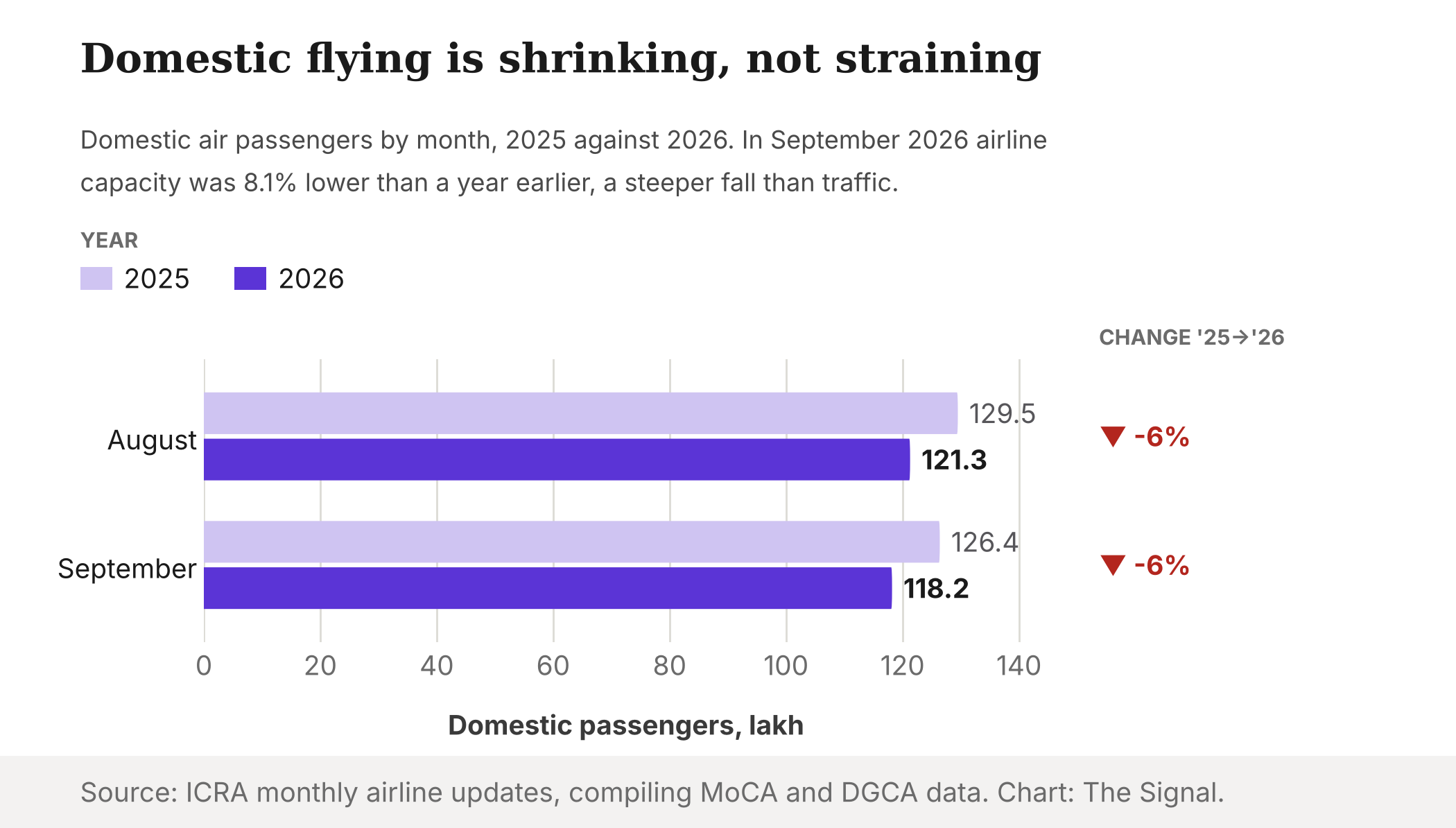
Both things are true at once. Capacity fell faster than traffic in September 2026, 8.1% against 6.5%, which is what a supply squeeze looks like. But traffic fell too, and cost is the obvious suspect. The Ministry of Civil Aviation said in April 2026 that global jet fuel costs had risen by more than 100% in the West Asia crisis, while the domestic increase was capped at 25%. The fuel bill reached passengers. The ministry told Parliament in July 2026 that DGCA had observed a 20.5% rise in the average airfare on 72 domestic sectors between March 2025 and June 2026, and it pointed to fuel costs and airlines cutting flights. Scarce seats and dearer fuel both push fares up, and dearer tickets mean fewer flyers.
The clearest signal of how airlines read this comes from Air India. Business Today, citing a Bloomberg report, said in June 2026 that Air India was in talks with Airbus and Boeing to defer deliveries from an order book of around 600 aircraft, most due in 2027 and 2028. Air India called the report highly speculative. Even so, an airline weighing whether to take its planes later is not an airline short of orders.
The honest objection
The strongest case for Goyal is that he is talking about the 2030s, not this winter. Aircraft makers build to a queue, and a plane ordered today is a claim on a production line years out. Goyal puts India's requirement at more than 2,000 planes, and a country with that ambition has to secure its place now, whatever this quarter's traffic says. On that reading, today's slump is fuel, and fuel passes.
That case is right about timing and wrong about remedy. New orders join the back of a line that already held 1,741 aircraft in January 2026. They do nothing for the 103 planes on the ground or for a delivery rate that fell to 95 aircraft in 2025. Seats come back sooner from engines repaired, spares delivered and existing slots kept than from a fresh signature.
The Signal
India's shortage is real, but it is a shortage of planes in the air, not of planes on paper. The binding numbers are deliveries and groundings, and both sit with manufacturers and engine shops abroad. Meanwhile the passengers the orders were meant to serve are 6.5% fewer in September 2026 than a year earlier, and fuel shares the blame. Watch three things: the 2026 induction total against 2025's 95, the count of grounded aircraft against 103, and whether monthly traffic turns positive again. If deliveries recover while traffic does not, the shortage becomes a glut. An order is a place in line, not a seat.
Reporting basis: Goyal's remarks are per a Press Trust of India report carried by ThePrint, with his order and requirement figures as reported by Business Today. The Prime Minister's order figure is from the Press Information Bureau transcript of his Wings India 2026 address. Order books by carrier are from ch-aviation's fleet database, as reported by ch-aviation. The end-2025 fleet, operational and grounded counts come from planespotters data as reported by Business Standard, a single source. Inductions for 2024 and 2025 are government data presented in the Lok Sabha, as reported by the Free Press Journal. IndiGo's fleet is from its second-quarter FY27 results, as reported by the Free Press Journal. Domestic traffic and capacity are DGCA and MoCA data compiled by ICRA. The Air India deferral talks rest on one Bloomberg report, carried by Business Today and disputed by the airline. The global GTF grounding figure is from Leeham News and Analysis. The fuel figures are from a Ministry of Civil Aviation release via PIB, the airfare rise is DGCA data cited in the ministry's reply to Parliament, as reported by Business Today, and the UDAN finding is from the ministry's written answer in the Lok Sabha. The order-to-fleet ratios, the carrier shares, the years-to-clear figure and the grounded-versus-delivered comparison are The Signal's calculations from those figures.