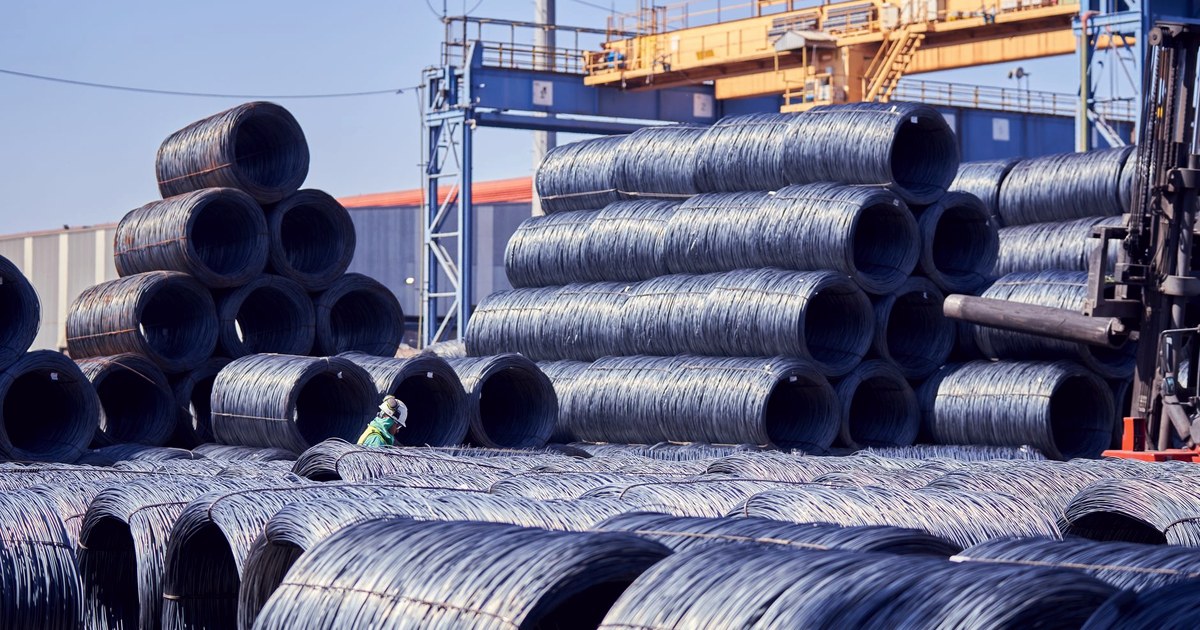
On Monday, 16 November 2026, Brussels added another barrier to Indian steel. The European Commission imposed definitive anti-dumping duties of 9.5% on certain cold-rolled flat steel from India, alongside 27.9% for Japan, 20.7-27% for Taiwan, 3-7.8% for Türkiye and 16% for Vietnam. The obvious reading writes itself. Europe is closing its doors, Indian mills will lose a premium market, and the steel shut out will flood back home.
Little of that reading survives the numbers. The duty itself is modest and the trade it touches is small. What changed on Monday is the reason Brussels gave, and that reason can be reused against other products too.
A small duty on a small slice
Start with the size of the trade. EU imports of the covered cold-rolled steel from India were worth €282 million, against €345 million from Taiwan, €240 million from Türkiye, €180 million from Japan and €125 million from Vietnam. India is the second-largest of the five, with about 24% of their combined €1.17 billion.
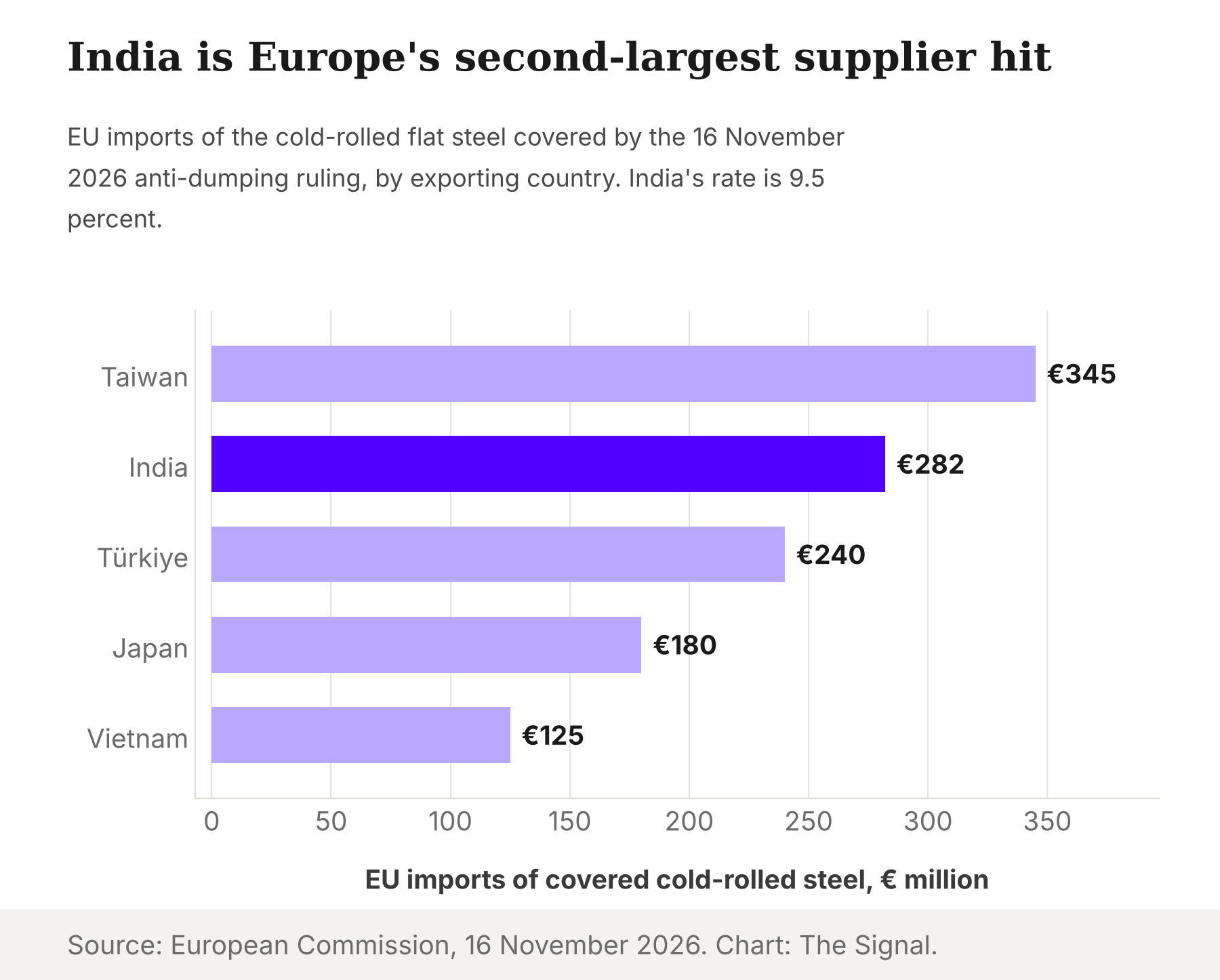
Set that against the market it sells into. The EU market for cold-rolled flat steel is worth some €23.2 billion, so India's shipments are about 1.2% of it. India's rate is also the second-lowest of the five, well below Japan's 27.9%. A 9.5% duty on €282 million of trade is not what moves an Indian steelmaker's year.
India does not need the outlet right now
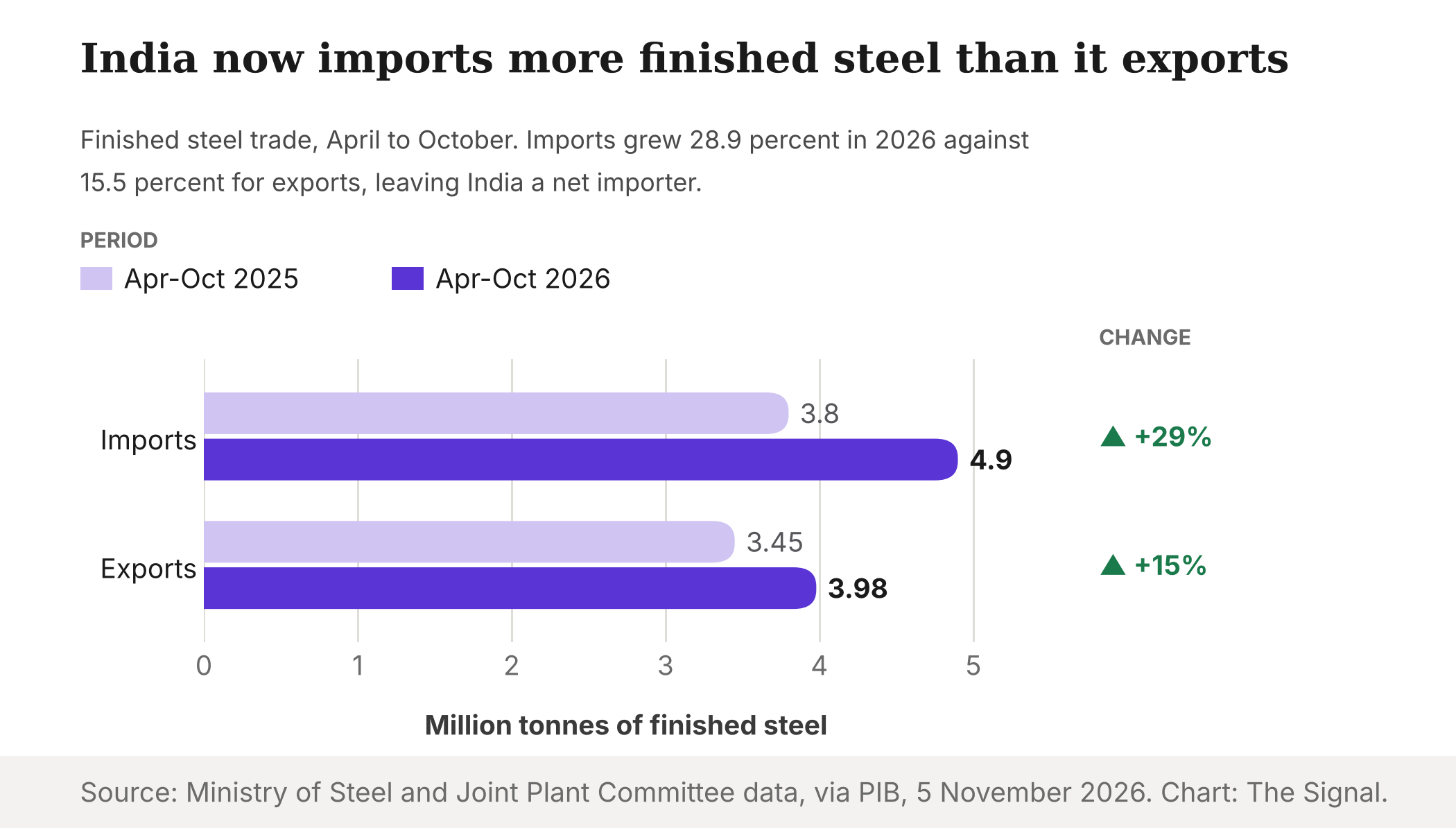
The flood-back-home fear assumes India has steel it cannot sell. The domestic data say the opposite. In April to October 2026, India exported 3.98 million tonnes of finished steel, up 15.5%, while it imported 4.90 million tonnes, up 28.9%, which left it a net importer by about 0.9 million tonnes. In October alone, the same Ministry of Steel release shows exports fell 32% while imports rose 65.8%.
Demand is the reason. Finished steel consumption rose 7.5% to 99.3 million tonnes in April to October 2026, while finished steel production rose 3.9% to 95.5 million tonnes. Prices confirm it. Domestic cold-rolled coil averaged ₹87,010 a tonne in October 2026, 33.3% higher than a year earlier, and hot-rolled coil was up 31.6%.
India also already protects that home market. Its safeguard duty on flat steel imports is 11.5% for goods landed between 21 April 2026 and 20 April 2027, falling to 11% after that, per a 30 December 2025 finance ministry notice. A mill turned away from Europe today sells into a market that is short of steel, priced a third higher than last year, and shielded by a duty slightly above the one Brussels just imposed.
The line that matters is about iron ore
The weight of Monday's decision sits in two sentences further down the Commission's page. The Commission said it established Particular Market Situations in India and Taiwan, and that in India government measures affected the domestic price of iron ore. It calls this the first probe in which it has made such a finding and describes the case as being of systemic importance for trade defence.
The mechanics explain why that matters. A dumping margin compares an exporter's price in Europe with its "normal value", usually the price at home. If Brussels decides home prices are distorted, it can construct that normal value instead. Once it has ruled that Indian iron ore prices are shaped by government policy, every Indian steel product made from that ore carries the same question. The next complaint does not need to prove a new distortion. It can cite this one.
Three walls, stacked
The ruling also lands on top of two broader barriers, and the regulation says they add up. Since 1 July 2026 the EU's new steel regime has charged an out-of-quota duty of 50%, doubled from 25%, and that duty applies in addition to other duties such as anti-dumping. The quotas were sized by applying the 2013 import share of around 13% to 2024 EU consumption.
Carbon is the third layer. The EU's carbon border mechanism entered its definitive regime on 1 January 2026, requiring importers to buy and surrender certificates for the emissions embedded in goods such as steel.
| Barrier | What it does | In force from |
|---|---|---|
| CBAM, definitive regime | Importers buy certificates for embedded emissions | 1 January 2026 |
| Steel tariff quotas | 50% duty once a quota is used up, on top of other duties | 1 July 2026 |
| Cold-rolled anti-dumping duty | 9.5% on Indian cold-rolled flat steel | 16 November 2026 |
Sources: European Commission, Taxation and Customs Union; Regulation (EU) 2026/1384; European Commission, DG Trade.
Europe's motive is spelled out in the same regulation. EU steel capacity utilisation fell to a historically low 67% in 2024, with more than 30 million tonnes of capacity and around 30,000 jobs lost since 2018. The EU expects global overcapacity to rise from 602 million tonnes in 2024 to 721 million tonnes by 2027. A bloc that sees that much surplus steel will keep adding walls.
The honest objection
The strongest case against this reading is that Europe still matters to Indian steel, and that the walls compound. Even after earlier measures, the EU steel industry body Eurofer reports that India supplied 7.7% of EU finished steel imports in the first half of 2026, fifth among suppliers, with volumes up about 1%. Domestic tightness is also cyclical. When Indian demand cools, mills will want export markets again, and they will find the most valuable one walled off at the moment they need it.
That objection is right about timing, and it strengthens the main point. The cost of Monday's ruling is not €282 million of cold-rolled trade this year. It is the option to sell into Europe later, and the iron ore finding is what narrows that option, because it is portable across products in a way a 9.5% rate is not.
The Signal
India's steel industry can absorb this duty easily, because right now it is selling into a home market where cold-rolled coil costs a third more than a year ago. That comfort hides the real change. For the first time, Brussels has written down that Indian government policy distorts the price of a core raw material, and it has said the finding matters beyond this product. Watch the next EU complaint against an Indian steel product. If it cites the iron ore finding, a single ruling will have become a standing presumption. The duty is 9.5%. The precedent has no rate.
Reporting basis: the duty rates, import values, market size and the Particular Market Situation finding are from the European Commission's DG Trade announcement of 16 November 2026. The 50% out-of-quota duty, the quota sizing method, the EU industry's capacity and job losses and the overcapacity projection are from Regulation (EU) 2026/1384 as published in the EU Official Journal. The CBAM start date is from the Commission's taxation and customs directorate. India's steel trade, consumption, production and price figures are Ministry of Steel and Joint Plant Committee data, via a PIB release of 5 November 2026. India's safeguard duty schedule rests on a single source, Argus Media's report of the finance ministry's 30 December 2025 notice. The EU import share for India is Eurofer's own figure; Eurofer is the EU steel industry body. India's share of the five countries' covered imports, its share of the EU cold-rolled market and its net import position are The Signal's calculations from those figures.