India's free grain scheme is usually described by one number, and the number never moves. The National Food Security Act covers up to 75% of the rural and up to 50% of the urban population, which at Census 2011 comes to about 81.35 crore people, the food department told Parliament. The Union Cabinet extended free foodgrains to those 81.35 crore persons for five years in November 2023, at an estimated cost of about ₹11.80 lakh crore. The easy read is that a vast programme has simply kept running at full stretch.
It is worth slowing down on that. The 81.35 crore figure is not a measure of need or a budget choice. It is the output of a formula, and the formula's input is the Census 2011 population count, taken fifteen years ago. India has grown since. The ceiling has not.
The formula still runs on 2011
The law ties coverage to the census. The 2013 Act says the number of people covered in each state's rural and urban areas is to be calculated on the population estimates of the latest census, and that proportion has not been updated because the census due in 2021 was postponed, PRS Legislative Research notes. In the same review, PRS records that the Supreme Court observed in 2021 that the Centre should take steps to re-determine coverage, and that in August 2025 the food department said it would not be proper to do so without updated census data.
The ceiling is close to full. As of August 2025, states had identified 80.6 crore beneficiaries, leaving room for only 79 lakh more under the existing cap, PRS reports, citing the department. Those rolls run to 2.3 crore Antyodaya households and 18.3 crore priority households as of January 2026, with free grain approved until 2029.
What the same formula says today
The government's own population projection lets you rerun the arithmetic. The National Commission on Population's technical group, which published its projections in July 2020, put India's population at about 142.3 crore on 1 March 2026, against 121.1 crore in 2011. The same projection puts the urban share at 36.19% in 2026, up from 31.14% in 2011.
Apply the Act's 75% rural and 50% urban ceilings to those projected figures and entitlement comes to about 93.9 crore people. That is roughly 12.5 crore more than the 81.35 crore cap, or about 13.3 crore more than the 80.6 crore actually identified.
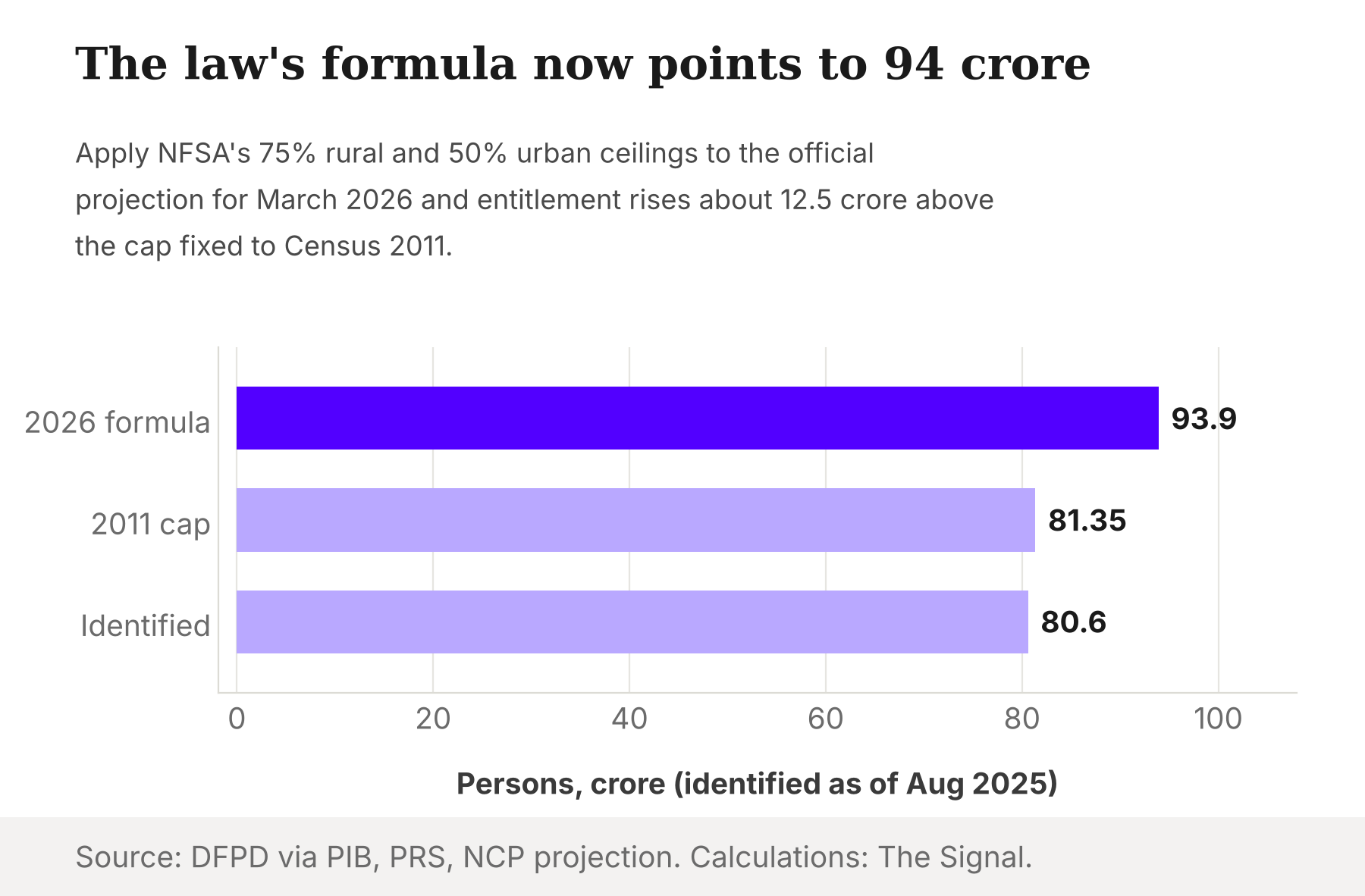
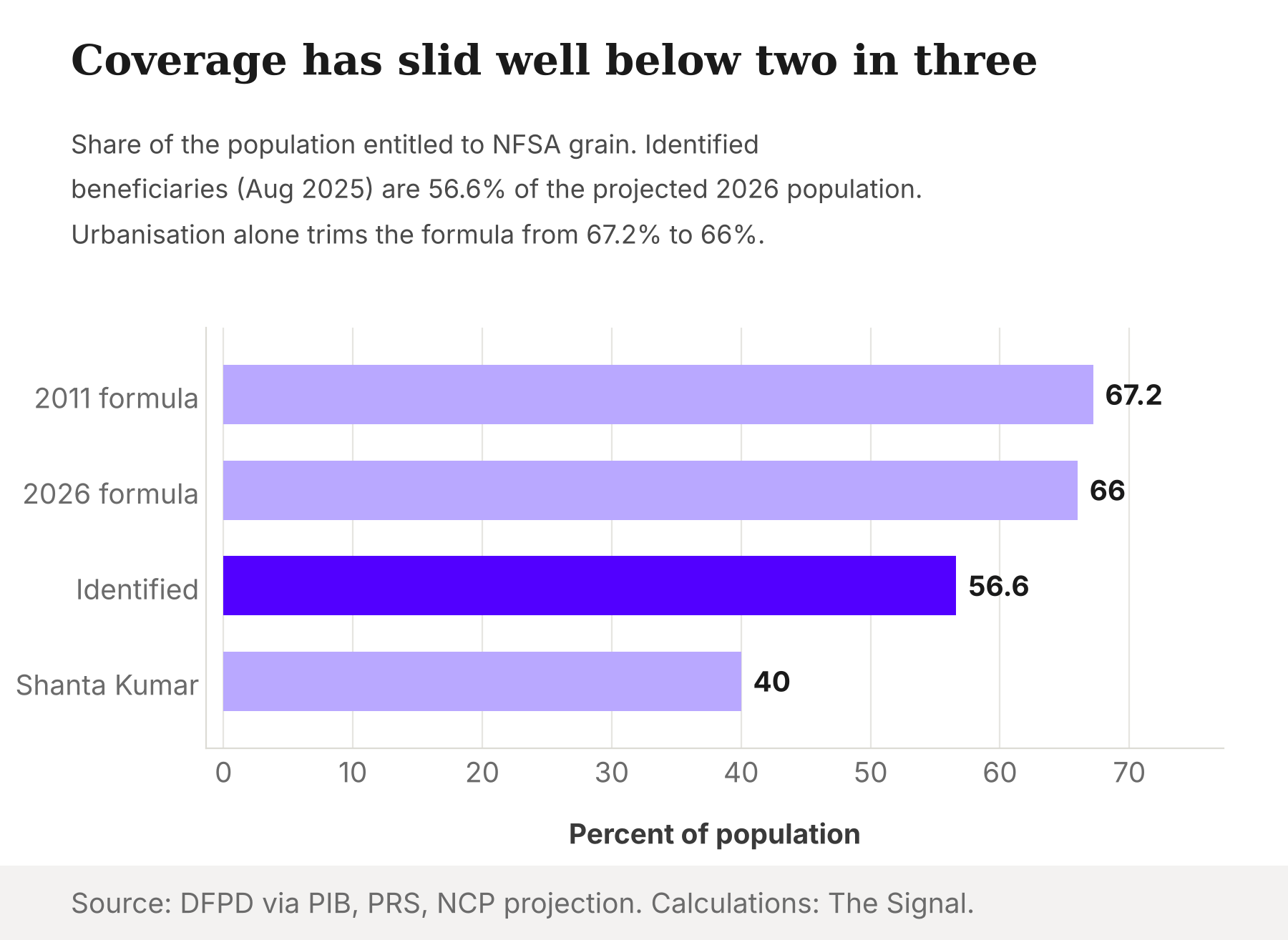
Put as a share, the drift is plainer. The 81.35 crore cap was about 67.2% of the 2011 population of 121.1 crore. The 80.6 crore identified as of August 2025 is about 56.6% of the projected 142.3 crore for 2026. A law written to reach two in three Indians now reaches fewer than three in five, without anyone amending it.
Urbanisation shrinks the formula, a little
There is a second mechanism inside the arithmetic that cuts the other way. The Act's ceiling is 75% for rural areas and 50% for urban ones. Every person who moves from the rural count to the urban count lowers the formula's yield.
On the 2011 urban share of 31.14%, the blended ceiling is about 67.2%. On the projected 2026 share of 36.19%, it falls to about 66.0%. Had the 2011 share held, 67.2% of 142.3 crore would be about 95.6 crore. Urbanisation alone trims about 1.75 crore people off what a fresh count would otherwise imply. The projection expects the urban share to reach 38.6% by 2036, with urban growth accounting for 73% of the population increase between 2011 and 2036, so that drag grows with every year the formula is rerun.
| Measure | Population base | Persons covered | Share of population |
|---|---|---|---|
| Cap in use (Census 2011 formula) | 121.1 crore (2011) | 81.35 crore | 67.2% |
| Identified by states (Aug 2025) | 142.3 crore (2026 projection) | 80.6 crore | 56.6% |
| Same formula on 2026 projection | 142.3 crore (2026 projection) | about 93.9 crore | 66.0% |
| 2011 share held at 67.2% | 142.3 crore (2026 projection) | about 95.6 crore | 67.2% |
Sources: DFPD via PIB; PRS Legislative Research; National Commission on Population. Rows three and four and all shares are The Signal's calculations.
The bill the frozen count has deferred
The money is the part the headline number hides. The Union Budget for 2026-27 allocates ₹2,27,429 crore to the free grain scheme, against ₹2,27,753.65 crore in the 2025-26 revised estimate and ₹1,99,500 crore actually spent in 2024-25. Spread across the 80.6 crore people identified as of August 2025, the 2026-27 allocation works out to roughly ₹2,800 per person per year.
At that rate, the 12.5 crore people the formula adds on the 2026 projection would cost on the order of ₹35,000 crore a year, about 15% on top of the current allocation. That is a rough marker, not a costing: the subsidy also pays for procurement, storage and buffer stocks, which do not scale one for one with ration cards.
Set that against the event that will force the question. The Cabinet approved Census 2027 at ₹11,718.24 crore, with houselisting from April to September 2026 and population enumeration in February 2027. On these numbers, one year of the deferred ration bill is about three times the cost of the entire census.
The honest objection
The strongest case against reading this as exclusion is that 67% was always too generous. In 2015 the Shanta Kumar committee on restructuring the Food Corporation of India observed that 67% coverage under NFSA was on the higher side, and that 40% could comfortably cover households below the poverty line. On that view, a ceiling frozen while incomes rose has drifted toward the right size, not away from it, and the 12.5 crore gap is an artefact of an outdated ratio rather than a count of hungry people.
That case is real, and it changes what the gap means. It does not change who holds the cards. The ratio is in the statute, and the department has tied any revision to fresh census data. Until then, coverage is set neither by a poverty test nor by the formula as written. It is set by the calendar.
The Signal
Census 2027 converts a quiet saving into an open choice. Once the population count is published, the government can rerun the formula and absorb a bill in the tens of thousands of crores, or change the 75 and 50 percent ratios, which means amending a law that entitles crores of households. Urbanisation will soften the arithmetic, but not by enough to make it disappear. The number to watch after the February 2027 enumeration is not the headcount. It is whether 81.35 crore survives it.
Reporting basis: the NFSA coverage ratios and the 81.35 crore ceiling are from the Department of Food and Public Distribution's February 2023 reply in the Rajya Sabha, via PIB, and the five-year free grain decision and its ₹11.80 lakh crore estimate are from the Union Cabinet's November 2023 decision, via PIB. The 2024-25 to 2026-27 scheme allocations are from the Union Budget's Demand No. 15. The August 2025 identified-beneficiary count, the January 2026 household counts, the department's position on re-determining coverage and the Supreme Court's 2021 observation are from the department and the court as summarised by PRS Legislative Research, which also relays the 2015 Shanta Kumar committee finding; those items rest on that single secondary summary. Population and urban-share projections are from the National Commission on Population's technical group report of July 2020, which is a projection, not a count. The Census 2027 cost and schedule are from the Union Cabinet, via the Prime Minister's Office. The formula-based entitlement of about 93.9 crore, the coverage shares, the urbanisation effect, the per-person allocation and the roughly ₹35,000 crore annual cost are The Signal's calculations from those figures.