The news from Mumbai, reported on November 15, 2026, sounded like routine housekeeping. RBI Deputy Governor Shirish Chandra Murmu told a microfinance industry event that the central bank is considering a review of the ₹3 lakh annual household income threshold for microfinance borrowers, and that it would examine the need for a change based on its own assessment of the sector. The industry has been asking for it. The easy read is that lenders want a bigger pond to fish in after two hard years, and the regulator may oblige.
That read misses where the line now sits. The ₹3 lakh figure is not a lending limit. It is the definition of who counts as a microfinance borrower at all, and the borrowers it is meant to describe appear to have walked up to it.
The number that carries the story
The number is ₹25,844. That is the average monthly income in a nationally representative 2025 NCAER survey of 10,342 microfinance borrowers across 10 states, released by the industry body MFIN in April 2026. Multiply by twelve and it comes to ₹3,10,128 a year.
Set that against the rule. RBI's 2022 master direction, effective April 1, 2022, defines a microfinance loan as a collateral-free loan to a household with annual income up to ₹3,00,000. The average borrower in the industry's own survey already earns more than the ceiling that makes them a microfinance borrower.
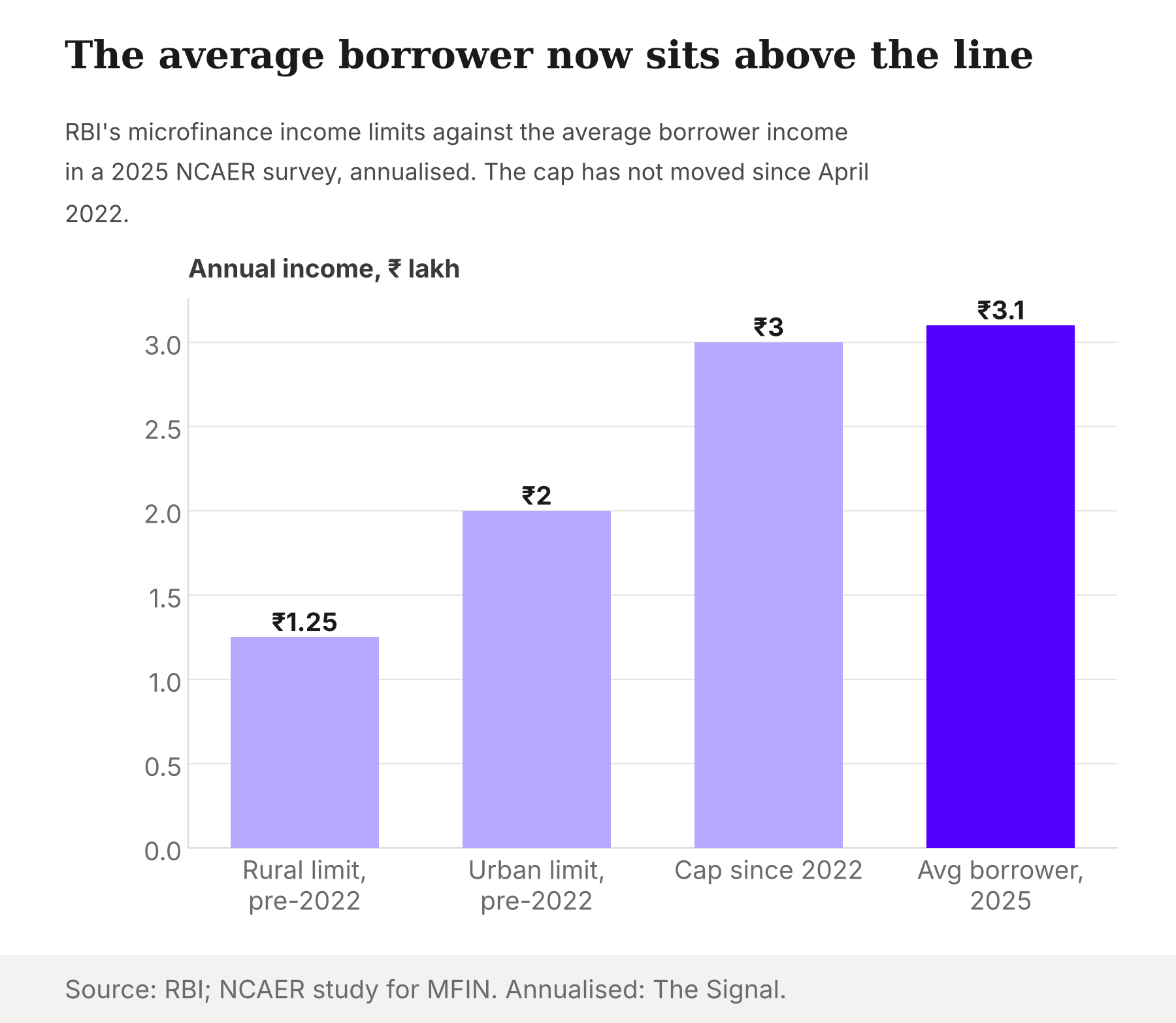
The cap itself was a large step up when it arrived. Before the 2022 framework, NBFC-MFI borrower limits were ₹1.25 lakh for rural and ₹2 lakh for urban and semi-urban households, according to then Deputy Governor M. Rajeshwar Rao, and the framework replaced both with a uniform ₹3 lakh. For rural households that was 2.4 times the old limit. It has not moved in the four and a half years since.
The lenders moved first
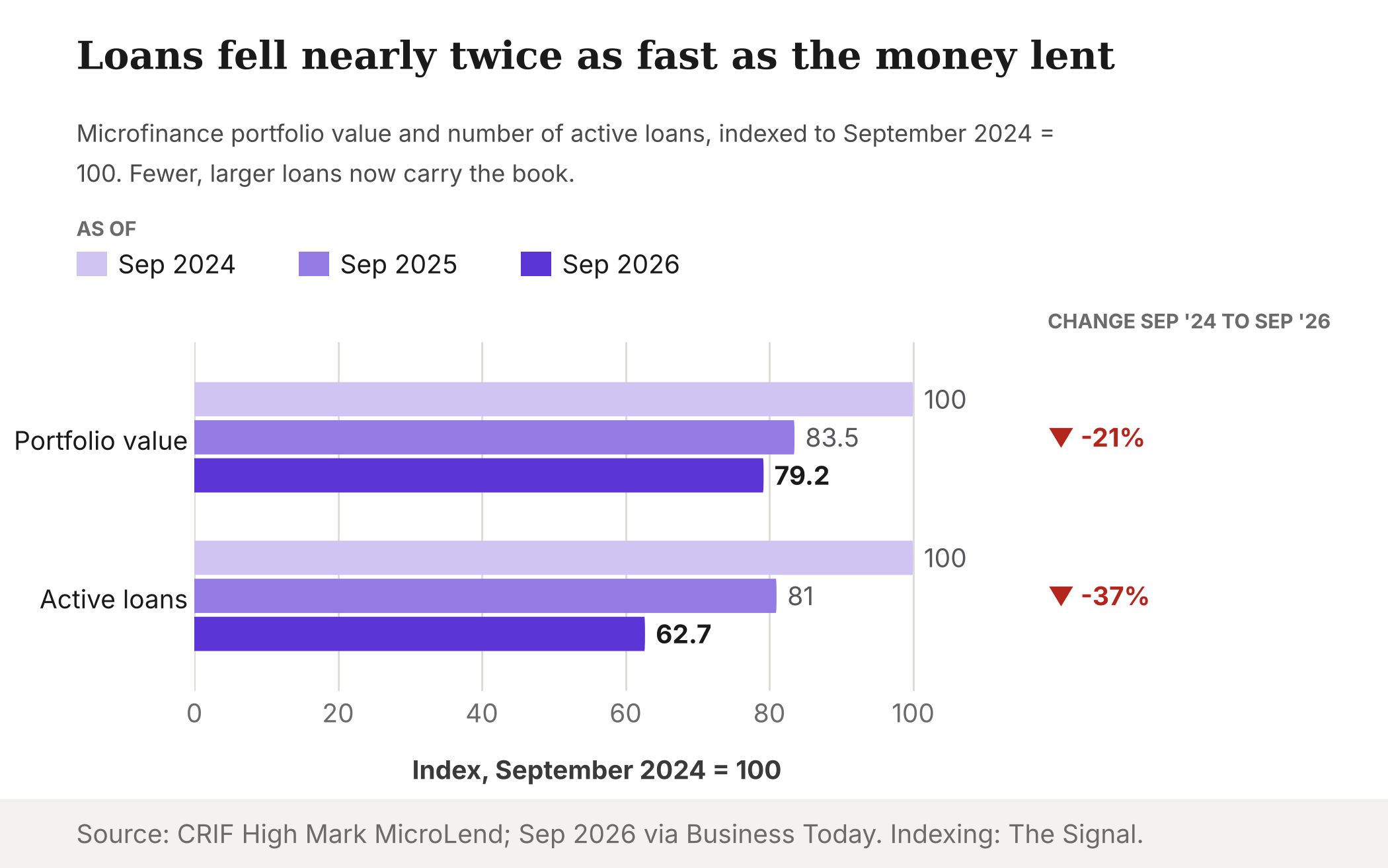
The shape of the loan book shows the industry has been drifting toward the top of its permitted range. CRIF High Mark's bureau data put the microfinance portfolio at ₹414.0 thousand crore in September 2024 and ₹345.6 thousand crore in September 2025, while active loans fell from 15.3 crore to 12.4 crore. By September 2026, CRIF counted a ₹3.28 lakh crore portfolio across 9.6 crore active loans and 6.4 crore live borrowers, as reported by Business Today.
Over those two years the money outstanding fell about 21 percent, from ₹414.0 thousand crore to ₹3.28 lakh crore. The number of loans fell about 37 percent. The average balance per loan rose from roughly ₹27,000 to roughly ₹34,000.
New lending tells the same story. The average microfinance ticket size rose 17.5 percent in a year to ₹63,100, and loans above ₹1 lakh made up 15.1 percent of origination value against 11.2 percent a year earlier, per CRIF's September 2026 data. Those bigger loans go to people lenders already know. Between July and September 2025, about 92 percent of loans of ₹1 lakh or more went to borrowers with a credit history of over 24 months.
MFIN says as much about itself. Its latest Micrometer release describes growth driven by NBFC-MFIs and higher loan sizes, reflecting a degree of consolidation around existing borrowers. A borrower with two years of credit history, taking a ₹1 lakh loan, is not a new entrant. That household's income has had years to grow toward ₹3 lakh, and on the survey's evidence past it.
Where the missing loans went
Part of the shrinkage is not shrinkage at all. MFIN reports the industry portfolio at ₹3,28,708 crore on June 30, 2026, down 6.9 percent in a year, and says the 28.5 percent fall in banks' microfinance portfolio was mostly due to reclassification of microfinance loans to retail. In the same release, MFIN argues that household incomes, wages and prices have risen materially since 2022, reducing the real value of the ₹3 lakh threshold.
This is the mechanism the headline review is really about. A household just under ₹3 lakh is a microfinance customer. It sits on the microfinance bureau, and its total loan repayments are capped at 50 percent of monthly household income under RBI's rules. A household just over ₹3 lakh can take the same unsecured loan as a retail product, outside that cap. As incomes rise against a fixed line, borrowers do not leave debt. They leave the rulebook.
That gives the review an odd shape. Raising the cap would bring more households back under the 50 percent repayment ceiling, a tighter regime than retail lending. It would also help one group of lenders directly. Since June 2025, NBFC-MFIs must hold a minimum of 60 percent of total assets in qualifying microfinance loans. Every household that rises above ₹3 lakh is a loan that stops counting toward that floor. A higher cap restores that headroom.
The honest objection
The strongest case against reading too much into ₹25,844 is that it is an average from a survey, not a measured household income at the point of lending. A few higher earners can pull a mean above the cap while most borrowers sit below it. The release also does not say whether the figure is the borrower's income or the household's. If it is the borrower's alone, household income is higher still and the point strengthens. If it is the household's, the gap over ₹3 lakh is narrow, about 3 percent. The study was commissioned by MFIN, which wants the cap raised.
There is also a good argument for leaving the line where it is. The same survey found an average fixed-obligation-to-income ratio of 18.7 percent, well within the 50 percent limit. And delinquency has fallen sharply, with PAR 31-180 at 1.6 percent in September 2026 against 4.6 percent a year earlier. A regulator could fairly conclude that the current perimeter is producing a cleaner book and should not be disturbed to rescue lender volumes.
Both points are real. Neither changes the direction of travel. A survey mean sitting at the cap means a large share of borrowers is near it, and the lending data show lenders deliberately moving toward those borrowers. The cleaner book is partly a product of that drift: seasoned, higher-income borrowers default less.
The Signal
The ₹3 lakh line was drawn to describe low-income households. Four and a half years on, it increasingly describes the boundary where an unsecured loan stops being supervised as microfinance. The review is less about letting richer people borrow than about whether the 50 percent repayment cap should follow the same people as their incomes rise.
Watch two things. First, whether RBI indexes the cap or simply resets it to a new round number that will erode again. Second, whether any revision is paired with the bureau-reporting fix MFIN has raised, since a higher cap without consistent reporting just moves the blind spot. A rule that defines its borrowers by income cannot stand still while their incomes do not.
Reporting basis: the ₹3 lakh income definition, the 50 percent repayment cap and the 60 percent qualifying-asset floor are from Reserve Bank of India directions verified on the RBI site; the pre-2022 rural and urban limits are from a 2022 speech by an RBI Deputy Governor, published by the Bank for International Settlements. The review announcement rests on a single wire report, by United News of India. Portfolio, loan-count, ticket-size, vintage and delinquency figures are from CRIF High Mark, a credit bureau: the September 2024 and 2025 figures from its own MicroLend report, and the September 2026 figures as reported by Business Today, which is the only relay checked for them. The June 2026 industry portfolio, the bank reclassification and the real-value argument are from MFIN, the industry's self-regulatory body, which favours a higher cap; the borrower income and repayment-ratio figures are from an NCAER survey commissioned by MFIN, as stated in MFIN's release. The annualised income, the declines in portfolio and loan count, the average balance per loan, and the rural-limit multiple are The Signal's calculations from those figures.