From 15 November 2026, a kilogram of CNG in Mumbai costs Rs 91.50. Oneindia reports that this is the eighth increase of 2026 and that motorists now pay Rs 11 a kg more than at the start of the year. Two days earlier, Reuters reported the International Energy Agency's view that supply will exceed demand by 1.7 million barrels a day in the fourth quarter of 2026. ANI, quoting the IEA, reports that North Sea Dated crude fell from a peak of $136 a barrel in early October to around $93. The obvious read is that gas follows oil, oil is falling, and so Mumbai's gas utility is either slow or greedy.
It is worth slowing down on that. The cheapest gas in Mumbai's CNG has not followed crude in either direction this year. PPAC's notification of 31 October 2026 sets the domestic gas formula price for November at $12.00 per MMBTU, but caps gas from ONGC and OIL's old nomination fields, the APM gas, at $7.00. In April 2026 the formula price was $10.76, under the same $7.00 ceiling. The APM price Mumbai's distributor paid did not move between April and November.
The number that matters is 30. Mahanagar Gas's CFO told analysts in July 2026 that roughly 30% of the company's gas comes through APM. The other 70% is what sets the price at the pump.
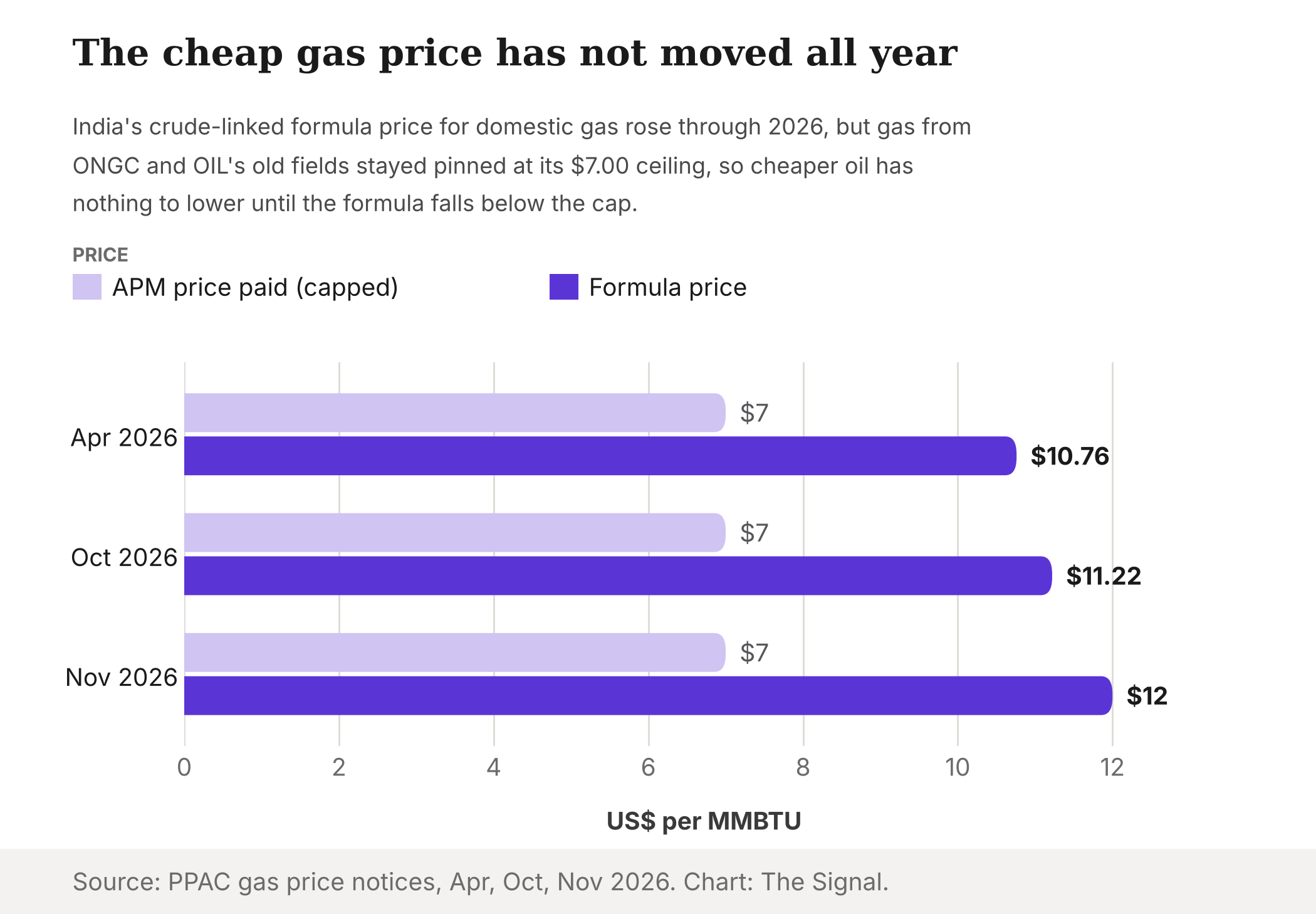
Source: PPAC domestic gas price notifications (April 2026; November 2026). Chart: The Signal.
Why cheaper oil cannot reach the capped gas
The formula is simple. Under the April 2023 guidelines, domestic gas is priced at 10% of the previous month's average Indian Crude Basket, with APM gas held between a floor and a ceiling. At 10%, a $7.00 cap starts to bind once the basket is above $70 a barrel. PPAC's crude basket table puts the October 2026 average at $119.91 a barrel, after $116.09 in September, which is why November's formula price came out at $12.00.
That is why a falling crude price does nothing for the APM slice. The basket itself had dropped to $91.15 by 12 November, PPAC's table shows, still more than $20 above the point where the cap stops binding. Crude would have to fall a long way further before the cheap third of Mumbai's gas got any cheaper.
The irony is that the crude link was sold as relief. In April 2025 the petroleum ministry said that because APM and new-well gas prices are linked to the Indian Crude Basket, the recent decline in crude would make gas more affordable. With the cap binding, that link is switched off.
The gas that actually sets the price
Only the APM third is priced at $7; the rest of MGL's gas costs far more.
| MGL gas source (July 2026) | Approx. share of supply | Price, US$ per MMBTU |
|---|---|---|
| APM (ONGC and OIL nomination fields) | about 30% | $7.00 cap (November 2026) |
| New-well and pooled gas | about 21% to 22% | about $12.5 to $13 |
| HPHT fields | about 14% to 15% | ceiling of $9.89 (Oct 2026 to Mar 2027) |
| Henry Hub-linked LNG | about 21% to 22% | not stated |
| Brent-linked contracts and spot LNG | the remainder | Brent-linked about $13 to $14; spot touched almost $20 |
Shares and contract prices from MGL's Q1 FY27 earnings call; APM cap from PPAC, November 2026; HPHT ceiling from PPAC's ceiling notice.
Every source other than APM costs more, and several cost close to double. PPAC's ceiling for deepwater and HPHT gas is $9.89 per MMBTU for October 2026 to March 2027. The CFO put pooled gas at $12.5 to $13 and Brent-linked gas at $13 to $14. On the same call he warned that "the time is coming where APM is substantially coming down".
MGL's own explanation for the latest hike fits that mix. The Free Press Journal reports that MGL attributed it to the Middle East crisis, reduced domestic gas allocation and greater dependence on imported RLNG. Each time cheap gas is swapped for an imported cargo, the average cost goes up, whatever crude is doing that week.
The currency is a smaller part of the story. Gas is bought in dollars per MMBTU and sold in rupees per kilogram, so a weaker rupee does raise the bill. But an IANS report carried by The Free Press Journal puts the rupee at 93.69 to the dollar on 11 November, down roughly 4% for the year after a record low of 96.96 in May. A 4% currency move cannot by itself explain a 13.7% rise in Mumbai's CNG price over 2026, since gas is only part of that price. The mix of gas does most of the work.
The hikes are trailing costs, not leading them
If MGL were pocketing the gap, its margin per unit would be widening. It is shrinking. MGL's Q2 FY27 investor presentation compares July to September 2026 with the same quarter of 2025. Per standard cubic metre, gas cost rose from Rs 33.65 to Rs 42.34, gas sales revenue rose from Rs 48.22 to Rs 56.11, and gross profit fell from Rs 14.57 to Rs 13.77. That is a 25.8% rise in cost against 16.4% in realisation.
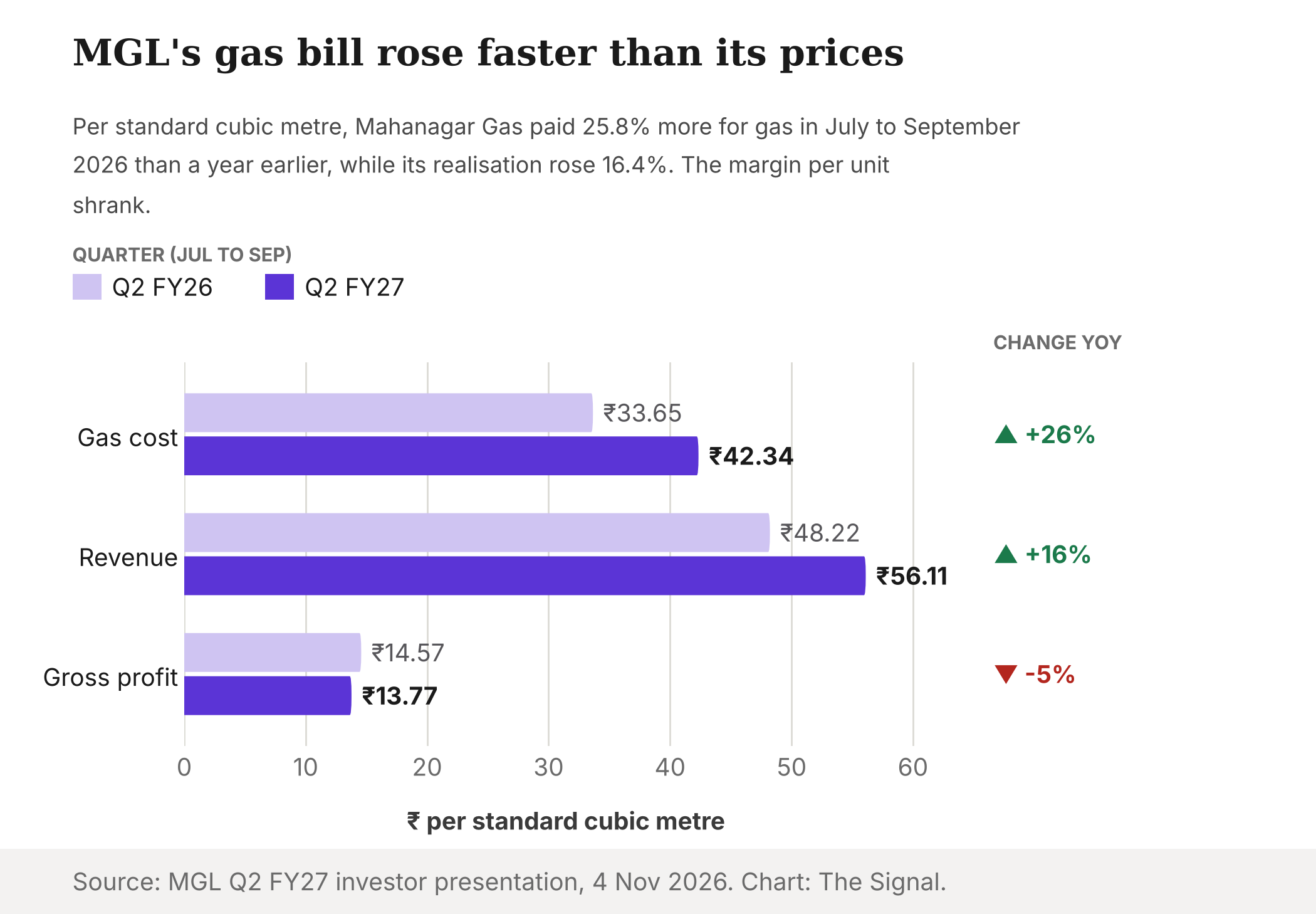
Source: Mahanagar Gas Q2 FY27 investor presentation. Percentage changes are The Signal's calculations. Chart: The Signal.
The same deck shows EBITDA margin at 12.01% against 16.49% a year earlier, and quarterly profit after tax down 29.13% to Rs 137.04 crore. The count of hikes depends on the start date. The Free Press Journal calls the 15 November increase of Rs 1.50 the seventh since April, Rs 10.50 a kg in total. Oneindia's eighth counts the full calendar year.
What it does to the CNG case
The squeeze on drivers is real but smaller than the headlines suggest. PPAC's daily price table shows Mumbai petrol at Rs 103.54 a litre on 1 January 2026 and Rs 111.21 from 25 May 2026 onward. Against CNG's Rs 11 rise to Rs 91.50, that is a 13.7% increase for CNG and 7.4% for petrol over 2026.
MGL's own fuel-economics slide assumes 26 km per kg for a CNG car and 18 km per litre for petrol. On those figures, CNG cost Rs 3.10 a km in January against Rs 5.75 for petrol, and Rs 3.52 against Rs 6.18 now. The rupee gap has held at about Rs 2.66 a km. The percentage saving has slipped from 46% to 43%.
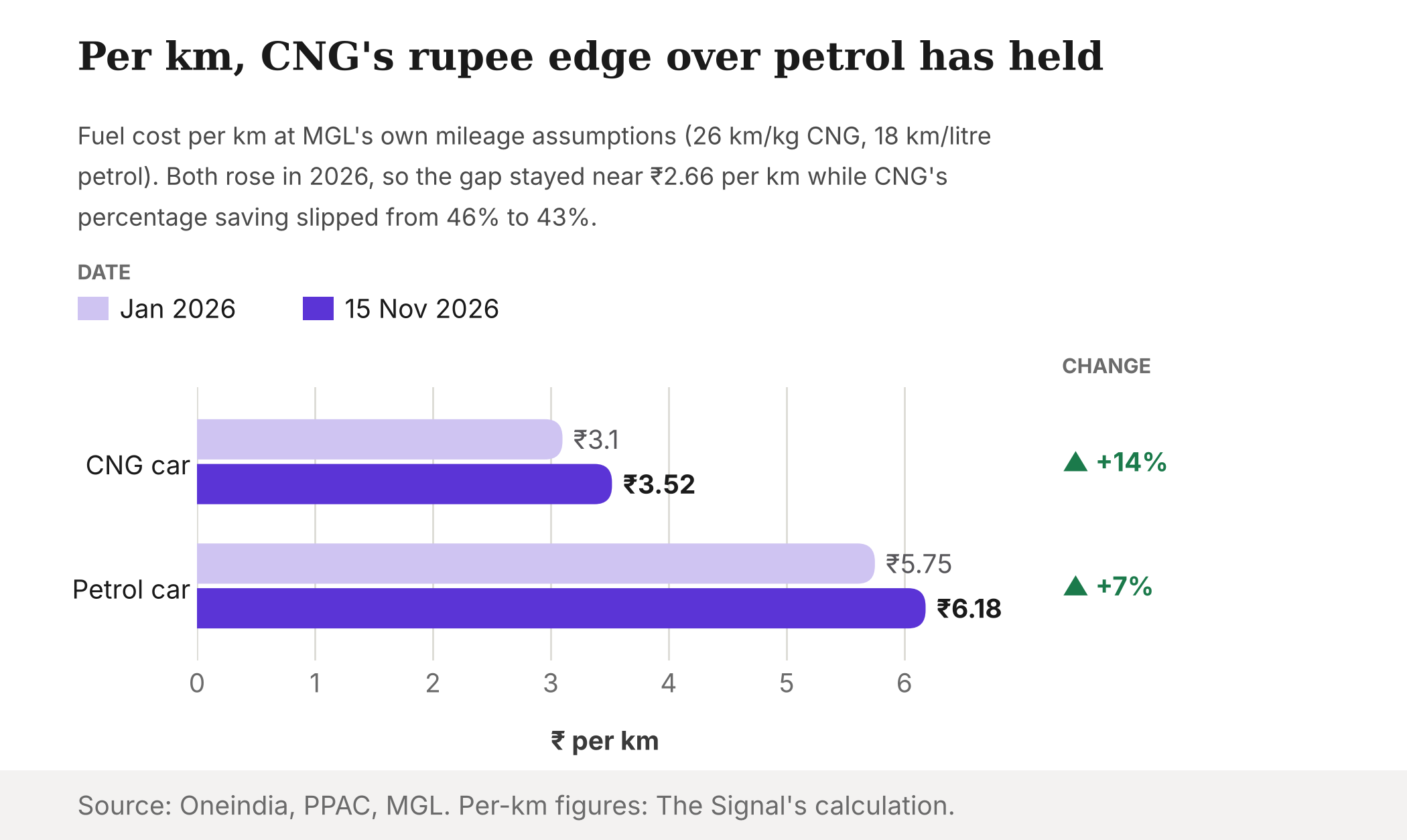
Source: mileage from MGL's Q1 FY27 investor presentation; prices from PPAC and Oneindia. Per-km costs are The Signal's calculations. Chart: The Signal.
The pressure lands hardest on fleets, where fuel is the business. From 1 September 2026 Mumbai's minimum auto fare rose Rs 1 to Rs 27 and the black-and-yellow taxi minimum rose Rs 2 to Rs 33. Union leaders put the number of MMR auto-rickshaw drivers dependent on CNG at nearly five lakh, so every rupee on a kilogram becomes a fare argument.
The honest objection
The strongest case against this reading is that crude does reach CNG, just late. Brent-linked LNG resets with crude, and an analyst on MGL's July 2026 call noted that the company's pricing generally runs on a three-month lag. Dated crude only peaked in early October 2026. On that view, relief is in the pipe and a cut in January 2027 is possible.
That case is real, and it explains part of the story. But it applies only to the Brent-linked slice, which the CFO put at $13 to $14 per MMBTU. The APM third cannot fall while the basket sits above $70, and MGL says the cheap share is the thing getting smaller. One limit should be stated plainly: there is no primary government figure for how much the 2026 allocation to city gas was cut. The direction rests on MGL's word.
The Signal
Mumbai's CNG is no longer priced off cheap domestic gas. It is priced off the imported and premium gas that fills the gap, while the domestic third sits frozen at a cap that falling crude cannot reach. MGL's per-unit margin fell even as it raised prices, which says the hikes are chasing costs. Watch three things: PPAC's December 2026 notice, MGL's price moves in January 2027 when the Brent lag catches up, and any official word on city gas allocation. If crude's fall shows up as a cut, the lag explained it. If it does not, the shrinking allocation did. Cheaper oil can only discount the gas Mumbai buys, never the gas it is no longer given.
Reporting basis: the Rs 91.50 price, the Rs 11 rise in 2026 and the eighth-hike count are per Oneindia; the seventh-since-April count, MGL's stated reasons, the September fare revision and the union's driver count are all per one origin, The Free Press Journal, and the driver count is a union claim. Gas formula prices, the APM cap, the HPHT ceiling, the Indian Crude Basket averages and Mumbai petrol prices are from PPAC notifications and price tables. The rupee's level and year-to-date fall are per an IANS wire report carried by The Free Press Journal, not an RBI reference rate. The crude-linked formula is per the petroleum ministry's April 2023 Cabinet release, and the 2025 allocation remarks per its April 2025 release, both via PIB. MGL's per-unit costs, margins, mileage assumptions and supply mix are from the company's own exchange filings, which an interested party produced. The IEA's surplus estimate is per Reuters and the Dated crude prices are per ANI; both relay the same IEA outlook rather than the report itself, so they count as one origin. No primary figure for the 2026 allocation cut was found. No MGL-specific price for its Henry Hub-linked LNG was found. The crude-basket thresholds, percentage changes, the currency comparison and per-km costs and gaps are The Signal's calculations from those figures.