The easy read on Hindustan Coca-Cola Holdings writes itself. The parent of Coca-Cola's largest Indian bottler has filed to list, and its draft prospectus describes an offer for sale of up to 997,461,456 shares by its promoter, Hindustan Coca-Cola Overseas Holdings, so the company itself raises nothing. Its key performance indicators show revenue from operations falling from ₹140,215.45 million in FY2024 to ₹115,485.79 million in FY2026, with volume down from 818.2 to 690.9 million unit cases. That is an 18% revenue slide in two years. Reliance's Campa spent that window pushing cheap price points at the mass end. Owner cashes out of a shrinking business under attack: case closed.
Strip one number out and that story dissolves.
The shrinkage is mostly states it sold
Between FY2024 and FY2026 the company handed Rajasthan, Bihar, Jharkhand, the Northeast, parts of West Bengal and North Gujarat to other Coca-Cola bottlers. The prospectus says the FY2025 and FY2026 declines "largely reflect these transfers rather than the performance of the business we continue to operate", and that the sales brought in ₹58,047.61 million over three years.
The filing also restates the business it kept, which it calls Retained Units. On that like-for-like basis, revenue went from ₹111,644.21 million in FY2024 to ₹117,500.90 million in FY2025 and ₹114,385.24 million in FY2026. That is up about 2.5% over two years, not down 18%.
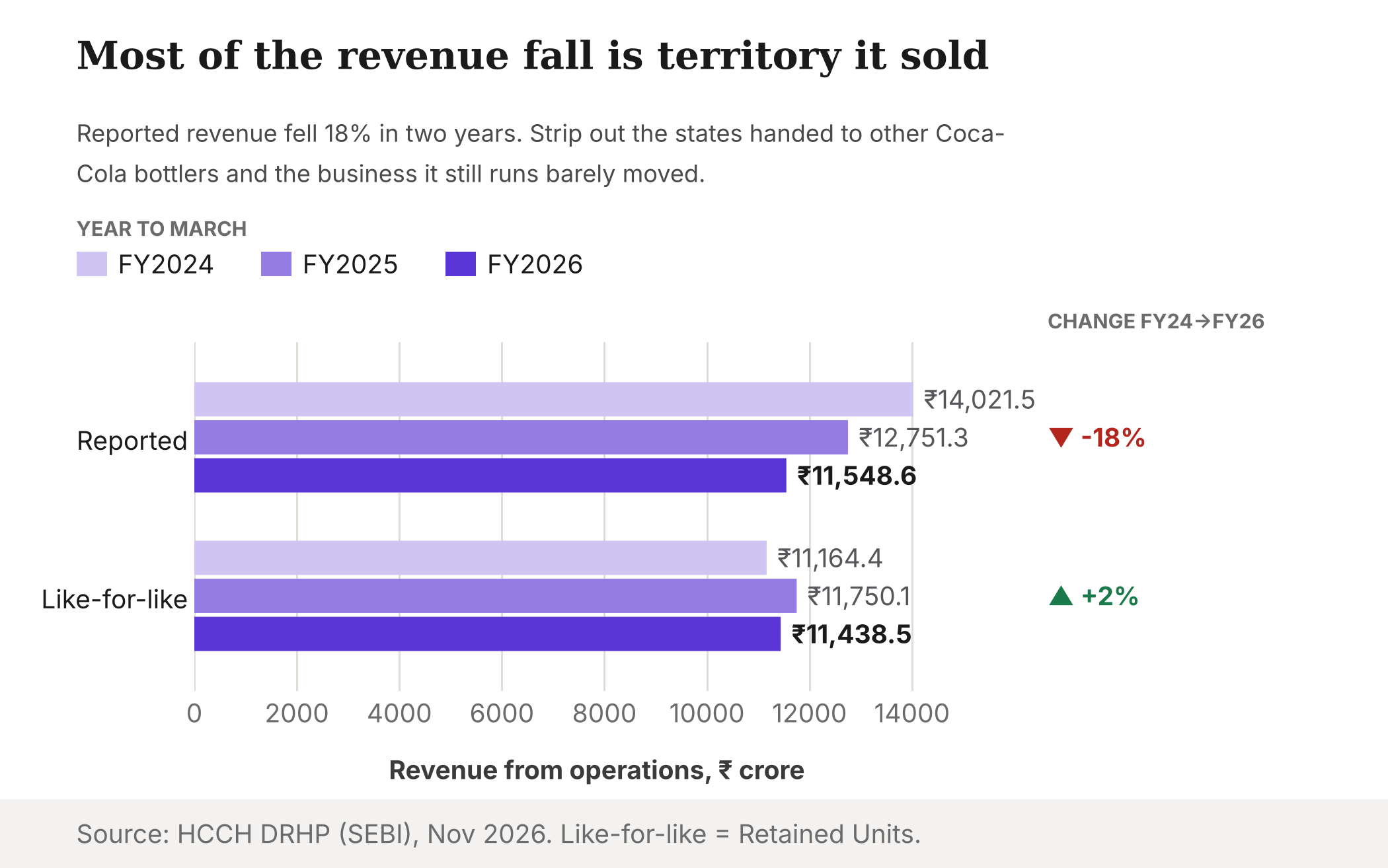
So Campa did not shrink Coca-Cola's bottler. The harder question is what it did instead, and the answer sits one line lower in the same table.
The number that carries the story
Like-for-like revenue per unit case was ₹168.9 in FY2024, ₹171.8 in FY2025 and ₹166.2 in FY2026. A unit case is about 5.7 litres. The bottler earned 1.6% less for each one in FY2026 than two years earlier.
Over the same stretch, IMF data put India's consumer price inflation at 4.6% for 2024 and 2.0% for 2025, which the IMF reports on India's fiscal-year basis. Compounded, prices rose about 6.7% from FY2024 to FY2026. In real terms, the bottler's take per case fell by roughly 8%.
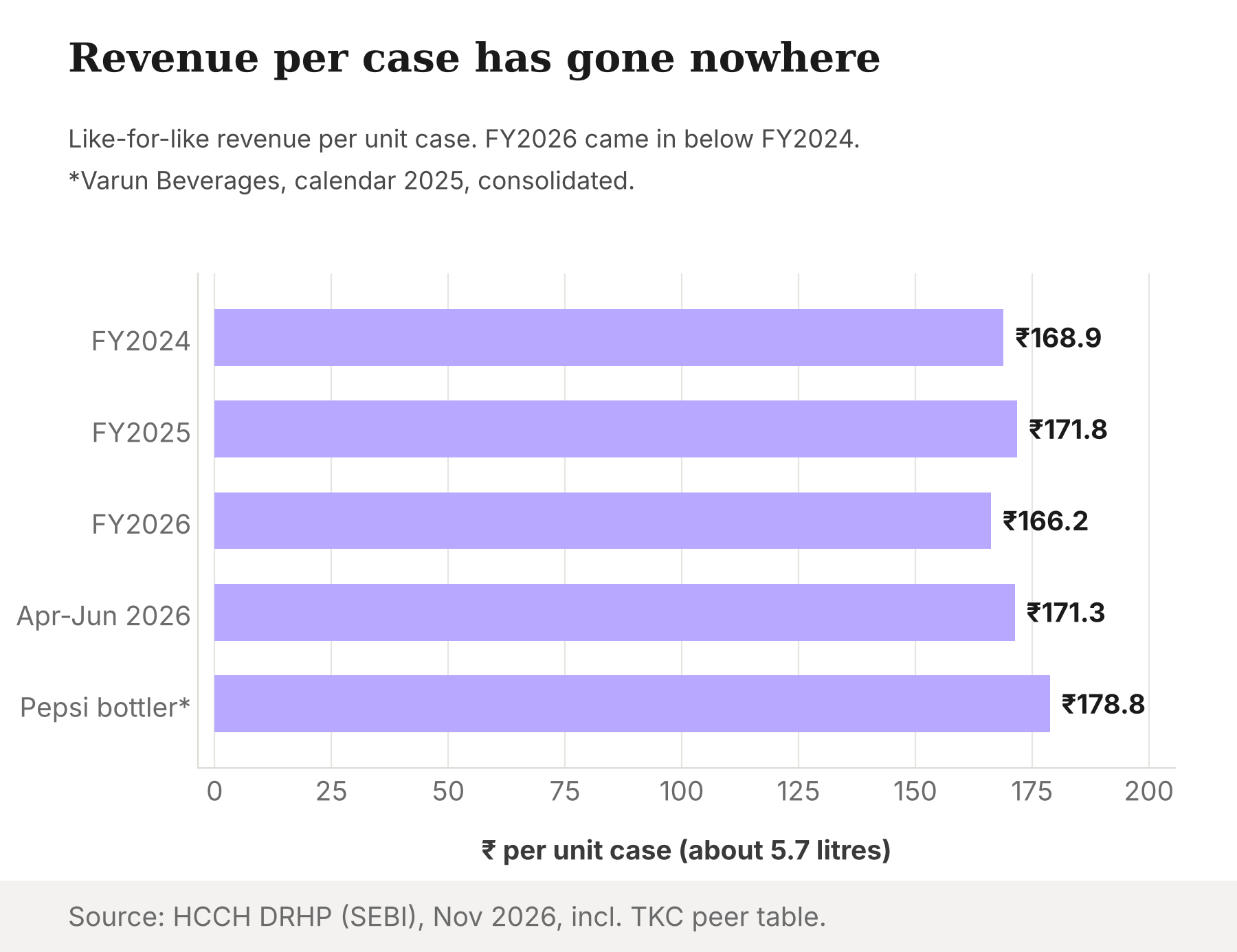
PepsiCo's bottler shows the gap. In the peer table, Varun Beverages realised ₹178.8 per unit case on a consolidated basis in calendar 2025, against ₹166.2 for the Coca-Cola bottler in FY2026. That is ₹12.6 more per case, about 7.6%. The same table shows Varun growing consolidated volume 7.89% while the Coca-Cola bottler's retained units grew 0.40%.
What the company says, and what it does not
The prospectus offers its own explanation. It says FY2026 like-for-like volume was "broadly stable" and that "a higher share of Hydration in our sales volumes reduced our Retained Units Realization per Unit Case, while Retained Units gross margin remained stable". Hydration means mostly packaged water, which sells for less per case than soda.
That is true, and the category split shows it. Water volume rose from 141.9 to 154.5 million unit cases in FY2026, while sparkling slipped from 463.7 to 461.6 million and juices fell from 76.2 to 68.5 million.
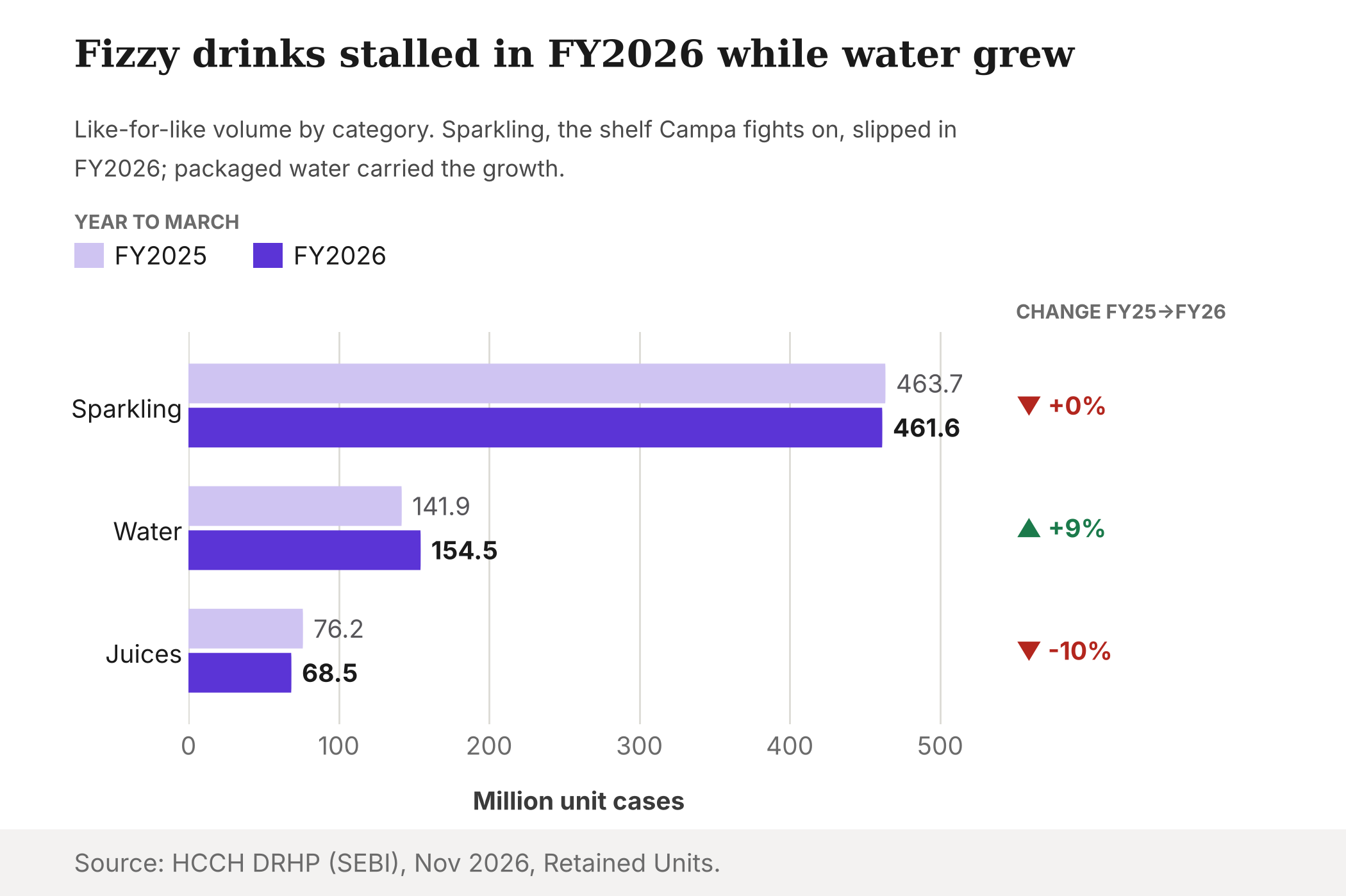
But the mix explanation answers a smaller question than the one investors face. Fizzy drinks are this company's core. Coca-Cola system brands held a 60.1% value share of sparkling drinks in its key states in the 12 months to June 2026. In FY2026, that core stopped growing, by 0.5%. Water filled the gap at a lower price. Margin held at the gross level, but like-for-like EBITDA margin eased from 12.26% in FY2024 to 11.46% in FY2026.
The prospectus names the rival
This offer document names its rival, through the industry report it commissioned. The TKC report says that "at the mass end, players such as Reliance Consumer Products through Campa, alongside regional beverage companies, are expanding through competitive price points".
The risk factors spell out the cost. Competition "may require us to reduce prices for the Beverages that we offer or incur additional marketing costs. Such price reductions could reduce our profitability".
Its pack strategy already reads like a response. The company sells sparkling drinks, juices and hydration at ₹10 in 150 to 250 ml packs, and has upsized its ₹20 sparkling packs to 300 ml and 400 ml in select markets. Upsizing at a fixed price is a price cut by volume, and it lands in exactly one place: revenue per case.
The challenger is not small anymore. Reliance says its Campa-led beverages business delivered about ₹2,900 crore of sales in April to June 2026, more than half its FY2026 sales, with double-digit market share in key markets. The Coca-Cola bottler's revenue from operations in the same quarter was ₹43,101.70 million, about ₹4,310 crore. The two figures are not measured the same way, so the ratio is rough. Even so, by that crude measure Reliance's beverage arm is already about two-thirds the size of India's biggest Coca-Cola bottler.
Tax narrows the room further. Aerated drinks have been taxed at 40% since the GST overhaul of September 2025. At a fixed ₹10 or ₹20 shelf price, that tax comes out of the sticker before the bottler or the shopkeeper is paid.
The honest objection
The strongest case against this reading is the latest quarter. In April to June 2026, like-for-like volume rose to 249.2 million unit cases from 210.1 million, with sparkling up from 146.2 to 168.2 million and revenue per case at ₹171.3 against ₹169.9. EBITDA margin in that quarter was 17.20% against 13.76%. Globally, The Coca-Cola Company said unit case volume grew 5% in July to September 2026, "led by India, China, Mexico and Brazil". On that view, FY2026 was a soft year, and the market is now big enough for Campa and Coca-Cola to grow together.
That holds up on volume. On price, it is much weaker. Like-for-like volume jumped 18.6% in the June 2026 quarter, but revenue per case rose from ₹169.9 to ₹171.3, or 0.8%. Even in its best recent quarter, the bottler earned slightly less per case than its FY2025 average of ₹171.8, and the June 2026 quarter's gross margin of 44.54% was lower than the year before. A growing market that cannot carry a price increase is what a contested market looks like.
The Signal
Coca-Cola's bottler is not a shrinking business; the headline decline is mostly states it sold. It is a business that has lost pricing power at the mass end. Its own prospectus warns that competition may force price cuts, names Campa, and shows a revenue per case that fell 1.6% in nominal terms over two years of rising prices. Investors are being asked to value a volume story while the filing documents a price ceiling. Watch one line when the final prospectus lands: if like-for-like realisation per case clears ₹172 for a full year, the bottler has pricing power again; if it sits near ₹166 to ₹171, the IPO is priced on volume alone. The cola war is being fought one 250 ml bottle at a time, and so far the bottle is getting bigger, not dearer.
Reporting basis: the offer structure, reported and like-for-like revenue, volumes by category, revenue per case, margins, the refranchising consideration, the risk-factor language, the pack and price points, and the 60.1% sparkling share all come from a single origin, Hindustan Coca-Cola Holdings' draft red herring prospectus filed with SEBI in November 2026; the Campa competition passage, the market share and the Varun Beverages peer comparison are from the TKC industry report reproduced in that filing, which the company commissioned and paid for, so they are not independent of it. Campa's April to June 2026 sales are Reliance Industries' own figure from its July 2026 analyst presentation. The global volume statement is from The Coca-Cola Company's third-quarter 2026 earnings release. Inflation is IMF World Economic Outlook data, and the 40% rate on aerated drinks is from the Press Information Bureau. The piece therefore rests on five independent origins, with the prospectus carrying most of the load. The two-year changes in revenue and revenue per case, the compounded inflation and real decline, the ₹ crore conversions, the gap to Varun Beverages and the comparison of Reliance's beverage sales with the bottler's quarterly revenue are The Signal's calculations from those figures.