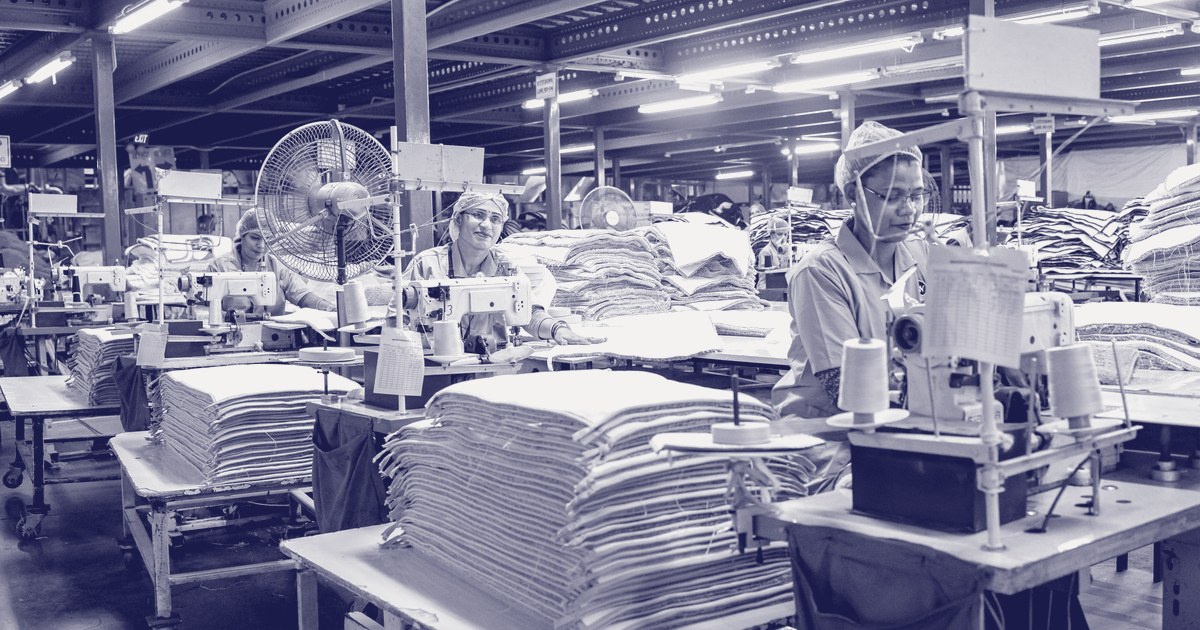
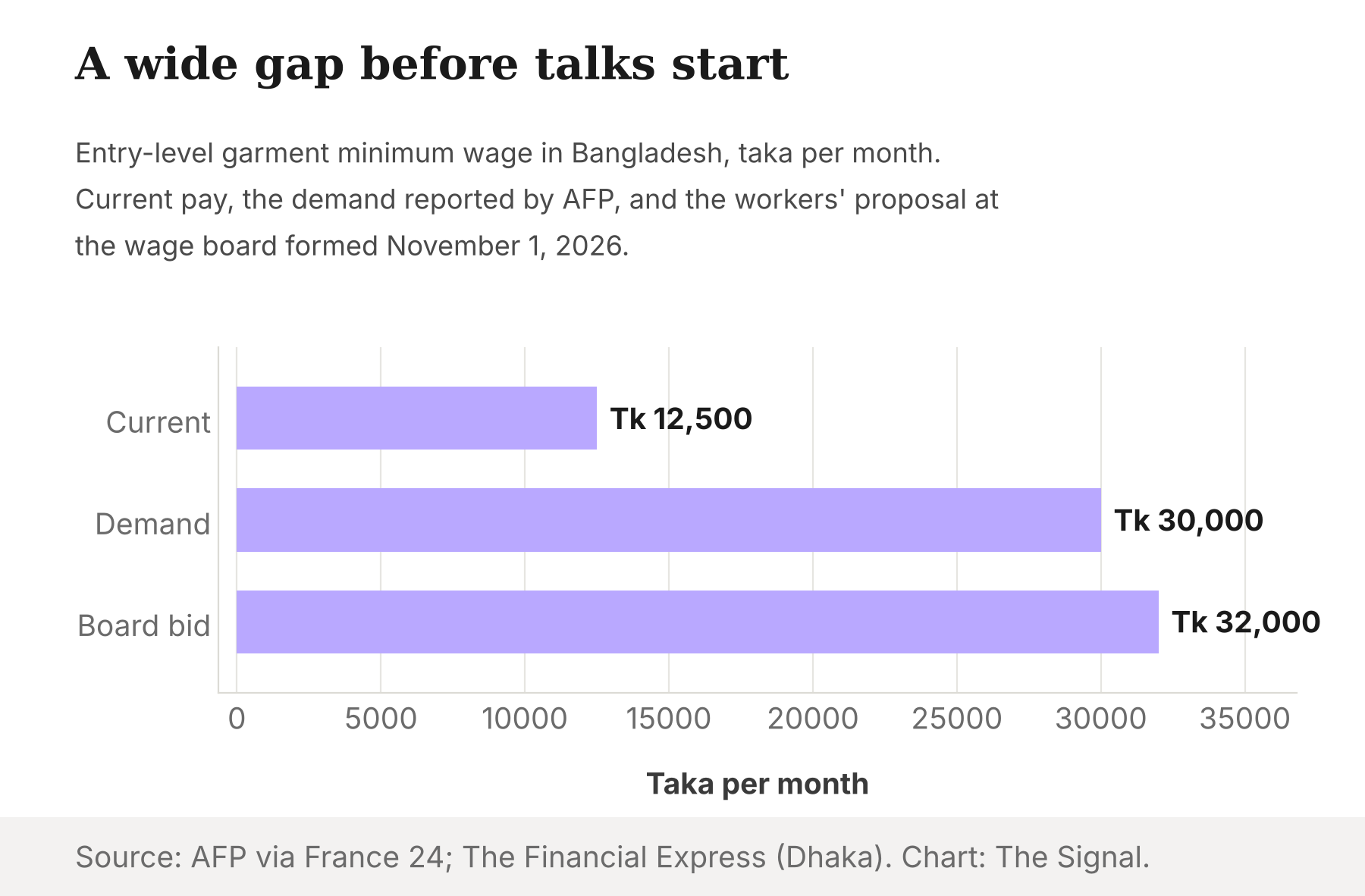
Bangladesh's garment industry is in the middle of a wage fight. The Financial Express in Dhaka reports that the government formed a wage board on November 1, 2026, that workers' representatives proposed Tk 32,000 as the entry-level monthly minimum, and that around 152 factories suspended production on November 10 as the protests continued. The board meets again on November 16. Workers want far more than they get now. AFP, via France 24, reports a demand of 30,000 taka ($240) a month, a 140 percent rise on the current 12,500 taka.
The usual Indian reading writes itself. Bangladesh is the world's second-biggest garment exporter after China. Unrest in Dhaka's factory belt has long been treated as a gift to Tiruppur, Noida and Bengaluru. Buyers worried about missed deliveries spread their orders around, and India is the obvious next stop.
That reading gets the order of events backwards. Indian garment exports had already started outrunning Bangladesh's before the wage board met. Washington, not Dhaka, moved first. And the next big swing will probably also come from Washington.
India was already pulling ahead
The Department of Commerce's October 2026 trade release shows exports of ready-made garments of all textiles grew 20.33 percent over October 2025. In the same month, Export Promotion Bureau data reported by The Business Standard show Bangladesh's garment exports rose 4.90 percent to $3.17 billion. India's growth rate was a little over four times Bangladesh's.
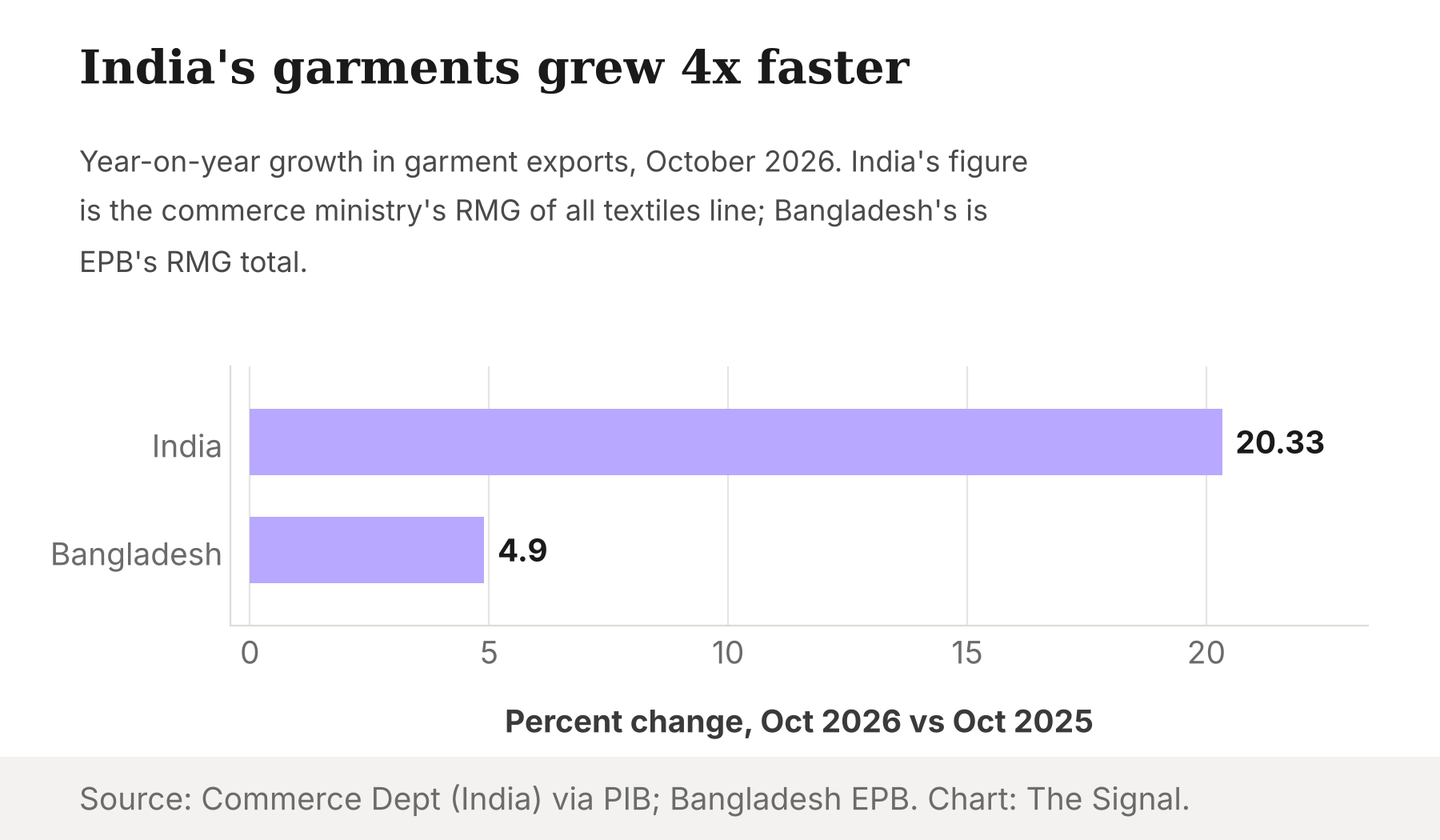
This is not a one-month blip. India's September 2026 trade release put garment export growth at 13.68 percent over September 2025. In the same month, EPB data reported by United News of Bangladesh show Bangladesh's garment exports grew 8.56 percent to $3.082 billion. Both months also predate the wage board, which was formed on November 1.
| Garment exports, year-on-year growth | India | Bangladesh |
|---|---|---|
| September 2026 | 13.68% | 8.56% |
| October 2026 | 20.33% | 4.90% |
Source: Department of Commerce (India), October and September releases; Bangladesh EPB via The Business Standard and UNB.
What changed was the US tariff, not Dhaka
To see why, look back at 2025. A Federal Register notice records that from August 27, 2025 the United States imposed an additional 25 percent duty on imports of articles of India over its purchases of Russian oil. That penalty did not apply to Bangladesh. For a buyer in New York choosing between a Tiruppur knitwear unit and a Gazipur one, it was a heavy handicap.
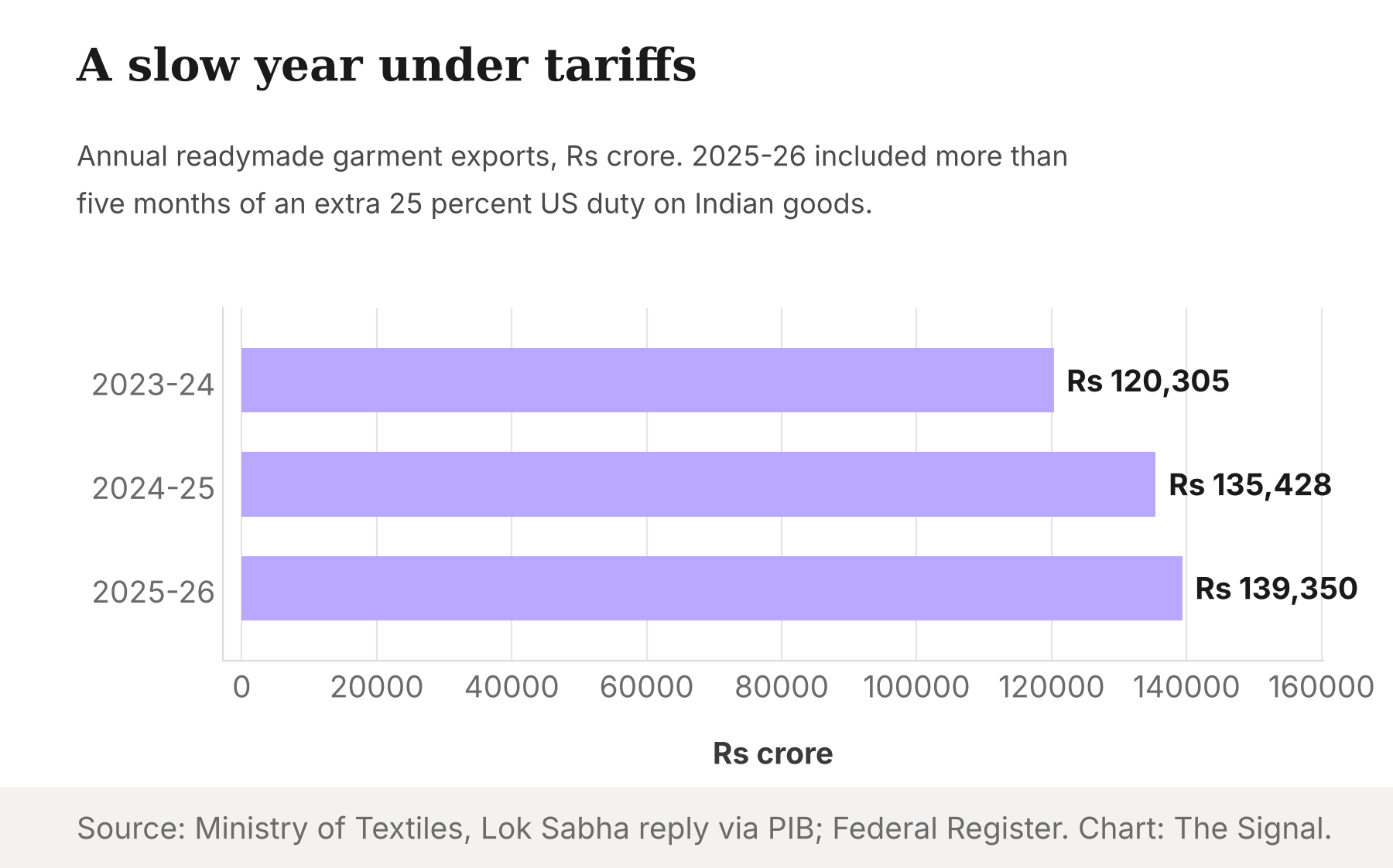
The annual numbers show the damage. The Ministry of Textiles told the Lok Sabha that India's ready-made garment exports were Rs 1,39,350 crore in 2025-26, against Rs 1,35,428 crore in 2024-25 and Rs 1,20,305 crore in 2023-24. Growth fell from about 12.6 percent to about 2.9 percent in the year that carried the extra duty.
Then the penalty went. An executive order published in the Federal Register states that from February 7, 2026, products of India are no longer subject to the additional 25 percent duty. The field is now level on paper. The USTR's final Section 301 notice states that from July 24, 2026, a 10 percent tariff applies to goods of a list of economies that includes both Bangladesh and India.
So the October growth gap is best read as India getting back into American order books after Washington lifted its penalty. Dhaka's wage board is a footnote to that so far.
The quota that could tilt it back
The same USTR notice contains the detail Indian exporters should care about most. It directs the trade representative to establish, when feasible, tariff-rate quotas for Bangladesh, Cambodia, Indonesia and Malaysia, tied to how much US cotton and textile input each one imports. India is not on that list.
A tariff-rate quota lets a set volume of goods in at a lower duty. Here, the notice ties it to how much American cotton a country buys. If it is set up, a Bangladeshi factory sewing shirts from US cotton could undercut an Indian one paying the full 10 percent. That would be a cost edge written into trade policy. A wage settlement shifts costs once.
Bangladesh is already gaining in the American market. EPB data reported by United News of Bangladesh show its garment exports to the US rose 10.16 percent to $2.85 billion in July to October 2026, even as total garment exports grew 5.82 percent to $13.75 billion.
The honest objection
The strongest case against this reading is that India's 20 percent is flattered by a weak base. October 2025 was the second full month of the extra 25 percent duty, so Indian garment shipments that month were depressed. Some of October 2026's growth is just recovery to where India would have been anyway. On that view, the real contest is still ahead. A Bangladeshi wage shock could then matter a great deal.
That objection is right about the base, and it cuts in our direction. If the growth is mostly a rebound from a tariff, the tariff is the thing that moves Indian garment orders. Bangladesh's labour costs also matter. If wages rise toward the 32,000 taka workers proposed, that is about 2.6 times the current 12,500 taka. That is a real cost shock. But wages are paid in taka and set once every few years. A quota on US cotton is set in Washington and could be renewed.
There is also scale to respect. AFP reports that Bangladesh's garment sector employs more than four million people and earns around four-fifths of the country's exports, worth up to $38 billion. A few weeks of closures in Ashulia do not hand that business to anyone. Buyers move orders slowly and at the margin.
The Signal
Indian exporters will be tempted to read Dhaka's wage board as their opening. The data says India's 2026 garment recovery began with a decision in Washington on February 7, and it could be dented by another one. The wage board's next meeting on November 16 will set Bangladesh's labour costs for years. The USTR notice establishing cotton quotas would set something more durable: which of the two countries can sell to American shoppers at a lower duty. India's garment fortunes are being decided in the Federal Register, not on the factory floors of Ashulia.
Reporting basis: the November 2026 wage board formation, the Tk 32,000 workers' proposal and the factory suspensions are per The Financial Express (Dhaka). The 30,000 taka demand, the 12,500 taka current minimum, and the industry's size are per AFP, as published by France 24. Bangladesh's October 2026 garment exports are Export Promotion Bureau figures, as reported by The Business Standard. Its September 2026 figure, July to October 2026 totals and US shipments are EPB figures, as reported by United News of Bangladesh; all of these rest on the same EPB origin. India's monthly garment export growth is from the Department of Commerce's September and October 2026 releases, the October one via the Press Information Bureau, and the annual figures are from the Ministry of Textiles' Lok Sabha reply via PIB. The 2025 Russia-oil duty, its removal and the 2026 Section 301 tariff and quota plan are from the Federal Register and the USTR's own notice. The four-times comparison, the 12.6 and 2.9 percent annual growth rates and the 2.6-times wage multiple are The Signal's calculations from those figures.